Showing posts with label Futenma. Show all posts

Wednesday, July 5, 2017

An Alternative to Henoko as a Marine Corps Air Base


A NEW VISION FOR OKINAWA AND ASIA-PACIFIC SECURITY: RECOMMENDATIONS FROM THE NEW DIPLOMACY INITIATIVE (ND)

Wednesday, July 12 
2:00 PM – 3:30 PM

East-West Center in Washington

1819 L St, NW, Washington, DC
Sixth Floor Conference Room
This event is free and open to the public.
Seminar will be broadcast live. 
Copies of the report will be available at the seminar.

REGISTER HERE by 5 PM EST July 11.

SPEAKERS

Tomohiro Yara

ND Board Member and ND Senior Researcher; Member of the ND Okinawa Project

Shigeru Handa

Member of the ND Okinawa Project

Sayo Saruta
Director, New Diplomacy Initiative (ND)
Dr. Mike M. Mochizuki (Discussant)
ND Board Member; Associate Professor of Political Science and International Affairs, George Washington University

☵

With the start of seawall construction for land reclamation on the shores of the Henoko area of Nago, Okinawa Prefecture, persistent resistance from Okinawans is strengthening with more legal action being undertaken by Governor Takeshi Onaga to stop the construction. Opposition may extend to other US military installations, including the highly important Kadena Air Base, which could undermine the US presence in Okinawa as well as the US-Japan alliance.

For the past three years, New Diplomacy Initiative (ND), a Japanese think tank established in 2013, has hosted study sessions for diplomacy, defense, and security experts to analyze and research the military role of the US Marines in Okinawa and the state of “deterrence.”

Since February 2016, ND has continued its research on the deployment of the US Marines in Okinawa, using US documents and facts about Marine operations as sources, and has held regular study sessions to compile a counterargument against the assertion that Henoko is the only option for the Futenma relocation. This report contains the results of those discussions, and sets forth a solution that will equally benefit Japan, the United States and Okinawa.

☵

Tomohiro Yara is a Board Member and Senior Researcher at New Diplomacy Initiative (ND) as well as a member of the ND Okinawa Project. He graduated from the University of the Philippines and thereafter worked at the Okinawa Times, where from 1992 he covered US military base issues. After working at the Okinawa Times Tokyo Bureau, he served as an editorial writer and social section chief. In order to research the 2006 US military defense posture review, from 2007 he spent one year at the East-West Center, University of Hawaii, as a visiting researcher. He left the Okinawa Times in June 2012 and is currently a freelance writer.

Shigeru Handa is a member of the ND Okinawa Project. After working at the Shimotsuke Shimbun, he joined the Chunichi Shimbun in 1991, and serves as an editorialist and senior staff writer at the Tokyo Shimbun. He is also an adjunct professor at Dokkyo University as well as Hosei University. He has been covering the Defense Agency since 1992. In 2007, he was awarded the 13th Peace and Cooperative Journalist Fund of Japan award (main prize) for his column "New Guardian Thought" [新防人考], which was published in the Tokyo Shimbun and the Chunichi Shimbun.

Sayo Saruta is the Director of New Diplomacy Initiative (ND), a think tank in Tokyo, and an Attorney at Law in Japan and the State of New York. After graduating from Waseda University, she received her Master’s degree from Colombia University Law School as well as her second Master’s degree in International Relations from American University in Washington, DC. Regarding U.S.-Japan diplomacy and other political issues, she has aided in providing opportunities for various voices of Japan to speak on various debates between Japan, the U.S. and other East Asian countries. She has arranged for Japan’s Diet members and local groups visit to Washington DC. to discuss topics such as Okinawa base issues, nuclear nonproliferation and nuclear energy. Her research interest is in the establishment theory of the U.S.-Japan diplomacy and her published works include Future Shape of US-Japan Diplomacy: Delivering Diverse Voices on Okinawa, Security, Nuclear Issues and TPP to Washington [Atarashii Nichibei Gaikou wo Kirihiraku] (Shueisha) and Voluntary Dependence on the US [Jihatsuteki Taibei Juzoku] (Kadokawa) (both English-language publication titles are provisional).

Mike M. Mochizuki holds the Japan-U.S. Relations Chair in Memory of Gaston Sigur at the Elliott School of International Affairs in George Washington University. Professor Mochizuki was associate dean for academic programs at the Elliott School from 2010 to 2014 and director of the Sigur Center for Asian Studies from 2001 to 2005. He co-directs the “Rising Powers Initiative” and the “Memory and Reconciliation in the Asia-Pacific” research and policy project of the Sigur Center. Previously he was a Senior Fellow at the Brookings Institution. He was also Co-Director of the Center for Asia-Pacific Policy at RAND and has taught at the University of Southern California and Yale University. He received his Ph.D. in political science from Harvard University. His books include Energy Security in Asia and Eurasia (co-editor and co-author, 2017); Nuclear Debates in Asia: The Role of Geopolitics and Domestic Processes (co-editor and author, 2016); The Okinawa Question: Futenma, the US-Japan Alliance, and Regional Security (co-editor and author, 2013); China’s Military and the U.S.-Japan Alliance in 2030: A Strategic Net Assessment (co-author, 2013); Japan in International Politics: The Foreign Policies of an Adaptive State (co-editor and author, 2007), and Crisis on the Korean Peninsula: How to Deal with a Nuclear North Korea (co-author, 2003). He has published articles in such journals as The American Interest, Asia Pacific Review, Foreign Affairs, International Security, Japan Quarterly, Journal of Strategic Studies, Nonproliferation Review, Survival, and Washington Quarterly.

Thursday, September 24, 2015

The suicide politics of Futenma relocation

Prospects on the MCAS Futenma Issue

By Ms. Yukie Yoshikawa
, Adjunct Fellow, Edwin O. Resichauer Center, School of Advanced International Studies, The Johns Hopkins University and APP member

First appeared in Nikkei Business, September 17, 2015 in Japanese

Newly elected Okinawa Governor Takeshi Onaga, supported by both conservatives and reformists, which is quite a rare phenomenon in Okinawa, announced his team leaders on the US military base issues at the end of 2014 and the beginning of 2015. Mr. Mitsuo Ageta, the former speaker of the Naha City Assembly, was appointed as Vice Governor (VG) in charge of base issues--the Okinawa Prefectural Government (OPG) has two vice governors. Mr. Masaru Machida was appointed Director General of the Governor’s Office. He had been an executive at the Okinawa Churashima Foundation, an affiliated organization of the OPG. VG Ageta used to be a member of the Okinawa Chapter of the Liberal Democratic Party (LDP), yet left after the party switched its policy on the Henoko plan from "against" to "accommodation." He formed the Shimpuh-kai (New Wind Group) as a counter. 

The Regional Security Policy Division, of which I was a member, is still alive. People wondered whether this section could survive the Onaga administration, since it was created by his predecessor, Gov. Hirokazu Nakaima. Gov. Onaga replaced this division with one named to clearly express its intent that is to deal with “the issue on the construction of new Henoko base” and called it more directly the Henoko Base Construction Countermeasures Division [ 辺野古新基地建設対策課].

Onaga can play only “All-or-Nothing” negotiation
Despite his landslide victory in the November 2014 gubernatorial election, Gov. Onaga’s power base is not solid. As his slogan during the campaign was “all-Okinawa,” Mr. Onaga limits his own maneuverable space to the minimum. In other words, all he can say  “No Henoko” and “No Ospreys” are acceptable by all Okinawans, including supporters of the US military bases. “All-Okinawa” does not indicate any realistic compromise. Should he make a statement beyond “No Henoko” his power base shatter.

In other words, Gov. Onaga can only play an “all-or-nothing” game, namely accept everything he says or no deal. Thus, he cannot be a reasonable negotiator with either the Government of Japan (GOJ) or the US Government (USG).

Since the inauguration of the Onaga administration in December 2014, senior officials of the GOJ have refused to meet Gov. Onaga. This was considered  “extra-ordinary.” (Other governors rarely meet with the prime ministers.) This “all-Okinawa” phenomenon has never happened since the return of Okinawa to Japan in 1972. People speculated that Tokyo viewed Naha, the capital of Okinawa Prefecture, cautiously, wondering whether the Governor could maintain his power base with both conservatives and reformists.

Nevertheless, Gov. Onaga and senior officials of the GOJ did start to meet in April 2015. In August, the two parties held a series of meetings discussing how to reduce Okinawa’s hosting responsibility and on the economic development. The last one was September 7th. It ended with no conclusion.

During the meetings, Gov. Onaga did not step back from his “No Henoko” stance, however hard the Abe cabinet tried. In office barely a half year--out of four--it is unreasonable to expect the governor to destroy his power base by backing down. This would be political suicide.

Gov. Onaga has few options to take
What can Gov. Onaga do to stop the landfill at Cape Henoko? Gov. Onaga’s advisory committee issued a report in July 2015 concluding that there were flaws in the process of Gov. Nakaima’s approval. The Ministry of Defense (MOD) resumed its boring investigation on September 12th, soon after the break-up of the intensive August and September meetings between the GOJ and the OPG. Gov. Onaga reacted to this by starting a procedure to cancel the landfill authorization on September 14th. This legal process is expected to take about a month.

Still, the OPG is powerless if the Abe cabinet simply ignores it. The OPG can appeal to the court to stop the landfill, but the court has no authority to interrupt the boring investigation and its ensuing landfill until a verdict is given. this could be months or years. Should the OPG win at the court after the landfill is completed, the result is that no one can bring back the nature as before. Thus, Gov. Onaga’s cancellation of the landfill is nothing other than a political performance.

Left in Gov. Onaga’s hand is un-approving any petitions for changes and additions to the original plan. The plan was submitted by the MOD to Gov. Nakaima in March 2013. At the time, the MOD did not anticipate working with an unfriendly OPG to develop or alter the plan.  The results of the boring investigation are certain to cause construction changes. Onaga could use these changes to stop the landfill and slow down the project.

Driving Gov. Onaga to the corner simply drives Okinawans to protests
Gov. Onaga has very limited options. Is it politically productive to force him to say yes to the Henoko plan? Sure, he might approve change petitions to smooth the landfill.

On the other hand, once the Okinawans hear that Gov. Onaga has succumb to the Abe cabinet, the anger demonstrated at the gubernatorial election in 2014 would explode at Cape Henoko. Okinawan people have made clear their rejection of the Henoko plan many times through elections. LDP administrations, however, have forced their leaders to “flipflop.” Okinawans view this as negligence against their will. If their voices raised democratically are unheard, they believe they have no choice but to resort to force at the construction site.

In Tokyo, I am often asked whether the protesters at Cape Henoko are non-Okinawans, mostly “professional” protesters similar to those during the construction of Narita Airport. There is no official and accurate data on where these protesters come from and I doubt such question is relevant for two reasons:
  1. First, during the American Occupation (1945-72), the islanders in Ie-Island and other parts of Okinawa protested and succeeded in stopping the construction of  US military bases and expansion. Okinawans can protest with success by themselves, without the help from others.
  2. Second, casualties caused by wrestling with the police and Coast Guard during protests or lying before the bulldozers and circling the landfill site with small  boats (slight injuries have already occured), would encourage  Okinawans to massively and aggressively embrace anti-base sentiments and demand the removal of all base, regardless of where the hometown of the casualty is.
If this happened would the Abe cabinet have the capability to deal with such situation? Also, would the USG, especially the US Forces in Okinawa (USFO), want to expand such anti-base sentiments in Okinawa? The USG wants the GOJ to manage prudently Okinawa to keep the islands safe enough to deploy its forces. The USG should not want to miss the forest (the USFO, especially Kadena Air Base) from the trees (the Futenma Air Station).

Paradoxically, the more the Abe cabinet pushes Gov. Onaga into a corner, the more Okinawans are driven to resort to force, which is a political suicide to the GOJ. The worst scenario can be avoided only by understanding this logic in Okinawa, by seriously searching for alternatives to the Henoko plan, and by seriously addressing the necessity to reduce the heavy hosting responsibility of Okinawa.

Monday, January 5, 2015

Prime Minister of Japan’s Schedule October 20-26, 2014

Monday, October 20, 2014

AM
12:00 At private residence (no visitors)
07:53 Depart from private residence in Tomigaya, Tokyo
08:09 Arrive at office
08:20 Minister of Economy, Trade and Industry Obuchi Yuko enters
08:50 Ms. Obuchi leaves
09:36 Meet with Minister in charge of the Abduction Issue Yamatani Eriko
10:01 End meeting with Ms. Yamatani
10:05 Meet with American CEO of Facebook Mark Zuckerberg
10:27 End meeting with Mr. Zuckerberg
10:28 Meet with Vice-Minister for Foreign Affairs Saiki Akitaka
10:56 End meeting with Mr. Saiki
11:02 Depart from office
10:10 Arrive at Imperial Palace. Register return to Japan. Attend Empress’s Birthday Celebration

PM
12:14 Depart from Imperial Palace
12:23 Arrive at office
01:09 Minister of Justice Matsushima Midori enters
01:26 Ms. Matsushima leaves
01:42 Interview open to all media: When asked about “Minister of Economy, Trade and Industry Ms. Obuchi and Minister of Justice Ms. Matsushima’s letters of resignation” Mr. Abe answers “I respect the intentions of these two people, and I accept their letters of resignation. As the Prime Minister it is my duty to fill these posts.”
01:45 Interview ends
01:50 Receive courtesy call from Mayor of Nihonmatsu City in Fukushima Prefecture and Chrysanthemum Ambassador Chiba Chie and others. LDP Lower House member Nemoto Takumi also attends
01:56 Courtesy call ends
02:02 Liaison Council of Government and Ruling and Opposition Parties Institutions for Measures against Abduction Issue meeting
02:53 Council meeting ends
02:55 Headquarters for the Abduction Issue meeting
03:16 Meeting ends
03:25 Speak with Ministry of Foreign Affairs (MOFA)’s Director-General of North American Affairs Bureau Tomita Koji, Ministry of Defense (MOD)’s Director-General of Bureau of Defense Policy Kuroe Tetsuro and Director-General of Bureau of Local Cooperation Nakajima Akihiko
03:35 Finish speaking with Mr. Tomita, Mr. Kuroe, and Mr. Nakajima
03:50 Meet with Minister in charge of Total Reform of Social Security and Tax Amari Akira
04:11 End meeting with Mr. Amari
04:12 Meet with Chief of Staff for Joint Staff Council Kawano Katsutoshi
04:27 End meeting with Mr. Kawano
04:39 Courtesy call from US Secretary of Commerce Penny Pritzker and colleagues. Resident US Ambassador to Japan Caroline Kennedy also attends
04:53 Courtesy call ends
04:55 Depart from office
04:56 Arrive at Diet
04:58 Enter LDP Secretary-General’s Room. Endorse candidate for Miyazaki Prefecture’s gubernatorial election. Commemorative photo session with candidates for Okinawa Prefecture’s gubernatorial election and Naha City (Okinawa Prefecture)’s mayoral election
05:04 Leave room
05:05 Enter LDP President’s Room
05:06 LDP Officers Meeting
05:24 Meeting ends
05:27 Leave room
05:28 Depart from Diet
05:30 Arrive at office
05:45 Council for Promoting the Alleviation of the Burden of Futenma Air Station meeting
06:05 Council meeting ends
06:21 Speak with incoming Minister of Economy, Trade and Industry Miyazawa Yoichi
06:33 Finish speaking with Mr. Miyazawa
06:34 Speak with incoming Minister of Justice Kamikawa Yoko
06:46 Finish speaking with Ms. Kamikawa
06:51 Interview open to all media: When asked about “the reason you rushed to appoint new Cabinet Ministers” Mr. Abe answers “Economics are a top priority that we must actively advance. In administration and governance we cannot delay.”
06:53 Interview ends
06:54 Depart from office
06:55 Arrive at official residence. Dinner meeting with Deputy Chief Cabinet Secretary Seko Hiroshige, Secretary-General for LDP in Upper House Date Chuichi, and colleagues
08:11 Everyone leaves

Tuesday, October 21, 2014


AM
12:00 At official residence (no visitors)
08:00 At official residence (no morning visitors)
08:13 Depart from official residence
08:16 Arrive at office
08:29 Speak with Chief Cabinet Secretary Suga Yoshihide
08:39 Finish speaking with Mr. Suga
08:41 Nine Ministers’ Group of National Security Council (NSC) meeting
08:50 Meeting ends
09:02 Cabinet Meeting begins
09:12 Cabinet Meeting ends
09:47 Depart from office
09:56 Arrive at Imperial Palace. Secret report to Emperor, attestation ceremony for Cabinet Ministers for LDP Lower House member Kamikawa Yoko (incoming Minister of Justice) and LDP Upper House member Miyazawa Yoichi (incoming Minister of Economy, Trade and Industry)
10:40 Depart from Imperial Palace
10:51 Arrive at office
11:01 Deliver notices of appointment to Ms. Kamikawa and Mr. Miyazawa
11:02 Finish delivering notices of appointment
11:03 Commemorative photo session with Ms. Kamikawa and Mr. Miyazawa
11:05 Photo session ends
11:24 Meet with Minister of State for Economic and Fiscal Policy Amari Akira, Cabinet Office’s Vice-Minister Matsuyama Kenji, and Director-Generals for Policies on Cohesive Society Maekawa Mamoru and Habuka Shigeki

PM
12:02 End meeting with Mr. Amari, Mr. Matsuyama, Mr. Maekawa and Mr. Habuka
01:35 Informal talk with editors of women’s magazines
02:18 Talk ends
Stanley Berman AJC
02:19 Speak with incoming Justice of Supreme Court Ikegami Masayuki and outgoing Justice Yokota Tomoyuki
02:24 Finish speaking with Mr. Ikegami and Mr. Yokota
02:35 Meet with President of American Jewish Committee Stanley Bergman
02:58 End meeting with Mr. Bergman
02:59 Meet with Vice-Minister for Foreign Affairs Saiki Akitaka
03:27 End meeting with Mr. Saiki
03:31 Inaugural greeting for Ambassador to Ukraine Sumi Shigeki and colleagues
03:36 Greeting ends
03:37 Director of Cabinet Intelligence Kitamura Shigeru, MOD’s Director of Defense Intelligence Headquarters (DIH) Miyagawa Tadashi, and MOD’s Administrative Vice-Minister Kawashima Takaki enter
03:50 Mr. Miyagawa and Mr. Kawashima leave
04:20 Mr. Kitamura leaves
04:58 Forum for Consultations between the National and Regional Governments
05:03 Forum ends
05:17 Ministerial Council on Monthly Economic Report and Other Relative Issues meeting
05:31 Meeting ends
05:35 Council on Economic and Fiscal Policy meeting
06:27 Meeting ends
07:18 Depart from office
07:40 Arrive at private residence in Tomigaya, Tokyo

Wednesday, October 22, 2014

AM
12:00 At private residence (no visitors)
08:00 At private residence in Tomigaya, Tokyo (no morning visitors)
09:28 Depart from private residence
09:47 Arrive at office
09:57 Meet with Minister of State for Economic and Fiscal Policy Amari Akira and Vice-Minister of Cabinet Office Matsuyama Kenji
10:25 End meeting with Mr. Amari and Mr. Matsuyama
10:26 Science and Technology in Society Forum
10:53 Forum ends
10:54 Meet with LDP Secretary-General Tanigaki Sadakazu
11:28 End meeting with Mr. Tanigaki
11:34 Director of Cabinet Intelligence Kitamura Shigeru and Director of Cabinet Satellite Intelligence Center Shimohira Koji enter
11:44 Mr. Shimohira leaves
11:54 Mr. Kitamura leaves

PM
01:22 Meet with Governor of Nagano Prefecture Abe Shuichi
01:40 End meeting with Mr. Abe
01:52 Meet with LDP Lower House member Noda Takeshi
02:13 End meeting with Mr. Noda
02:23 Meet with LDP Lower House member Kawai Katsuyuki
02:44 End meeting with Mr. Kawai
02:45 Meet with President of Japan-Korea Parliamentarians’ Union [日韓議員連盟 : Nikkan Giin Renmei] Nukaga Fukushiro
03:15 End meeting with Mr. Nukaga
03:37 Interview open to all media: When asked about “the reason for dispatching a group to South Korea” Mr. Abe answers “To those in charge of the special investigative committee, the abduction issue is treated as top priority, and they thought without a dispatch the investigation may become impossible to conduct.”
03:40 End interview
03:43 Government-Labor-Management Meeting
04:38 Meeting ends
04:53 Receive courtesy call from Nobel Prize for Physics award winner Amano Hiroshi, professor at Nagoya University
05:03 Courtesy call ends
05:04 Council for Science, Technology and Innovation meeting
05:29 Meeting ends
05:34 NSC meeting
06:12 NSC meeting ends
06:21 Depart from office
06:26 Arrive at Hotel Okura in Toranomon, Tokyo. Attend dinner party for Tokaido Shinkansen 50th Anniversary of Start of Operations in banquet hall Heian Room, deliver address
07:04 Depart from hotel
07:14 Arrive at hotel Le Port Kojimachi in Hirakawa-cho, Tokyo. Dinner meeting with 1st-time elected LDP Lower House members in banquet hall Shiki-tei
08:53 Depart from hotel
09:12 Arrive at private residence

Thursday, October 23, 2014

AM
12:00 At private residence (no visitors)
08:00 At private residence in Tomigaya, Tokyo (no morning visitors)
09:26 Arrive at private residence
09:43 Arrive at office
10:57 Meet with Director of NSC Yachi Shotaro
11:32 End meeting with Mr. Yachi
11:33 Meet with MOD’s Administrative Vice-Minister Tokuchi Hideshi and Director of DIH Miyagawa Tadashi

PM
12:04 End meeting with Mr. Tokuchi and Mr. Miyagawa
01:17 Depart from office
01:21 Arrive at hotel Grand Arc Hanzomon in Hayabusa-cho, Tokyo. Participate in Memorial Service for Police Officers Who Lost Their Lives on Duty and for Citizens Who Lost Their Lives Assisting with Police Duties in banquet hall Fuji, deliver address, offer flowers
02:02 Depart from hotel
02:06 Arrive at office
03:45 Meet with Singapore’s Minister for Foreign Affairs K. Shanmugam
04:00 End meeting with Mr. Shanmugam
04:30 Meet with Mr. Yachi
05:00 End meeting with Mr. Yachi
05:35 Depart from office
05:42 Arrive at Imperial Hotel in Uchisaiwai-cho, Tokyo. Attend Gathering of Representatives of National Federation of Small Business Associations in banquet hall Fuji, deliver address
06:01 Depart from hotel
06:17 Arrive at Roppongi Hills in Roppongi, Tokyo. Attend Opening Ceremony of Tokyo International Film Festival in movie theater TOHO Cinemas Roppongi Hills, deliver address
06:52 Commemorative photo session with Japanese actor Oka Masi. LDP Upper House member Yamamoto Ichita also attends
06:54 Photo session ends
06:55 Depart from Roppongi Hills
06:56 Arrive at hotel Grand Hyatt Tokyo in Roppongi, Tokyo
07:03 Depart from hotel
07:08 Arrive at (funeral home) Aoyama Sougisho in Minami-Aoyama, Tokyo. Attend wake of the late Sekiguchi Noritaka, President of Bussho-Gonenkai religious organization
07:11 Depart from Aoyama Sougisho
07:20 Arrive at official residence

Friday, October 24, 2014

AM
12:00 At official residence (no visitors)
07:56 Depart from official residence
07:57 Arrive at office
08:02 Cabinet Meeting begins
08:11 Cabinet Meeting ends
10:16 Depart from office
10:25 Arrive at Imperial Palace, secret report to Emperor
11:09 Depart from Imperial Palace
11:17 Arrive at office
11:37 Meet with Secretary-General of Headquarters for the Abduction Issue Ishikawa Shoichiro

PM
12:06 End meeting with Mr. Ishikawa
03:02 Depart from office
03:11 Arrive at Kyodo News in Higashi-Shinbashi, Tokyo
03:12 Informal talk with President of Kyodo News Service Fukuyama Masaki in President’s Reception Room
03:25 Finish talking with Mr. Fukuyama
03:26 Attend Meeting of Managing Editors of Member Companies of Kyodo News in Special Convention Hall, deliver address
03:42 Leave meeting
03:43 Depart from Kyodo News
03:51 Arrive at office
03:57 MOFA’s Vice-Minister Saiki Akitaka and Director-General of Foreign Policy Bureau Hiramatsu Kenji enter
04:23 Mr. Hiramatsu leaves
04:44 Mr. Saiki leaves
04:45 Receive courtesy call from Chiefs of Staff and Other Officials of Air Forces in Indo-Pacific Region
04:59 Courtesy call ends
05:27 Filming for video message regarding Fukuoka 2014 Special Olympics
05:39 Finish filming
06:05 Summit Conference with President of Georgia Giorgi Margvelashvili
06:38 Summit Conference ends
06:41 Joint signing ceremony and joint press release
06:53 Depart from office
06:54 Arrive at official residence. Dinner meeting hosted by Prime Minster Abe Shinzo and his wife
07:59 See off President Margvelashvili
08:02 Finish seeing off President Margvelashvili

Saturday, October 25, 2014

AM
12:00 At official residence (no visitors)
08:00 At official residence (no morning visitors)
09:44 Depart from official residence
09:58 Arrive at Ministry of Defense in Honmura-cho, Ichigaya, Tokyo. Attend Memorial Service for Members of Self-Defense Force Who Lost Their Lives on Duty, deliver memorial address, offer flowers
10:53 Depart from Ministry of Defense
11:01 Arrive at official residence

PM
Stay at official residence through afternoon and evening

Sunday, October 26, 2014


AM
12:00 At official residence (no visitors)
10:00 Depart from official residence
10:01 Arrive at office
10:11 Depart from Kantei rooftop heliport in Ground Self-Defense Forces’ helicopter. Special Advisors to the Prime Minister Isozaki Yosuke and Hasegawa Eiichi accompany
10:41 Arrive at Hyakuri Base of Air Self-Defense Force (JASDF) in Omitama City, Ibaraki Prefecture
10:51 Meet with Minister of Defense Eto Akinori, MOD’s Chief of Staff for JASDF Saito Harukazu, and Commander of Hyakuri Base Fukazawa Eiichiro at JASDF Air Defense Command’s 7th Air Wing Headquarters Office
11:15 End meeting with Mr. Eto, Mr. Saito, and Mr. Fukazawa
11:19 Arrive at military review site. Attend Air Review Held on 60th Anniversary of Establishment of MOD and Self-Defense Forces, give instruction

PM
01:11 View new US Military transport craft MV-22 Osprey
01:18 Finish viewing craft
01:39 Lunch meeting with Mr. Eto, Chief Representative of New Komeito Yamaguchi Natsuo, MOD’s Administrative Vice-Minister Nishi Masanori, Chief of Staff for Maritime Self-Defense Force Kawano Katsutoshi, Mr. Saito, and colleagues at JASDF Air Defense Command’s 7th Air Wing Headquarters Office
02:13 Lunch meeting ends
02:40 Depart from Hyakuri Air Base by helicopter
03:20 Arrive at Kantei rooftop heliport
03:24 Depart from office
03:40 Arrive at private residence in Tomigaya, Tokyo
04:45 Depart from private residence
04:52 Arrive at salon HAIR GUEST in Shibuya, Tokyo. Hair cut
06:29 Depart from salon
06:40 Arrive at Akasaka Excel Hotel Tokyu in Nagata-cho, Tokyo. Dinner meeting with local supporters in banquet hall Hikari within hotel
08:08 Depart from hotel
08:25 Arrive at private residence


Provisional Translation by: Erin M. Jones

Friday, December 19, 2014

Election Win Gives Abe More Time for Change

By William Brooks, APP Senior Fellow
and Mindy Kotler, APP Director

Japan voted for stability in the December 14th Lower House elections. The election was not about change. In contrast, the election for Prime Minister Abe Shinzo was about winning time for change. The election brought him time to continue his promised policy changes such as constitutional revision. Without the snap election, Abe would have had only two more years of a guaranteed Lower House majority. Now, barring any political setbacks, he has four or until 2018.

Whereas Japan’s voters are uncomfortable with change, the Abe Administration is focused on a number of substantial ones. The prime minister wants to revise the constitution, not just Japan’s no-war clause Article 9 but also the clauses on human rights, civil liberties, and the Emperor’s divinity. He wants to enhance Japan’s military posture and extend the right of collective self-defense. And he wants an economic overhaul in Japan that includes opening markets, loosening labor regulations, altering agricultural practices, returning to nuclear power, and empowering women.

The Lower House election did not give Abe a mandate. Opposition forces made some gains and he still needs his coalition partner the Komeito, which is less enamored of his plans. Abe will have to work hard to convince the public to accept each aspect of his agenda. This will take time and this he now has.

No Mandate, Just TINA
The LDP’s December 14th win was not a “mandate” to steamroll their agenda through the Diet. The party remains strapped to a sometime reluctant coalition partner, the Komeito, to achieve a two-thirds super-majority. Compromises will continue to be necessary and negotiated.

Voter disinterest, as demonstrated by a record low turnout of 53%--down 6.6 points from 2012—was not simply a factor of bad weather. Only 10 years ago voter turnout was nearly 70%. Japan’s media summarized the mood of the electorate as “TINA”, meaning “There is no alternative.”

An Asahi Shimbun poll the day after the election supported this view.  More than seven out of ten respondents said the LDP won big because of the opposition’s “lack of appeal.” Only 11% attributed the ruling coalition’s lopsided victory to the voters’ positive evaluation of Abe’s policies. Almost 80% said none of the opposition parties are capable of governing the nation. However, about 60% said the ruling coalition captured too many seats. According to the survey, 53% of respondents expressed “concern” about the premier’s future policies and only 31% had “expectations of success.

The opposition, despite its nonstop attacks on the “failure” of Abenomics, was unable to unseat the feeling that there was no replacement to Abe’s policies. It was easy for Abe and the LDP to exploit this resistance to change. Although Japanese opinion polls showed that voters did not feel the economy improved—reinforced by negative GDP numbers—most were uncomfortable with new alternatives. They were willing to give Abe more time to make Abenomics work

The disorganized opposition was also a factor. Not enough candidates were fielded to put up a significant fight. And the party platforms were less specific than those of the LDP. The voters were so disenchanted with the major opposition party the Democratic Party of Japan (DPJ) that its leader lost his seat and the party’s leadership.

Yes, the ruling coalition won, but the LDP lost four seats and the Komeito picked up four. Thus, the two parties’ numerical strength is the same as before the election. Interestingly, the Party for the Next Generations, often a proxy voice for the Abe agenda lost big, going from 20 seats to only two. The DPJ picked up 11 seats to end with 73, keeping it the major opposition party. The real opposition winner was the Japanese Communist Party (JCP), which captured the anti-LDP vote by more than doubling its seats in the Lower House, rising from eight to 21. The JCP comes across in Japan as the last socialist force standing, a pacifist protector of the Constitution from change, and an advocate of a basically unarmed Japan.

Amending the Constitution
Abe’s main goal for extending his tenure four years is to give himself enough time to amend or rewrite Japan’s Constitution. The two-thirds majority that the ruling coalition now holds in the Lower House allows it to override any bill rejected by the Upper House. But in order to amend the Constitution, as Abe plans, it will take two-thirds in the Upper House as well, which the coalition does not have.

The next Upper House election is in the summer of 2016. Unless the LDP suffers a crushing defeat in the Upper House in this election, it is possible that Abe will preside over a long-term administration until the term of office of Lower House members expires in 2018.

Despite the pro-LDP vote in the Lower House elections, there is a division between the electorate and the elected in their support for amending the Constitution. At its heart is changing Article 9 and allowing for collective self-defense. A Mainichi Shimbun poll before the election found only 35% of the public favoring Japan’s use of the right of collective defense and 51% opposed. Even among Abe supporters in the poll, only 57% were in favor of collective self-defense and 31% opposed.

In contrast, another Mainichi Shimbun survey of those returned to the Diet found that 83% favored amending the Constitution. This totaled 390 of all those elected, exceeding two-thirds (317 members) required for the Lower House to initiate amendments to the Constitution. Asked whether they think Article 9 of the Constitution should be amended, 57% (267 members) answered yes.

In the Asahi Shimbun mentioned above, only 3% felt that the Abe Administration should focus on amending the Constitution. Respondents felt social security and the economy should be of primary concern.

Neighbors” Reaction
China and South Korea have reacted predictably to the election. The see the LDP’s win as an endorsement of the “rightward policies that deny past history.” Those countries believe Abe’s commitment to amend Japan’s pacifist Constitution as creating even more conflict with them. Abe laid the groundwork for repairing damaged ties with China, and it seems likely he will continue to do so. A visit to Yasukuni or a fishing boat collision could produce set back.

Ties with South Korea are at rock bottom. It will take a lot of patient diplomacy on both sides to inch the relationship forward. The media war between the two countries over the Comfort Women issue has yet to abate. Abe will have to distance himself from such mud-slinging and accusation, and take the high road toward a future-oriented relationship that would be in Japan’s national interests.

There are domestic advantages to hostile neighbors. It can encourage further political support for stability and unity. Coupled with doubt about the reliability of allies, an uncertain security environment helps justify the range of defense changes and enhancements advocated by the Abe Administration.

Alliance Deepening; Okinawa Worsening
On the Alliance, relations with the U.S. under Abe have continued to improve over the past two years. Spring should see the completion of a new set of defense cooperation guidelines that will further deepen ties. The Okinawa base issue, however, could become a thorn in the relationship if Abe is not careful.

The loss of Okinawa seats was the LDP’s and Abe’s biggest calamity in the otherwise smooth election. The prefecture is now dominated by anti-base activists, starting with the governor, who vows to block the relocation of the Futenma Air Station to Henoko Point, where a runway is to be built. In this hostile political environment, Abe will have to somehow build new channels of support and expand economic packages to the prefecture. Passage of casino gambling legislation made get an added push. Henoko will not be built by bulldozing the project over local protests. Yet blocking the Futenma relocation only delays its closing. Neither is a satisfactory solution.

Year Ahead
The LDP faces another election: the national unified local elections in April. To sweep these local assemblies, the LDP will have to soft-sell unpopular policies such as support for TPP and restarting nuclear power stations. Prime Minister Abe will have to tread lightly on controversial decisions until those elections are over. An early decision on TPP, for example, could reverberate wide across the farming prefectures that are against the agreement and at the base of the LDP.

There are also warnings of complacency and over-reach of, Kantei, the prime minister's office. Komeito is wary that Kantei may act arbitrarily. After signing the coalition agreement with Abe on December 15th, party leader Natsuo Yamaguchi stressed that, “We agreed not to become arrogant and to manage the administration steadily.” At his news conference on December 15th, Abe himself said: “We will lose the people’s support instantly if we become arrogant with the majority we enjoy and lose our humility.”

Until May, Abe will be cautious in both initiating and implementing domestic policies. He will continue his photogenic multi-national trips to shore up international support for Japan’s peaceful development and to emphasize his world leadership. At home, Abe will be patient. He will wait until he has solid domestic political backing, which he currently does not have. In all, he is buying time.

Edited 12/20/14

Wednesday, July 30, 2014

Prime Minister of Japan's Schedule June 23-29, 2014

Monday, June 23, 2014

AM

12:00 At private residence (no visitors)
07:05 Depart from private residence in Tomigaya, Tokyo
07:33 Arrive at Haneda Airport
08:03 Depart from Haneda Airport on ANA Flight 125. Special Advisor to the Prime Minister Hasegawa Eiichi accompanies
10:25 Arrive at Naha Airport
10:42 Depart from Naha airport
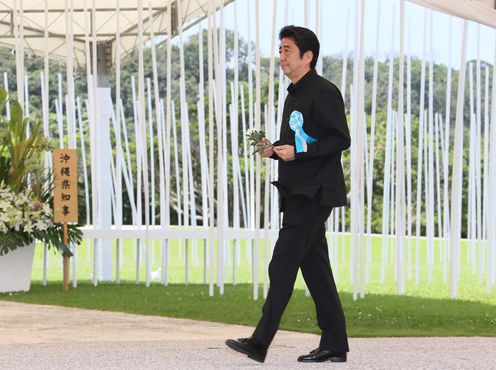
11:08 Arrive at Peace Memorial Park in Itoman City, offer flowers at National War Dead Peace Mausoleum. Governor of Okinawa Prefecture Nakaima Hirokazu accompanies
11:12 Depart from mausoleum
11:16 Arrive at Okinawa Peace Hall within Peace Memorial Park
11:45 Depart from Okinawa Peace Hall
11:50 Within the Peace Memorial Park, attend memorial service for all dead from the Battle of Okinawa, offer flowers, and deliver address

PM
12:51 Memorial service ends
12:57 Interview open to all media: When asked “By when will the Cabinet make a decision on the right to collective self-defense?” Mr. Abe answers “I want the Cabinet to start deciding when that becomes its political duty.”
01:01 Interview ends
01:04 Depart from Peace Memorial Park
01:31 Arrive at Crowne Plaza ANA Okinawa Harborview Hotel
01:59 Lunch meeting with Mr. Nakaima commences. Minister of State for Okinawa and Northern Territories Affairs Yamamoto Ichita and Vice Governor of Okinawa Prefecture Takara Kurayoshi also attend
02:51 Lunch meeting ends
02:53 Depart from hotel
03:00 Arrive at Naha Airport cargo terminal in Naha City, view the terminal
03:26 Leave cargo terminal
03:35 Arrive at Naha Airport grounds for planned extension to 2nd runway, view the area
03:44 Leave 2nd runway extension grounds
04:04 Arrive at Naha Airport proper
05:07 Depart from Naha Airport on ANA Flight 132. Mr. Yamamoto accompanies
07:02 Arrive at Haneda Airport
07:25 Depart from Haneda Airport
08:07 Give condolence call in honor of former Cabinet Legislation Bureau Director-General Komatsu Ichiro at his house in Zenbukuji, Tokyo
08:15 Depart from Mr. Komatsu’s house
08:45 Arrive at official residence
08:46 Interview open to all media: When asked “Please give us a single word concerning the news of former Cabinet Legislation Bureau Director-General Komatsu’s death.” Mr. Abe answers “For respect of the way Mr. Komatsu lived his life, I bow my head. I give my thanks to him, and pray for his well-earned happiness in the next world.”
08:47 Interview ends

Tuesday, June 24, 2014

AM

12:00 At official residence (no visitors)
08:00 At official residence (no morning visitors)
08:16 Depart from official residence
08:17 Arrive at office
08:23 Council for Science, Technology and Innovation meeting
08:40 Meeting ends
08:42 Headquarters on Creating Dynamism through Agriculture, Forestry and Fishery Industries and Local Communities meeting
08:49 Meeting ends
08:54 Cabinet Meeting begins
09:14 Cabinet Meeting ends
09:27 Depart from office
09:29 Arrive at LDP Party Headquarters
09:33 LDP Officers Meeting begins
10:02 Meeting ends
10:03 Depart from LDP Party Headquarters
10:05 Arrive at office
10:16 Depart from office
10:17 Arrive at Diet
10:19 Make rounds to all political parties in the Lower House with Lower House Speaker Ibuki Bunmei and Vice-Speaker Akamatsu Hirotaka
10:46 Finish making rounds in Lower House
10:47 Make rounds to all political parties in the Upper House with President of Upper House Yamazaki Masaki and Vice-President Koshiishi Azuma
11:00 Finish making rounds in Upper House
11:02 Depart from Diet
11:04 Arrive at official residence
11:50 Summit Conference with President of the Philippines Benigno Aquino III

PM
12:35 Summit with Mr. Aquino ends
12:36 Working lunch with Mr. Aquino
01:21 Working lunch ends
01:22 Joint press release
01:42 Joint press release ends
01:44 See off Mr. Aquino
01:45 Finish seeing off Mr. Aquino
01:46 Depart from official residence
01:47 Arrive at office
02:34 Exchange of views with Federation of Economic Organizations [Keidanren], Japan Chamber of Commerce and Industry, and Japan Association of Corporate Executives
02:51 Exchange ends
04:05 Interview with Bloomberg News
04:19 Interview ends
04:31 Council for Promoting the Alleviation of the Burden of Futenma Air Station meeting
05:05 Meeting ends
05:13 Joint meeting of the Council on Economic and Fiscal Policy and the Industrial Competitiveness Council
05:35 Joint meeting ends
05:41 Extraordinary Session Cabinet Meeting begins
05:47 Cabinet Meeting ends
06:30 Press conference
06:58 Press conference ends
08:29 Depart from office
08:30 Arrive at official residence
08:33 Filming for TV Tokyo News Program
08:55 Finish filming for TV Tokyo

Wednesday, June 25, 2014
AM
12:00 At official residence (no visitors)
08:00 At official residence (no morning visitor)
09:01 Depart from official residence
09:02 Arrive at office
09:38 Meet with Minister in charge of Support for Women’s Empowerment and Child Rearing Mori Masako
09:59 End meeting with Ms. Mori

10:00 National Security Council (NSC) Director Yachi Shotaro, Ministry of Foreign Affairs (MOFA)’s Vice-Ministers for Foreign Affairs Saiki Akitaka and Sugiyama Shinsuke, and Asian and Oceanian Affairs Bureau Director-General Ihara Junichi enter
10:07 Mr. Ihara leaves
10:20 Mr. Sugiyama leaves
10:37 Everyone leaves
10:40 Meet with Minister in charge of Total Reform of Social Security and Tax Amari Akira
10:55 End meeting with Mr. Amari
10:56 Meet with former US National Security Advisor Stephen J. Hadley
11:36 End meeting with Mr. Hadley

PM
02:00 Interview with journalist Godo Kenji
02:50 Interview ends
02:51 Speak with Chief Cabinet Secretary Suga Yoshihide
03:01 Finish speaking with Mr. Suga
03:02 Meet with Director of Kyoto University Kokoro Research Center Yoshikawa Sakiko
03:32 End meeting with Ms. Yoshikawa
04:56 Director of Cabinet Intelligence Kitamura Shigeru and Mr. Yachi enter
05:06 Mr. Yachi leaves
05:25 Mr. Kitamura leaves
06:00 Summit Conference with President of Paraguay Horacio Cartes
06:32 Summit Conference ends
06:36 Joint press conference
06:47 Joint press conference ends
06:48 Depart from office
06:49 Arrive at official residence. Dinner meeting hosted by the Prime Minister
08:11 See off Mr. Cartes
08:12 Finish seeing off Mr. Cartes

Thursday, June 26, 2014

AM

12:00 At official residence (no visitors)
08:00 At official residence (no morning visitors)
09:31 Depart from official residence
09:32 Arrive at office
11:30 Meet with of UK-Japan 21sy Century Group’s Japanese-side President and Lower House member Shiozaki Yasuhisa and President of Japan Center for Intercultural Exchange Okawara Akio
11:57 End meeting with Mr. Shiozaki and Mr. Okawara

PM
01:49 Meet with international petrochemical group of companies Royal Dutch Shell CEO Ben van Beurden
02:24 End meeting with Mr. van Beurden
02:25 Meet with Japan Productivity Center incoming Chairman Mogi Yuzaburo and outgoing Chairman Ushio Jiro
02:50 End meeting wit Mr. Mogi and Mr. Ushio
03:07 Meet with President and Editor-in-Chief of Forbes magazine Steve Forbes
03:22 End meeting with Mr. Forbes
03:23 Deputy Prime Minister and Minister of Finance Aso Taro, Vice-Minister of Finance Kinoshita Yasushi, Deputy Vice-Minister of Finance Sato Shinichi, Ministry of Finance’s Budget Bureau Director-General Kagawa Shunsuke and Tax Bureau Director-General Tanaka Kazuho enter
03:59 Mr. Kinoshita, Mr. Sato, Mr. Kagawa, and Mr. Tanaka all leave
04:23 Mr. Aso leaves
04:35 Meet with Chairman of Interchange Association representative office of Japan in Taiwan Ohashi Mitsuo
04:50 End meeting with Mr. Ohashi
04:51 Speak with MOFA’s Asian and Oceanian Affairs Bureau Director-General Ihara Jyunichi
04:54 Finish speaking with Mr. Ihara
05:01 Meet with International Olympic Committee Coordination Commission (for the Games of the XXXII Olympiad in Tokyo in 2020) Chairman John D. Coates. Tokyo 2020 Organizing Committee of the Olympic and Paralympic Games President Mori Yoshiro also attends
05:16 Meeting ends
05:21 NSC meeting commences. National Public Safety Commission Chairman Furuya Keiji attends
05:59 Mr. Furuya leaves NSC meeting
06:14 NSC meeting ends
06:41 Depart from office
06:42 Arrive at official residence

Friday, June 27, 2014

AM

12:00 At official residence (no visitors)
08:00 At official residence (no morning visitors)
09:23 Depart from official residence
09:24 Arrive at office
09:46 Headquarters for Promoting Decentralization Reform meeting
09:55 Meeting ends
10:01 Cabinet Meeting begins
10:20 Cabinet Meeting ends
10:37 Meet with Mexican Secretary of Foreign Affairs José Antonio Meade Kuribreña
10:53 End meeting with Mr. Meade
10:54 Meet with Vice-Minister for Foreign Affairs Saiki Akitaka and MOFA’s Asian and Oceanian Affairs Bureau Director-General Ihara Jyunichi
11:25 Meet with Administrative Vice-Minister of Defense Nishi Masanori
11:43 End meeting with Mr. Nishi
11:44 Meet with Chairman of Project Team for nonpartisan Diet Members’ Caucus on Sports Endo Toshiaki. Director-General of Personnel Affairs Bureau Kato Katsunobu attends

PM
12:04 End meeting with Mr. Kato
12:06 Receive courtesy call from a joint group of elementary and middle school students of Great Falls Elementary School in Virginia USA and Eisugakkan Elementary and Middle Schools in Fukuyama City, Hiroshima Prefecture
12:09 Courtesy call ends
12:10 Speak with Minister in charge of Ocean Policy and Territorial Issues Yamamoto Ichita
12:15 Finish speaking with Mr. Yamamoto
01:19 Meet with Minister in charge of TPP Amari Akira, Deputy Chief Negotiator of Government Headquarters for the TPP Oe Hiroshi, and Vice-Minister of Agriculture, Forestry and Fisheries Minagawa Yoshitsugu
02:02 End meeting with Mr. Amari, Mr. Oe, and Mr. Minagawa
02:03 Meet with Vice-Minister of Internal Affairs and Communications Okazaki Hiromi
02:32 End meeting with Mr. Okazaki
02:37 Meet with Minister for Reconstruction Nemoto Takumi
03:02 End meeting with Mr. Nemoto
03:53 Vice-Minister for Foreign Affairs Saiki Akitaka, MOFA’s Director-General of the European Affairs Bureau Kozuki Toyohisa, Director-General of Middle Eastern and African Affairs Bureau Uemura Tsukasa, and Director-General of the International Legal Affairs Bureau Ishii Masafumi enter
04:23 Mr. Kozuki and Mr. Ishii leave
04:35 Everyone leaves
05:18 Meet with Director of Cabinet Intelligence Kitamura Shigeru
05:46 End meeting with Mr. Kitamura
05:55 Depart from office
06:14 Arrive at private residence in Tomigaya, Tokyo
06:38 Depart from private residence
08:00 Arrive at Chinese restaurant Isaichugokusaikan Kokyu in Fujikawaguchiko-cho, Yamanashi Prefecture. Dinner with Special Advisor to President of the LDP Hagiuda Koichi and colleagues
10:24 Depart from restaurant
10:35 Arrive at holiday home in Narusawa Village Yamanashi Prefecture
10:42 Mr. Hagiuda enters

Saturday, June 28, 2014

AM

12:00 At holiday home (no new visitors). Mr. Hagiuda stays the night
06:57 Depart from holiday home in Narusawa Village, Yamanashi Prefecture
07:01 Arrive at Fujizakura Country Club golf course, play golf with Special Advisor to President of the LDP Hagiuda Kochi and colleagues

PM
02:53 Depart from Fujizakura Country Club
04:20 Arrive at private residence in Tomigaya, Tokyo
05:48 Depart from private residence
05:59 Arrive at sushi restaurant Sushi Kuon Hanare in Nishihara, Shibuya-ku, Tokyo. Have dinner with mother Kishi Yoko
07:26 Depart from Sushi Kuon Hanare
07:33 Arrive at private residence

Sunday, June 29, 2014

AM

12:00 At private residence (no visitors)
09:16 Deputy Chief Cabinet Secretary for Crisis Management Nishimura Yasuhiko and Director of NSC Yachi Shotaro enter Mr. Abe’s private residence in Tomigaya, Tokyo
09:59 Mr. Nishimura and Mr. Yachi leave

PM
Stay at private residence throughout the afternoon, no visitors
06:05 Depart from private residence
06:29 Arrive at Mitsubishi Kaitokaku, former residence of Iwasaki Koyata of Mitsubishi Corporation, in Takanawa, Tokyo. Dinner meeting with Deputy Prime Minister and Minister of Finance Aso Taro and Keio University emeritus professor Iwasaki Koko
08:38 Depart from Mitsubishi Kaitokaku
09:02 Arrive at private residence

Friday, April 12, 2013

U.S.-Japan Okinawa Agreement Not a Breakthrough

George Washington University Professor Mike Mochizuki, an APP Board Member, was interviewed on April 11th by Peter Ennis for Toyo Keizai On-Line and Dispatch Japan regarding the "new" agreement to set a timetable for the return of some property to Okinawa.

DISPATCH JAPAN: What is the significance of the recently-announced agreement between Washington and Tokyo concerning the return of some territory in Okinawa?

MOCHIZUKI: This is a last-ditch effort by the US and Japanese governments to alter base politics in Okinawa so that the Futenma Replacement Facility can be constructed at Henoko Bay.

DISPATCH JAPAN: Is this a genuine breakthrough on the issue?

MOCHIZUKI: If by “genuine breakthrough,” you mean that the agreement will succeed in fundamentally altering current political dynamics in Okinawa, I would say it is not a breakthrough. Moreover, the agreement does not entail a significant acceleration in the timetable for returning U.S. facilities south of Kadena Air Force Base, which has been sought by Okinawans.

DISPATCH JAPAN: It seems that Tokyo is trying to “buy off” Okinawa. Can that tactic work anymore?

MOCHIZUKI: Okinawa of course welcomes the financial aid from the central government in order to promote development. But this aid does not necessarily translate into local willingness to accept a new Marine Air Station within the prefecture.

DISPATCH JAPAN: So much of the new agreement depends on construction of replacement facilities, which has been one reason for the impasse of many years. So where is the “breakthrough?”

MOCHIZUKI: There is no substantive breakthrough. But I think that by recommitting themselves to the return of Futenma as well as the return of facilities south of Kadena, the U.S. and Japanese governments hope to turn around public opinion in Okinawa. After the resignation of Prime Minister Hatoyama, the political executives of every city, town, and village of Okinawa –whether conservative or progressive-- have declared their opposition to the Henoko FRF plan. So what the Abe government would like to do is at least win the support of conservatives in Okinawa for the current Futenma relocation plan. But when Okinawans read the fine print of the agreement and consider the conditions and the probable schedule for the return of U.S. military facilities, there is not much to cheer about.

DISPATCH JAPAN: Do you see any change in the attitude of Governor Nakaima? There are top-level MOD officials who believe that since the governor is an LDP member, he will eventually alter his opposition to the Henoko plan.

MOCHIZUKI: I think Governor Nakaima wants to maintain a good rapport with the Abe government, and he is wisely refraining from rejecting central government initiatives out of hand. But I don’t think this means that he is now prepared to accept the Henoko plan. He is being cautious, and he has stated that he needs to find out how local communities that will be affected by the latest agreement feel.

DISPATCH JAPAN: The MOD and the Kantei seem to think they can out-maneuver Mayor Inamine by somehow winning the support of a majority of assembly members. Do you see that as feasible?

MOCHIZUKI: Winning over the majority of the Nago City Assembly is an ambitious goal for the MOD and Kantei. But what is key is whether or not Mayor Inamine, who has vehemently opposed the Henoko plan, wins re-election in 2014.

DISPATCH JAPAN: Is there a different attitude toward the Henoko project between the local Henoko residents vs. the other sections of the prefecture? The OPG staff seems to think that the Henoko community favors the project, but all other sections of Okinawa remain opposed.

MOCHIZUKI: Because there has been so much money flowing into the communities closest to Henoko Bay, it is not surprising that these communities tend to favor the FRF project. But those sections of Nago City away from Henoko Bay tend to be opposed. And public opposition to the Henoko plan remains pretty robust in the rest of Okinawa Prefecture.

DISPATCH JAPAN: How would you characterize the Abe government’s approach toward Okinawa? Tokyo seems intent on using the period of review of the landfill application to win over a significant portion of Okinawa sentiment that, up to now, has been opposed.

MOCHIZUKI: Through both financial aid and the promise of future closures of U.S. military facilities in attractive areas for development, the Abe government hopes to win over the hearts and minds of conservative Okinawans who are pro-development and more supportive of the security alliance with the United States. Unfortunately, the latest agreement tends to take a piecemeal approach so the effect on these Okinawans is unlikely to be dramatic.

DISPATCH JAPAN: Has the tension with North Korea had any significant impact on how the long-standing stalemate for FRF? (Putting pressure on Okinawa to agree to Henoko…)

MOCHIZUKI: Tensions with North Korea as well as tensions with China over the Senkakus may have increased support for the US-Japan alliance among some Okinawans. But this does not necessarily mean that they will now embrace the Henoko plan. Rather many Okinawans are probably asking that if US military forces are so important for Japanese security, why don’t other prefectures offer to host those forces?

DISPATCH JAPAN: According to the new agreement, Futenma would remain open for at least another 9 years (2022). Is it wise to keep such a controversial facility open for such a long time?

MOCHIZUKI: The target date of 2022 is probably frustrating and depressing for Okinawans. Remember that under the original 1996 agreement, the goal was to have Futenma returned between 2001 and 2003. 2022 would be at least 19 years after the target date. That’s a whole generation. Moreover, the April 2013 agreement does not declare Futenma will be returned in 2022 at the latest. The document instead states “2022 or later.” So there is a strong possibility that the 2022 target year will not be met.

DISPATCH JAPAN: The plan to relocate a large number of US Marines to Guam seems to be in question, as construction of new facilities on Guam is caught up in cost-overruns, underestimation of costs, questions in Congress, and now the sequestration. How can the overall base realignment move forward if the US can’t deliver on the Guam side of the deal?

MOCHIZUKI: That’s a good question. Michael O’Hanlon of Brookings and I, however, have an answer to that. We propose relocating these Marines back to bases on the continental United States. If we pre-positioned equipment in Japan and elsewhere in the region, we can easily and rapidly fly Marines back into the region during a contingency. Moreover, Marines can maintain a regular regional presence through rotational deployments.

DISPATCH JAPAN: Is the US Marine presence on Okinawa really of strategic importance, or is the real motivation more mundane bureaucratic considerations?

MOCHIZUKI: If Okinawa were willing to host 20,000 Marines permanently, I would acknowledge that there may be strategic benefits of such a presence. But that is not the case. Therefore, we have to recognize the political strain that such a Marine presence poses on the alliance. Moreover, having Futenma Marine Air Station located in a crowded urban area increases the probability of a tragic accident.If such a tragedy were to occur, this would have a devastating effect on the alliance. It is strategically important to maintain support in Okinawa for hosting more vital facilities like Kadena Air Force base. I am not arguing that all the Marines should leave Okinawa. But I believe that we can dramatically reduce the Marine presence on Okinawa without undermining the US security role in the Asia-Pacific.

Monday, January 2, 2012

More Futenma Analysis

APP's Senior Fellow William Brooks has published in December Cracks in the Alliance? Futenma Log: Base Relocation Negotiations 2009-2010 on the current status of Futenma negotiations. It is issued by Johns Hopkins University SAIS Reischauer Center as a sequel to his highly regarded monograph The Politics of the Futenma Base Issue in Okinawa, which reviews the first two agreements to close and relocate the Futenma Marine Corps Air Station.

Dr. Brooks details how the first two Democratic Party of Japan (DPJ) governments—those of Hatoyama Yukio and Kan Naoto—committed to implementing previous bilateral US-Japan understandings, but in the end were unable to make significant progress. He makes three major points: (1) Hatoyama made serious tactical mistakes, that seriously complicate future resolution of the Futenma problem; (2) Forceful Japanese leadership is required for resolution of the Futenma problem, which Kan did not provide, despite a more positive attitude than Hatoyama; and (3) Feasible routes for resolution of the Futenma problem, consistent with original US-Japan understandings, still remain, but will likely involve a package agreement redefining some key elements of the 2006 understandings, that could take some time to negotiate.

He notes:
The contradiction of asking for an immediate closing of a base, whose function in a contingency is regarded as critical, and at the same time saying that it cannot be relocated in Okinawa, while knowing full well from recent efforts that such an option is impossible, can mean two things. One is that the level of emotions among Okinawans since the Hatoyama “betrayal” is so high it has overridden logic and pragmatism. But it also means that Futenma has become a political cause – a tool for political activists who want to see all Marines or all U.S. bases out of Okinawa. Either way, Okinawa loses. The status quo – or worse – is likely to remain for a long, long while. 
Like it or not, the strategic reality is that Okinawa has become even more crucial a center for the forward deployment of U.S. forces in East Asia as China becomes more militarily active in the region. Stable basing is a requirement for the U.S. forces in Japan, and Okinawa provides far more than its share of prime land for that purpose. The 2006 Roadmap Agreement promised to lighten Okinawa’s security burden by closing six facilities and shifting some of the U.S Marine presence to Guam, but it has not been implemented due to local resistance. There are no incentives thus for the U.S. to offer more concessions when the earlier ones have been spurned.

Sunday, December 18, 2011

Cracks in the Alliance

On November 22nd, APP Senior Fellow Dr. William Brooks was in Tokyo and gave a presentation reviewing the history of Japan's negotiations with the United States over a replacement facility for the U.S. Marine Corps Futenma Air Station. He spoke at Temple University's influential Institute of Contemporary Asian Studies run by APP member Dr. Robert Dujarric.

You can view the presentation slides HERE and view the presentation below.

Friday, November 18, 2011

Brooks to talk November 22 in Tokyo

THE FUTENMA ISSUE - AN UPDATE. 11/22, 7:00-9:00pm, Tokyo, Japan. Sponsor: Institute of Contemporary Asian Studies (ICAS), Temple University Japan Campus. Speakers: Dr. William L. Brooks, APP Senior Fellow, former head of Media Analysis & Translation, US Embassy Japan; Most recent monographs: The Politics of the Futenma Base Issue in Okinawa: Relocation Negotiations in 1995-97, 2005-2006 (SAIS, 2010), and Cracks in the Alliance (fall 2011). Location: Temple University, Japan Campus.

Tuesday, July 20, 2010

Kan's policies float like a butterfly, voters sting like a bee

Stung by the loss of his party’s Upper House majority and his dramatic decline in popularity, Japanese Prime Minister Naoto Kan (right) is struggling to find the Calamine lotion.

He is now more sensitive to public opinion and more realistic about the domestic constraints on his actions. Not unexpectedly, Kan’s promise to resolve the Futenma relocation by the end of August is unrealistic and unlikely to soothe raw nerves any time soon.

The public continues to disapprove of how the DPJ is running the country. In the latest Yomiuri poll (July 14), the support rate for the Kan cabinet plummeted seven points from the July 2-4 survey to 38%, with a majority, 54%, welcoming the DPJ’s election loss. The non-support rate soared 13 points to an alarming 52%, overtaking the approval rate for the first time. Only a month ago (June 8-9 survey), just after Kan took over, the support rate was a healthy 64% and the non-support an insignificant 25%.

The DPJ’s support rate has also taken a beating, dropping from 34% to 28% in just one week. In contrast, the support rate for the Liberal Democratic Party (LDP), the anointed "winner" in the recent election, jumped from 18% to 24% in a week. Support for the splinter party, Your Party, which picked up 10 seats in the election, placing it on the political map, jumped from 5% to 12%. Asked about the DPJ’s loss of 10 seats in the election, 38% of the public blamed it on Prime Minister Kan’s remarks about hiking the consumption tax, but a significant 31% said they were dissatisfied with the party’s campaign manifesto.

According to press reports, rather than confront the wrath of Okinawans opposed to any relocation of Futenma inside the prefecture, Tokyo is now pressing for an ambiguous late-August decision, veering away from any specific plan. Foreign Minister Katsuya Okada told the press on July 13 that the government would work to rebuild confidence in it in Okinawa even if it takes time. Chief Cabinet Secretary Sengoku separately added that he did not expect a final resolution of the Futenma relocation by November, when President Obama is scheduled to visit Japan. On July 16th, Okada told the press "I would like to continue mulling over whether to announce it publicly, or not to disclose it even if it becomes clear effectively."

Okinawa is now represented in the Upper House by a newly elected lawmaker from the Liberal Democratic Party, Aiko Shimajiri. She won not because of her association with the party that brought Okinawa the Futenma dilemma, but because she promised to do what the DPJ could not deliver: completely reject any Futenma relocation plan that left the facility in Okinawa. She also went one step further, promising in her campaign to follow the will of the prefecture to “establish a peaceful Okinawa with no bases,” and to “return to the starting point.” She says she plans to visit Washington soon to deliver that anti-base message.

In addition this new and unique LDP voice, Social Democratic Party head Mizuho Fukushima, who kept repeating her Futenma solution of kengai, kokugai (out of the prefecture, out of the country) during the election campaign, convinced an overwhelming number of Okinawa voters to choose her party in the proportional representation race. The SDP led the pack with 126,400 votes or 22.7% of the total, compared to the mere 3.8% of the vote that it tallied in the rest of the country. It unseated, ironically, the incumbent, a peace activist from the DPJ, who later bitterly denounced his party for its “betrayal” of Okinawa.

This angry mood across Okinawa is likely to affect the outcome of the Nago City assembly election on September 12 as well as the gubernatorial election on November 28. These are likely to pit an anti-base activist against the moderate incumbent. It is still unclear how much the rest of Japan is sensitive to the issues on Okinawa.

The Japanese people are feeling injured and less tolerant of central government prescriptions. Little wonder that the Kan government wants to postpone or not even announce its final decision on Futenma. Left as is, the open sores are unlikely to improve and could become inoperable. The inevitable clash of political forces in Japan has merely been delayed.

In response, the US-Japan Alliance will either have to restructure and adjust or cease.

Dr William Brooks
APP Senior Fellow
Mindy Kotler
APP Director

Sunday, May 30, 2010

Hatoyama's next decision: Go now or in July


It's cost him a the respect of two nations and a coalition ally, and it looks likely the Futenma flap will cost him his job.

After months of efforts in vain to find a spot to relocate Futenma Air Station anywhere but inside Okinawa, Prime Minister Yukio Hatayama has reluctantly concluded that something close to the original plan for a replacement facility at Henoko in Nago City is the only practical solution, and an agreement with the US is now in the works.

Opting to revisit the original plan to put relocate Futenma to the Camp Schwab vicinity at Henoko came after the Hatoyama administration's attempts to obtain the cooperation of new candidate sites for relocation – such as Tokunoshima Island in Kagoshima Prefecture--failed one after another, mainly due to opposition from local governments and residents. Swallowing his pride, the Prime Minister even journeyed to Okinawa over the weekend to personally apologize – with TV cameras rolling – to Governor Nakaima for reneging on his campaign promise to remove Futenma from Okinawan soil. The governor was predictably angry and uncooperative, and public outcries of “betrayal” from Okinawans dominated news coverage of the event.

Though he made the only decision he felt possible, Hatoyama is being attacked for it by even the liberal press. The usually Democratic Party of Japan-friendlyAsahi Shimbun and Mainichi Shimbun, severely faulted him in editorials for his decision to keep Futenma inside Okinawa, though neither paper offered any other solution. The conservative Yomiuri Shimbun, usually harsh toward the DPJ government on this issue, soundly scolded Hatoyama in its editorial for the long delay, but supported his decision to opt for the alliance over local interests.

The reaction of the former ruling Liberal Democratic Party was disappointing. Instead of applauding a decision on Futenma for a plan that they had favored, the LDP opportunistically used the occasion to blast Hatoyama for callous treatment of Okinawan sensitivities. The former ruling party is even threatening to file a no-confidence motion against the Prime Minister.

Okinawa may have their issues with a DPJ government that promised change but delivered the opposite, but the prefecture from the start has rejected any pragmatic resolution. The governor previously supported the Henoko plan negotiated and approved by his successor in 2006. Now, he has joined the crowd calling for Futenma’s immediate closure and removal from Okinawa.

The Hatoyama government is to blame for raising false hopes, and then wasting everyone’s time while it scurried around looking for relocation sites outside of Okinawa. It also needlessly tried US patience by reneging on the old agreement only to come up in the end months later with a resolution that is almost the same as before. Such a decision arguably could have been made last December. Of course, at that time, Hatoyama was besieged by the Social Democratic Party, which wanted the base moved to Guam and threatened to bolt the ruling coalition if he made a decision that kept Futenma in Okinawa. The SDP is no longer needed in the coalition now, the budget and other major legislation having been passed. The DPJ can find other, more cooperative coalition partners among the small parties after the July election.

Still, even at this late point, Prime Minister Hatoyama should be praised for finally displaying leadership and making a pragmatic decision and then swallowing his pride to apologize face to face to the Okinawa governor. Yes, it was probably the only choice he could have made under the circumstances; the only other alternative would have been to ask the US to send all the Marines home so he could close the base.

The Prime Minister cited the need to maintain “military deterrence” as his chief reason for not siding with Okinawa on this issue. He probably knew that was the priority all along. But it is tempting to speculate that the latest round of scary saber rattling by North Korea, torpedoing a South Korean patrol boat and killing 46 sailors, may have added impetus to Hatoyama’s resolve to side with the alliance in resolving the Futenma issue.

The Alliance may have suffered a bit of damage by this affair but that will heal. The real collateral damage is a major loss of trust in Okinawa for a party that was seen by many as the prefecture’s white knight on US base issues. Now, Futenma may be more than just a symbol of the base problem. It may in effect have become a rallying cry for a nascent political movement in Okinawa that not only rejects a pragmatic solution for the long-delayed reversion -- in effect keeping the citizens of Ginowan City near the base in perpetual limbo -- it also may seek the long-term goal of removing the US military presence from the island prefecture. Such goals and activities are not new in the history of base negotiations in Okinawa, but this inchoate movement, fueled by the DPJ government’s inept handling of the issue and anger at its broken promises, could escalate. 

The LDP’s tack in the past was to offer economic incentives to placate Okinawa whenever the base problem heated up, essentially capping strong anti-base movements. But the DPJ has been loathe to use such devices. Moreover, the locals were never given a say, reading about most proposals and now the final decision in the newspapers, which has only added more fuel to the fires of outrage. If the new relocation plan is ever to have a chance of being implemented, the ruling party may now have no choice but to belatedly enter the realm so masterly managed by the LDP in the past and offer lavish economic measures.

As for Prime Minister Hatoyama’s political fate, his popularity has already plummeted to 20% or below in the polls, and his party’s support ratings are even below the LDP’s in some surveys. Hatoyama’s controversial decision is not likely to endear him to a public that has already given up on his administration. Having made the decision, and assuming that a US-Japan agreement is in its final stage, the Prime Minister may indeed decide that the situation has become untenable and resign to let a fresh face take the party into the general election in July.

It may come down to a question of whether to resign before the election to take responsibility for breaking his promise to Okinawa, or having to resign after it to take responsibility for a poor showing for his party. In either case, Hatoyama gets no respect for a decision he promised and delivered in May.

Dr William Brooks
APP Senior Fellow