Showing posts with label Taniguchi Tomohiko. Show all posts

Friday, September 11, 2015

Prime Minister of Japan’s Schedule August 31-September 6, 2015

Monday, August 31, 2015

AM
08:00 At private residence (no morning visitors)
09:31 Depart from private residence
09:44 Arrive at office
09:53 Meet with resident Ambassador to U.S. Sasae Kenichiro and Vice-Minister for Foreign Affairs Saiki Akitaka
10:37 End meeting with Mr. Sasae and Mr. Saiki
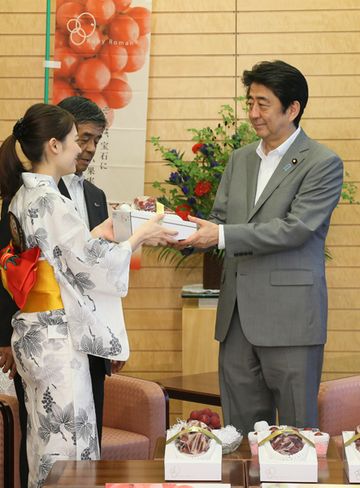
11:45 Presentation of grapes from Governor of Ishikawa Prefecture Tanimoto Masano. Senior Vice-Minister of Environment Kitamura Shigeo also attends
11:53 Presentation of grapes ends

PM
04:18 Meet with MOFA’s Director-General of Foreign Policy Bureau Hiramatsu Kenji
04:43 End meeting with Mr. Hiramatsu
04:58 Depart from office
04:59 Arrive at Diet
05:00 Enter LDP President’s Office
05:01 LDP Officers Meeting
05:15 Meeting ends
05:39 Exit LDP President’s Office
05:41 Depart from Diet
05:42 Arrive at office
05:59 Depart from office
06:00 Arrive at official residence. Dinner meeting with Chairman of Lower House Special Committee on Legislation for the Peace and Security of Japan and the International Community Hamada Yasukazu, Director of Lower House Special Committee on Legislation for the Peace and Security of Japan and the International Community Toyama Kiyohiko, and other colleagues. Chief Cabinet Secretary Suga Yoshihide and Deputy Chief Cabinet Secretary Kato Katsunobu also attend
07:24 Everyone leaves

Tuesday, September 1, 2015
AM
12:00 At official residence (no visitors)
08:00 At official residence (no morning visitors)
08:17 Depart from official residence
08:18 Arrive at office
08:25 Hold the first meeting of the Emergency Disaster Response Headquarters as part of the annual comprehensive disaster prevention drills for 2015. Phone conference with Governor of Tokyo Prefecture Masuzoe Yoichi. Temporary Cabinet meeting
08:50 Meeting ends
09:00 Press conference
09:03 Press conference ends
09:12 Cabinet meeting
09:22 Cabinet meeting ends
10:27 Depart from office
11:17 Arrive at Showa Commemorative National Government Park in Tachikawa, Tokyo
11:20 Depart from park
11:27 Arrive at Takamatsu station of Tama-monorail in Tachikawa, Tokyo. Observe a rescue and assistance drill
11:33 Depart from Takamatsu station of Tama-monorail
11:39 Arrive at Showa Commemorative National Government Park. Participate in a firefighting drill. Observe a rescue and assistance drill from a collapsed building. Deliver address

PM
12:53 Presentation of a disaster prevention book from Governor of the Tokyo Metropolitan Government Masuzoe Yoichi
12:56 Presentation of the book ends
12:59 Interview with news reporters. Respond to the question "Why do you run for the LDP President?" by saying "Continuation is power, and I want to fully fulfill the responsibility."
01:02 End interview
01:03 Depart from park
01:48 Arrive at official residence
01:59 Depart from official residence
02:00 Arrive at office
02:58 Meet with Vice-Minister for Foreign Affairs Saiki Akitaka
03:34 End meeting with Mr. Saiki
04:06 Meet with Director of National Security Council (NSC) Yachi Shotaro, Director of Cabinet Intelligence Kitamura Shigeru, and Deputy Director-General of Public Security Intelligence Agency (PSIA) Sugiyama Haruki
04:18 Mr. Yachi and Mr. Sugiyama leave
04:30 Mr. Kitamura leaves
04:31 Deputy Prime Minister and Minister of Finance Aso Taro, Vice-Minister of Finance Tanaka Kazuho, and Deputy Vice-Minister of Finance Sato Shinichi enter
05:05 Mr. Sato leaves. Vice Minister of Finance for International Affairs Asakawa Masatsugu enters
05:18 Mr. Tanaka and Mr. Asakawa leave
05:25 Mr. Aso leaves
05:34 National Security Council meeting. Minister of Economy, Trade and Industry Miyazawa Yoichi also attends
06:08 Meeting ends
06:22 Depart from office
06:37 Arrive at Italian restaurant LA BETTOLA da Ochiai in Ginza, Tokyo. Dinner meeting with Assistant Chief Cabinet Secretary Kanehara Nobukatsu, Special Adviser to the Cabinet Taniguchi Tomohiko, and other colleagues
09:20 Depart from restaurant
09:40 Arrive at private residence

Wednesday, September 2, 2015

AM
12:00 At private residence (no visitors)
08:00 At private residence (no morning visitors)
09:32 Depart from private residence
09:47 Arrive at official residence
12:00 Meet with LDP Secretary-General Tanigaki Sadakazu

PM
12:38 End meeting with Mr. Tanigaki
02:41 Meet with Secretary-General of Headquarters for Abduction Issue Ishikawa Shoichiro
02:56 End meeting with Mr. Ishikawa
06:39 Depart from office
06:40 Arrive at official residence

Thursday, September 3, 2015

AM
12:00 At official residence (no visitors)
08:00 At official residence (no morning visitors)
08:47 Depart from official residence
08:48 Arrive at office
08:52 Meet with Deputy Chief Cabinet Secretary Seko Hiroshige
09:33 End meeting with Mr. Seko
09:54 Depart from office
09:56 Arrive at Diet
09:57 Enter Upper House 43rd Committee Members’ Room
10:00 Meeting of the Committee on Health, Labour, and Welfare of the House of Councillors

PM
12:02 Meeting recesses. Exit Upper House 43rd Committee Members’ Room
12:03 Depart from Diet
12:06 Arrive at office
02:02 Meet with Vice-Minister of Cabinet Office Matsuyama Kenji and Cabinet Office’s Director-General of Decoration Bureau Kuroba Ryosuke
02:12 End meeting with Mr. Matsuyama and Mr. Kuroba
02:17 Meet with Deputy Vice Minister of Finance Okamoto Shigeaki and Director-General of the Financial Bureau Sakota Hidenori
02:27 End meeting with Mr. Okamoto and Mr. Kuroba
03:00 Meet with Chairman of LDP Regional Government (doshu-sei) Promotion Headquarters Sata Genichiro. Special Advisor to the Prime Minister Isozaki Yosuke also attends
03:21 End meeting with Mr. Sata
03:22 Meet with Vice-Minister for Foreign Affairs Saiki Akitaka
03:45 End meeting with Mr. Saiki
04:01 Meet with MOFA’s Director-General of Asian and Oceanian Affairs Bureau Ihara Junichi
04:34 End meeting with Mr. Ihara
04:37 Receive a proposal from a delegation led by Chairman of LDP General Council Toshihiro Nikai on the development of Ogasawara
04:55 End reception
05:04 Meet with Director of Cabinet Intelligence Kitamura Shigeru
05:32 End meeting with Mr. Kitamura
06:23 Depart from office
06:32 Arrive at Tokyo Prince Hotel in Shiba-park, Tokyo. Attend a social gathering of LDP policy group Kisaragi-kai in banquet hall Sun Flower Hall, deliver address
07:19 Depart from hotel
07:27 Arrive at official residence

Wednesday, January 21, 2015

Sourcing Misinformation from Japan's Rightwing

Denying cannibalism by Japanese troops is popular trope used by Japan's Rightwingers to discredit the book and film Unbroken. The net-uyoku have accused the author of Unbroken of spreading a lie about Japanese having a “custom” of cannibalism. They proudly declare that Japan has no "food culture" of cannibalism, thus it is simply untrue that Imperial Japanese soldiers and sailors consumed POWs out of hunger or triumph. This denial is at the heart of the online petition to ban the movie in Japan. However, neither the book nor the movie depict acts of cannibalism.

Unbroken is a biography of Olympian and former American POW of Japan Louis Zamperini. The author, Laura Hillenbrand, tries to capture in one paragraph (p 315), the litany of abuses heaped upon those captured by the Japanese. One clause in one sentence refers to "eaten alive in ritual acts of cannibalism." Nowhere else is this mentioned.

The book has not been translated into Japanese nor has the film been shown in Japan. Thus, what is the source of this misperception?

It seems that it can be traced to an one-word mistranslation in a book review of Unbroken in Wedge, a conservative magazine published by a subsidiary of JR Central [see below]. The honorary chairman of JR Central is Yoshiyuki Kasai and the then-adviser to the magazine was Tomohiko Taniguchi. Kasai is a confidante of Prime Minister Shinzo Abe and Taniguchi is in charge of the government's international public relations. 

Neither man has moved to clear up this misunderstanding. Both are deeply concerned with Japan's global public image. The result is that the campaign  against Unbroken is intensifying and in December a book was published embellishing the false notion that Unbroken is part of a campaign to dishonor Japan. This view is part of a greater ideology that the war crimes trials were based of falsified information and the product of victor's justice.

Unfortunately, reports of cannibalism are true. Officers were prosecuted in war crimes trials and hanged. Imperial Japan's excessive abuse of its military and civilian prisoners is also true.

The following, for scholarly understanding and analysis, is a provisional, annotated translation of the Wedge article that propagated the campaign against Unbroken.

Very Popular Book In U.S.A. Stirs-up Anti-Japan Feelings
-- Japanese Military's Abuse of POWs, Why Bring It Up Now?

Wedge Magazine, February 20, 2011
By Soichiro MORIKAWA -- Journalist who has experience of living in New York during the time of IT Bubble
Link: 反日感情をあおる本が米国で大人気

* * * * * * * * * *
COLUMN: What best-seller books are being read in America? Learn about trends/signs of the times. You think you know, but may not really know, the true state of affairs in America -- and this is essential for thinking about Japan.
* * * * * * * * * *

"UNBROKEN", by Laura Hillenbrand, published by Random House. $27.00

A non-fiction book which describes the true story, in great detail, how a Japanese soldier abused a U.S. POW during World War II. It is unmistakably a book which will certainly heighten anti-Japanese feelings in America, and is being widely-read in the U.S. It is a special category book listed in the New York Times weekly non-fiction bestseller list, and has ranked in the top-five for thirteen-straight weeks. Most recently it dropped to number two, but for six weeks before that it was at the top of the list.

-- JAPANESE MILITARY'S ABUSE OF POWS

Louis Zamperini, is currently a healthy 93-year-old American man of Italian ancestry. The book follows/describes the misfortunes he experienced during his lifetime -- in particular how he had to deal with inhumane treatment as a POW held by the Imperial Japanese military.

As a young 19-year-old middle-distance runner, he raced in the 1936 Berlin Olympics as part of the U.S.A.'s team. He did not win a medal, but his hard-running style drew the attention of Adolf Hitler, who was watching from the stands -- and there is an anecdote that later on,

Hitler shook Zamperini's hand.

Thereafter, Zamperini continued to train as a runner, hoping to compete in teh 1940 Olympics, which were schedule to be held in Tokyo -- but due to the Japan-China War, those games were postponed, and he joined the U.S. Army Air Force. However, bad luck later struck when his aircraft developed engine trouble and it crashed. He eventually drifted ashore on Kwajalein Island, located in the Marshall Islands, about 3,900 KM southwest of Honolulu, Hawaii.

That was when Zamperini became a POW of the Japanese military, in a place which was called "Execution Island." Zamperini was not executed, once the Japanese military realized he was an Olympic athlete, and he was sent bakc to the mainland Japan.

After that, we had to survive being a POW, who was moved from place-to-place in camps at Ofuna, Omori, and Naoetsu, and eventually returned alive to America in August 1945. The book describes, in a cool/factual style, the numerous cases/examples of maltreatment Zamperini received while in the POW camps -- and, conversely, this really causes the image of the cruel Japanese soldiers to vividly emerge.

In particular, the most involved/powerful descriptions of abuse and cruelty are those which cover the actions of Japanese Corporal Mutsuhiro Watanabe, who came to be called "The Bird." The book calls Watanabe a sadist, who seemed to derive sexual pleasure feelings from punishing/tormenting the POWs. For example, the following is one example of innumerable POW-abuse scenes which
are written in the book:

--"THE BIRD," SADISTIC WATANABE

"The Bird swung the belt backward, with the buckle on the loose end, and then whipped it around himself and forward, as if he were performing a hammer throw. The buckle rammed into Louie’s left temple and ear. Louie felt as if he had been shot in the head. Though he had resolved never to let the Bird knock him down, the power of blow, and the explosive pain that followed, overawed everything in him. His legs seemed to liquefy, and he went down. The room spun." (page 251)

Corporal Watanabe, aka "The Bird", made Zamperini his personal enemy, and almost every day he would beat Zamperini, and would also prevent him from receiving adequate amounts of food. The book also states that Japanese soldiers would seize food from International Red Cross relief packages, and prevent distribution of such food to the POWs.

The book further describes, using statistical information, to show that Japan's treatment of POWs was clearly much worse and cruel than Nazi Germany.

"In its rampage over the east, Japan had brought atrocity and death on a scale that staggers the imagination. In the midst of it were the prisoners of war. Japan held some 132,000 POWs from America, Britain, Canada, New Zealand, Holland, and Australia. Of those, nearly 36,000 died, more than one in every four. Americans fared particularly badly; of the 34,648 Americans held by Japan, 12,935? more than 37 percent?died. By comparison, only 1 percent of Americans held by the Nazis and Italians died." (pages 314-315)

POWs were subjected to especially cruel treatment, supposedly, as described in the following passage...

"Thousands of other POWs were beaten, burned, stabbed, or clubbed to death, shot, beheaded, killed during medical experiments, or eaten alive in ritual acts of cannibalism. And as a result of being fed grossly inadequate and befouled food and water, thousands more died of starvation and easily preventable diseases." (page 315)

** TRANSLATOR'S NOTE: Here Mr. Morikawa (mis)translated the phrase "ritual acts of cannibalism" as hito-kui fushu de-- he used the word fushu for :ritual", but, fushu's meaning is customary, or common practice -- which does not really match the nuance of ritual.**

The book then tries to explain why the Japanese military's abuse of POWs occurred so routinely/commonly. As is shown in the following quote, the cause can be seen from one aspect of the Japanese military's unique "culture": "In the Japanese military of that era, corporal punishment was routine practice. “Iron must be beaten while it’s hot; soldiers must be beaten while they’re fresh” was a saying among servicemen. “No strong soldiers,” went another, “are made without beatings.” For all Japanese soldiers, especially low-ranking ones, beating was inescapable, often a daily event." (page 194)

Since Japanese soldiers themselves routinely experienced being beaten, their resentment/anger was thereafter directed at the POWs.

This writer, Morikawa, at the time of reading this section of the book, recalled reading the war novel: "The Human Condition", by Junpei Gomikawa, which described the irrational/unreasonable aspects of the army, and I found myself nodding in agreement with what was written about the reality/true nature of the Japanese military in UNBROKEN.

-- JUSTIFICATION OF THE A-BOMBINGS

However, I cannot accept the logic deployed by the book that: since POWs were abused/treated cruelly, therefore, the large-scale bombings of Tokyo and other cities, and the A-bombings of Hiroshima and Nagasaki were unavoidable.

For example, the book tells of a newly-released POW, right after the end of the war, travelling by train through central Hiroshima after the dropping of the a-bomb, and looking at the scene he said:

“Nothing! It was beautiful.”

The American POW felt it was due to the A-bombings that he was able to meet/reach the end of the war, where he were released from captivity. So this is the deep emotion he had when he saw devastated nothingness of the central explosion area -- and to him it looked beautiful. The book records the ex-POW's comment using the following expression:

“I know it’s not right to say it was beautiful, because it really wasn’t. But I believed the end probably justified the means.” (p320)

-- IS JAPAN'S DIPLOMACY COPING/ABLE TO DEAL WITH THIS BESTSELLER?

The typical thinking/logic of America's conservative class can be seen in the assertion that the A-bombings were unavoidable actions, which were required to end the war. While UNBROKEN goes into great detail explaining the abuse of POWs by Japanese soldiers, it does not mention at all that hundreds of thousands of civilians were killed by the A-bombings. The following passage from the book is written as if to say that, from the start, the Japanese government was really responsible for the victims of the A-bombings:

"That same night, B-29s showered leaflets over thirty-five Japanese cities, warning civilians of coming bombings and urging them to evacuate. The Japanese government ordered civilians to turn the leaflets in to authorities, forbade them from sharing the warnings with others, and arrested anyone with leaflets in their possession. Among the cities listed on the leaflets were Hiroshima and Nagasaki." (page 297)

To be honest, this writer, Morikawa, had no previous knowledge about the issue of how Japan handled/treated POWs during the Second World War. So, I had numerous confused/bewildered thoughts as I read UNBROKEN. I also have no ability to judge/verify the statistical information which was cited in the book.

Furthermore, what I cannot understand is why this book was published at this time -- and, beyond that, that fact of how it has become a top best-seller.

Japanese should take notice/be aware that such a book is selling well in America. I think it would be wise for Japan's MOFA to read and analyze the contents of UNBROKEN, and then develop a countermeasures plan as part of a diplomatic strategy to improve the image of Japan.

Sunday, May 5, 2013

Abe in the Tank


Americans snickered this week at the viral photo of Japanese Prime Minister Shinzo Abe in a tank wearing a helmut. It recalled a similar image of failed presidential candidate Michael Dukakis.

Above is the full event of Abe boarding and then disembarking from the tank. TBS has already removed its video, but there are many personal videos of the visit. The still does not do the event justice.

As you can see, the Abe photo was not taken at a military base or at a JGSDF tank exercise. On April 27, he was visiting Nico Nico Douga, Japan’s popular video-sharing website's, second Nico Nico Chokaigi fan event at the Makuhari Messe center. Geeks, gamers, and cosplayers came out in record numbers.

click for synopsis
Near the Japan Self-Defense Force and U.S. Forces booth, a Type-10 MBT tank was on display for fans of the new tank-based anime Girls und Panzer. Teenage school girls apparently service and command tanks as a required school sport. In this alternative universe, Sensha-dō (戦車道, lit. "Way of the Tank"), the art of operating combat tanks has become a traditional martial art. Third Reich imagery pervades.

Abe's minister without portfolio for Public Enlightenment and Propaganda Tomohiko Taniguchi, although familiar with American politics, ignored one of its critical rules. Never, ever let your candidate wear a hat, any hat, ever. But geek (otaku) culture is part of today's Japan and it is among these disaffected that Abe is turning to for support in his quest for constitutional change. Play-acting is natural for those potential voters.

This not the first time that Abe appealed to Japan's otaku. On election eve in December 2012, Abe gave a speech from a van in Akihabara. As reported on Kotaku, an English-language website for serious gamers, some found the flag waving amidst the displays for video games and girl bands disturbing.

The other golden PR rule in American politics is not to be seen with clowns. But Japan is not the United States.

Thursday, April 11, 2013

Prime Minister of Japan's Schedule Feb 18-March 10, 2013


February 18, 2013 (Mon)

AM

07:12 Office
07:14 Mr. Sekou, Deputy Chief Cabinet Secretary
08:29 Mr. Sekou leaves
08:52 Parliament
09:00 The Upper House Budget Committee
11:58 Office

PM
12:02 Mr. Kishida, Foreign Minister
12:20 Mr. Kitamura, Director of Cabinet Intelligence
12:52 Parliament
01:00 The Upper House Budget Committee
05:34 LDP Executive Officers’ Meeting
05:57 Office
06:17 Mr. Komura, LDP Vice President
06:56 Industrial Competitiveness Council
07:50 The Imperial Hotel, Dinner with Ms. Noda, LDP General Affairs Chief; Mr. Nikai, Deputy Chief; and Mr. Kaneko
09:00 Home in Tomigaya, Tokyo

February 19, 2013 (Tue)

AM

07:15 Office
07:17 Mr. Sekou, Deputy Chief Cabinet Secretary
08:19 Mr. Sekou leaves
08:22 Parliament
08:27 Ministerial meeting
09:00 The Upper House Budget Committee
11:57 Office

PM
12:32 Mr. Masset, Ambassador of France
12:53 Parliament
01:00 The Upper House Budget Committee
05:28 Office
05:35 Mr. Kitamura, Director of Cabinet Intelligence
06:07, Mr. Katou, Mr. Sekou, and Mr. Sugita, Deputy Chief Cabinet Secretaries
06:31 Mr. Keiichi Hayashi, Ambassador for UK, and others who attend European Ambassadors’ Meeting
06:55 Mr. Kawai, Administrative Vice Foreign Minister; Mr. Saiki, Deputy Foreign Minister, Mr. Hiramatsu, Director General, General Foreign Policy Bureau; and Mr. Ihara, Director General, North American Affairs Bureau
07:32 Dinner with Ms. Seiko Noda, LDP General Affairs Chief; Ms. Yuriko Koike, LDP PR Chief; and others at Restaurant Voie Lacte in Toranomon, Tokyo
07:57 Dinner with Mr. Tsuyoshi Iwaya, Yoshio Mochizuki, and other LDP Lower House members, in Japanese Restaurant Ori Ori, in Akasaka, Tokyo
09:24 Home in Tomigaya

February 20, 2013 (Wed)

AM

07:29 Office
07:30 Mr. Sekou, Deputy Chief Cabinet Secretary
08:49 Mr. Sekou leaves
08:54 Parliament
09:00 The Upper House Budget Committee
11:59 Office

PM
12:10 Mi Yin Wei, Former Myanmar Students Association in Japan President
12:54 Parliament
01:00 The Upper House Budget Committee
05:07 Office
05:08 Mr. Manago, Administrative Vice Finance Minister; Mr. Nakao, Director General, Finance Bureau; Mr. Yamazaki, Director General, International Bureau
05:31 Mr. Sugita, Deputy Chief Cabinet Secretary
06:09 Mr. Kato and Mr. Sekou, Deputy Chief Cabinet Secretaries; Mr. Saiki, Deputy Foreign Minister; Mr. Ihara, Director General, MoFA North American Affairs Bureau; Mr. Nakao, Director General, MoF Finance Bureau; and Mr. Ueda, Director General, METI Trade and Commerce Policy Bureau
06:35 All leave
07:16 Interview with Asahi Shimbun
08:15 Home in Tomigaya

February 21, 2013 (Thu)

AM

09:23 Office
09:24 Mr. Minamigawa, Administrative Vice Environment Minister; and Mr. Suzuki, Environment Ministry Secretary
09:57 Mr. Kishida, Foreign Minister; Mr. Kawai, Administrative Vice Foreign Minister; Mr. Saiki, Deputy Foreign Minister; Mr. Hiramatsu, Director General, MoFA, General Foreign Policy Bureau; Mr. Ihara, Director General, MoFA, North American Affairs Bureau; and Mr. Nishi, Director General, MoD Policy Bureau
10:13 Mr. Nishi leaves
11:10 All leave

PM
12:00 Mr. Ishiba, LDP Secretary General
12:45 Mr. Yamaguchi, President of New Komei Party; Ruling Party Leaders’ meeting; Mr. Ishiba and Mr. Inoue, Secretary Generals of each party, also attend
01:10 Mr. Saiki, Deputy Foreign Minister
01:56 Mr. Yamamoto, Minister of State for Science and Technology Policy
02:20 Mr. Yamamoto leaves
05:02 Press interviews
05:25 Haneda Airport
05:51 Leave the airport for the United States; Foreign Minister Kishida accompanies

February 22, 2013 (Fri) Visits the United States
(Local time February 21 PM)
Arrive at Andrews AFB
Stay in the Blair House (Guest House) in DC

(Local time February 22) AM
Lay wreath in the Arlington National Cemetery

February 23, 2013 (Sat) Visits the United States
(Local Time February 22)PM

Meeting with President Obama in the White House.
Press interview with President Obama
Lunch hosted by President Obama
Policy speech at CSIS
Press conference at Hotel Renaissance Washington.
Reception at Hotel Willard Intercontinental
Dinner at Ambassador’s Residence
Stay in the Blair House

Monday, March 4, 2013

Prime Minister of Japan's Schedule Feb 4-10

February 4, 2012 (MON)

AM

09:35 Office
10:25 Mr. Saiki, Deputy Minister of Foreign Affairs; and Amb. Ichiro Fujisaki, former Ambassador to the U.S.
10:52 Mr. Saiki; and Mr. Ihara, MoFA North American Bureau Director General; and Mr. Katagami, Economic Affairs Bureau Director General
11:33 Mr. Amari, Minister of Economic Reviltalization; and Mr. Nishimura, Senior Vice Minister of Cabinet Office

PM
12:02 The Liaison Meeting of the Government and Ruling Parties
12:30 Mr. Ishiba, LDP Secretary General
12:53 Parliament
01:02 Lower House Plenary Session
01:13 Mr. Kimura, Special Advisor for PM
01:30 Upper House Plenary Session
01:44 Office
03:15 Mr. Manago, Administrative Vice Minister of Finance; Mr. Nakao, Financial Affairs Director General, MoF; Mr. Yamazaki, International Affairs Bureau Director General, MoF
03:54 Mr. Onodera, Minister of Defense; and Mr. Kanazawa, Administrative Vice Minister of Defense
04:48 Mr. Yoshihiro Shigehisa Group Representative of Nikki, a Plant Building Company that was victimized by the terrorist attack in Algeria; Mr. Kyousuke Takeuchi, Board Chair of Nikki; Mr. Hirokazu Kawana, President of Nikki
05:01 Parliament
05:03 LDP Executive Meeting
05:36 Office
05:38 Mr. Sugita, Deputy Chief Cabinet Secretary
06:29 Residence; Dinner with Ms. Takaichi, LDP Policy Research Council Chief; Mr. Shiozaki, Deputy Chief; and Mr. Suga
08:45 Home in Tomigaya

February 5, 2013 (TUE)

AM

09:35 Office
09:37 Mr. Amari, Minister of Economic Revitalization; and Mr. Matsumoto, Administrative Vice Minister of Cabinet Office; and Mr. Matsuyama, Cabinet Office Councillor
10:03 Ministerial meeting
10:30 Ms. Mori, Minister of State for Gender Equality
10:39 Ms. Inada, Minister in charge of Administrative Reform
10:41 Ms. Inada leaves

PM
12:52 Parliament
01:02 Lower House Plenary Session
03:29 Office
03:55 Mr. Onodera, Minister of Defense; Mr. Nishi, Defense Policy Bureau Chief, MoD; and Mr. Ihara, MoFA North American Affairs Bureau Director General
04:33 Mr. Tsugio Morita, Vice President of Japan War-Bereaved Association
05:02 Council on Economic and Fiscal Policy
06:08 Meeting ends
06:12 Mr. Masaaki Shirakawa, President of BoJ
06:21 Mr. Sugita, Deputy Chief Cabinet Secretary
06:47 Dinner with Mr. Tadashi Okamura, Mayor of Japan Chamber of Commerce; Mr. Fujio Mitarai, President and CEO of Cannon; Mr. Jiro Ushio, Board Chair of Ushio Electronics; Mr. Motoyuki Oka, Advisor of Sumitomo Corp. at Japanese Restaurant Nadaman in Hotel New Otani
09:00 Funeral ceremony of Danjurou Ichikawa, a Kabuki actor, Aobadai, Tokyo
09:10 Home in Tomigaya

February 6, 2013 (WED)

AM

08:41 Office
09:53 Parliament
10:01 Upper House Plenary Session

PM
12:00 Lower House Plenary Session
12:12 Upper House Budget Committee
12:22 LDP Headquarters
12:24 Video Message Shoot for Nippon Sport Science University, the winner of the 2013 Hakone Ekiden (marathon relay race)
12:47 Office
12:49 Mr. Yasuhiko Hiraoka, Assembly member of Shimonoseki City, Yamaguchi Prefecture
12:57 All leave
02:12 Mr. Takashi Abe, Miyagi Prefecture Assembly member from LDP, and others; Mr. Onodera, Minister of Defense, attends
02:46 Mr. Kishida, Minister of Foreign Affairs
02:59 Mr. Kishida leaves
04:18 Mr. Toshihiko Nikai, LDP Deputy General Affairs Chief; and Mr. Mikio Hayashi, LDP Election Affairs Council Deputy Chief
04:48 Giving of Letter of Assignment (Parliamentary Secretary)
05:00 Courtesy Call from Members of the "Plum Mission" of Dazaifu Tenmangu Shrine
05:30 Mr. Kitamura, Director of Cabinet Intelligence
05:41 Mr. Kitamura leaves
06:57 Home in Tomigaya

February 7, 2013 (THU) 

AM

07:36 Office
08:54 Parliament
05:09 Lower House Budget Committee

PM
12:23 Shinjuku Culture Center; the 2013 National Rally to Demand the Return of the Northern Territories
12:52 Parliament
12:59 Lower House Budget Committee
05:35 Office
05:37 Mr. Sugiyama, MoFA Asia and Oceanic Affairs Bureau Director General; Mr. Sugita, Deputy Chief Cabinet Secretary, attends
05:50 Mr. Kawai, Administrative Vice Minister of Foreign Affairs; Mr. Saiki, Deputy Minister of Foreign Affairs; and Mr. Kozuki, MoFA European Affairs Bureau Director General
06:33 Daiichi Hotel Tokyo: meeting with own supporters
07:02 The Imperial Hotel; Dinner with Iryou Kimura, President of Asahi Shimbun, and others, at a Chinese Restaurant Peking
09:08 Home in Tomigaya

February 8, 2013 (FRI)

AM

07:18 Office
07:21 Mr. Katou, Deputy Chief Cabinet Secretary
08:19 Parliament
08:25 Ministerial Meeting
08:59 Lower House Budget Committee

PM
12:05 Office
12:11 Mr. Kitamura, Director of Cabinet Intelligence
12:54 Parliament
12:59 Lower House Budget Committee
05:37 Office
05:39 Mr. Suga, Chief Cabinet Secretary
05:55 Meeting of the Advisory Panel on Reconstruction of the Legal Basis for Security
06:52 Mr. Kawai, Administrative Vice Minister of Foreign Affairs; Mr. Saiki, Deputy Minister of Foreign Affairs; and Mr. Ihara, MoFA North American Affairs Bureau Director General
07:15 Mr. Kanazawa, Administrative Vice Minister of Defense; Mr. Iawasaki, Chief of Joint Staff, JSDF; and Mr. Kuroe, MoD Operation and Planning Bureau Director General
07:29 Mr. Saiki
08:26 Fuji TV, Odaiba, Tokyo
08:37 Appear on a news program
09:56 The program ends
10:23 Home in Tomigaya

February 9, 2013 (SAT)
Visit Miyagi and Iwate Prefectures

February 10, 2013 (SUN)

AM

Spend the morning at home in Tomigaya

PM
12:49 Hotel Gran Hyatt Tokyo; Exercise at Nagomi Spa and Fitness
4:41 Home
04:56 Mr. Taniguchi, Cabinet Office Councillor for PR
06:16 Mr. Taniguchi leaves

Thursday, February 21, 2013

Listening to Abe

On Friday afternoon in the basement of CSIS, the Prime Minister of Japan Shinzo Abe will give a presentation (Webcast). He will have just come from lunch and talks with US President Barack Obama.

It will not the first time that Abe has given a speech in Washington. And it is likely he will deliver it in English. At the recent Davos conclave, he sent in an English-language message to the attendees. He observed that "democracy is on the wax among assin' nations."


Abe is again getting public relations advice from Tomohiko Taniguchi who was recently appointed Naikaku Shingikan (Cabinet Councillor) for Public Relations. In the first Abe Administration, Taniguchi was Deputy Press Secretary for the Japanese Ministry of Foreign Affairs. A former Nikkei reporter, Taniguchi has spent the last few years as an adviser to the head of JR Central Kasai and the company's magazine The Wedge. In 2006, Taniguchi gave a presentation on Abe's foreign policy at The Brookings Institution where he described Abe as "one of the most relaxed lawmakers, a very much approachable figure, thereby winning bi-partisan support."

Abe has spoken publicly a number of times in Washington: AEI (2004), Brookings (2005 and 2009), and Hudson (2010). At times he startles his audience with awkward references to American literature or values.

In 2004, speaking at the American Enterprise Institute (AEI), he explained that Japan needed to change its Constitution and rid itself of the "mind control" imposed by the Americans.
Perhaps it was because of the trauma of defeat that postwar Japan looked upon its Constitution as an immutable code of laws. In this climate, the dominant sentiment was one that claimed that the Constitution should not be touched or changed in any way. In a sense, the whole nation was victim to a form of mind control. I believe that these tendencies must definitely be abolished.
Abe relaunched his political career at The Brookings Institution on April 17, 2009* with a speech entitled A New Era Requires a New Political Will.
Last time I gave a speech here was four years ago in 2005.  To end that speech, I quoted from Miles to Go, a book by Daniel Patrick Moynihan.  That quote went like this:  “Politics is almost always in some measure an argument about the future and persons claiming to be knowledgeable in this regard will almost always find an audience among politicians.”  For me, this quote means that you must have the courage to swallow bitter medicine if it is from someone really knowledgeable.  I am engaged in politics only to build a better future for Japan and for the world.

Most Americans would interpret that passage as a warning to be wary of those who claim to know the future as the only ones who believe them are politicians looking for a quick fix.

Still, he ended his speech identifying himself as a statesman, a topic that came up several times in his remarks.
In democracies, statesmen are a critical part of the system. They hear the vox populi, and do what ought to be  done, though it may be bitter, rather than easy to digest. Therefore, the strong wills of the statesmen count most. That is what I tell myself, every day when I wake up.
At the Hudson Institute in October 2010, Abe failed to understand that the founder of the Institute Herman Kahn was a proponent of thermo-nuclear warfare. He opened his luncheon speech by noting his “deep admiration for Dr. Herman Kahn, the founder of the Hudson Institute.” He said
The phrase that he coined, ‘thinking the unthinkable,’ has provided me much food for thought throughout my career as a member of the Diet. My own interpretation of the phrase 'thinking the unthinkable' is as follows: 'to provide hope for the future, based on a clear understanding of the past and an accurate perception of the present.'
The audience, which included Herman Kahn's daughter, wondered how the thought of surviving a thermal-nuclear war had provided Abe with “hope”?

*1996: Japan and the United States signed the “Joint Declaration of the Japan-US security”

Thursday, February 7, 2013

Prime Minister of Japan's Schedule Jan 14-20

January 14, 2012 (MON)

AM

Home in Tomigaya

PM
12:05 Hotel Okura, Toranomon, Tokyo; Lunch with former Democrat Senator and Senate Majority Leader Thomas Daschle and former White House NSC Senior Asia Director Torkel Patterson, at a Japanese Restaurant Yamazato
01:46 Residence
02:02 Mr. Suga and Mr. Sokou, Chief and Deputy Chief Cabinet Secretaries; Mr. Saiki, Deputy Minister of Foreign Affairs; Mr. Sasaki, Deputy Minister of Economy, Trade, and Industry; Mr. Ishizu, Deputy Minister of Land, Infrastructure, and Transportation; Mr. Yamazaki, Director General, Ministry of Finance International Affairs Bureau; and Mr. Tomohiko Taniguchi, former MoFA Deputy Press Secretary
02:44 Mr. Taniguchi leaves
03:55 All leave
05:43 Home

January 15, 2013 (TUE)

AM

08:12 Office
08:21 Mr. Aso, Minister of Finance; and Mr. Manago, Administrative Vice Minister of Finance
08:26 Mr. Kinoshita, Ministry of Finance Director-General of the International Bureau
08:58 All leave
09:12 LDP Headquarters
09:20 Give party endorsement for the Upper House by-election candidate in Yamaguchi Prefecture
09:32 LDP Executive meeting
09:59 Office
10:01 Ministerial meeting
10:18 Mr. Aso, Minister of Finance; and Mr. Amari, Minister of Economic Revitalization
10:44 Mr. Saiki, Deputy Minister of Foreign Affairs; and Mr. Tomohiko Taniguchi, former MoFA Deputy Press Secretary
11:01 Mr. Taniguchi leaves
11:18 Mr. Saiki leaves
11:36 Mr. Hironobu Takesaki, Chief Justice, Supreme Court of Japan

PM
12:01Mr. Kouichi Hamada, Cabinet Office Special Advisor; Financial Affairs experts including Nobuyuki Nakahara, member of BoJ Policy Board; Mr. Aso; Mr. Amari, and Mr. Suga
01:36 Mr. Furuya, Minister for Abduction Issue; and Mr. Mitani, Deputy Director, Headquarters for the Abduction Issue
01:55 Mr. Yamamoto, Minister of State for Okinawa and Northern Territories Affairs
02:49 The Forum for Consultations between the National and Regional Governments
02:56 Mr. Akio Shigemitsu, Chair of Lotte Group
03:11 Mr. Tomohiko Taniguchi, former MoFA Deputy Press Secretary
03:52 The Prime Minister Receives a Request from the Governors of Aomori, Iwate, Fukushima and Miyagi Prefectures and Others
04:09 The Inauguration Ceremony for the Education Rebuilding Implementation Council, with Mr. Hakubun Shimomura, Minister of Education
04:21 Office
04:23 Mr. Kishida, Minister of Foreign Affairs; Mr. Suga; and Mr. Kawai, Administrative Vice Minister of Foreign Affairs
05:06 Mr. Onodera, Minister of Defense; and Mr. Iwasaki, MoD Head of the Joint Staff
05:17 Mr. Naoki Inose, Governor of Tokyo
05:36 Mr. Satoshi Ishii, President of Kyodo News; and Mr. Fumikazu Yoshida, Chief Editor, Kyodo News
05:43 Mr. Amari, Minister in charge of Total Reform of Social Security and Tax
05:55 National Security Council meeting
06:32 Extraordinary Ministerial Meeting
07:04 Residence; Dinner with Mr. Yoshida, LDP Upper House Deputy Secretary General; and Mr. Sekiguchi, LDP Upper House Parliamentary Affairs Council Deputy Chief; Mr. Sekou, Deputy Chief Cabinet Secretary, attends
07:27 Mr. Suga joins
08:40 All leave
08:41 Mr. Soichiro Tahara, Journalist
09:11 Mr. Tahara leaves
09:28 Home in Tomigaya
January 16, 2013 (WED) *First Day of the Prime Minister's Visit to Southeast Asia

AM

09:40 Haneda Airport
09:50 Press interview
10:20 Leave the airport for Vietnam, Thailand, and Indonesia

PM (Local Time)
Arrive at Noi Bai International Airport, Hanoi, Vietnam
Welcome ceremony at Head of State Office
Meeting with Prime Minister Nguyen Tan Dung of Vietnam
Joint Press Statement
Meeting with Nguyen Phu Trong, General Secretary of the Central Committee of the Communist Party of Vietnam
Pay a courtesy visit to Truong Tan Sang, President of Vietnam
Meeting with elementary school students at Hotel Nikko Hanoi
Dinner party hosted by Prime Minister and Mrs. Dung at an international conference center
Stay in Hotel Nikko Hanoi

January 17, 2013 (THU) *Second Day of the Prime Minister's Visit to Southeast Asia

AM
Press interview at Hotel Nikko Hanoi
Leave Noi Bai International Airport, Hanoi, Vietnam
Arrive at Don Mueang International Airport, Bangkok, Thailand

PM
Meeting with local Japanese residents at the Four Seasons Hotel Bangkok
Observe Thai-Japan Industrial University
Converse with accompanying press
Pay a courtesy visit King Bhumibol Adulyadej at Siriraj Hospital
Welcome ceremony at Prime Minister’s office
Meeting with Prime Minister Yingluck Shinawatra
Joint press conference; gift exchange
Dinner party hosted by Prime Minister Yingluck
Teleconference with Prime Minister Sellal of Algeria
Stay in the Four Seasons Hotel Bangkok

January 18, 2013 (FRI) * Third Day of the Prime Minister's Visit to Southeast Asia

AM

Leave Don Mueang International Airport, Bangkok
Arrive at Halim Perdanakusuma International Airport, Jakarta, Indonesia

PM
Press interview at Hotel Indonesia Kempinski Jakarta
Interview with Fuji TV
Welcome ceremony at Presidential Palace
Meeting with President Yudhoyono
Joint Press Conference
Leave Halim Perdanakusuma International Airport, Jakarta

January 19, 2013 (SAT)

AM

03:54 Arrive at Haneda Airport
04:26 Office
04:28 Mr. Suga, Chief Cabinet Secretary; Mr. Kato and Mr. Sekou, Deputy Chief Cabinet Secretaries; and Mr. Kawai, Administrative Vice Minister of Foreign Affairs
05:02 Mr. Kawai leaves
05:13 Mr. Suga, Mr. Kato, and Mr. Sekou leave
06:01 Meeting of the Response Headquarters for the Japanese Nationals Abducted in Algeria
06:20 Press interview
06:23 Cabinet Crisis Management Center, give a word of encouragement
07:15 Home in Tomigaya

PM
05:33 Office
05:46 Mr. Kato and Mr. Sugita, Deputy Chief Cabinet Secretaries; Mr. Yonemura, Deputy Chief Cabinet Secretary for Crisis Management; Mr. Kitamura, Director of Cabinet Intelligence; Mr. Saiki, Deputy Minister of Foreign Affairs; Mr. Hiramatsu, Foreign Policy Bureau Director-General
06:00 Teleconference with Prime Minister Cameron of the United Kingdom
06:26 Press interview
06:30 The Capitol Hotel Tokyu, Nagatacho; meeting with Mr. Yamaguchi, President of the New Komei Party
06:50 Dinner with Mr. Shiozaki, LDP Policy Research Council Deputy Chief; Mr. Watanabe, President of the Your Party; and Mr. Youichi Takahashi, former Cabinet Secretary Counsellor
09:11 Office
09:25 Teleconference with Prime Minister Stoltenberg of Norway
09:35 Teleconference ends

January 20, 2013 (SUN)

AM

12:30 Teleconference with Prime Minister Sellal of Algeria
12:53 Press interview
01:06 Home
09:34 Office
10:02 Meeting of the Response Headquarters for the Japanese Nationals Abducted in Algeria
10:23 Press interview
10:36 Ministry of Defense
10:37 Pay a flower Tribute to memorial of those fallen on duty
11:05 Prime Minister Visits the Ministry of Defense to Attend the Handover Ceremony of the Flag of the Golan Heights PKO (United Nations Disengagement Observer Force, UNDOF) Unit
1:37 Lunch with Mr. Onodera, Minister of Defense; and Mr. Ishiba, LDP Secretary General; Observe Central Commanding Post

PM
01:10 Office
01:29 Mr. Kishida, Minister of Foreign Affairs; Mr. Kawai, Administrative Vice Minister of Foreign Affairs; and Mr. Ihara, Director General, North American Affairs Bureau, MoFA
02:15 Mr. Yonemura, Deputy Chief Cabinet Secretary for Crisis Management; Mr. Kitamura, Director of Cabinet Intelligence; Mr. Kawai, Administrative Vice Minister of Foreign Affairs; and Mr. Saiki, Deputy Minister of Foreign Affairs;
03:11 Home
05:05 Prime Minister’s residence
05:11 Mr. Ishiba, LDP Secretary-General
06:05 Mr. Ishiba leaves
06:45 Teleconference with President Holland of France
07:03 Mr. Aso, Minister of Finance; Mr. Manago, Administrative Vice Minister of Finance; Mr. Kinoshita, Director General, Budget Bureau, MoF; and Mr. Tanaka, Director General, Tax Bureau, MoF; and Mr. Furusawa, Director General, Financial Bureau, MoF
07:23 Mr. Kinoshita and Mr. Furusawa leave
07:54 All leave
08:11 Home