Showing posts with label Okinawa. Show all posts

Tuesday, September 10, 2024

The Okinawa Problem

The Governor of Okinawa Denny Tamaki will be in the U.S. the week of September 8th. He will be speaking publicly at in Washington, DC at the Hudson Institute on the 9th and George Washington University's Sigur Center on the 11th and in New York City at Columbia University on the 12th.


Okinawans must not be overlooked in new US–Japan counter-crime forum 

By Alexis Dudden, Professor of History at the University of Connecticut, Visiting Professor of Japanese Studies at the National University of Singapore, and APP Member.

On 22 July 2024, US Forces Japan Commander Lieutenant General Ricky Rupp announced the creation of a new joint US–Japan forum to address the endemic issue of crimes committed off base by US military personnel stationed in Okinawa — particularly sex crimes.

How Rupp’s forum will differ from the Cooperative Working Team established in October 2000 to address similar concerns is not clear. The Cooperative Working Team met 27 times until petering out in April 2017. It brought together representatives from the US military and government, Japanese foreign and defence ministries, the Okinawan prefectural government and police, as well as members of the prefecture’s chambers of commerce and bar association. Since its dissolution, active-duty US servicemen in Okinawa have committed several well-documented rapes, abductions and assaults — including against children.

The task force must acknowledge Okinawan elected officials’ right to immediate and accurate information about crimes US soldiers commit. This fundamental step does not require changing existing protocols. Instead, it requires that the US government, US military and the Japanese central government adhere to procedures established in the 1997 US–Japan Joint Committee Agreement. This document augmented Okinawans’ rights with regard to Article XVII of the Status of Forces Agreement between the United States and Japan, which concerns jurisdiction over crimes committed on Japanese territory.

Notably indiscernible on the Japanese Foreign Ministry website, the Okinawan Prefectural Government wants more publicity for the Agreement’s ‘Notification Channel Details for Okinawa-related Issues’. According to protocol, in the aftermath of a crime committed by a US service member or civilian attached to the US military, the commander responsible must notify the duty officer at command headquarters and the Naha Defence Facilities Administration Bureau.

The US side then moves up through military and diplomatic chains of command to the US Embassy in Tokyo, while the Japanese side moves from the Naha-based agency — Okinawa’s capital city — and simultaneously notifies the Okinawan prefectural government, Defence Administration Agency and the Ministry of Foreign Affairs Okinawa Office, who then convey information to the Prime Minister’s Office in Tokyo.

This did not happen during the first half of 2024, leading Okinawa Governor Denny Tamaki to emphasise during his press conference on 7 August at Tokyo’s Foreign Correspondents’ Club of Japan that he cannot be sure how many crimes he and previous Okinawan prefectural officials have never even learned about.

Tamaki accused the Japanese central government of ignoring his right to information about these crimes as Okinawa’s highest elected official. Referencing the 24 December 2023 abduction and rape of an Okinawan minor as well as the 26 May 2024 sexual assault of an Okinawan woman, Tamaki gave a full explanation of the 1997 Notification Channel Details and the Japanese government’s wilful failure to abide by them.

The repetitious nature of the crimes against Okinawan women and girls, and the US and Japanese government’s botched response to them — specifically the failure to notify the Okinawan prefectural government about crimes against their citizens — highlights the need for Commander Rupp’s forum to do something different from the prior Working Team. Reforms are urgent, with a third instance of sexual assault reported on 6 September 2024.

Speculation continues concerning Tokyo’s rationale for withholding information from the Governor. The central government may have feared that Okinawans would protest against the dominant presence of the US military, as they did in 1995 following three US servicemen’s abduction and gang rape of an elementary schoolgirl.

Such protests could have adversely affected the Okinawa elections held on 16 June 2024. Tokyo’s ruling Liberal Democratic Party wanted victory for the Governor’s opponents in order to resume construction on the unpopular new US base at Henoko, that Tamaki and his supporters blocked. Tamaki’s opponents won the election, and Tokyo ordered construction of the base to recommence despite ongoing local protests.

During the press conference Tamaki also underscored the challenge of overcoming the central government’s perennial disdain for Okinawans’ place in structural matters involving the US–Japan Alliance, despite the centrality of the territory and its people to this calculus. Taking umbrage with Tokyo’s use of ‘privacy’ as justification for not sharing information, Tamaki reiterated his 10 July 2024 Letter of Protest to Japanese Prime Minister Kishida and requested ‘that all crimes, incidents, and accidents involving US military service members and related personnel be reported, without fail, to the prefectural government’.

In September, Governor Tamaki will visit Washington to drive home his concerns to members of the US Congress and related bureaucracies. The governor will explain the disproportionate burden he and his constituents bear vis a vis US bases in Japan under the United States’ broader ‘Indo-Pacific Strategy’. Noticeably, this policy emphasises a ‘rules-based order’. For these words to have any meaning at all, the Japanese government and the United States government and military must include Okinawans as equals.

Monday, September 9, 2024

Monday Asia Events September 9, 2024

FUTURE SECURITY FORUM 2024: GLOBAL SECURITY IN THE NEXT DECADE. 9/9-10, HYBRID. Sponsors: Arizona State University, New America, Security, and Defence PLuS. Speakers Include: Adm. Christopher W. Grady, Vice Chairman, Joint Chiefs of Staff; LTG (ret.) H.R. McMaster, fmr. National Security Adviser, Author, At War with Ourselves, Distinguished University Fellow, ASU; Major General Borys Kremenetskyi, Defense Attaché, Ukrainian Embassy, US; Sir Lawrence Freedman, Emeritus Professor of War Studies, King’s College, Author, Command and The Future of War: A History; Evelyn Farkas, Executive Director, The McCain Institute, ASU, fmr. Deputy Assistant Secretary of Defense for Russia/Ukraine/Eurasia; Vice Admiral Ann Rondeau (US Navy, Ret.), President, Naval Postgraduate School; Elizabeth Campbell, Deputy Assistant Secretary, Bureau of Population, Refugees, and Migration, U.S. State Department; Roger Carstens, Special Presidential Envoy for Hostage Affairs, U.S. State Department; Sir Simon Gass, Senior Advisor to SC Strategy, fmr. British diplomat, Chair, UK Joint Intelligence Committee; Anne-Marie Slaughter, CEO, New America, Professor of Practice at Arizona State University, fmr. Director of Policy Planning, State Department. 

REACHING NET ZERO: THE POWER OF ALIGNING NDCS WITH LONG-TERM STRATEGIES. 9/9, 8:00-9:30am (EDT), VIRTUAL. Sponsor: World Resources Institute. : Aloisio Lopes P. de Melo, Director of Climate Policy, Ministry of Environment and Climate Change, Brazil; Anna Amalia, Associate Planner, Directorate of Environmental Affairs, Ministry of National Development Planning, Indonesia; Jongikhaya Witi, Chief Director, Department of Environmental Affairs, South Africa; Rachel Harris, Branch Head, Department of Climate Change, Energy, the Environment and Water, Australia. 

INSIGHTS FROM OKINAWA: GOVERNOR DENNY TAMAKI ON BUILDING A SUSTAINABLE US-JAPAN RELATIONSHIP. 9/9, 10:00-11:00am (EDT), HYBRID. Sponsor: Hudson Institute. Speaker: Okinawa Governor Denny Tamaki. 

VOICES FOR PEACE AND HUMAN RIGHTS IN ISRAEL/PALESTINE. 9/9, 10:00-11:00am (EDT), HYBRID. Sponsor: Stimson Center. Speakers: Aida Touma-Sliman, Member of the Knesset; Nadav Weiman, Executive Director, Breaking the Silence; Dahlia Scheindlin, Political Strategist and Public Opinion Researcher. 

THE ROLE OF CHINA IN AFRICA'S JUST ENERGY TRANSITION. 9/9, 10:00-11:15am (EDT), VIRTUAL. Sponsor: Wilson Center. Speakers: Gloria Majiga-Kamoto, Program Officer, Centre for Environmental Policy and Advocacy; 2021 Goldman Prize Winner; Samantha Atukunda Kakuru Mwesigwa, Executive Director and Legal Counsel, Greenwatch, Uganda; Emmanuella Doreen Kwofie, Lawyer, Green Climate Fund, Climate Negotiator; Mazi Choshane, Attorney, Centre for Applied Legal Studies. 

EXPOSING CHINA'S COMPLICITY IN AMERICA'S FENTANYL CRISIS. 9/9, 10:30-11:45am (EDT), VIRTUAL. Sponsor: Heritage Foundation. Speakers: Carrie Filipetti, Executive Director, and The Vandenberg Coalition, Former Deputy Assistant Secretary of State; Andrés Martínez-Fernández, Senior Policy Analyst, Allison Center for National Security; The Hon. Steve Yates, Senior Fellow and Chair, China Policy Initiative.

MANAGING U.S.-CHINA TECHNOLOGY COMPETITION IN AN ERA OF RISING TENSIONS. 9/9, 11:00am-Noon (EDT), VIRTUAL. Sponsor: Center for American Progress (CAP). Speakers: Adam Conner, CAP Vice President for Technology Policy; Emily Kilcrease, Center for a New American Security Senior Fellow and Director of the Energy, Economics, and Security Program. 

ACCELERATING INNOVATION FOR CLIMATE AND PANDEMIC PREPAREDNESS. 9/9, 11:00am-1:00pm (EDT), VIRTUAL. Sponsor: Center for Global Development (CGD). Speakers: Major General (Ret.) Dr. Paul Friedrichs, Director, Office of Pandemic Preparedness and Response, The White House; Rachel Glennerster, Incoming President, CGD; Dr. Javier Guzman, Director, Global Health Policy Program and Senior Policy Fellow, CGD; Dr. Charles Kenny, Senior Fellow, CGD; Michael Kremer, Economics Nobel Laureate, 2019, University Professor in Economics, University of Chicago; Dr. Stephanie Psaki, U.S. Coordinator for Global Health Security, The White House; Nan Ransohoff, Head of Climate, Stripe; Christopher Snyder, Joel Z. and Susan Hyatt Professor of Economics, Dartmouth. 

THE STRUGGLE FOR TAIWAN: A HISTORY OF AMERICA, CHINA, AND THE ISLAND CAUGHT BETWEEN. 9/9, 4:00-5:30am (EDT), VIRTUAL. Sponsor: Wilson Center. Speakers: Sulmaan Khan, Denison Chair, International History and Chinese Foreign Relations, Fletcher School, Tufts University; Shihoko Goto, Director, Indo-Pacific Program; Hsiao-ting Lin, Research Fellow, Curator of East Asian Collection, Hoover Institution, Stanford University. 

THE EU-US PERCEPTION OF THE RISE OF CHINA AND TAIWAN'S RESILIENCE. 9/9, 4:00-5:30pm (EDT), HYBRID. Sponsor: Weatherhead East Asian Institute, Columbia University. Speakers: Hung-dah Su, Professor and Jean Monnet, Chair of Department, Political Science at National Taiwan University, Director General of the European Union Centre in Taiwan. 

CLIMATE CHANGE AS A THREAT MULTIPLIER: IMPLICATIONS FOR US DEFENSE AND GLOBAL SECURITY. 9/9, 4:00pm (EDT), HYBRID. Sponsor: Atlantic Council. Speaker: Sherri Goodman, Secretary General, International Military Council on Climate and Security. 

CAMPBELL AND OTHERS ON HOW TO GOVERN A WARMING PLANET. 9/9, 5:00-6:00pm (BST), HYBRID. Sponsor: Chatham House. Speakers: Ana Yang, Executive Director, Sustainability Accelerator, Environment and Society Centre; Rt Hon Kim Campbell, Former Prime Minister of Canada; Pascal Lamy, Former Director General of the World Trade Organization. 

Tuesday, October 3, 2023

What did the Okinawa Governor say in Geneva?

On September 18, 2023, Denny Tamaki, Governor of Okinawa, Japan under the auspices of Shimin Gaikou Centre (Citizens' Diplomatic Centre for the Rights of Indigenous Peoples) testified to the session for the Interactive Dialogue with the Independent Expert on the promotion of a democratic and equitable international order at the 54th session of the Human Rights Council in Geneva, Switzerland.

Tamaki was the first Okinawa governor in eight years to deliver a speech on the problem of military bases on the island at a UN Human Rights Council meeting. In 2015, then-Okinawa governor Takeshi Onaga spoke out against the creation of the Henoko airfield as a replacement for the one at Futenma. Onaga stated "the Okinawan people are being deprived of their right to self-determination and their human rights." Tamaki declared the same.

In Geneva, the current governor held talks with officials with a number of officials with HRC. He was to speak again at the Council, at a meeting on toxic substances, but there was not enough time. Some speakers reportedly had gone over their time. Funny how that happens.

His plea to respect of the human rights of Okinawan people and to lessen the burden of military bases on the islands was countered and condemned by the Japanese government and the rightwing press.

POSTED DOCUMENT. FULL TEXT BELOW  
FOR AN AUDIO RECORDING CLICK HERE, click the > at the right and click play
For context see: Commentary by Takya Nishmura.


ID with IE on international order
Oral Statement at the United Nations Human Rights Council by the governor of Okinawa Item 3: interactive dialogue with the Independent Expert on the promotion of a democratic and equitable international order - Interactive Dialogue
(193 words, 2:28:11 minutes)

Thank you very much, Mr. Chair.

I am Denny Tamaki, Governor of Okinawa, Japan.

I am here today to ask the world to witness the situation in Okinawa, where the concentration of the American bases threatens the peace, and prevents equal participation in decision-making.

Okinawa covers only 0.6% of Japan’s total land area, but 70% of all the U.S. military bases in Japan are concentrated on our small island.

Furthermore, the Japanese government is imposing the construction of a new American base in Okinawa by reclaiming the precious sea areas, which I believe will further increase the burden on my people. The reclamation proceeds despite the fact that it was clearly opposed by Okinawan voters in a democratically-held referendum.

We are afraid that the build-up of military capabilities will increase tensions in the areas around Japan, and lead to unexpected situations. This is totally incompatible with Okinawan people’s aspiration for peace.

We call for the stronger diplomatic efforts by the relevant governments to embody in our region the “right to peace,” which was adopted at the 2016 United Nations General Assembly.

Thank you very much for the opportunity to speak here today.

Saturday, March 20, 2021

Monday Asia Events, March 22, 2021

BUILDING BACK DIPLOMACY: THE BIDEN ADMINISTRATION STRIDES INTO ASIA. 3/22, 9:30-11:30am, LIVE WEBCAST. Sponsors: Wilson Center; Hyundai Motor-korea Foundation Center For Korean History And Public Policy; Kissinger Institute on China and the United States. Speakers: J. Stapleton Roy, Distinguished Fellow, Founding Director Emeritus, Kissinger Institute on China and the United States; Abraham Denmark, Director, Asia Program; Robert Daly, Director, Kissinger Institute on China and the United States; Shihoko Goto, Deputy Director for Geoeconomics and Senior Associate for Northeast Asia, Asia Program; Michael Kugelman, Deputy Director and Senior Associate for South Asia; Jean H. Lee, Director, Hyundai Motor-Korea Foundation Center for Korean History and Public Policy, Journalist and former Pyongyang Bureau Chief, Associated Press; Charles Edel, Global Fellow, Senior Fellow at the United States Studies Centre at the University of Sydney; Rui Zhong, Program Associate.

ISIS AND THE FUTURE OF VIOLENT EXTREMISM IN THE MIDDLE EAST. 3/22, 10:30am-Noon (EDT). WEBCAST. Sponsors: United States Institute of Peace (USIP); Wilson Center (WWC). Speakers: James F. Jeffrey, Chair, Middle East Program, Woodrow Wilson International Center for Scholars, and Former Ambassador to Iraq and Turkey and Special Envoy to the Global Coalition to Defeat ISIS; Ali Soufan, Chairman and CEO, Soufan Group; Robin Wright, USIP-Wilson Center Distinguished Fellow, Author and Columnist, The New Yorker.

CSIS COMMISSION ON THE KOREAN PENINSULA: RECOMMENDATIONS FOR THE U.S.-KOREA ALLIANCE. 3/22, 11:00am-12:15pm, ZOOM WEBINAR. Sponsor: CSIS. Speakers: Vincent Brooks, Former Commander, UNC/CFC/USFK; Wendy Cutler, Vice President, Asia Society Policy Institute; Former Acting Deputy U.S. Trade Representative; Randall Schriver, Chairman, Project 2049 Institute; Former Assistant Secretary of Defense for Indo-Pacific Security Affairs, U.S. Department of Defense; Kathleen Stephens, President & CEO, Korea Economic Institute of America; Former U.S. Ambassador to the Republic of Korea; John J. Hamre, CSIS President and CEO, and Langone Chair in American Leadership; Joseph S. Nye Jr., CSIS Trustee; Victor Cha, Senior Adviser and Korea Chair; Michael J. Green, Senior Vice President for Asia and Japan Chair; Sue Mi Terry, Senior Fellow, Korea Chair; Katrin Fraser Katz, Adjunct Fellow (Non-resident), Korea Chair.

SENATOR DEB FISCHER ON THE FUTURE OF NUCLEAR MODERNIZATION. 3/22, 11:30am-Noon (EDT). VIRTUAL EVENT. Sponsor: Heritage Foundation. Speaker: The Honorable Deb Fischer (R-NE), United States Senator; Moderator: Patty-Jane Geller, Policy Analyst, Nuclear Deterrence and Missile Defense, Heritage Foundation.

TIME FOR A NEW NATIONAL INNOVATION SYSTEM FOR DEFENSE AND COMPETITIVENESS. 3/22, 1:00-2:30pm (EDT). WEBINAR. Sponsor: Information Technology and Innovation Foundation (ITIF). Speakers: Adam Smith, US Representative (D-WA); Michael Brown, Director of the Defense Innovation Unit (DIU), United States Department of Defense; Scott Stapp, Corporate Vice President & CTO, Northrop Grumman; Matt Turpin, Visiting Fellow, Hoover Institution, and Senior Advisor, Palantir Technologies; General Stephen Wilson, Former Vice Chief of Staff, United States Air Force; Moderator: Robert D. Atkinson, President, ITIF.

CHINA’S NEW LEGISLATIVE AGENDA: UNPACKING CHINA’S “TWO MEETINGS”. 3/22, 3:00-4:00pm (EDT), LIVE WEBCAST. Sponsor: CSIS. Speakers: Bonnie S. Glaser, Senior Adviser for Asia; Director, China Power Project; Scott Kennedy, Senior Adviser and Trustee Chair in Chinese Business and Economics; Jude Blanchette, Freeman Chair in China Studies.

THE POLITICS OF MASS VIOLENCE IN THE MIDDLE EAST. 3/22, 4:00-5:30pm (EDT). WEBCAST. Sponsors: Wilson Center (WWC); National History Center (NHC). Speakers: Laura Robson, Oliver-McCourtney Professor of History, Penn State University; Laila Parsons, Professor of Modern Middle East History, McGill University; Ussama Makdisi, Professor of History and the first holder of the Arab-American Educational Foundation Chair of Arab Studies, Rice University; Moderators: Christian F. Ostermann, Director, History and Public Policy Program, Cold War International History Project, North Korea Documentation Project, and Nuclear Proliferation International History Project, WWC; Eric Arnesen, Professor of History, George Washington University, and Director, National History Center of the American Historical Association.

purchase book
DONIA HUMAN RIGHTS CENTER DISCUSSION. SHARED SOVEREIGNTY AND ACCOUNTABILITY IN FRAGILE STATES. 3/22
, 4:30-5:30pm, (EDT) ZOOM WEBINAR. Sponsor: Center for Southeast Asian Studies, University of Michigan. Speakers: John D. Ciorciari, Associate Professor, Gerald R. Ford School of Public Policy, University of Michigan; Susanna Campbell, Assistant Professor, School of International Service, American University. 

TECHNICAL ISSUES OF FUTENMA REPLACEMENT FACILITY. 3/22, 5:00-5:45 (EST), ZOOM WEBINAR. Sponsor: Okinawa Prefecture Washington, DC Office. Speaker: Dr. Shoji Kamao, Associate Professor, Nihon University. 

MOTOSHIGE ITOH (GAKUSHUIN UNIVERSITY), "JAPAN’S GROWTH STRATEGY IN THE 2020S: DEMAND- AND SUPPLY-SIDE DIMENSIONS". 3/22, 8:00-9:00pm (EDT), ONLINE ONLY. Sponsors: Weatherhead Center for International Affairs, Mossavar-Rahmani Center for Business and Government, Harvard Kennedy School. Speakers: Motoshige Itoh, Professor, the Faculty of International Social Sciences, Gakushuin University; Professor Emeritus, University of Tokyo. Moderator: Christina Davis, Director, Program on U.S.-Japan Relations; Professor of Government; and Susan S. and Kenneth L. Wallach Professor, Radcliffe Institute for Advanced Study, Harvard University.

Saturday, September 22, 2018

Role of South Korea in US-Japan Strategic Islands Defense

It is rare to get an honest answer from a Japanese as Korea is repeatedly and regularly ignored in their grand foreign policy or security visions.

Thus, it was startling and refreshing to hear Hudson Institute's Senior Fellow Jun Isomura give that rare answer. He brushed off cooperation with the Koreans because they are just too emotionally unstable.

He spoke at a September 21, 2018 program introducing Hudson's report U.S.-Japan Strategic and Operational Cooperation on Remote Island Defense, that gave lay recommendations for how the United States and Japan can strengthen their operational and strategic cooperation in defense of the Ryukyus. The writers believed that the U.S. would more likely come to the defense of the Ryukyus (Okinawa Prefecture, Pop 1.5 million), sparsely populated islets in the East China Sea, than of Taiwan, which is at the end of this island chain.

Below is the clip of Mr. Isomura explaining why Japanese leaders avoid including their Korean counterparts in regional plans.


Monday, July 31, 2017

Washington’s shifting nuclear policy in the Asia-Pacific region

Puts Japan in a difficult position and enhances its policy contradictions

By David McNeill,
Tokyo-based journalist and writer, APP member

THE JAPAN TIMES, JULY 29, 2017

A global ban on nuclear weapons was approved earlier this month at the U.N. headquarters in New York. A total of 122 countries signed the Treaty on the Prohibition of Nuclear Weapons. None of the signatories, however, possesses a nuclear bomb.

The world’s nuclear club — the United States, Britain, Russia, China, France, India, Israel, Pakistan and, most recently, North Korea — boycotted the talks, arguably dooming them to failure. Nikki Haley, U.S. ambassador to the United Nations, said in March that Washington couldn’t allow “bad actors” to have nuclear weapons and “those of us that are good, trying to keep peace and safety, not to have them.”

A joint statement by the United States, Britain and France on July 7 said the ban “disregards the realities of the international security environment.” As a result, all countries that rely on the nuclear deterrent either stayed away (including South Korea), voted against the ban (the Netherlands) or abstained (Singapore).

Japan’s absence from the talks was striking. The U.S. atomic bombings of Hiroshima and Nagasaki in August 1945, which are estimated to have killed or wounded more than 200,000 people, mostly civilians, remain the only use of nuclear weapons in warfare, giving Japan considerable moral heft in any discussion on abolition.

Tokyo’s disarmament ambassador, Nobushige Takamizawa, lamented in March at the beginning of negotiations that while his country would “continue to pursue realistic and effective” disarmament measures, “regrettably” it was unable to join the talks.

Toshiki Fujimori, assistant secretary-general of Nihon Hidankyo, greets Elayne Whyte Gomez, president of the U.N. conference on prohibiting nuclear weapons, after participants voted to adopt a ban on nuclear arms on July 7.

Toshiki Fujimori, assistant secretary-general of Nihon Hidankyo, greets Elayne Whyte Gomez, president of the U.N. conference on prohibiting nuclear weapons, after participants voted to adopt a ban on nuclear arms on July 7. | KYODO

The decision appalled Japan’s hibakusha, the dwindling survivors of the 1945 atomic bombings. Toshiki Fujimori, assistant secretary-general of Nihon Hidankyo, an organization for atomic bomb victims, said it left him “heartbroken.” Fujimori was little more than a year old when the bomb exploded over Hiroshima on Aug. 6, 1945.

Terumi Tanaka, former director of Hidankyo, says he believes diplomatic pressure was brought to bear on Japanese officials.

“Up until the day before the negotiation convened, the minister of foreign affairs showed an intent to attend the negotiations but, in the end, he didn’t,” Tanaka said. “I think there was influence from the Prime Minister’s Office not to go.”

Japan has for decades acknowledged the anti-nuclear cause while sheltering under the U.S. defense umbrella. The nation’s so-called three non-nuclear principles, outlined by Prime Minister Eisaku Sato and formally adopted in 1971, state that Japan shall neither possess nor produce nuclear weapons, nor shall it permit their introduction into Japanese territory.

“Japan is the only country in the world to have suffered the ravages of atomic bombing,” said Sato, accepting the 1974 Nobel Peace Prize for his contribution to the efforts toward nonproliferation of nuclear weapons. “That experience left an indelible mark on the hearts of our people, making them passionately determined to renounce all wars.”

However, those noble sentiments were not safe from the Cold War calculations needed to maintain the facade of pacifism in a heavily nuclearized neighborhood, when the Soviet Union and then China acquired their own deterrents against what they saw as potential U.S. aggression.

Japan’s no-nuke rule was undermined by a backroom deal struck between Washington and Tokyo, signed by Sato and President Richard Nixon in 1969. The deal allowed the possibility that nuclear-armed U.S. ships and aircraft traffic anywhere through or over Japanese territory for decades.

Politicians on both sides of the Pacific repeatedly denied the deal. In February 2016, Washington finally admitted what had almost become an open secret — that nuclear weapons were stored in Okinawa in Japan’s far south before its reversion to Japanese rule in May 1972. The secret agreement allowed for their re-introduction without prior Japanese consent in times of crisis.

Japan’s abstention from this year’s U.N. conference, therefore, did not come out of the blue. In 1998, it declined to sign a U.N. resolution against no first use of a nuclear weapon. Washington has historically maintained the right to a preemptive strike. Attempts to end the policy are typically condemned as liberal naivete.

Prime Minister Shinzo Abe appears to agree. Last year, shortly after standing beside U.S. President Barack Obama on his historic visit to Hiroshima, Abe reportedly expressed “concern” that the United States was weighing whether or not to end its policy of no first use. Abe warned Adm. Harry Harris Jr., head of the U.S. Pacific Command, that deterrence against North Korea would suffer as a result, according to a report in The Washington Post, a report that has not been denied.

Japanese officials rarely discuss such nuclear issues publicly — hardly surprising given their unpopularity: Just 5 percent of Japanese people said they wanted their country to possess nuclear weapons in a poll conducted by think tank Genron in 2016. In South Korea, by contrast, the figure is consistently over 50 percent.

A senior Japanese defense official, speaking off the record owing to the sensitivity of the issue, said whatever his personal feelings, the “reality” is that as part of Japan’s alliance with the United States, the nuclear deterrent is necessary.

“We share the view that we should have a peaceful and stable world without nuclear weapons, but can we one-sidedly do away with them?” the official asked. “If someone has nuclear weapons, they must believe in them.”

The contradictions of Japan’s position, however — acknowledging domestic sentiment on nuclear weapons while supporting the United States’ right to deploy and use them — are likely to become more glaring as tensions in East Asia grow.

As the Cold War eased following the fall of Soviet communism, U.S. President George Bush almost halved America’s nuclear stockpile, withdrawing tactical nukes from ships and submarines across Asia in 1991. His son, George W. Bush, cut the global stockpile again.

China’s growing economic and military clout and, since 2006, the entry of North Korea into the group of nuclear powers have helped convince Pentagon planners that such moves may have been premature. The shifting U.S. defense policy puts Japan in a difficult position as it tries to deal with three nuclear-armed states on its doorstep.

Bush’s “liberal” successor, Barack Obama, authorized “the largest expansion of funding on nuclear weapons since the fall of the Soviet Union,” said the Alliance for Nuclear Accountability, a Washington think tank, in September 2014. The $1 trillion splurge puts the world on track for a 21st-century arms race, it warned.

Washington will not rule out a first-strike option against China, says Gregory Kulacki, a China specialist at the Union of Concerned Scientists, a think tank.

“(China) has been asking that for 10 years, and we won’t give it to them,” Kulacki says.

Since building its first nuclear bomb in 1964, Beijing has repeatedly reaffirmed a no first-use policy.

The Pentagon’s Strategic Command, meanwhile, which was charged with obliterating the Soviet Union during the Cold War, is working on a new evaluation to determine “whether the Russian and Chinese leadership could survive a nuclear strike and keep operating,” the Bloomberg news agency reported.

Critics say the “modernization” of U.S. nuclear forces is code for a technological leap, increasing America’s capacity to fight and win a nuclear war.

“This increase in capability is astonishing — boosting the overall killing power of existing U.S. ballistic missile forces by a factor of roughly three,” says a paper in the Bulletin of the Atomic Scientists in March. That, in turn, encourages America’s enemies to keep their own fingers on the trigger, the paper’s authors say.

These developments make Japan’s long-standing duality increasingly untenable, Kulacki says.

Historically, he says, there have been two sets of Japanese voices on U.S. nuclear weapons policy. The first, reflecting the majority of the Japanese public, “is strongly opposed to the use of U.S. nuclear weapons in the defense of Japan.”

The second, Kulacki says, “is a small and secretive group of bureaucrats in Japan’s defense and foreign policy institutions who may have different views.” Alarmed by China’s territorial claims to much of East Asia, as well as North Korea’s five nuclear tests, these bureaucrats are working harder to reverse the Bush legacy, he says.

“They have made a sustained effort to have U.S. tactical nuclear weapons redeployed in Asia,” Kulacki says. In addition, he says, the once-taboo notion of “tailored nuclear options” has growing support on both sides of the Pacific.

For tailored, read “usable.”

“(Bureaucrats) believe that a credible threat to use nuclear weapons first or preemptively is necessary for maintaining the credibility of the U.S. nuclear deterrent in Asia,” Kulacki says.

Defense officials in Japan will neither confirm nor deny these claims. Noboru Yamaguchi, a retired lieutenant general with the Japan Ground Self-Defense Forces, who supports the modernization of America’s nuclear arsenal, says tactical nukes in East Asia “don’t make any sense.”

“Tactical nuclear weapons used to be a good tool to compensate for inferiority in conventional arms,” Yamaguchi says. “Not any longer — we are conventionally superior. In this region, the U.S. Navy and Japanese Navy have always been superior to any other navy, including the Chinese or the Soviets, so there is no need to rely on such weapons.”

Ramesh Thakur, director of the Centre for Nuclear Non-proliferation and Disarmament at the Australian National University and author of “Nuclear Weapons and International Security,” calls such a strategy a seductive illusion.

“The limited utility of nuclear weapons rests on the certainty of nuclear retaliation, not in any belief in its first use,” Thakur says. “First-use posture is a Cold War deterrence legacy whose logic breaks down once nuclear weapons are used and the empirical reality is transformed from peacetime deterrence … to fighting an actual war.”

Thakur is “skeptical” of the strength and influence of pro-nuclear officials in the Japanese national security bureaucracy. Nevertheless, the distance between them and mainstream thinking in the government appears to have narrowed under Abe, Thakur says.

Some analysts note, for example, that Shotaro Yachi, a key Abe aide, was a disciple of Kei Wakaizumi, the diplomat who negotiated the secret deal with Nixon in 1969. Wakaizumi is believed to have been a “realist” who wanted to end Japan’s “insular pacifism” and over-reliance on U.S. military protection, says Giulio Pugliese, a lecturer in war studies in King’s College London.

That said, Japan is very unlikely to go so far as to start building its own nuclear arsenal for protection, despite Donald Trump telling The New York Times while running for U.S. president last year that it might not be such a “bad thing” if Japan (and South Korea) developed nuclear weapons.

U.S. Vice President Joe Biden had also played a similar card last year. “What happens if Japan, who could go nuclear tomorrow? They have the capacity to do it virtually overnight,” Biden told Chinese President Xi Jinping in June 2016.

While few doubt that Japan has the required capital, technology and raw materials, there is more to joining the nuclear club than that, says Alessio Patalano, a reader in East Asian warfare and security at the Department of War Studies at King’s College London.

“You need civil-military relations set up, command and control, a national security council,” Patalano says. “And you need political confidence to understand the complexity of how to use nuclear weapons.”

Another obstacle is popular opposition — merely floating the idea of a nuclear weapon would most likely be tantamount to political suicide — and the certainty that it would trigger a regional arms race.

Whatever the thinking, tactical nuclear weapons in East Asia would be a disaster, says Thakur, ratcheting up tensions with China and North Korea and potentially spooking Kim Jong-un into launching a preemptive strike on Seoul if he fears imminent U.S. attack.

“Remember, Pyongyang has been living with hair-trigger sensitivity and preparing for a U.S. attack for decades,” Thakur says. “A nuclear umbrella may offer protection of the great and powerful ally, but any actual use ceases to be protective and instead morphs into the most catastrophically self-destructive security guarantee imaginable.”

Wednesday, July 5, 2017

An Alternative to Henoko as a Marine Corps Air Base


A NEW VISION FOR OKINAWA AND ASIA-PACIFIC SECURITY: RECOMMENDATIONS FROM THE NEW DIPLOMACY INITIATIVE (ND)

Wednesday, July 12 
2:00 PM – 3:30 PM

East-West Center in Washington

1819 L St, NW, Washington, DC
Sixth Floor Conference Room
This event is free and open to the public.
Seminar will be broadcast live. 
Copies of the report will be available at the seminar.

REGISTER HERE by 5 PM EST July 11.

SPEAKERS

Tomohiro Yara

ND Board Member and ND Senior Researcher; Member of the ND Okinawa Project

Shigeru Handa

Member of the ND Okinawa Project

Sayo Saruta
Director, New Diplomacy Initiative (ND)
Dr. Mike M. Mochizuki (Discussant)
ND Board Member; Associate Professor of Political Science and International Affairs, George Washington University


With the start of seawall construction for land reclamation on the shores of the Henoko area of Nago, Okinawa Prefecture, persistent resistance from Okinawans is strengthening with more legal action being undertaken by Governor Takeshi Onaga to stop the construction. Opposition may extend to other US military installations, including the highly important Kadena Air Base, which could undermine the US presence in Okinawa as well as the US-Japan alliance.

For the past three years, New Diplomacy Initiative (ND), a Japanese think tank established in 2013, has hosted study sessions for diplomacy, defense, and security experts to analyze and research the military role of the US Marines in Okinawa and the state of “deterrence.”

Since February 2016, ND has continued its research on the deployment of the US Marines in Okinawa, using US documents and facts about Marine operations as sources, and has held regular study sessions to compile a counterargument against the assertion that Henoko is the only option for the Futenma relocation. This report contains the results of those discussions, and sets forth a solution that will equally benefit Japan, the United States and Okinawa.


Tomohiro Yara is a Board Member and Senior Researcher at New Diplomacy Initiative (ND) as well as a member of the ND Okinawa Project. He graduated from the University of the Philippines and thereafter worked at the Okinawa Times, where from 1992 he covered US military base issues. After working at the Okinawa Times Tokyo Bureau, he served as an editorial writer and social section chief. In order to research the 2006 US military defense posture review, from 2007 he spent one year at the East-West Center, University of Hawaii, as a visiting researcher. He left the Okinawa Times in June 2012 and is currently a freelance writer.

Shigeru Handa is a member of the ND Okinawa Project. After working at the Shimotsuke Shimbun, he joined the Chunichi Shimbun in 1991, and serves as an editorialist and senior staff writer at the Tokyo Shimbun. He is also an adjunct professor at Dokkyo University as well as Hosei University. He has been covering the Defense Agency since 1992. In 2007, he was awarded the 13th Peace and Cooperative Journalist Fund of Japan award (main prize) for his column "New Guardian Thought" [新防人考], which was published in the Tokyo Shimbun and the Chunichi Shimbun.

Sayo Saruta is the Director of New Diplomacy Initiative (ND), a think tank in Tokyo, and an Attorney at Law in Japan and the State of New York. After graduating from Waseda University, she received her Master’s degree from Colombia University Law School as well as her second Master’s degree in International Relations from American University in Washington, DC. Regarding U.S.-Japan diplomacy and other political issues, she has aided in providing opportunities for various voices of Japan to speak on various debates between Japan, the U.S. and other East Asian countries. She has arranged for Japan’s Diet members and local groups visit to Washington DC. to discuss topics such as Okinawa base issues, nuclear nonproliferation and nuclear energy. Her research interest is in the establishment theory of the U.S.-Japan diplomacy and her published works include Future Shape of US-Japan Diplomacy: Delivering Diverse Voices on Okinawa, Security, Nuclear Issues and TPP to Washington [Atarashii Nichibei Gaikou wo Kirihiraku] (Shueisha) and Voluntary Dependence on the US [Jihatsuteki Taibei Juzoku] (Kadokawa) (both English-language publication titles are provisional).

Mike M. Mochizuki holds the Japan-U.S. Relations Chair in Memory of Gaston Sigur at the Elliott School of International Affairs in George Washington University. Professor Mochizuki was associate dean for academic programs at the Elliott School from 2010 to 2014 and director of the Sigur Center for Asian Studies from 2001 to 2005. He co-directs the “Rising Powers Initiative” and the “Memory and Reconciliation in the Asia-Pacific” research and policy project of the Sigur Center. Previously he was a Senior Fellow at the Brookings Institution. He was also Co-Director of the Center for Asia-Pacific Policy at RAND and has taught at the University of Southern California and Yale University. He received his Ph.D. in political science from Harvard University. His books include Energy Security in Asia and Eurasia (co-editor and co-author, 2017); Nuclear Debates in Asia: The Role of Geopolitics and Domestic Processes (co-editor and author, 2016); The Okinawa Question: Futenma, the US-Japan Alliance, and Regional Security (co-editor and author, 2013); China’s Military and the U.S.-Japan Alliance in 2030: A Strategic Net Assessment (co-author, 2013); Japan in International Politics: The Foreign Policies of an Adaptive State (co-editor and author, 2007), and Crisis on the Korean Peninsula: How to Deal with a Nuclear North Korea (co-author, 2003). He has published articles in such journals as The American Interest, Asia Pacific Review, Foreign Affairs, International Security, Japan Quarterly, Journal of Strategic Studies, Nonproliferation Review, Survival, and Washington Quarterly.

Saturday, November 28, 2015

Prime Minister of Japan’s Schedule May 25-31, 2015

Monday, May 25, 2015

AM
08:00 At private residence (no visitors)
08:43 Depart from private residence
08:56 Arrive at office
09:30 The second meeting of the Cyber Security Strategy Headquarters
09:35 Meeting ends
09:41 Receive a proposal from the Science and Technology Parliamentary Association
10:01 End reception
10:12 Meet with Secretary-General of Headquarters for Abduction Issue Ishikawa Shoichiro
10:27 End meeting with Mr. Ishikawa
10:29 Meet with Minister of Defense Nakatani Gen, Director of National Security Council (NSC) Yachi Shotaro, MOFA’s Director-General of International Legal Affairs Bureau Akiba Takeo, and Ministry of Defense (MOD)’s Director-General of Bureau of Defense Policy Kuroe Tetsuo
11:32 End meeting with Mr. Nakatani, Mr. Yachi, Mr. Akiba, and Mr. Kuroe

PM
12:12 Depart from office
12:19 Arrive at Chidorigafuchi National Cemetery. Attend the Ceremony of Reverence, lay a wreath
12:45 Depart from Chidorigafuchi National Cemetery
12:54 Arrive at office
01:36 Film video message for medical science-related activity
01:59 End filming
02:01 Meet with Minister of State for Economic and Fiscal Policy Amari Akira, Vice-Minister of Cabinet Office Matsuyama Kenji, Cabinet Office Director-General for Policies on Cohesive Society Maekawa Mamoru, Cabinet Office Director-General for Policies on Cohesive Society Habuka Shigeki, Cabinet Office’s Director-General for Policies on Cohesive Society Tawa Hiroshi
02:34 End meeting with Mr. Amari, Mr. Matsuyama, Mr. Maekawa, Mr. Habuka, and Mr. Tawa
02:35 Meet with Former Minister of Internal Affairs and Communications Masuda Hiroya
03:12 End meeting with Mr. Masuda
03:20 Meet with Administrative Vice-Minister for Foreign Affairs Nagamine Yasumasa
04:02 End meeting with Mr. Nagamine
04:03 Meet with Ministry of Finance (MOF)’s Deputy Vice-Minister Fukuda Junichi and MOF’s Director-General of Tax Bureau Sato Shinichi
04:29 End meeting with Mr. Fukuda and Mr. Sato
Suga and Yamaguchi think shirt itches
04:33 Presentation of Kariyushi Shirt from the Governor of Okinawa Prefecture Takeshi Onaga. Chief Cabinet Secretary Suga Yoshihide and Minister of State for Okinawa and Northern Territories Affairs Yamaguchi Shunichi also attend
04:45 Presentation ends
04:53 Depart from office
04:54 Arrive at Diet
04:55 Enter LDP Secretary-General’s Conference Room
04:56 Endorse the Governor candidate for Gunma Prefecture. Photograph Session
04:58 Leave LDP Secretary-General’s Conference Room
04:59 Enter LDP President’s Office
05:01 LDP Officers Meeting
05:20 Meeting ends
05:38 Speak with Chairman of LDP Election Strategy Committee Motegi Toshimitsu
05:42 Leave LDP President’s Office
05:43 Depart from Diet
05:45 Arrive at office
06:14 Reception for Prime Minister of Malaysia Dato’ Sri Haji Mohd Najib bin Tun Haji Abdul Razak. Commemoration Photograph Session.
06:15 Ceremony by the guard of honor
06:21 Ceremony ends
06:23 Japan-Malaysia Summit Meeting with Prime Minister Najib Razak
07:19 Summit meeting ends
07:22 Joint Press Announcement
07:36 Joint Press Announcement ends
07:37 Depart from office
07:38 Arrive at the official residence. Banquet hosted by Prime Minister Abe Shinzo and wife Akie
08:56 Send off Prime Minister Najib Razak and his spouse Datin Seri Rosmah Mansor
08:58 Send-off ends

Tuesday, May 26, 2015

AM
12:00 At official residence (no visitors)
07:27 Depart from office
07:32 Meet with Deputy Chief Cabinet Secretary Seko Hiroshige
08:13 End meeting with Mr. Seko
08:24 Cabinet meeting
08:40 Cabinet meeting ends
08:41 Meet with Deputy Chief Cabinet Secretary Kato Katsunobu
09:53 End meeting with Mr. Kato
09:54 Depart from office
09:56 Arrive at Diet
09:57 Enter Upper House Committee Room No. 43
10:00 Meeting of the Committee on Health, Labour, and Welfare of the Upper House

PM
12:03 Meeting adjourns. Leave Upper House Committee Room No. 43
12:04 Depart from Diet
12:06 Arrive at office
12:36 Depart from office
12:38 Arrive at Diet
12:40 Enter LDP President’s Office
12:41 Meet with Chief Representative of Japan Innovation Party Matsuno Yorihisa
12:49 End meeting with Mr. Matsuno
12:50 Leave LDP President’s Office
12:52 Enter Lower House Speaker’s Reception Room
12:55 Meet with Deputy Prime Minister and Minister of Finance Aso Taro and Minister of Defense Nakatani Gen
12:59 End meeting with Mr. Aso and Mr. Nakatani
01:00 Leave Lower House Speaker’s Reception Room, enter Lower House Chamber
01:02 Plenary session of the Lower House
04:01 Plenary session adjourns, leave Lower House Chamber
04:02 Depart from Diet
04:04 Arrive at office
04:05 Meet with Minister of Economy, Trade and Industry Miyazawa Yoichi and State Minister of Economy, Trade and Industry Takagi Yosuke
04:23 End meeting with Mr. Miyazawa and Mr. Takagi
04:48 Meet with Director of National Security Council (NSC) Yachi Shotaro, Director of Cabinet Intelligence Kitamura Shigeru, and Director of Cabinet Satellite Intelligence Center Shimohira Koji
04:56 Mr. Yachi and Mr. Shimohira leave
05:08 Mr. Kitamura leaves
05:17 Meeting of the Council on Economic and Fiscal Policy
06:22 Meeting ends
06:28 Ceremony to Present the Commendations for Contributors to Consumer Support for FY2015
06:40 Ceremony ends
06:56 Receive a courtesy call from a delegation led by Chairman of the Strategic Forces Subcommittee of the House Armed Services Committee of the United States Michael D. Rogers
07:13 Courtesy call ends
07:15 Depart from office
07:32 Arrive at Italian restaurant Ristorante ASO. Dinner meeting with Chairman of the ANA Holdings Inc.’s Board Ito Shinichiro and President of ANA Holdings Inc. Katanozaka Shinya
09:01 Depart from the restaurant.
09:09 Arrive at private residence in Tomigaya, Tokyo

Wednesday, May 27, 2015

AM
12:00 At private residence (no visitors)
07:14 Depart from private residence
07:27 Arrive at office
08:54 Depart from office
08:56 Arrive at Diet
08:58 Enter Lower House Committee Room No. 1
09:00 Meeting of the Special Committee of the House of Representatives on the Legislation for Peace and Security of Japan and the International Community

PM
12:01 Meeting adjourns
12:02 Leave Lower House Committee Room No. 1
12:04 Depart from Diet
12:05 Arrive at office
12:54 Depart from office
12:55 Arrive at Diet
12:57 Enter Lower House Committee Room No. 1
01:00 Meeting of the Special Committee of the House of Representatives on the Legislation for Peace and Security of Japan and the International Community reopens
05:02 Meeting adjourns
05:03 Leave Lower House Committee Room No. 1
05:05 Depart from Diet
05:07 Arrive at office
05:13 Meeting of the Ministerial Council on the Monthly Economic Report and Other Relative Issues
05:27 Meeting ends
05:28 Speak with Minister of Land, Infrastructure, Transport and Tourism Ohta Akihiro
05:30 Finish speaking with Mr. Ohta
05:43 Meet with Chairman of LDP General Council Nikai Toshihiro, former Minister of Agriculture, Forestry and Fisheries Nishikawa Koya, and others
06:17 End meeting with Mr. Nikai, Mr. Nishikawa, and others
06:22 Depart from office
06:31 Arrive at Palace Hotel Tokyo in Marunouchi, Tokyo. Attend a party hosted by LDP faction Santo in banquet hall Aoi within the hotel, deliver an address.
06:41 Depart from the hotel
06:49 Arrive at Japanese restaurant Kurosawa in Nagata-Cho, Tokyo. Dinner meeting with President of Nippon Television Holdings, Inc. Okubo Yoshio, journalist Goto Kenji, and others
09:37 Depart from the restaurant
09:53 Arrive at private residence

Thursday, May 28, 2015

AM
12:00 At private residence (no visitors)
07:12 Depart from private residence
07:24 Arrive at office
07:26 Meet with Deputy Chief Cabinet Secretary Kato Katsunobu
08:53 End meeting with Mr. Kato
08:54 Depart from office
08:55 Arrive at Diet
08:57 Enter Lower House Committee Room No. 1
09:03 Meeting of the Special Committee of the House of Representatives on the Legislation for Peace and Security of Japan and the International Community

PM
12:02 Meeting adjourns
12:03 Leave Lower House Committee Room No. 1
12:05 Depart from Diet
12:06 Arrive at office
12:47 Meet with Chief Cabinet Secretary Suga Yoshihide
12:54 Depart from office
12:55 Arrive at Diet
12:57 Enter Lower House Committee Room No. 1
01:00 Meeting of the Special Committee of the House of Representatives on the Legislation for Peace and Security of Japan and the International Community reopens
05:04 Meeting adjourns
05:05 Leave Lower House Committee Room No. 1
05:07 Depart from Diet
05:08 Arrive at office
05:19 National Security Council meeting
05:54 Meeting ends
06:03 Depart from office
06:11 Arrive at Hotel New Otani in Kioi-Cho, Tokyo. Attend a party hosted by LDP Lower House member Hosoda Hiroyuki in banquet hall Ho-Oh-No-Ma, deliver address
06:22 Depart from office
06:40 Arrive at Japanese restaurant Shinbashi Matsuyama in Ginza, Tokyo. Dinner meeting with Deputy Chief Cabinet Secretary Seko Hiroshige and others
07:21 Depart from the restaurant
07:27 Arrive at steakhouse Kawamura in Ginza, Tokyo. Dinner meeting with Chairman of LDP General Council Nikai Toshihiro, LDP Lower House member Kawamura Takeo, and others
09:28 Depart from the steakhouse
09:48 Arrive at private residence

Asia mostly backsliding on democratic values

BY Jeff Kingston, director of Asian Studies, Temple University Japan and APP member

THE JAPAN TIMES,  November 28, 2015 

In Japan, lawyers are fortunately not arrested by the state for doing their job, as they are in China. Nor are academics faced with indictment for challenging mainstream history narratives, as in South Korea.

We tend to expect the worst when it comes to China, but in democratic South Korea it is troubling to learn that professor Park Yu-ha is being subjected to a witch-hunt over her recent book, which challenges the official story of the “comfort women.” Whether she is right or not is irrelevant; in a functioning democracy scholars should have the political space needed to voice their opinions even if their ideas are unpopular.

Combined with President Park Geun-hye’s recent initiative to reassert a state monopoly on high school textbooks by 2017, and the arrest of a Japanese journalist for what amounted to shoddy journalism — thereby transforming him into an undeserving icon for press freedom — clearly the South Korean government is working overtime to tarnish that nation’s hard-won image for robust democracy. The good news is that large-scale demonstrations against the president’s gambit to white-wash history show that citizens zealously guard these rights and are not going to tolerate any conservative backsliding on South Korea’s praetorian history.

Park must envy Prime Minister Shinzo Abe. He has promoted patriotic education and imposed new guidelines that give the state inordinate control over what is written in Japan’s textbooks; when it comes to touchy subjects like territorial disputes or comfort women, they must conform with government views. And Abe has accomplished this without sparking mass protests about the history lobotomy he is administering. Perhaps this is because Abe’s Japan is a target-rich environment for progressive activists as he propels reactionary agendas across the board ranging from welfare for the wealthy — aka “Abenomics” — to nuclear restarts, collective self-defense, shoving a new U.S. military base at Henoko down the throats of Okinawans, arms exports, moral education, faux “womenomics,” visits to Yasukuni Shrine and so on. With so many targets, it’s hard to focus public disaffection.

Abe’s signature initiatives and grandstanding gestures may not be popular, but a weak and fragmented opposition gives him a free hand. The mass protests this past summer, in which demonstrators rallied in defense of the Constitution and against his security legislation, followed protests against his 2013 state secrets legislation, a remarkable rollback of what limited transparency has ensued since a national information disclosure law was passed in 2001.

The government seems paranoid over international scrutiny of this secrecy legislation, as the planned December visit of David Kaye, the U.N. special rapporteur charged with examining Japan’s record on transparency and accountability, has been postponed indefinitely. No doubt the officials charged with designating state secrets are so busy making sure that none of the dirty linen sees the light of day for 60 years — yes, that is the inscrutably lengthy period for which government documents can be withheld from public scrutiny — that making time to welcome an unwelcome visitor is a low priority.

So next month, when Abe visits Prime Minister Narendra Modi in India, he can offer moral support for New Delhi’s recent stonewalling of visits by U.S. State Department officials regarding human trafficking and LGBT rights. Given that Modi’s star is fading rapidly in India, underscored by a monumental setback at the state polls earlier this month in Bihar, where he had campaigned extensively, he could use a bit of Abe-teflon. Increasingly Modi has fallen back on the dark agenda of Hindutva (Hindu chauvinism) to offset the growing disenchantment with his mounting failures on the promises of national rejuvenation encapsulated in the “India Shining” propaganda. As with Abe’s historical revisionism, support for the Japan Conference (Nippon Kaigi) and Yasukuni visits, Modi finds the temptations of the primordial are hard to resist and is also dumbing down India’s textbooks. Abe will try to seal the deal on exporting Japanese nuclear technology to India and Shin Maywa’s amphibious U-2 planes, which can track Chinese submarines in the Indian Ocean. He will also try to get New Delhi to buy Japanese high-speed rail technology.

China’s recent snatching of the Indonesian high-speed rail contract came as an unpleasant surprise given close bilateral ties between Indonesia and Japan since World War II and lingering animosity toward Beijing in Jakarta for alleged (and unsubstantiated) support for a so-called communist coup in 1965. In the aftermath, the military mounted a real coup under former President Suharto (1967-98), who, with the aid of Islamic youth groups and paramilitary organizations and gangs, unleashed a wave of terror that killed up to 1 million Indonesians.

This slaughter remains controversial in Indonesia, where President Joko “Jokowi” Widodo has not carried through on his pledges for a full reckoning. This might be somewhat easier now, after the U.S. State Department in September declassified materials related to Washington’s involvement in fingering targets for the death squads. But Jokowi is politically weak and has also been unable to follow through on promises to open the troubled province of Papua to journalistic scrutiny because security forces there want to keep their repressive operations under wraps. And his “boss,” Indonesian Democratic Party of Struggle leader Megawati Sukarnoputri, is now trying to kill the anti-corruption commission in one of the most corrupt nations in the world.

At a November conference in Berlin on Sino-Japanese rivalry, discussion of Abe’s recent tour through central Asia singled out his visits to Turkmenistan and Uzbekistan, where Abe disappointed human rights activists by shifting toward a more pragmatic stance similar to China’s. Unlike his predecessors, Abe came up short by ignoring widespread concerns about political repression. Given that China’s energy deals overshadow Japan’s by far, Abe had little to lose and much to gain by standing tall on democratic values and human rights. Alas, Abe decided that “success” depended on acting more like Beijing and cozying up to despots.

Myanmar is one of the bright spots for democracy in Asia, after Aung San Suu Kyi’s National League for Democracy won a resounding landslide victory in the October election. It now faces the impossible task of meeting unreasonably high expectations. She doesn’t have a magic wand, however, and has to deal with ethnic problems that have proven intractable for the entire post-WWII independence period. She also needs to cope with militant Buddhist monks eager to whip up anti-Muslim violence.

Yet, the people voted out the military-backed junta for the second time in 25 years, and this time the generals indicate they will respect the outcome, a belated reward for citizens’ perseverance under a despotic regime. There is, however, an urgent need for donors to open the spigots of aid and the flow of technical assistance required to help them climb out of the very deep hole dug by an inept kleptocracy that has misruled for way too long.

Thursday, September 24, 2015

The suicide politics of Futenma relocation

Prospects on the MCAS Futenma Issue

By Ms. Yukie Yoshikawa
, Adjunct Fellow, Edwin O. Resichauer Center, School of Advanced International Studies, The Johns Hopkins University and APP member

First appeared in Nikkei Business, September 17, 2015 in Japanese

Newly elected Okinawa Governor Takeshi Onaga, supported by both conservatives and reformists, which is quite a rare phenomenon in Okinawa, announced his team leaders on the US military base issues at the end of 2014 and the beginning of 2015. Mr. Mitsuo Ageta, the former speaker of the Naha City Assembly, was appointed as Vice Governor (VG) in charge of base issues--the Okinawa Prefectural Government (OPG) has two vice governors. Mr. Masaru Machida was appointed Director General of the Governor’s Office. He had been an executive at the Okinawa Churashima Foundation, an affiliated organization of the OPG. VG Ageta used to be a member of the Okinawa Chapter of the Liberal Democratic Party (LDP), yet left after the party switched its policy on the Henoko plan from "against" to "accommodation." He formed the Shimpuh-kai (New Wind Group) as a counter. 

The Regional Security Policy Division, of which I was a member, is still alive. People wondered whether this section could survive the Onaga administration, since it was created by his predecessor, Gov. Hirokazu Nakaima. Gov. Onaga replaced this division with one named to clearly express its intent that is to deal with “the issue on the construction of new Henoko base” and called it more directly the Henoko Base Construction Countermeasures Division [ 辺野古新基地建設対策課].

Onaga can play only “All-or-Nothing” negotiation
Despite his landslide victory in the November 2014 gubernatorial election, Gov. Onaga’s power base is not solid. As his slogan during the campaign was “all-Okinawa,” Mr. Onaga limits his own maneuverable space to the minimum. In other words, all he can say  “No Henoko” and “No Ospreys” are acceptable by all Okinawans, including supporters of the US military bases. “All-Okinawa” does not indicate any realistic compromise. Should he make a statement beyond “No Henoko” his power base shatter.

In other words, Gov. Onaga can only play an “all-or-nothing” game, namely accept everything he says or no deal. Thus, he cannot be a reasonable negotiator with either the Government of Japan (GOJ) or the US Government (USG).

Since the inauguration of the Onaga administration in December 2014, senior officials of the GOJ have refused to meet Gov. Onaga. This was considered  “extra-ordinary.” (Other governors rarely meet with the prime ministers.) This “all-Okinawa” phenomenon has never happened since the return of Okinawa to Japan in 1972. People speculated that Tokyo viewed Naha, the capital of Okinawa Prefecture, cautiously, wondering whether the Governor could maintain his power base with both conservatives and reformists.

Nevertheless, Gov. Onaga and senior officials of the GOJ did start to meet in April 2015. In August, the two parties held a series of meetings discussing how to reduce Okinawa’s hosting responsibility and on the economic development. The last one was September 7th. It ended with no conclusion.

During the meetings, Gov. Onaga did not step back from his “No Henoko” stance, however hard the Abe cabinet tried. In office barely a half year--out of four--it is unreasonable to expect the governor to destroy his power base by backing down. This would be political suicide.

Gov. Onaga has few options to take
What can Gov. Onaga do to stop the landfill at Cape Henoko? Gov. Onaga’s advisory committee issued a report in July 2015 concluding that there were flaws in the process of Gov. Nakaima’s approval. The Ministry of Defense (MOD) resumed its boring investigation on September 12th, soon after the break-up of the intensive August and September meetings between the GOJ and the OPG. Gov. Onaga reacted to this by starting a procedure to cancel the landfill authorization on September 14th. This legal process is expected to take about a month.

Still, the OPG is powerless if the Abe cabinet simply ignores it. The OPG can appeal to the court to stop the landfill, but the court has no authority to interrupt the boring investigation and its ensuing landfill until a verdict is given. this could be months or years. Should the OPG win at the court after the landfill is completed, the result is that no one can bring back the nature as before. Thus, Gov. Onaga’s cancellation of the landfill is nothing other than a political performance.

Left in Gov. Onaga’s hand is un-approving any petitions for changes and additions to the original plan. The plan was submitted by the MOD to Gov. Nakaima in March 2013. At the time, the MOD did not anticipate working with an unfriendly OPG to develop or alter the plan.  The results of the boring investigation are certain to cause construction changes. Onaga could use these changes to stop the landfill and slow down the project.

Driving Gov. Onaga to the corner simply drives Okinawans to protests
Gov. Onaga has very limited options. Is it politically productive to force him to say yes to the Henoko plan? Sure, he might approve change petitions to smooth the landfill.

On the other hand, once the Okinawans hear that Gov. Onaga has succumb to the Abe cabinet, the anger demonstrated at the gubernatorial election in 2014 would explode at Cape Henoko. Okinawan people have made clear their rejection of the Henoko plan many times through elections. LDP administrations, however, have forced their leaders to “flipflop.” Okinawans view this as negligence against their will. If their voices raised democratically are unheard, they believe they have no choice but to resort to force at the construction site.

In Tokyo, I am often asked whether the protesters at Cape Henoko are non-Okinawans, mostly “professional” protesters similar to those during the construction of Narita Airport. There is no official and accurate data on where these protesters come from and I doubt such question is relevant for two reasons:
  1. First, during the American Occupation (1945-72), the islanders in Ie-Island and other parts of Okinawa protested and succeeded in stopping the construction of  US military bases and expansion. Okinawans can protest with success by themselves, without the help from others.
  2. Second, casualties caused by wrestling with the police and Coast Guard during protests or lying before the bulldozers and circling the landfill site with small  boats (slight injuries have already occured), would encourage  Okinawans to massively and aggressively embrace anti-base sentiments and demand the removal of all base, regardless of where the hometown of the casualty is.
If this happened would the Abe cabinet have the capability to deal with such situation? Also, would the USG, especially the US Forces in Okinawa (USFO), want to expand such anti-base sentiments in Okinawa? The USG wants the GOJ to manage prudently Okinawa to keep the islands safe enough to deploy its forces. The USG should not want to miss the forest (the USFO, especially Kadena Air Base) from the trees (the Futenma Air Station).

Paradoxically, the more the Abe cabinet pushes Gov. Onaga into a corner, the more Okinawans are driven to resort to force, which is a political suicide to the GOJ. The worst scenario can be avoided only by understanding this logic in Okinawa, by seriously searching for alternatives to the Henoko plan, and by seriously addressing the necessity to reduce the heavy hosting responsibility of Okinawa.

Wednesday, April 29, 2015

The Okinawa Threat to U.S.-Japan Defense Ties


Especially controversial is whether the U.S. Marine Air Station at Futenma, in the densely populated city of Ginowan, will be relocated to a rural part of the island—as Washington and Tokyo agreed in 1996—or moved out of Okinawa, as the local governor and many voters demand.

During my tenure as a fellow of the Okinawa prefectural government from 2012 to 2014, I visited most of the U.S. military bases and their local city halls in Okinawa. This is the island where nearly 75% of U.S. military facilities (for exclusive use) in Japan are concentrated. I met with many local residents and members of the U.S. military and learned a great deal about U.S.-Japan relations on the ground.

To my dismay, and despite much high-level rhetoric from Washington and Tokyo about the importance of the U.S.-Japan alliance, most Okinawans had very low opinions of the U.S. military. Some local government officials told me it had been several years since a U.S. military officer last visited their offices.

Few Okinawan officials had a clear understanding of the chains of command within the military institutions based on the island. Local U.S. Marine commanders may provide the prefectural government with an organization chart, I was told, but there would be no accompanying explanation of how each department within the organization functions.

Part of this stems from wariness on the part of the Americans. When one U.S. Marine commander suggested that more information be shared with the prefectural government in order to minimize the chances of miscommunication, his advisors rejected the proposal, believing that Okinawan officials would leak the information to local interest groups opposed to the presence of U.S. bases there.

This lack of communication helps create a climate of animosity, as local officials seeking clarity on military procedures are routinely stonewalled and frustrated, lending credence to their belief that the U.S. military doesn’t care about them. They, in turn, become more uncooperative toward U.S. military personnel.

The onus, however, is on the Americans. The Americans need to maintain good relations with the locals, especially given that many locals question the very existence of the bases. The base issue has always been a touchy one, driving risk-averse local bureaucrats to avoid military contact. The language barrier stands tall, while the fence surrounding the U.S. bases creates a physical divide that allows little space for interaction.

Americans have tried to build good relations with the locals and contribute to Okinawa’s quality of life—for instance, by cleaning up beaches, teaching English or organizing sporting events. But such actions don’t always succeed. Often they are viewed by locals with suspicion or cynicism.

These acts of goodwill should not be a goal but merely a starting point. I found during my interviews, with very few exceptions, that the most successful U.S. base commanders and liaison officers were those who had developed deep local relations. These officers and commanders are frequently visiting city halls and befriending ward chiefs. They also clean beaches and teach English, but they focus first on establishing friendships with the locals, sometimes going for coffee together after beach events or having dinner after language lessons.

Such relationships make it easier to establish the necessary lines of communications when potential controversies arise, such as car accidents or crimes committed by U.S. service members. The locals would inform the liaison officers and base commanders of incidents soon after they occur, helping them understand how and when to apologize, and to whom—all of which would be vital for effective damage control.

Meeting in person with local leaders and residents, therefore, is the essential first step to reducing mistrust between the U.S. military and the people of Okinawa. As one successful U.S. commander said he learned from his Okinawan interlocutors: “If I see you in person, it is difficult to hate you.”

Wednesday, July 30, 2014

Prime Minister of Japan's Schedule June 23-29, 2014

Monday, June 23, 2014

AM

12:00 At private residence (no visitors)
07:05 Depart from private residence in Tomigaya, Tokyo
07:33 Arrive at Haneda Airport
08:03 Depart from Haneda Airport on ANA Flight 125. Special Advisor to the Prime Minister Hasegawa Eiichi accompanies
10:25 Arrive at Naha Airport
10:42 Depart from Naha airport
11:08 Arrive at Peace Memorial Park in Itoman City, offer flowers at National War Dead Peace Mausoleum. Governor of Okinawa Prefecture Nakaima Hirokazu accompanies
11:12 Depart from mausoleum
11:16 Arrive at Okinawa Peace Hall within Peace Memorial Park
11:45 Depart from Okinawa Peace Hall
11:50 Within the Peace Memorial Park, attend memorial service for all dead from the Battle of Okinawa, offer flowers, and deliver address

PM
12:51 Memorial service ends
12:57 Interview open to all media: When asked “By when will the Cabinet make a decision on the right to collective self-defense?” Mr. Abe answers “I want the Cabinet to start deciding when that becomes its political duty.”
01:01 Interview ends
01:04 Depart from Peace Memorial Park
01:31 Arrive at Crowne Plaza ANA Okinawa Harborview Hotel
01:59 Lunch meeting with Mr. Nakaima commences. Minister of State for Okinawa and Northern Territories Affairs Yamamoto Ichita and Vice Governor of Okinawa Prefecture Takara Kurayoshi also attend
02:51 Lunch meeting ends
02:53 Depart from hotel
03:00 Arrive at Naha Airport cargo terminal in Naha City, view the terminal
03:26 Leave cargo terminal
03:35 Arrive at Naha Airport grounds for planned extension to 2nd runway, view the area
03:44 Leave 2nd runway extension grounds
04:04 Arrive at Naha Airport proper
05:07 Depart from Naha Airport on ANA Flight 132. Mr. Yamamoto accompanies
07:02 Arrive at Haneda Airport
07:25 Depart from Haneda Airport
08:07 Give condolence call in honor of former Cabinet Legislation Bureau Director-General Komatsu Ichiro at his house in Zenbukuji, Tokyo
08:15 Depart from Mr. Komatsu’s house
08:45 Arrive at official residence
08:46 Interview open to all media: When asked “Please give us a single word concerning the news of former Cabinet Legislation Bureau Director-General Komatsu’s death.” Mr. Abe answers “For respect of the way Mr. Komatsu lived his life, I bow my head. I give my thanks to him, and pray for his well-earned happiness in the next world.”
08:47 Interview ends

Tuesday, June 24, 2014

AM

12:00 At official residence (no visitors)
08:00 At official residence (no morning visitors)
08:16 Depart from official residence
08:17 Arrive at office
08:23 Council for Science, Technology and Innovation meeting
08:40 Meeting ends
08:42 Headquarters on Creating Dynamism through Agriculture, Forestry and Fishery Industries and Local Communities meeting
08:49 Meeting ends
08:54 Cabinet Meeting begins
09:14 Cabinet Meeting ends
09:27 Depart from office
09:29 Arrive at LDP Party Headquarters
09:33 LDP Officers Meeting begins
10:02 Meeting ends
10:03 Depart from LDP Party Headquarters
10:05 Arrive at office
10:16 Depart from office
10:17 Arrive at Diet
10:19 Make rounds to all political parties in the Lower House with Lower House Speaker Ibuki Bunmei and Vice-Speaker Akamatsu Hirotaka
10:46 Finish making rounds in Lower House
10:47 Make rounds to all political parties in the Upper House with President of Upper House Yamazaki Masaki and Vice-President Koshiishi Azuma
11:00 Finish making rounds in Upper House
11:02 Depart from Diet
11:04 Arrive at official residence
11:50 Summit Conference with President of the Philippines Benigno Aquino III

PM
12:35 Summit with Mr. Aquino ends
12:36 Working lunch with Mr. Aquino
01:21 Working lunch ends
01:22 Joint press release
01:42 Joint press release ends
01:44 See off Mr. Aquino
01:45 Finish seeing off Mr. Aquino
01:46 Depart from official residence
01:47 Arrive at office
02:34 Exchange of views with Federation of Economic Organizations [Keidanren], Japan Chamber of Commerce and Industry, and Japan Association of Corporate Executives
02:51 Exchange ends
04:05 Interview with Bloomberg News
04:19 Interview ends
04:31 Council for Promoting the Alleviation of the Burden of Futenma Air Station meeting
05:05 Meeting ends
05:13 Joint meeting of the Council on Economic and Fiscal Policy and the Industrial Competitiveness Council
05:35 Joint meeting ends
05:41 Extraordinary Session Cabinet Meeting begins
05:47 Cabinet Meeting ends
06:30 Press conference
06:58 Press conference ends
08:29 Depart from office
08:30 Arrive at official residence
08:33 Filming for TV Tokyo News Program
08:55 Finish filming for TV Tokyo

Wednesday, June 25, 2014
AM
12:00 At official residence (no visitors)
08:00 At official residence (no morning visitor)
09:01 Depart from official residence
09:02 Arrive at office
09:38 Meet with Minister in charge of Support for Women’s Empowerment and Child Rearing Mori Masako
09:59 End meeting with Ms. Mori

10:00 National Security Council (NSC) Director Yachi Shotaro, Ministry of Foreign Affairs (MOFA)’s Vice-Ministers for Foreign Affairs Saiki Akitaka and Sugiyama Shinsuke, and Asian and Oceanian Affairs Bureau Director-General Ihara Junichi enter
10:07 Mr. Ihara leaves
10:20 Mr. Sugiyama leaves
10:37 Everyone leaves
10:40 Meet with Minister in charge of Total Reform of Social Security and Tax Amari Akira
10:55 End meeting with Mr. Amari
10:56 Meet with former US National Security Advisor Stephen J. Hadley
11:36 End meeting with Mr. Hadley

PM
02:00 Interview with journalist Godo Kenji
02:50 Interview ends
02:51 Speak with Chief Cabinet Secretary Suga Yoshihide
03:01 Finish speaking with Mr. Suga
03:02 Meet with Director of Kyoto University Kokoro Research Center Yoshikawa Sakiko
03:32 End meeting with Ms. Yoshikawa
04:56 Director of Cabinet Intelligence Kitamura Shigeru and Mr. Yachi enter
05:06 Mr. Yachi leaves
05:25 Mr. Kitamura leaves
06:00 Summit Conference with President of Paraguay Horacio Cartes
06:32 Summit Conference ends
06:36 Joint press conference
06:47 Joint press conference ends
06:48 Depart from office
06:49 Arrive at official residence. Dinner meeting hosted by the Prime Minister
08:11 See off Mr. Cartes
08:12 Finish seeing off Mr. Cartes

Thursday, June 26, 2014

AM

12:00 At official residence (no visitors)
08:00 At official residence (no morning visitors)
09:31 Depart from official residence
09:32 Arrive at office
11:30 Meet with of UK-Japan 21sy Century Group’s Japanese-side President and Lower House member Shiozaki Yasuhisa and President of Japan Center for Intercultural Exchange Okawara Akio
11:57 End meeting with Mr. Shiozaki and Mr. Okawara

PM
01:49 Meet with international petrochemical group of companies Royal Dutch Shell CEO Ben van Beurden
02:24 End meeting with Mr. van Beurden
02:25 Meet with Japan Productivity Center incoming Chairman Mogi Yuzaburo and outgoing Chairman Ushio Jiro
02:50 End meeting wit Mr. Mogi and Mr. Ushio
03:07 Meet with President and Editor-in-Chief of Forbes magazine Steve Forbes
03:22 End meeting with Mr. Forbes
03:23 Deputy Prime Minister and Minister of Finance Aso Taro, Vice-Minister of Finance Kinoshita Yasushi, Deputy Vice-Minister of Finance Sato Shinichi, Ministry of Finance’s Budget Bureau Director-General Kagawa Shunsuke and Tax Bureau Director-General Tanaka Kazuho enter
03:59 Mr. Kinoshita, Mr. Sato, Mr. Kagawa, and Mr. Tanaka all leave
04:23 Mr. Aso leaves
04:35 Meet with Chairman of Interchange Association representative office of Japan in Taiwan Ohashi Mitsuo
04:50 End meeting with Mr. Ohashi
04:51 Speak with MOFA’s Asian and Oceanian Affairs Bureau Director-General Ihara Jyunichi
04:54 Finish speaking with Mr. Ihara
05:01 Meet with International Olympic Committee Coordination Commission (for the Games of the XXXII Olympiad in Tokyo in 2020) Chairman John D. Coates. Tokyo 2020 Organizing Committee of the Olympic and Paralympic Games President Mori Yoshiro also attends
05:16 Meeting ends
05:21 NSC meeting commences. National Public Safety Commission Chairman Furuya Keiji attends
05:59 Mr. Furuya leaves NSC meeting
06:14 NSC meeting ends
06:41 Depart from office
06:42 Arrive at official residence

Friday, June 27, 2014

AM

12:00 At official residence (no visitors)
08:00 At official residence (no morning visitors)
09:23 Depart from official residence
09:24 Arrive at office
09:46 Headquarters for Promoting Decentralization Reform meeting
09:55 Meeting ends
10:01 Cabinet Meeting begins
10:20 Cabinet Meeting ends
10:37 Meet with Mexican Secretary of Foreign Affairs José Antonio Meade Kuribreña
10:53 End meeting with Mr. Meade
10:54 Meet with Vice-Minister for Foreign Affairs Saiki Akitaka and MOFA’s Asian and Oceanian Affairs Bureau Director-General Ihara Jyunichi
11:25 Meet with Administrative Vice-Minister of Defense Nishi Masanori
11:43 End meeting with Mr. Nishi
11:44 Meet with Chairman of Project Team for nonpartisan Diet Members’ Caucus on Sports Endo Toshiaki. Director-General of Personnel Affairs Bureau Kato Katsunobu attends

PM
12:04 End meeting with Mr. Kato
12:06 Receive courtesy call from a joint group of elementary and middle school students of Great Falls Elementary School in Virginia USA and Eisugakkan Elementary and Middle Schools in Fukuyama City, Hiroshima Prefecture
12:09 Courtesy call ends
12:10 Speak with Minister in charge of Ocean Policy and Territorial Issues Yamamoto Ichita
12:15 Finish speaking with Mr. Yamamoto
01:19 Meet with Minister in charge of TPP Amari Akira, Deputy Chief Negotiator of Government Headquarters for the TPP Oe Hiroshi, and Vice-Minister of Agriculture, Forestry and Fisheries Minagawa Yoshitsugu
02:02 End meeting with Mr. Amari, Mr. Oe, and Mr. Minagawa
02:03 Meet with Vice-Minister of Internal Affairs and Communications Okazaki Hiromi
02:32 End meeting with Mr. Okazaki
02:37 Meet with Minister for Reconstruction Nemoto Takumi
03:02 End meeting with Mr. Nemoto
03:53 Vice-Minister for Foreign Affairs Saiki Akitaka, MOFA’s Director-General of the European Affairs Bureau Kozuki Toyohisa, Director-General of Middle Eastern and African Affairs Bureau Uemura Tsukasa, and Director-General of the International Legal Affairs Bureau Ishii Masafumi enter
04:23 Mr. Kozuki and Mr. Ishii leave
04:35 Everyone leaves
05:18 Meet with Director of Cabinet Intelligence Kitamura Shigeru
05:46 End meeting with Mr. Kitamura
05:55 Depart from office
06:14 Arrive at private residence in Tomigaya, Tokyo
06:38 Depart from private residence
08:00 Arrive at Chinese restaurant Isaichugokusaikan Kokyu in Fujikawaguchiko-cho, Yamanashi Prefecture. Dinner with Special Advisor to President of the LDP Hagiuda Koichi and colleagues
10:24 Depart from restaurant
10:35 Arrive at holiday home in Narusawa Village Yamanashi Prefecture
10:42 Mr. Hagiuda enters

Saturday, June 28, 2014

AM

12:00 At holiday home (no new visitors). Mr. Hagiuda stays the night
06:57 Depart from holiday home in Narusawa Village, Yamanashi Prefecture
07:01 Arrive at Fujizakura Country Club golf course, play golf with Special Advisor to President of the LDP Hagiuda Kochi and colleagues

PM
02:53 Depart from Fujizakura Country Club
04:20 Arrive at private residence in Tomigaya, Tokyo
05:48 Depart from private residence
05:59 Arrive at sushi restaurant Sushi Kuon Hanare in Nishihara, Shibuya-ku, Tokyo. Have dinner with mother Kishi Yoko
07:26 Depart from Sushi Kuon Hanare
07:33 Arrive at private residence
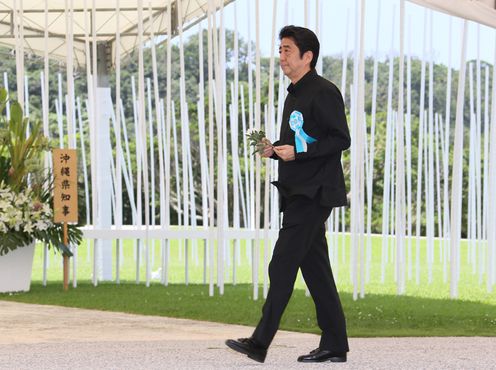
Sunday, June 29, 2014

AM

12:00 At private residence (no visitors)
09:16 Deputy Chief Cabinet Secretary for Crisis Management Nishimura Yasuhiko and Director of NSC Yachi Shotaro enter Mr. Abe’s private residence in Tomigaya, Tokyo
09:59 Mr. Nishimura and Mr. Yachi leave

PM
Stay at private residence throughout the afternoon, no visitors
06:05 Depart from private residence
06:29 Arrive at Mitsubishi Kaitokaku, former residence of Iwasaki Koyata of Mitsubishi Corporation, in Takanawa, Tokyo. Dinner meeting with Deputy Prime Minister and Minister of Finance Aso Taro and Keio University emeritus professor Iwasaki Koko
08:38 Depart from Mitsubishi Kaitokaku
09:02 Arrive at private residence