Showing posts with label Keidanren. Show all posts

Wednesday, April 21, 2021

Japan’s Looming Climate Showdown

Tokyo Has a Chance to Break Its Coal Addiction—and Spark a Regional Energy Revolution

By Richard Katz,  Senior Fellow at the Carnegie Council for Ethics in International Affairs and is writing a book on reviving entrepreneurship in Japan. He is an APP member.

Foreign Affairs, April 21, 2021

In October of last year, Japanese Prime Minister Yoshihide Suga announced that Japan was shifting course. The country—which in 2020 came in a miserable 45th out of 61 countries in addressing climate change—would now commit itself to achieving net-zero greenhouse gas emissions by 2050, a goal the country had once hoped to achieve sometime between 2050 and 2100.

That Tokyo’s record on climate change has been so dismal might surprise observers who associate Japan with technological innovation. But almost a third of the country’s electricity derives from coal—the single largest contributor to anthropogenic climate change. Worse yet, Japan is currently constructing 15 new coal-fired plants and is planning another seven, all to be finished within the next five years. Its carbon tax is a mere $3 per ton of carbon dioxide, compared with $33 in France and $126 in Sweden.

That makes Suga’s new stance a significant reversal for Japan. To reach the country’s new benchmark, the prime minister has pledged to “fundamentally shift” Japan’s policy on coal-powered electricity, initiate a study on the feasibility of carbon pricing, and phase out gasoline-fueled vehicles by 2035. “[Responding] to global warming is no longer a constraint on economic growth,” he explained.

Strong and rapid measures will not only decrease Japan’s own emissions but might also help induce other countries in the region to take similar steps. Just days after Suga’s speech, South Korea, the world’s ninth-largest emitter, committed to net zero by 2050. Activists in Australia, a major coal exporter, have called on Canberra to match Tokyo’s shift. Whether or not Japan delivers on its lofty promises, however, will depend on the policy battles now raging in Tokyo.

STOP AND GO

Japan’s feeble response to climate change has its roots in a national trauma. In 2010, carbon-free nuclear energy supplied a third of the country’s electricity. That number was supposed to increase to 40 percent by 2017 and 53 percent by 2030. With an additional 20 percent to be derived from renewables such as solar, wind, and hydroelectric, Japan was on track to cut overall emissions by 30 percent from 1990 levels.

Then came March 11, 2011. A horrific tsunami ripped through Fukushima prefecture, killing 20,000 people and causing a meltdown at the Fukushima Daiichi nuclear plant that narrowly missed spewing radiation on millions. Had the utility company TEPCO simply followed global best practices and its own engineer’s recommendations, the meltdown would never have occurred. Worse yet, TEPCO had falsified safety data while government regulators turned a blind eye. The disaster destroyed nuclear energy’s credibility. All of Japan’s 54 nuclear reactors were shut down, and public opposition has thus far prevented most from reopening. In response, Japan turned to coal.

Today, however, a combination of what the Japanese call gai-atsu (foreign pressure) and nai-atsu (domestic pressure) is shifting Tokyo’s response to climate change. Joe Biden’s election as U.S. president also bolstered those in Japan who were already urging robust action. During their April 16 summit in Washington, Biden and Suga announced a new Climate Partnership, which includes measures to help other countries decarbonize.

Meanwhile, global companies have begun to include the practices of their suppliers in their net-zero commitments, and Japan’s leading corporations are feeling the heat. Apple, for example, will stop buying from suppliers that do not use 100 percent renewable electricity by 2030. Some Japanese producers have European facilities that could meet this goal, but those located inside Japan cannot. Only 19 percent of the country’s electricity comes from renewables, and the government’s current goal for 2030, set in 2018, is for that number to rise to between just 22 and 24 percent. The CEOs of Sony and three other major Japanese companies warned Administrative Reform Minister Taro Kono that failure to reach at least 40 percent renewable electricity by 2030 could compel many Japanese firms to shift some production offshore.  

At the same time, extreme floods and disastrous heat waves over the last several years have visited the direct effects of climate change on Japanese citizens and companies. An astonishing 90 percent of voters supported Suga’s October declaration to reach net zero by 2050. In 2018, several leading companies—including heavy hitters such as Sony, Nissan, SoftBank, and Mitsubishi Estate—created a new alliance called the Japan Climate Initiative (JCI). The group was designed to pressure Tokyo into meeting the decarbonization goals set in the Paris climate accord, and today it has almost 400 corporate members. This January, 92 member companies urged the government to expand renewable electricity generation to between 40 and 50 percent of overall production by 2030 as part of the Strategic Energy Plan to be released in June. Keizai Doyukai, a separate federation of executives from 1,000 leading corporations, urged similar action last summer.

Climate-minded politicians are also rising through the ranks of the country’s perennially dominant Liberal Democratic Party (LDP). This includes Suga and two potential future prime ministers, Kono and Environment Minister Shinjiro Koizumi, both of whom support aggressive action on climate change. According to a source close to Suga, the prime minister was frustrated by the slow pace of decarbonization under his predecessor, Shinzo Abe. Suga believed that Abe was too reliant on advice from the Ministry of Economy, Trade, and Industry (METI), which—according to the same person—was “not aggressive about carbon neutrality because the business world was reluctant to make a big change.”

Kono, for his part, told the JCI in November 2020 that he planned to remove regulatory obstacles to renewable electricity production—an important step toward Suga’s 2050 goal. Japan’s regional utility companies, for instance, can currently give their own power plants priority access to transmission lines. Kono has cited cases in which the utilities blocked new companies from transmitting wind-generated electricity, even on unused lines. Similarly, land use laws prevent abandoned farmland from being used for nonagricultural purposes, such as solar and wind farms.

With a combination of these regulatory shifts, current technology, and an upgraded grid, the country could generate between 40 and 45 percent of its electricity from renewable sources by 2030, according to Mika Ohbayashi, a member of the JCI secretariat and a director of Japan’s Renewable Energy Institute. Net zero by 2050, however, will require what she called “revolutionary technologies.”

BUMPS IN THE ROAD

Although Japanese efforts to decarbonize are gathering strength, there is still strong resistance. In a “Green Growth Strategy” document published on December 25, for instance, METI included hybrid gas-electric vehicles as part of Japan’s plan to eliminate gasoline-powered transportation by 2035, contradicting Suga’s talk of fully electric cars. And in April, a METI advisory committee proposed that coal should supply 26 percent of Japan’s electricity in 2030, the same goal set in 2018. If accepted, the target would defy Suga’s promise to “fundamentally shift” the country’s coal policy.

Similar opposition to change also exists in parts of the corporate world. The Toyota chieftain Akio Toyoda railed against Suga’s talk of ending sales of gasoline cars by the mid-2030s, inaccurately asserting that “the more electric vehicles we build, the worse carbon dioxide gets.” Separately, Keidanren, Japan’s most powerful business federation, has endorsed net zero by 2050 but opposes many of the measures needed to reach that goal. The federation insists that coal is necessary until reliable battery storage and hydrogen fuel become commercially feasible. “Energy security means Japan must have diverse sources of energy, including coal, at least in the short term,” said Masami Hasegawa, a Keidanren director.

Keidanren also prefers the current lax emission enforcement system, where industry associations voluntarily create goals for their member companies and the government reviews the results. Although Keidanren points to progress in reducing emissions, at the current pace, Japan will not even come close to net zero by 2050. Keidanren also opposes a carbon tax, which Hasegawa contends “would deprive companies of the funds needed to develop indispensable revolutionary technologies like hydrogen fuel and CCS [carbon capture and storage].” It will take at least two or three decades, however, before hydrogen and CCS become commercially competitive.

In reality, carbon pricing would have a dramatic effect even with current technology. Steelmaking, for example, is responsible for about ten percent of Japan’s total carbon emissions—mainly because 80 percent of the country’s crude steel output is still made in carbon-intensive coal-fired blast furnaces, compared with 33 percent in the United States. A carbon tax would make steel from blast furnaces uncompetitive in the marketplace, forcing companies to switch to cleaner alternatives.

An important factor in the outcome of this dispute is Suga’s waning political capital. His mishandling of the COVID-19 pandemic and poor communication skills have tanked his popularity. In September, he will have finished filling Abe’s term as the LDP president and must run for reelection on his own. Suga’s vulnerability could weaken his leverage over resistant bureaucrats. If he falls, the pace of progress will depend on the LPD’s choice of a successor. Polls currently show that the public overwhelmingly prefers Kono, who is strongly committed to fighting climate change.

SEA CHANGE

Despite the opposition to change among some leading companies, others have already altered important practices. Until last spring, Japan’s three megabanks—Mizuho, Sumitomo Mitsui, and Bank of Tokyo-Mitsubishi UFJ—provided a third of all global financing for new coal-fired power plants. Last spring, they decided to stop underwriting new projects (although some loopholes remain). Several giant trading companies have also stopped investing in coal mines, and JCI member Toshiba announced that it will not build new coal-fired plants.

These actions are a good start. But Tokyo’s long-term goal of net-zero emissions by 2050 will be unreachable unless the government commits to sufficiently ambitious short-term objectives in its forthcoming Strategic Energy Plan, which sets targets for 2030. To succeed, Japan will need a much larger cut in emissions than the current and fiercely criticized target of 26 percent from 2013 levels. The Environment Ministry is advocating for a 45 percent reduction, while METI is pushing for a more modest 35 percent. Washington, for its part, is reportedly urging 50 percent.

Turning any eventual target into reality, however, will require a dramatic increase in the renewable electricity supply (potentially between 40 and 50 percent), along with Suga’s pledge to phase out gasoline vehicles. Japan, moreover, would need to immediately stop building new coal-fired plants and phase out all existing facilities by the 2030s. The government will also need to take advantage of market forces by adopting a more demanding carbon price or tax.

Tokyo’s ability to deliver on these measures will have a vital impact on global efforts to address climate change. Some argue that Japan’s actions make only a marginal difference since the country produces just three percent of global carbon emissions. That number, however, makes Japan the world’s fifth-largest emitter—behind only China, the United States, India, and Russia. And unless each nation does its share, addressing climate change will be an impossible task. If Japan stops shirking its responsibility, its behavior might pressure others to follow suit—accelerating global action on decarbonization and hastening the adoption of climate friendly technologies. The next signal will be the specifics that Suga announces, or fails to announce, at Biden’s April 22–23 climate summit. The world awaits Tokyo’s decision.

Thursday, February 9, 2017

Who Spends Time with Abe?

Who are the frequent visitors to the Prime Minister's Office

By 北川開Nikkei Shimbun Reporter

Originally published in Japanese in Nikkei Shimbun (1/29/2017)
[面会多い相手は?安倍首相の4年間、データで解剖  ]
Provisional translation by APP interns for scholarly exchange.

How does Prime Minister Shinzo Abe spend the day as the head of the government? A look at the prime minister’s tightly scheduled meetings throughout the day will give us a picture of where the administration’s priorities lie, as well as Abe’s relationship with people surrounding him. Using data accumulated for the Nikkei Shimbun’s column “Prime Minister’s Office [Shusho Kantei]” that appears daily in the paper’s Politics section, we have done an analysis of Prime Minister Abe’s four years since his return to the premiership.

“Abe’s most frequent visitor” in the past four years has been the cabinet’s top intelligence official, Director of Cabinet Intelligence Shigeru Kitamura. Kitamura reports to Abe on confidential matters ranging from diplomacy and security to elections that the cabinet intelligence and research office compiles. Kitamura is often seen visiting Abe multiple times a day. Occasionally, he carries necessary information to the PM at his vacation home in Yamanashi Prefecture. Kitamura had worked under the first Abe administration as an executive secretary to the prime minister and supported Abe through that challenging period.

At the Center is “2A+S”

A reporter, who is assigned to cover the prime minister’s daily activities, waits at the door to the Prime Minister’s Office [Kantei] and ask everyone who goes through the door whether he/she met with Abe. Kitamura always tells the reporter “yes” but nothing else.

The second most frequent visitor has been the former vice-minister for foreign affairs Akitaka Saiki. Abe has known Saiki well ever since he served as an English-language interpreter for Abe’s father Shintaro Abe when the senior Abe was foreign minister. Saiki, the foreign ministry’s top administrative official, frequently visited the Kantei to keep Abe abreast of events and receive instructions. In this way, the Abe administration emphasizes Abe’s direct control of the foreign ministry. Abe’s weight in negotiations with foreign counterparts has been increasing, and Japanese diplomats, more than ever, cannot take actions without Abe’s instructions.

The third was Secretary General of the National Security Secretariat Shotaro Yachi. He served under the first Abe administration as a foreign vice-minister and is described as Abe’s brain in diplomacy. In the U.S., Russian, and Chinese governments the organization that reports direct to the head of the state wields influence. One example is the U.S. National Security Council. Yachi has acted as the counterpart to these organizations, and has arranged Abe’s summit diplomacy from behind the scenes.

Meetings between Abe, Kitamura, Yachi, and senior officials from the foreign and defense ministries are held regularly, generally twice a month. The highest-ranking uniformed officer of the SDF, Joint Chief of Staff Katsutoshi Kawano has also been a member of that group. The meetings provide a framework for discussing matters significant to the country’s security policy.

Among politicians, Chief Cabinet Secretary Yoshihide Suga has been the fourth most frequent visitor, followed by Deputy Prime Minister and Finance Minister Taro Aso. Suga is often in attendance when Abe meets with important visitors. Aso comes with senior officials from the finance ministry for reporting, then usually stays behind to talk with the prime minister alone. While the ministry officials are there, the meeting revolves around the government’s financial policy. During their private conversation, Abe and Aso likely discuss and exchange opinions about political decision making.

Abe, Aso, Suga and the former Minister of Economic Revitalization, Economic and Fiscal Policy Akira Amari, the so-called 3A+S, were the core of the Abe administration. Since Amari resigned the ministerial post in 2016 as a result of a political-fund scandal, the “2A+S” has been in charge of running the administration.

The sixth most frequent visitor, Minister of Economy, Trade and Industry Hiroshige Seko (former deputy chief cabinet secretary, Upper House) and the eighth, Minister in Charge of Empowerment of All Citizens Katsunobu Kato (former deputy chief cabinet secretary, Lower House) had been regulars at the prime minister’s office during their terms as deputy CCS. On mornings of the day Abe is scheduled to go to the Diet, both houses’ deputy CCSs participate, without fail, in a Diet preparation session for the prime minister.

Unknowable Inner Meetings inside Kantei

News reporters in charge of the prime minister must remain near the entrance to the Kantei when talking to people and are not allowed to go inside rooms. Therefore, if a person who works inside the Kantei meets and talks with the prime minister, that meeting may not appear in the “Prime Minister’s Office.” According to a high-ranking government official, a meeting is held every day between the prime minister, the chief cabinet secretary, deputy chief cabinet secretary, and executive secretary to the prime minister in charge of policies. By meeting every day, the core members of the administration at the Kantei confirm basic policy directions and avoid inconsistent remarks. Even without a particular agenda, just meeting with each other regularly gives a sense of unity.

Abe’s office is on the same floor as Suga’s, increasing the chances they meet much more often than what is reported.

Among agencies, senior officials from the ministry of foreign affairs, the ministry of finance, the ministry of defense, the ministry of economy, trade and industry, and the cabinet office have been the ones frequenting the Kantei. As for annual visits by officials above the level of director-general of each ministry, the number of visits by senior officials of the foreign and defense ministries greatly increased in 2016 compared with the previous three years.

The Ministry of Foreign Affairs had the highest number by far of visits to the prime minister’s office, due to the many significant diplomatic exchanges that occurred in 2016, including the Ise-Shima G7 Summit in May and the Japan-Russia summit meetings.

If we only look at the Administration’s fourth year, the defense ministry’s Director General for Defense Policy Satoshi Maeda was the fifth most frequent visitor. It reflects the weight the administration placed on managing the threats posed by an escalation of North Korean nuclear missile development and Chinese maritime advancement in the South and the East China Seas.

Meetings held with finance ministry officials have been slightly fewer than in past administrations, according to a source close to the prime minister. Although METI officials did not come to the Kantei as much, Takaya Imai, an executive secretary to the prime minister (policy) and a former METI bureaucrat, has likely been acting as a bridge between Abe and the ministry and helped Abe exert his influence. Meanwhile, the cabinet office is taking the initiative in the policy of the dynamic engagement of all citizens and work-style reform to increase its leadership presence.

Discuss Policy Over Noodles

Lunch and dinner meetings are good for developing friendly relationships. Besides the Kantei visitors, the Nikkei Shimbun looked into the prime minister’s favorite restaurants and dinner partners.

The most frequently used restaurant has been “ORIGAMI”, a restaurant in the Capitol Hotel Tokyu. So far during the second Abe administration, the prime minister has dined at the restaurant a total of 40 times. A majority of his dining partners have been people close to Abe such as executive secretaries and Chief Cabinet Secretary Suga. It seems he uses ORIGAMI when he wants to have a casual dinner meeting.

The prime minister’s favorite choice from the menu is pork rib ramen noodles, priced at 2,730 yen including tax. Last December, former Osaka mayor Toru Hashimoto, currently a legal and policy advisor to the Nippon Ishin no Kai, joined Abe for a steak lunch. The hotel has many exits for vehicles, making it easy for a guest to leave without being seen by the press.

Traditional Japanese-style restaurants [ryotei] have generally been chosen for meetings with business leaders. One of the venues is Arisugawa Shimizu, a Japanese restaurant in Minamiazabu, where members of Sakurakai, a high-powered business group, frequently gather. Yoshiyuki Kasai, the chairman emeritus of JR Tokai, and Shigetaka Furumori, the chairman and CEO of Fujifilm Holdings, belong to Sakurakai. The group has been a loyal supporter of Abe since before his first premiership.

Fukudaya, a Japanese restaurant in Kioicho, is where the prime minister regularly meets with Takashi Imai and Hiroshi Okuda, the chairmen emeritus of Keidanren.

When meeting with people from the entertainment industry, the prime minister often chooses more fashionable venues. He and actor Masahiko Tsugawa are friends who celebrate each other’s birthdays. They eat together with other people from the industry at Italian restaurants and the like. Abe is said to enjoy hearing stories from a community with which he has less frequent contact.

Dinner with Tsugawa often can last for hours. On Jan. 5, they talked for as long as three hours and 25 minutes. The prime minister’s dinner meetings generally end within a couple of hours. But when Abe is with close friends and family, the gathering tends to last much longer.

Weekend’s Activities

Before his return to the premiership, Abe has determined to accomplish three things every month--conduct an overseas visit, visit affected areas of the Great East Japan Earthquake and play golf.

Keeping the pace of almost once a month, Abe has conducted totally 50 times overseas visits under the banner of “diplomacy that takes a panoramic perspective of the world map”. As many as 66 countries and regions has been visited. He takes full advantage of the Golden week and summer during the Diet recess.

Weekends are often used for visits to the affected areas of the Great East Japan Earthquake. Abe has visited 31 times in total so far, once in every 48 days after his return to premiership. If the visits to affected areas of Kumamoto Earthquake and typhoons are included, the number adds up to 42 times in total, which means he has visited once in every 36 days. He has mostly achieved his own goal to visit the disaster affected areas “once in a month”.

Concerning his hobby golf, Abe plays it several days in a row during vacations and so far has played 56 times. Though his score of Golf has not been revealed as a state secret, a person who played with him said it was “91”. Chairman of Japan Business Federation (Keidanren), Sadayuki Sakakibara, who often plays with Abe, is said to be better at golf than him. The prime minister has two favorite golf courses, one located in Chiba prefecture and the other in Kanagawa prefecture, and three favorite courses in Yamanashi prefecture, where Abe has his villa.

Abe goes to have hair cut almost once in a month. The prime minister’s favorite beauty salon is “HAIR GUEST” (Tokyo, Shibuya). Originally, “Barber Shop MURAGI” was his favorite, but it is said that he started to commute to “HAIR GUEST” thanks to his wife Akie’s recommendation. Though he had a stylist part his hair on the side at “Barber Shop MURAGI”, he asks a stylist at “HAIR GUEST” to make fluffy hair style.

Spending Year-end and New Year’s holidays at Grand Hyatt Tokyo in Roppongi with his relatives is a standard routine every year. Abe is a regular customer of “Nagomi Spa and Fitness”, and has been there 67 times since his second term. Therefore it is understood that he does his health management there once in 22 days.

Abe never fails to ensure health check. He gets a full medical check in Spring and Autumn every year, and sees a dentist almost once in a month. Mostly he goes to the dentist in the first Congressman Hall of the House of Representatives during the intervals between weekday official duties.

Abe cherishes his friendship with old friends. He frequently participates in the gathering of Keisei Gakuen, which he commuted to from elementary school to university. He frequently meets with friends he made during his study in the U.S. after graduation from university. He tends to relax during mealtime with his family and friends, and sometimes greets reporters, who are assigned to cover the prime minister’s daily activities, by saying “Otsukaresama”.

Beyond the Right to Know

Regarding media coverage of the prime minister’s daily activities such as meeting opponents, Tokyo Governor Yuriko Koike has pointed out “it’s beyond the public’s right to know” when she was a Member of the House of Representatives. The U.S. media don’t seem to have detailed schedules of the President Trump. Also, President Xi Jinping is doing what or where right now is confidential information in China. Reporting the prime minister’s movement with high transparency is significant for monitoring power. We would like to continue to keep track of the prime minister.

Sunday, June 26, 2016

Prime Minister of Japan’s Schedule July 13- July 19, 2015

Monday, July 13, 2015 

AM

08:00 At private residence in Tomigaya (no morning visitors)
09:10 Depart private residence
09:25 Arrive at office
10:00 Meet with Chinese Ambassador to Japan, Cheng Yonghua and Vice-Minister of Foreign Affairs, Saiki Akitaka
10:30 End meeting with Mr. Cheng and Mr. Akitaka
11:08 Depart office
11:10 Arrive at Lower House 1st Diet Members’ Meeting Hall, receive dental treatment at dentist’s office
11:28 Depart Lower House
11:30 Arrive at office
11:39 Meet with President of Lions Club International Association, Yamada Mihiro and former Minister of Transport, Fujii Takao

PM
00:03 End meeting with Mr. Yamada and Mr. Fujii
00:48 Depart office
00:55 Arrive at Hotel Okura in Toranomon, Tokyo. Attend and deliver address at 30th National Meeting of the Japan Private Kindergarten PTA Association in banquet hall Heian
01:23 Depart hotel
01:26 Arrive at office
03:05 Meet with Assistant Chief Cabinet Secretary, Takamizawa Nobushige
03:29 End meeting with Mr. Takamizawa
03:30 Meet with Special Advisor to the Prime Minister, Eto Seiichi
04:11 End meeting with Mr. Eto
04:57 Depart office
04:58 Arrive at National Diet
05:00 Head towards LDP’s President’s Office
05:01 LDP’s Officers Meeting
05:14 Meeting ends
05:15 Meet with LDP members: Vice-President, Komura Masahiko, Secretary-General, Tanigaki Sadakazu and Executive Acting Secretary-General, Hosoda Hiroyuki and Chairman of LDP Election Strategy, Motegi Toshimitsu.
05:43 Depart room
05:45 Depart National Diet
05:46 Arrive at office
06:07 Depart office
07:21 Arrive at Federation of Economic Organizations in Otemachi, Tokyo. Attend, deliver address and take commemorative photos at The Sixth Asian Business Summit Reception  
07:44 Depart reception
07:57 Arrive at Japanese restaurant, ‘Kouetsu’ in Akasaka, Tokyo. Dinner meeting with former Lower House Speaker, Ibuki Bunmei. Chief Cabinet Secretary, Suga Yoshihide and Deputy Chief Cabinet Secretary, Kato Katsunobu also attend
08:40 Depart from restaurant
08:45 Arrive at LDP headquarters, appear on LDP internet program Café Sta
09:22 Depart headquarters
09:41 Arrive at private residence

Tuesday, July 14, 2015

AM

07:51 Depart from private residence
08:02 Arrive at office
08:13 The eighth meeting of the Headquarters for Promoting Decentralization Reform  
08:18 Meeting ends
08:23 Cabinet meeting starts
08:35 Cabinet meeting ends
08:36 Meet with Deputy Prime Minister and Minister of Finance, Aso Taro
09:20 End meeting with Mr. Aso
09:52 Meet Chairman of the Indonesian Chamber of Commerce, Mr. Suryo Bambang Sulisto and Indonesian Ambassador to Japan, Yusron Ihza Mahendra
10:24 End meeting with Mr. Suryo and Yusron
10:53 Meet with Secretary-General of Headquarters for Abduction Issue, Ishikawa Shoichiro
11:20 End meeting with Mr. Ishikawa
11:21 Meet with Director of National Security Council, Yachi Shotaro and Vice-Minister for Foreign Affairs, Saiki Akitaka
11:48 End meeting with Mr. Yachi and Mr. Saiki

PM
02:35 Director of National Security Council, Mr. Yachi, Director of Cabinet Intelligence, Mr. Kitamura, Head of LDP Yamanashi Chapter, Shimizu Takenori and Director of Cabinet Satellite Intelligence, Shimohira Koji enters
02:48 Mr. Yachi and Mr. Shimohira leave
03:09 Mr. Kimura leaves
03:19 Meet with Vice-Minister for Foreign Affairs, Saiki Akitaka
03:48 End meeting with Mr. Saiki
04:20 Meet with Special Advisor to President of LDP, Hagiuda Koichi
04:46 End meeting with Mr. Hagiuda
05:00 Meet with Minister of State for Economic and Fiscal Policy, Amari Akira and Cabinet Office members: Vice-Minister, Matsuyama Kenji, Director-Generals for Policies on Cohesive Society, Maekawa Mamoru, Habuka Shigeki and Tawa Hiroshi
05:26 End meeting with Mr. Amari, Mr. Matsuyama, Mr. Maekawa, Mr. Habuka and Mr. Tawa
05:32 Courtesy Call from the Consortium for the Promotion of the Modern Industrial Heritage in Kyushu and Yamaguchi to Inscription on the World Heritage
05:44 Courtesy call ends
05:45 Meet with Chairperson of LDP Policy Research Council, Inada Tomomi
06:18 End meeting with Ms. Inada Tomomi
06:24 Depart office
06:47 Arrive at private residence

Wednesday, July 15, 2015
AM

07:30 Depart private residence in Tomigaya, Tokyo
07:41 Arrive at office
07:45 Meet with Deputy Chief Cabinet Secretary, Kato Katsunobu
08:11 End meeting with Mr. Kato
08:53 Depart office
08:54 Arrive at National Diet
08:56 Head towards Lower House Committee Room No. 1
09:00 Meeting of the Special Committee of the House of Representatives on the Legislation for Peace and Security of Japan and the International Community

PM
00:10 Leave seat during proceedings
00:12 Depart National Diet
00:13 Arrive at office
00:18 Meet with Chief Cabinet Secretary, Suga Yoshihide
00:26 End meeting with Mr. Suga
06:37 Interview to all media: when asked ‘Has the Security bills been approved by the Lower House Members of the Diet?’ Mr. Abe answers, ‘I would like to proceed in explaining this to our citizens including the discussion in the National Diet in an easy-to-understand manner.’
06:38 Depart office
06:44 Arrive at soba restaurant, ’Sampei’ in Akasaka, Tokyo. Dinner meeting with Yomiuri Newspaper group board member and Top Advisor, Oikawa Shouichi, and an artist of Western painting, Kinutani Kouji
08:36 Depart restaurant
08:56 Arrive at private residence

Thursday, July 16, 2015

AM
08:00 At private residence in Tomigaya ( no morning visitors)
09:28 Depart private residence
09:47 Arrive at office
10:40 Courtesy Call from the Deputy Chairman of the Cabinet of Ministers of Turkmenistan
10:53 Courtesy call ends
10:57 Meet with Deputy Prime Minister and Minister of Finance, Aso Taro, Ministry of Finance members, Vice-Minister, Tanaka Kazuho, Deputy Vice-Minister, Fukuda Junichi and Director-General of Tax Bureau, Sato Shinichi
11:34 Mr. Tanaka, Mr. Fukuda and Mr. Sato leave
11:41 Mr. Aso leaves
11:45 Filming video message for industrial group 
11:51 Finish filming

PM
00:47 Depart office
00:49 Arrive at National Diet
00:50 Head towards Lower House Waiting Room No. 14
00:51 Meeting of LDP Diet Members
00:57 Meeting ends
00:58 Depart room
00:59 Head towards Lower House Plenary Meeting Hall
01:02 Lower House Plenary Session opens
02:06 Meeting adjourns
02:07 Depart the hall
02:09 Depart National Diet
02:11 Arrive at office
02:12 Interview open to all media: when asked ‘the security bills that have been approved by the lower house of the Diet,’ Mr Abe answers, ‘for our national citizens to have a greater understanding, our whole party will be mobilized and will continue to work hard’.
02:14 Interview ends
02:30 Meeting with Special Advisor to the Prime Minister, Eto Seiichi
03:41 End meeting with Mr. Eto
03:45 Meet with Administrative Vice-Minister of Defense, Mr. Nishi Masanori and Ministry of Defense, Director-General of Bureau of Local Cooperation, Nakajima Akihiko
03:56 End meeting with Mr. Nishi and Mr. Nakajima
04:19 Meeting of the Council on Economic and Fiscal Policy
05:13 Meeting ends
05:14 Meet with Minister of Internal Affairs and Communications, Takaichi Sanae
05:27 End meeting with Mr. Takaichi
06:46 Depart office
06:55 Arrive at Japanese restaurant, ‘Tsuyama’ in Akasaka, Tokyo. Dinner meeting with former Prime Minister, Mori Yoshiro, LDP’s Executive Acting Secretary-General, Hosoda Hiroyuki and Secretary-General for LDP in Upper House, Date Chuichi.
08:41 Depart restaurant
09:13 Arrive at private residence

Friday, July 17, 2015

AM
08:00 At private residence in Tomigaya, Tokyo (no morning visitors)
08:42 Depart private residence
08:56 Arrive at office
09:03 Cabinet meeting starts
09:08 Cabinet meeting ends
09:14 The meeting of Global Warming Prevention Headquarters
09:22 Meeting ends
09:25 Speak with Minister of Land, Infrastructure and Transportation, Mr. Ohta Akihiro
09:35 End speaking with Mr. Ohta
09:36 Meet with Minister of State for Economic and Fiscal Policy, Amari Akira, Cabinet members, Vice-Minister, Matsuyama Kenji and Director-Generals for Policies on Cohesive Society, Habuka Shigeki and Tawa Hiroshi
09:56 End meeting with Mr. Amari, Mr. Matsuyama and Mr. Tawa
10:02 Vice-Minister for Foreign Affairs, Saiki Akitaka enters
10:52 MOFA’s Director-General of Middle Eastern and African Affairs Bureau, Uemura Tsukasa, Director-General of International Legal Affairs Bureau, Akiba Takeo and Director-General of Intelligence and Analysis Service Oka Hiroshi join
11:18 Mr. Uemura and Mr. Oka leave
11:30 Mr. Saiki and Mr. Akiba leave

PM
00:01 Meet with LDP Secretary-General, Tanigaki Sadakazu
00:40 End meeting with Mr. Tanigaki
01:55 Formal Prime Minister, Mori Yoshiro enters
02:00 Vice-Minister for Foreign Affairs, Saiki Akitaka, Minister of Education, Culture, Sports, Science and Technology, Shimomura Hakubun and Minister in charge of Tokyo Olympic and Paralympics, Endo Toshiaki join
03:37 All members leave
03:38 Interview open to all media: when asked ‘What kind of decision has been reached for the new National Stadium plans?’ Mr. Abe answers, “I have decided that we will cancel the current plan for the New National Stadium that is to be the venue for the Tokyo Olympic and Paralympic Games, and create a new plan from scratch.”
03:42 Interview ends
04:08 Meet with Director of Cabinet Intelligence, Kitamura Shigeru
04:35 End meeting with Mr. Kitamura
05:00 Speak with MOFA’s Director-General of Asian and Oceanian Affairs Bureau, Ihara Junichi and Director-General of International Legal Affairs Bureau, Akiba Takeo
05:10 End speaking with Mr. Ihara and Mr. Akiba
05:30 Reception and commemorative photo with Prime Minister of Luxembourg, Xavier Bettel. Japan-Luxembourg Summit Meeting and Other Events
05.31Pay courtesy to honor guards
05:37 Honor guards ceremony ends
05:39 Summit conference with Prime Minister Bettel
06:23 Conference ends
06:28 Joint press release
06:40 Press release ends
06:41 Depart office
06:42 Arrive at official residence. Dinner meeting hosted by Prime Minister Abe
07:55 To see off Prime Minister Bettel 
07:56 See-off ends
08:17 Meet with Special Advisor to the Prime Minister, Eto Seiichi
10:01 End meeting with Mr. Eto

Saturday, July 18, 2015

AM

08:00 At official residence (no morning visitors)
Stay at private residence throughout the morning

PM
02:13 Depart official residence
02:33 Arrive at wedding venue ‘Shimomegurogajoen’ in Shimomeguro, Tokyo. Attend LDP’s Upper House member, Ejima Kiyoshi’s eldest daughter’s wedding reception banquet
05:23 Depart wedding ceremony
05:54 Arrive at private residence in Tomigaya, Tokyo

Sunday, July 19, 2015

AM

10:00 At private residence (no morning visitors)
Stay at private residence throughout the morning

PM
04:13 Depart private residence
04:22 Arrive at ‘Hair Guest’ hairdressers in Shibuya, Tokyo, receive haircut
05:57 Depart from hairdressers
06:12 Arrive at private residence

Provisional translation by Kelly Ing

Saturday, February 20, 2016

Prime Minister of Japan’s Schedule June 15-21, 2015

Monday, June 15, 2015

AM
08:00 At private residence in Tomigaya, Tokyo (no morning visitors)
09:44 Depart from private residence
09:58 Arrive at office
11:16 Accept an interview with the monthly magazine WiLL
11:51 Interview ends
11:52 Meet with Minister of State for Science and Technology Policy Yamaguchi Shunichi and Cabinet Office Director-General for Policies on Cohesive Society Morimoto Koichi
11:58 End meeting with Mr. Yamaguchi and Mr. Morimoto

PM
02:19 Accept an interview with a Hong Kong–based television broadcaster Phoenix Television
02:37 Interview ends
02:38 Meet with the President of Phoenix Television Liu Chang-le
02:51 End meeting with Mr. Liu
04:06 Meet with Minister of State for Regulatory Reform Arimura Haruko and Cabinet Office Director-General for Policies on Cohesive Society Habuka Shigeki
04:28 End meeting with Mr. Arimura and Mr. Habuka
04:32 Receive a courtesy call from members of the Wise-men Group on the Japan-Brazil Strategic Economic Partnership
04:43 Courtesy call ends
04:58 Depart from office
04:59 Arrive at the Diet
05:00 Enter LDP President’s Office
05:01 LDP Officers Meeting
05:22 Meeting ends
05:35 Leave LDP President’s Office
05:36 Depart from the Diet
05:38 Arrive at office
05:43 Meeting of the Ministerial Council on the Monthly Economic Report and Other Relative Issues
05:56 Meeting ends
05:57 Speak with Minister of State for Economic and Fiscal Policy Amari Akira
05:58 Finish speaking with Mr. Amari
06:01 Meet with Chairperson of LDP Policy Research Council Inada Tomomi
06:19 End meeting with Ms. Inada
06:22 Receive a request to the Government on the return of the Northern Territories from Governor of Hokkaido Harumi Takahashi and others
06:32 Finish receiving the request
06:35 Depart from office
06:42 Arrive at Imperial Hotel in Uchisaiwai-Cho, Tokyo. Dinner meeting with Chairman of Japan Association of Corporate Executives Kobayashi Yoshimitsu, Vice-Chairman of Japan Association of Corporate Executives Ninami Takeshi and others
08:35 Depart from the hotel
08:51 Arrive at private residence

Tuesday, June 16, 2015

AM
12:00 At private residence (no visitors)
08:00 At private residence in Tomigaya, Tokyo (no morning visitors)
08:02 Depart from private residence
08:14 Arrive at office
08:29 Meet with Deputy Chief Cabinet Secretary Seko Hiroshige
09:05 End meeting with Mr. Seko
09:07 The fourth meeting of the National Resilience Promotion Headquarters
09:17 Meeting ends
09:24 Cabinet meeting
09:35 Meeting ends
09:36 Speak with Minister of Health, Labour and Welfare Shiozaki Yasuhisa
09:39 Finish speaking with Mr. Shiozaki
09:53 Depart from office
09:55 Arrive at the Diet
09:56 Enter Upper House Committee Room No. 21
10:00 Meeting of the Committee on Economy and Industry of the Upper House
11:58 Meeting adjourns. Leave Upper House Committee Room No. 21

PM
12:00 Depart from the Diet
12:01 Arrive at the office
12:02 Interview open to all media: when asked “the response to the eruption of Mount Asama,” Mr. Abe answers, “The government is strengthening safety measures and gathering relevant information. I hope to achieve perfection of safe measures.”
12:53 Depart from office
12:55 Arrive at the Diet
12:56 Enter Lower House Chamber
12:57 Speak with Chairman of LDP Election Strategy Committee Motegi Toshimitsu
12:59 Finish speaking with Mr. Motegi
01:00 Speak with LDP Executive Acting Secretary-General Hosoda Hiroyuki
01:01 Finish speaking with Mr. Hosoda
01:02 Lower House Plenary Session
01:21 Leave in the middle of Lower House Plenary Session
01:23 Depart from the Diet
01:24 Arrive at the office
01:30 Meet with Minister for Reconstruction Takeshita Wataru and Vice-Minister of Reconstruction Agency Okamoto Masakatsu
01:48 End meeting with Mr. Takeshita and Mr. Okamoto
02:44 Receive a courtesy call from a delegation led by Governor of the State of Hawaii David Ige. Chairman of Japan-Hawaii Parliamentarians’ Union, LDP Lower House member Kawamura Takeo also attends
03:09 Receive proposals from the Special Committee on Fiscal Rehabilitation of the Policy Research Council of the Liberal Democratic Party (LDP); the Regulatory Reform Committee of the Headquarters for Japan's Economic Revitalization; and the Committee for Realizing a Positive Economic Cycle of the Headquarters for Japan's Economic Revitalization
03:43 Finish receiving proposals
03:50 Minister of State for Economic and Fiscal Policy Amari Akira, Vice-Minister of Cabinet Office Matsuyama Kenji, and Cabinet Office Director-General for Policies on Cohesive Society Maekawa Mamoru enter
04:07 Mr. Matsuyama and Mr. Maekawa leave
04:18 Mr. Amari leaves
04:19 Meet with Minister in charge of Administrative Reform Arimura Haruko and Secretary-General of Headquarters for Promotion of Administrative Reform Takimoto Sumio
04:33 End meeting with Ms. Arimura and Mr. Takimoto
04:34 Meet with Chairman of General Assembly of LDP Members in House of Councillors Mizote Kensei
05:04 End meeting with Mr. Mizote
05:05 Meet with Vice-Minister for Foreign Affairs Saiki Akitaka
05:16 End meeting with Mr. Saiki
05:17 The 47th meeting of the Regulatory Reform Council
05:31 Meeting ends
05:37 Director of National Security Council (NSC) Yachi Shotaro and Director of Cabinet Intelligence Kitamura Shigeru enter
05:45 Mr. Yachi leaves
06:00 Mr. Kitamura leaves
06:01 Meet with Director of National Security Council (NSC) Yachi Shotaro, Director of Cabinet Intelligence Kitamura Shigeru, Ministry of Defense (MOD)’s Director-General of Bureau of Defense Policy Kuroe Tetsuro, and Chief of Staff for Joint Staff Council Kawano Katsutoshi
06:27 End meeting with Mr. Yachi, Mr. Kitamura, Mr. Kuroe, and Mr. Kawano
06:30 Depart from the office
06:31 Arrive at the official residence

Wednesday, June 17, 2015

AM
08:00 At the official residence (no morning visitors)
09:08 Depart from official residence
09:09 Arrive at the office
09:50 Depart from the office
09:55 Arrive at the Tokyo Metropolitan Hibiya Public Hall in Hibiya Park, Tokyo. Attend a Regular General Meeting of the National Association of Chairpersons of City Councils, deliver an address
10:13 Depart from the public hall
10:17 Arrive at the office
10:23 Meet with Meet with Deputy Chief Cabinet Secretary Seko Hiroshige
10:36 End meeting with Mr. Seko

PM
02:52 Depart from the office
02:54 Arrive at the Diet
02:56 Enter Upper House Committee Room No. 1
03:00 Party Leaders’ Debate
03:49 Party Leaders’ Debate ends
03:51 Leave Upper House Committee Room No. 1
03:53 Depart from the Diet
03:54 Arrive at the office
04:10 Meet with Minister of Land, Infrastructure, Transport and Tourism Ohta Akihiro
04:32 End meeting with Mr. Ohta
04:45 Receive a courtesy call from Deputy Managing Director r of International Monetary Fund (IMF) Furusawa Mitsuhiro
04:59 Courtesy call ends
05:00 Meet with Minister of State for Special Missions Yamaguchi Shunichi and Secretary-General of Intellectual Property Strategy Headquarters Yokoo Hidehiro
05:15 End meeting with Mr. Yamaguchi and Mr. Yokoo
05:23 The first meeting in FY2015 of the Forum for Consultations between the National and Regional Governments
05:32 Meeting ends
05:59 Reception for Prime Minister of the Republic of Croatia Zoran Milanovic. Commemorative photo session
06:00 Commemorative photo session ends
06:01 A ceremony by the guard of honor
06:07 Ceremony ends
06:08 Japan-Croatia summit meeting with Prime Minister Zoran Milanovic
06:51 Summit meeting ends
06:53 Joint press announcement
07:04 Joint press announcement ends
07:05 Depart from office
07:06 Arrive at the official residence. Reception hosted by Prime Minister Abe
08:25 Send-off for Prime Minister Zoran Milanovic
08:26 Send-off ends

Thursday, June 18, 2015

AM
12:00 At official residence (no visitors)
07:09 Depart from official residence
07:10 Arrive at the office
07:11 Meet with Deputy Chief Cabinet Secretary Kato Katsunobu
08:15 End meeting with Mr. Kato
08:48 Depart from office
08:50 Arrive at the Diet
08:52 Enter Lower House Committee Room No.1
08:53 Speak with Deputy Prime Minister and Minister of Finance Aso Taro
08:55 Finish speaking with Mr. Aso
08:56 Meeting of the Budget Committee of the Lower House

PM
12:02 Meeting adjourns
12:03 Leave Lower House Committee Room No.1
12:05 Depart from the Diet
12:06 Arrive at the office
12:53 Depart from the office
12:55 Arrive at the Diet
12:57 Enter Lower House Committee Room No.1
01:00 Meeting of the Budget Committee of the Lower House reopens
05:04 Meeting of the Budget Committee of the Lower House adjourns
05:05 Leave Lower House Committee Room No.1
05:07 Depart from the Diet
05:08 Arrive at the office
05:13 The 1st meeting of Service Productivity & Innovation for Growth
05:46 Meeting ends
05:48 The 17th meeting of the Administrative Reform Promotion Council
05:59 Meeting ends
06:06 The 10th meeting of the Council for Science, Technology, and Innovation
06:29 Meeting ends
06:30 Depart from the office
06:35 Arrive at the official residence of the Lower House Speaker in Nagata-Cho, Tokyo. Informal discussion with Lower House Speaker Oshima Tadamori, Lower House Vice-Speaker Kawabata Tatsuo, Chairman of LDP General Council Nikai Toshihiro, Chairperson of LDP Policy Research Council Inada Tomomi, and other LDP cadres
08:16 Depart from the official residence of the Lower House Speaker
08:33 Arrive at the private residence in Tomigaya, Tokyo

Friday, June 19, 2015

AM
12:00 At the private residence (no visitors)
07:46 Depart from private residence
07:59 Arrive at the office
08:08 Meeting of the Intellectual Property Strategy Headquarters
08:16 Meeting ends
08:20 Cabinet meeting
08:39 Cabinet meeting end
08:40 Speak with Minister of Justice Kamikawa Yoko
08:43 End speaking with Ms. Kamikawa
08:44 Meet with Deputy Chief Cabinet Secretary Kato Katsunobu
09:10 End meeting with Mr. Kato
09:24 Depart from the office
09:25 Arrive at the Diet
09:26 Enter Lower House Committee Room No.16
09:30 Meeting of the Committee on Health, Labour, and Welfare of the Lower House
10:33 Leave in the middle of the meeting
10:35 Depart from the Diet
10:36 Arrive at the office
10:37 Meet with former Minister for Internal Affairs and Communications Masuda Hiroya
10:52 End meeting with Mr. Masuda
10:57 Meet with former Prime Minister Mori Yoshiro, Secretary-General of Japan-Korea Parliamentarians’ Union Kawamura Takeo
11:35 End meeting with Mr. Mori and Mr. Kawamura

PM
12:01 Meet with LDP Secretary-General Tanigaki Sadakazu. Chief Cabinet Secretary Suga Yoshihide also attends
12:34 End meeting with Mr. Tanigaki
12:48 Meet with MOFA’s Director-General of North American Affairs Bureau Tomita Koji and Ministry of Defense (MOD)’s Director-General of Bureau of Defense Policy Kuroe Tetsuro
01:08 End meeting with Mr. Tomita and Mr. Kuroe
01:29 Depart from the office
01:30 Arrive at the Diet
01:31 Enter the Lower House Chamber. Attend the Lower House Plenary Session
01:33 Speak with Minister in charge of Overcoming Population Decline and Vitalizing Local Economy in Japan Ishiba Shigeru
01:36 Finish speaking with Mr. Ishiba
01:37 Speak with LDP Executive Acting Secretary-General Hosoda Hiroyuki
01:38 Finish speaking with Mr. Hosoda
01:43 Low House Plenary Session ends
01:44 Leave Lower House Chamber
01:45 Depart from the Diet
01:47 Arrive at the office
01:48 Meet with Minister in charge of Economic Revitalization Amari Akira and Acting Director of Bureau of Headquarters for Japan’s Economic Revitalization Sugawara Ikuro
02:08 End meeting with Mr. Amari and Mr. Sugawara
02:09 Meet with Director of Cabinet Intelligence Kitamura Shigeru
02:33 End meeting with Mr. Kitamura
02:42 Depart from the office
02:55 Arrive at the Federation of Economic Organizations [Keidanren] Assembly Hall in Otemachi, Tokyo. Attend the Annual Meeting of the National Association of Shinkin Banks, deliver an address
03:20 Depart from the Hall
03:35 Arrive at the office
03:51 Meet with Deputy Prime Minister and Minister of Finance Aso Taro, Ministry of Finance (MOF)’s Deputy Vice-Minister Fukuda Junichi, and MOF’s Director-General of Budget Bureau Tanaka Kazuho, and MOF’s Director-General of Tax Bureau Sato Shinichi
04:23 Minister of State for Economic and Fiscal Policy Amari Akira, Vice-Minister of Cabinet Office Matsuyama Kenji, and Cabinet Office Director-General for Policies on Cohesive Society Maekawa Mamoru, Cabinet Office Director-General for Policies on Cohesive Society Habuka Shigeki, and Cabinet Office Director-General for Policies on Cohesive Society Tawa Hiroshi enter
04:35 Mr. Matsyama, Mr. Maekawa, Mr. Habuka, and Mr. Tawa leave
04:44 Mr. Amari leaves
04:45 Meet with Vice-Minister for Foreign Affairs Saiki Akitaka
04:54 End meeting with Mr. Saiki
04:55 Meet with President of Japan-Korea Parliamentarians’ Union Nukaga Fukushiro
05:18 End meeting with Mr. Nukaga
05:26 Receive a courtesy call from participants of the High-Level Seminar on Peacebuilding, National Reconciliation and Democratization in Asia [3 minutes]
Tomorrow’s seminar is the first ever attempt to gather government representatives, members of international organizations, intellectuals, and members of NGOs who have been involved in the areas of peacebuilding, national reconciliation and democratization in Asian countries. I would like to conclude my address and expression of gratitude to you by stating my hope that this seminar will provide a means for all of you to have a meaningful exchange of opinions, and be an opportunity to communicate your collective wisdom to the international community as we work to build even greater peace and prosperity in Asia.
05:53 Courtesy call ends
05:54 Meet with the Founder and Executive Chairman of World Economic Forum Klaus Schwab and the Professor of Keio University Takenaka Heizō
06:03 End meeting with Mr. Schwab and Mr. Takenaka
06:33 Reception for President of the Republic of Niger Issoufou Mahamadou, commemorative photo session
06:34 Ceremony by the guard of honor
06:41 Ceremony ends
06:43 Japan-Niger Summit Meeting with President Issoufou
07:22 Summit meeting ends
07:24 Signing ceremony. Joint press announcement
07:44 Joint press announcement ends
07:45 Depart from the office
07:46 Arrive at the official residence. Reception dinner hosted by Prime Minster
08:44 Send off for President Issoufou
08:45 Send-off ends

Wednesday, February 17, 2016

Prime Minister of Japan’s Schedule June 8-14, 2015

Monday, June 8, 2015

AM

(Local time in German)
Hold talks with Prime Minister of the United Kingdom David Cameron in Schloss Elmau
Attend the G7 Summit, discuss energy, climate change, and counter-terrorism issues with outreach guests.

PM
Attend a commemorative photo session with outreach guests
Working lunch with outreach guests on the theme of development, women, health and Africa
Hold a press conference in the city of Munich

Tuesday, June 9, 2015AM
(In transit)

PM
04:47 Arrive at Haneda Airport from Germany on personal government aircraft with wife Akie, completing attendance of the G7 Summit
05:04 Depart from airport
05:26 Arrive at Imperial Palace. Register return to Japan
05:33 Depart from Imperial Palace
05:47 Arrive at private residence in Tomigaya, Tokyo

Wednesday, June 10, 2015

AM

12:00 At private residence (no visitors)
08:00 At private residence in Tomigaya, Tokyo (no morning visitors)
09:41 Depart from private residence
09:55 Arrive at Hotel New Otani in Kioi-Cho, Tokyo. Attend the 85th General Meeting of the Japan Association of City Mayors in the banquet hall Tsuru within the hotel, deliver address
10:17 Depart from hotel
10:22 Arrive at office
10:36 Meet with Minister of State for Economic and Fiscal Policy Amari Akira, Vice-Minister of Cabinet Office Matsuyama Kenji, and Cabinet Office Director-Generals for Policies on Cohesive Society Maekawa Mamoru, Habuka Shigeki, and Tawa Hiroshi
10:58 End meeting with Mr. Amari, Mr. Matsuyama, Mr. Maekawa, Mr. Habuka, and Mr. Tawa
10:59 Meet with wife Junko of former Lower House Speaker, the late Machimura Nobutaka
11:14 End meeting with Ms. Machimura Junko

PM
12:13 Meet with LDP Secretary-General Tanigaki Sadakazu
12:47 End meeting with Mr. Tanigaki
01:15 Meet with Ministry of Defense (MOD)’s Administrative Vice-Minister Nishi Masanori and Director-General of Bureau of Personnel and Education Manabe Ro
02:08 End meeting with Mr. Nishi and Mr. Manabe
02:26 Meet with Secretary-General of Headquarters for Abduction Issue Ishikawa Shoichiro
03:01 End meeting with Mr. Ishikawa
03:04 Meet with Vice-Minister for Foreign Affairs Saiki Akitaka
04:14 End meeting with Mr. Saiki
04:25 Director of National Security Council (NSC) Yachi Shotaro, Director of Cabinet Intelligence Kitamura Shigeru, and MOD’s Director of Defense Intelligence Headquarters (DIH) Miyagawa Tadashi enter
04:33 Mr. Yachi and Mr. Miyagawa leave
04:40 Mr. Kitamura leaves
05:17 Council on Economic and Fiscal Policy meeting
06:20 Council meeting ends
06:21 Speak with Minister of Internal Affairs and Communications Takaichi Sanae
06:31 Finish speaking with Ms. Takaichi
06:33 Depart from office
06:40 Arrive at Chinese restaurant Akasaka Hanten in Akasaka, Tokyo. Dinner meeting with Chairman of Yamaguchi Prefectural Assembly Hatahara Motonari and colleagues
07:52 Depart from restaurant
08:09 Arrive at private residence

Thursday, June 11, 2015

AM

08:00 At private residence in Tomigaya, Tokyo (no morning visitors)
09:30 Depart from private residence
09:47 Arrive at office
10:10 Meet with LDP Lower House member Kawai Katsuyuki
10:25 End meeting with Mr. Kawai
10:50 Meet with Cabinet Office’s Vice-Minister for Policy Coordination Inoue Motomi
11:00 End meeting with Mr. Inoue
11:19 Meet with State Minister of Economy, Trade and Industry Takagi Yosuke
11:39 End meeting with Mr. Takagi
11:49 Receive a courtesy call from the Hokota Brand Ambassadors and others from Hokota City, Ibaraki Prefecture. LDP Lower House member Nukaga Fukushiro also attends
11:55 Courtesy call ends
11:56 Meet with the Governor of Yamaguchi Prefecture Tsugumasa Muraoka and President of Yamaguchi Prefectural Assembly Hatahara Motonari

PM
12:10 End meeting with Mr. Tsugumasa and Mr. Hatahara
01:39 Meet with Minister in charge of Economic Revitalization Amari Akira and Acting Director of Bureau of Headquarters for Japan’s Economic Revitalization Sugawara Ikuro
02:07 End meeting with Mr. Amari and Mr. Sugawara
02:09 Receive a courtesy call from the Governor of Mie Prefecture Eikei Suzuki. Chief Cabinet Secretary Suga Yoshihide
02:22 Courtesy call ends
02:24 Meet with Chairman of Japan War-Bereaved Families Association [Nippon Izokukai], LDP Upper House member Mizuochi Toshiei
02:39 Meet with Director of National Security Council (NSC) Yachi Shotaro, Director of Cabinet Intelligence Kitamura Shigeru, MOFA’s Director-General of Foreign Policy Bureau Hiramatsu Kenji, Ministry of Defense (MOD)’s Director-General of Bureau of Defense Policy Kuroe Tetsuro
02:49 End meeting with Mr. Yachi, Mr. Kitamura, Mr. Hiramatsu, and Mr. Kuroe
02:53 Meet with Special Advisor to the Prime Minister Kimura Taro
02:59 Meet with Minister in charge of Overcoming Population Decline and Vitalizing Local Economy in Japan Ishiba Shigeru, Special Advisor to Minister of State for Special Missions Ito Tatsuya
03:32 End meeting with Mr. Ishiba and Mr. Ito
03:33 Meet with Minister in charge of Total Reform of Social Security and Tax Amari Akira. Deputy Chief Cabinet Secretary Kato Katsunobu also attends
04:02 End meeting with Mr. Amari
04:03 Vice-Minister for Internal Affairs and Communications Oishi Toshio, Ministry of Economy, Trade and Industry‘s Administrative Vice-Minister Ishiguro Norihiko, Ministry of Foreign Affairs (MOFA)’s Director-General of Middle Eastern and African Affairs Bureau Uemura Tsukasa. Deputy Chief Cabinet Secretary Seko Hiroshige also attends
04:18 The 21st meeting of the Industrial Competitiveness Council
05:11 Meeting ends
05:13 Meet with Deputy Prime Minister and Minister of Finance Aso Taro
05:35 End meeting with Mr. Aso
05:36 National Security Council meeting
06:09 Meeting ends
06:17 Depart from office
06:25 Arrive at Palace Hotel Tokyo. Attend the gathering organized by Prime Minister supporters’ group Shinsei-kai that is formed by psychiatrists, exchange views with participants. Special Advisor to President of LDP Hagiuda Koichi also attends
06:55 Depart from the hotel
07:09 Arrive at Japanese restaurant Fukudaya. Dinner meeting with financiers including three Honorary Chairmen of Keidanren Imai Takashi, Okuda Hiroshi, Mitarai Fujio, and President of Japan Post Holdings Co. Nishimuro Taizo
08:41 Depart from hotel
08:55 Arrive at private residence

Friday, June 12, 2015

AM

12:00 At private residence (no visitors)
07:51 Depart from private residence in Tomigaya, Tokyo
08:03 Arrive at office
08:11 The 37th meeting of the Nuclear Emergency Response Headquarters
08:24 Meeting ends
08:26 Cabinet meeting
08:38 Meeting ends
08:39 Speak with Minster in charge of Abduction Issue Yamatani Eriko
08:40 Speak with Minister of Education, Culture, Sports, Science and Technology Shimomura Hakubun
08:42 End speaking with Mr. Shimomura
08:48 Meet with Deputy Chief Cabinet Secretary Kato Katsunobu
09:15 End meeting with Mr. Kato
09:53 Depart from office
09:55 Arrive at the Diet
09:56 Enter Lower House Committee Room No. 16
10:12 Meeting of the Committee on Health, Labor, and Welfare of the Lower House begins

PM
12:01 Meeting of the Committee on Health, Labor, and Welfare of the Lower House adjourns, leave Lower House Committee Room No.16
12:03 Depart the Diet
12:04 Arrive at the office
12:06 LDP Research Commission on Regional Diplomatic and Economic Partnership Chairman Komura Masahiko, Chairman of LDP Headquarters for Regional Diplomatic and Economic Partnership Eto Seishiro, and Director of LDP Foreign Affairs Division Akiba Kenya
12:19 End meeting with Mr. Komura, Mr. Eto, and Mr. Akiba
01:39 Meet with Minister in charge of TPP Amari Akira, Chief Domestic Coordinator of Governmental Headquarters for TPP Sasaki Toyonari, Chief Negotiator of Government Headquarters for the TPP Tsuruoka Koji, Deputy Chief Negotiator of Government Headquarters for TPP Oe Hiroshi and others
02:10 End meeting with Mr. Amari, Mr. Sasaki, Mr. Tsuruoka, and Mr. Oe
02:11 Meet with Minister of State for Economic and Fiscal Policy Amari Akira, Vice-Minister of Cabinet Office Matsuyama Kenji, Cabinet Office’s Director-General for Policies on Cohesive Society Tawa Hiroshi
02:18 End meeting with Mr. Amari, Mr. Matsuyama, and Mr. Tawa
02:25 Receive a courtesy call from Admiral Harry B. Harris, Jr. Commander of the U.S. Pacific Command
02:46 Courtesy call ends
02:47 Receive a courtesy call from President of Center for American Progress Neera Tanden
03:20 Courtesy call ends
03:23 Meet with Governor of Fukushima Prefecture Uchibori Masao. Former Minister for Reconstruction Nemoto Takumi also attends
03:37 End meeting with Mr. Uchibori
03:38 Vice-Minister for Foreign Affairs Saiki Akitaka, Ministry of Foreign Affairs (MOFA)’s Special Envoy for Peace in the Middle East Kohno Masaharu, Former Commissioner of Agency for Cultural Affairs Kondo Seiichi enter
03:51 Mr. Kohno and Mr. Kondo leave
04:07 Mr. Saiki leaves
04:08 Meet with Director of Cabinet Intelligence Kitamura Shigeru
04:36 End meeting with Mr. Kitamura
05:02 The sixth meeting of the Council on Overcoming Population Decline and Vitalizing Local Economy in Japan
05:05 Meeting ends
05:51 Deliver an address for the inauguration of Japanese Ambassador to Sri Lanka and Maldives Suganuma Kenichi and other ambassadors
05:56 Finish the address
05:57 Depart from office
06:03 Arrive at Izakaya Fukunohana- Tameike-Sanno in Akasaka, Tokyo. Informal talks with Head of Yamaguchi Prefecture’s Representative Office in Tokyo Murata Dai and others
06:43 Depart from the Izakaya
06:58 Arrive at Japanese restaurant Ginza Syotoh in Ginza, Tokyo. Dinner with wife Akie
09:11 Depart from office
09:34 Arrive at private residence

Saturday, June 13, 2015

AM

08:00 At private residence in Tomigaya, Tokyo (no morning visitors)
08:27 Depart from private residence
08:55 Arrive at Haneda Airport
09:09 Depart from the airport by Japan Air Self-Defense Force (JASDF)’s U4 plane
10:48 Arrive at Kagoshima Airport
11:17 Depart from the airport by JASDF’s C1 Transport

PM
12:03 Arrive at Yakushima Airport
12:09 Depart from the airport
12:26 Arrive at a welfare facility in Yakushima Town. Encourage the residents who had evacuated there
12:35 Depart from the facility
12:41 Depart from the Miyanoura branch of the Yakushima Town Hall. Hear an explanation on the state of damage and state of evacuation, and then exchange views with Governor of Kagoshima Prefecture Ito Yuichiro and Mayor of Yakushima Town Araki Koji
01:08 Finish exchanging views
01:09 Encourage the members of the Yakushima Town Disaster Headquarters
01:12 Finish encouraging the members
01:13 Lunch with Governor of Kagoshima Prefecture Ito Yuichiro and Mayor of Yakushima Town Araki Koji
01:22 Lunch ends
01:28 Arrive at the Miyanoura Community Hall, now an evacuation center
01:30 Exchange views with residents who had evacuated there
01:38 Finish exchanging views
01:40 Encourage the primary school and middle school students who had evacuated there. Commemorative Photo session
01:44 Commemorative Photo session ends
01:49 Interview open to all media: when asked “how will the government handle the situation of the residents from Kuchinoerabu island and other places in the future,” Mr. Abe answers, “Based on observations of the situation, the government will accelerate the preparation for the temporary visits and the building of temporary residences and will strive to restore the damaged reputation.”
01:54 Interview ends
01:58 Depart from the community hall
02:15 Arrive at the Yakushima Airport
02:26 Depart from the airport by JASDF’s C1 Transport
02:49 Arrive at Kagoshima Airport
03:09 Depart from the airport by Japan Air Self-Defense Force (JASDF)’s U4 plane
04:29 Arrive at Haneda Airport
04:40 Depart from the airport
05:01 Arrive at official residence

Sunday, June 14, 2015

AM

11:00 At official residence (no morning visitors)
Stay at official residence throughout morning

PM
02:40 Depart from official residence
02:49 Arrive at hotel Grand Hyatt Tokyo in Roppongi, Tokyo. Do exercise in the gym NAGOMI Spa and Fitness within the hotel
05:44 Depart from hotel
05:55 Arrive at the skyscraper complex project Toranomon Hills in Toranomon, Tokyo. Dinner meeting with Japan Innovation Party’s Supreme Adviser Hashimoto Toru and Japan Innovation Party’s Adviser Matsui Ichiro in the hotel Andaz Tokyo
09:00 Depart from hotel
09:18 Arrive at private residence in Tomigaya, Tokyo


Provisional Translation by Lu Pengqiao

Wednesday, November 4, 2015

Prime Minister of Japan’s Schedule May 4-10, 2015

Monday, May 4, 2015

AM
12:00 At holiday home (no visitors)
07:08 Depart from holiday home in Narusawa Village, Yamanashi Prefecture
07:12 Arrive at golf course Fujizakura Country Club in Fujikawaguchiko Town, Yamanashi Prefecture. Golf with relatives, friends, and secretary

PM
03:26 Depart from golf course
03:29 Arrive at holiday home
05:30 Barbecue with wife Akie, mother Kishi Yoko, Cabinet Advisor Honda Etsuro, and secretaries


Tuesday, May 5, 2015

AM
12:00 At holiday home (no visitors)
07:50 Depart from holiday home in Narusawa Village, Yamanashi Prefecture
07:55 Arrive at Narusawa Golf Club in Narusawa Village. Golf with wife Akie, President of Rickie Business Solution Shibuya Koichi, and secretaries

PM
04:07 Depart from Narusawa Golf Club
04:13 Arrive at holiday home
06:20 Depart from holiday home
06:30 Arrive at yakiniku restaurant Tetsuan in Fujikawaguchiko Town, Yamanashi Prefecture. Dinner with wife Akie and relatives
08:20 Depart from restaurant
08:28 Arrive at holiday home

Wednesday, May 6, 2015

AM
12:00 At holiday home (no visitors)
07:24 Depart from holiday home in Narusawa Village, Yamanashi Prefecture
07:47 Arrive at Fuji Golf Course in Yamanakako Village, Yamanashi Prefecture. Golf with Honorary Chairman of Federation of Economic Organizations (Keidanren) Mitarai Fujio, Chairman of Keidanren Sakakibara Sadayuki, and Honorary Executive Consultant of JX Holdings Watari Fumiaki

PM
02:41 Depart from golf course
04:12 Arrive at private residence in Tomigaya, Tokyo

Thursday, May 7, 2015

AM
12:00 At private residence (no visitors)
08:00 At private residence in Tomigaya, Tokyo (no morning visitors)
09:30 Depart from private residence
09:45 Arrive at Imperial Palace. Register return to Japan
09:54 Depart from Imperial Palace
10:04 Arrive at office
10:23 Speak with Ministry of Defense (MOD)’s Director-General of Bureau of Operational Policy Miyama Nobuaki, Chief of Staff for Joint Staff Council Kawano Katsutoshi, and Commander of Escort Flotilla 4, Japan Maritime Self-Defense Force (JMSDF) Ito Hiroshi
10:37 Finish speaking with Mr. Miyama, Mr. Kawano, and Commander Ito
10:43 Meet with Minister of State for Science and Technology Policy Yamaguchi Shunichi and President of Science Council of Japan Onishi Takashi
11:02 End meeting with Mr. Yamaguchi and Mr. Onishi
11:03 Speak with Chairman of INPEX Corporation Kuroda Naoki
11:11 Finish speaking with Mr. Kuroda
11:21 Speak with Commissioner General of the National Police Agency Kanetaka Masahito
11:31 Finish speaking with Mr. Kanetaka
11:33 Speak with Director of Cabinet Intelligence Kitamura Shigeru
11:46 Finish speaking with Mr. Kitamura

PM
12:02 Meet with LDP Secretary-General Tanigaki Sadakazu
12:46 End meeting with Mr. Tanigaki
01:45 Meet with LDP Upper House member Moriya Hiroshi and others
02:02 End meeting with Mr. Moriya and others
02:03 Meet with Director of NSC Yachi Shotaro and MOD’s Director-General of Bureau of Defense Policy Kuroe Tetsuro
02:52 End meeting with Mr. Yachi and Mr. Kuroe
02:53 Meet with Vice-Minister for Foreign Affairs Saiki Akitaka
03:31 End meeting with Mr. Saiki
03:32 Meet with Minister for Reconstruction Takeshita Wataru and Reconstruction Agency’s Director-General for Reconstruction Policy Okamoto Masakatsu
03:53 End meeting with Mr. Takeshita and Mr. Okamoto
04:03 Receive a courtesy call from former Prime Minister of Papua New Guinea Michael Somare and his wife. Wife Akie also attends
04:34 Coutesy call ends
04:46 Meet with new Justice of the Supreme Court of Japan Koike Hiroshi and former Justice of the Supreme Court of Japan Kanetsuki Seishi
05:05 End meeting with Mr. Koike and Mr. Kanetsuki
05:08 Meet with Mr. Kitamura
05:32 End meeting with Mr. Kitamura
05:37 Meet with Minister of Internal Affairs and Communications Takaichi Sanae
06:00 End meeting with Ms. Takaichi
06:01 Meet with Minister for Foreign Affairs Kishida Fumio and MOFA’s Director-General of Latin American and Caribbean Affairs Bureau Takase Yasushi
06:49 Depart from office
06:50 Arrive at official residence

Friday, May 8, 2015

AM
12:00 At official residence (no visitors)
08:00 At official residence (no morning visitors)
08:06 Depart from official residence
08:07 Arrive at office
08:11 Headquarters for Promotion of Privatization of Postal Services meeting
08:17 Meeting ends
08:23 Cabinet Meeting begins
08:34 Cabinet Meeting ends
08:41 Meet with Deputy Prime Minister and Minister of Finance Aso Taro
09:06 End meeting with Mr. Aso
09:07 Meet with Secretary-General of Japan-Korea Parliamentarians’ Union Kawamura Takeo
09:33 End meeting with Mr. Kawamura
09:35 Speak with Special Advisor to the Prime Minister Kimura Taro
09:42 Finish speaking with Mr. Kimura
10:02 Depart from office
10:11 Arrive at Imperial Palace
10:30 Spring Presentation of Grand Cordon Ceremony
10:52 Depart from Imperial Palace
11:02 Arrive at office
11:21 Meet with Minister in charge of Abduction Issue Yamatani Eriko
11:47 End meeting with Ms. Yamatani

PM
01:11 Depart from office
01:18 Arrive at Imperial Palace. Spring Conferring of Order Ranks Ceremony
01:53 Depart from Imperial Palace
02:04 Arrive at office
03:15 Speak with President of Hisamitsu Pharmaceutical Company Nakatomi Hirotaka
03:25 Finish speaking with Mr. Nakatomi
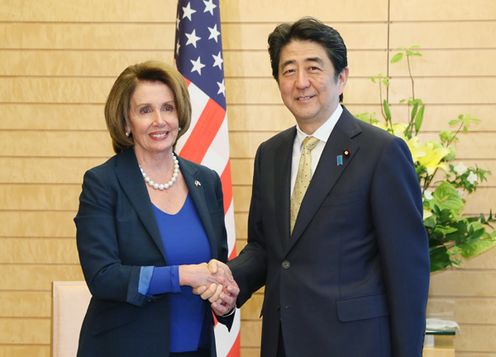
03:31 Receive a courtesy call from Democratic Leader of the United States House of Representatives Nancy Pelosi (D – CA)
04:19 Courtesy call ends
06:21 Depart from office
06:38 Arrive at private residence in Tomigaya, Tokyo

Saturday, May 9, 2015

AM
12:00 At private residence (no visitors)
08:00 At private residence in Tomigaya, Tokyo (no morning visitors)
Stay at private residence throughout morning

PM
12:17 Depart from private residence
12:36 Arrive at Palace Hotel Tokyo in Marunouchi, Tokyo. Attend Pacific Vision 21 Tokyo Meeting at French restaurant Crown within hotel, deliver address
01:51 Depart from hotel
02:03 Arrive at hotel Grand Hyatt Tokyo in Roppongi, Tokyo. Exercise at NAGOMI Spa and Fitness within hotel
03:44 Depart from hotel
04:07 Arrive at private residence

Sunday, May 10, 2015

AM
12:00 At private residence (no visitors)
10:00 At private residence in Tomigaya, Tokyo (no morning visitors)
Stay at private residence throughout morning

PM
Stay at private residence throughout afternoon and evening

Provisional Translation by: Erin M. Jones and Lu Pengqiao

Friday, September 25, 2015

Japanese University Humanities and Social Sciences Programs Under Attack


click to order
Some suspect that the real targets of announced government reform are university departments that nurture appreciation for liberal democratic values


By Jeff Kingston is Director of Asian Studies, Temple University Japan and author of Asian Nationalisms Since 1945 (Wiley 2016), editor of Asian Nationalism Reconsidered (Routledge 2015) and Press Freedom in Japan (Routledge 2016). He is an Asia-Pacific Journal Contributing Editor and APP member.

>First appeared in the The Asia-Pacific Journal, Vol. 13, Issue. 39, No. 1, September 28, 2015

On June 8 the Ministry of Education, Culture, Sports, Science and Technology (MEXT) sent a ten-page directive to all 86 national universities in Japan, apparently calling on them, inter alia, to abolish or reorganize their humanities and social sciences (HSS) departments.1 I use the word “apparently” because the wording of the letter is ambiguous. A former Ministry of Education official’s Facebook posting in September is quoted by the European Association of Japanese Studies asserting that the directive has been misinterpreted.2 Be it as it may, the Yomiuri reports that 26 of 60 public universities operating HSS departments have agreed to stop accepting students into these programs or reduce relevant electives. Nevertheless, how far reaching this compliance will be remains unclear. What is clear is that prominent national universities, including the elite University of Tokyo and Kyoto University, are not shutting down HSS, demonstrating that powerful institutions with access to sufficient funding and no shortage of applicants are not beholden to MEXT.

Various organizations in Japan have also issued statements critical of MEXT’s initiative, including Keidanren, the big business lobby, so if indeed there is a misunderstanding about MEXT’s intentions, it is fairly widespread. This directive has also incited a chorus of criticism in the international press, including The Wall Street Journal, Forbes, Times Higher Education, Time, Bloomberg, and Japan Times, prompting a petition campaign among European scholars keen to protect HSS. Overseas researchers are alarmed that this hollowing out of higher education will adversely affect their research in Japan and stifle intellectual inquiry about subjects the rest of the world still highly esteems and deems essential for a well-rounded education. Numerous postings on NBR, an Internet discussion forum on Japan, have also criticized both the directive and the quality of education provided by Japan’s universities.

Japanese government officials are concerned that Japans universities don’t come out well in international rankings and apparently believe that focusing on STEM (Science, Technology, Engineering and Math) is the fastest way to catapult more universities into the top 100 world rankings. There are good reasons to doubt whether these world rankings are in fact a reliable and objective measure of education, learning outcomes and research output, especially given the bias in favor of Anglophone institutions, but Japanese officialdom’s obsession with such rankings renders them a powerful pretext for reforms. Can Japan really launch more of its universities into the top 100 world rankings by gutting the study of subjects that constitute the core of what universities embody?

The QS World University Rankings for 2015/16 rank five Japanese universities in the top 100: Kyoto University (38), University of Tokyo (39), Tokyo Institute of Technology (56), Osaka University (58) and Tohoku University (74).3 This relatively poor showing—with tiny Singapore boasting two universities in the top 15, while China and Hong Kong each have four in the top 100 and South Korea has three—has been a longstanding sore point , sparking national hand wringing and an action plan. PM Abe has targeted getting 10 Japanese universities into the world’s top 100 by 2025. However, he has been better at setting unrealistically ambitious targets on a range of issues—i.e., 30% female managers by 2020—than actually doing what is necessary to achieve them. The new emphasis on natural sciences overlooks the fact that most top universities around the world maintain vibrant HSS departments so it’s not clear that favoring STEM at the expense of HSS is an inspired or pragmatic strategy.

There is a risk that rather than improving Japan’s mediocre universities, the MEXT foray will make them the global punch-line for jokes about educational reform. It is hard to imagine that scrapping the study of humanities and social sciences at Japan’s national universities will bring any tangible benefits, while the downside could well be staggering. This anti-intellectual salvo from Prime Minister Abe’s government fits into a larger pattern of dumbing down education, whitewashing textbooks, promoting patriotic education and stifling dissent.

But not everyone agrees with the alarmist interpretation of the MEXT letter. I contacted several national university professors and experts on higher education in Japan and elicited a range of responses. Some Japanese professors declined to comment while others said that it is hard to predict the outcome of the reform proposals because it is not clear what MEXT intends or how universities will respond. Education ‘big bangs’ in the past have fizzled over time, so it will take time to assess the actual consequences.

Following numerous denunciations of the June directive from across the domestic spectrum, Education Minister Shimomura Hakubun explained at a news conference in late July, “We do not mean to treat the studies of humanities lightly. We also do not put special priority just on fields of practical sciences that immediately become useful in society.” 4 But, this rhetorical concession has not altered the reality of looming budget cuts that will force significant changes and a lingering anxiety that HSS remains in the crosshairs of Abe’s educational reforms for political reasons.

Minister of Education Shimomura Hakubun
In 2015 the government also tabled legislation that will concentrate all decision-making power in university presidents’ hands while downgrading the role of faculty councils, a major shift from the current situation that is consistent with what Keidanren, a big business federation, has lobbied for.5 Currently the faculty is in charge of hiring new faculty and appointing department heads, but that power would shift to the president, who also stands to gain greater control of discretionary funding in the form of MEXT block grants. This reform is aimed at weakening the power of professors and making it easier to impose reforms from above that they have been resisting.

Structural Impetus for Reform
How bad are the budget cuts? Between 2001 and 2009, basic subsidies for national universities dropped nearly one third, while support for basic expenditures out of total allocations dropped from 86% in FY 2001 to 71% in 2009, marking a shift to competitive resource allocation that favors universities that meet MEXT performance criteria.6 In 2014 the OECD found that Japan’s public expenditures on higher education amounted to 0.5% of GDP, lowest in the OECD, compared to an average of 1.1% among member nations.7

The reforms are also driven by private university lobbying and grim prospects for enrollments and government finances. Currently about 40% of the nation’s private universities are not meeting their quotas for enrollments as the pool of high school graduates is shrinking. In addition, only half of Japan’s high school graduates enter universities (excluding junior colleges), well below the OECD average of 62% and far below Australia where more than 90% do so and South Korea where the university enrollment rate for high school graduates is 82%.

So with a shrinking population and a low enrollment rate, some of Japan’s numerous universities are facing dire times. The number of 18 years olds has plunged from 2 million in 1990 to 1.5 million in 2000 and 1.2 million in 2010, a demographic time bomb that is hitting many lower ranked universities hard, intensifying stiff competition among the best universities for the best candidates. Private universities complain that they enroll nearly 80% of freshmen undergraduates while national universities get nearly 80% of government funding for education. This disparity is the source of vigorous lobbying by private universities to spread the funding more equitably and to downsize national universities, a pitch that plays well with a conservative government eager to cut budgets and rely more on the private sector. In addition, given demographic trends there is an oversupply of universities in Japan with 86 national universities, 90 universities run by prefectures or municipalities, and 606 private institutions, so consolidation is inevitable. And, so is intensified marketing aimed at convincing students of the merits of particular programs with increasing emphasis on where a degree will lead.

Stifling Dissent
Reforming Japan’s universities may indeed require bold initiatives, and everything I have read, and everyone I contacted, suggests that much is amiss in these institutions. Indeed, the international reputation of Japanese higher education is dismal, mirroring domestic perceptions that university is a four-year hiatus, often dubbed “leisure land”. Such disparaging assessments are the kindling of reformist impulses, but many of those I contacted see this as an attack on the academy and academic freedom in the guise of reform. Indeed, stifling dissent under the pretext of reform is a longstanding concern as politicization “of Japan's youth is a source of uneasiness for the government. The government fears that those who receive a university education will become supporters of opposition political parties. This fear is not without basis.” (Kitamura and Cummings 1972)

Red Army Protestors in 1960s
Those sentiments expressed in the wake of the widespread and often violent protests by university students in the 1960s resonate decades later among conservatives who remain wary of politically engaged students even though contemporary student demonstrators embrace moderate tactics in order to mainstream their message about protecting liberal democratic values and constitutionalism. The point is that conservatives prefer a quiescent citizenry, and are content with low voter participation rates and a tame democracy because it gives them a free hand. Demonstrators in recent months have been targeting PM Abe because they see him as a threat to Japanese democracy and pacifism, earning the ire of authorities. It is emblematic of conservative attitudes that Ishiba Shigeru, then LDP secretary general, said that demonstrators against the controversial state secrets legislation in December 2012 should be arrested as ‘terrorists’, even though they were only exercising their democratic rights in a peaceful manner and opinion polls indicated that nearly 80% of the public agreed with them. The students involved then in Students Against Secret Protection Law (SASPL) are now the core of Students Emergency Action for Liberal Democracy (SEALDs) and remain committed to revitalizing democracy. It is in this context that there is deep distrust regarding the political agenda of Team Abe’s educational reforms targeting HSS.

This past August, Sawa Takamitsu, President of Shiga University, a national university, condemned the reforms in his Japan Times column, drawing a parallel to the wartime exemption from conscription accorded to students in natural sciences and pointing out that Kishi Nobuske, Abe’s grandfather and prime minister from 1957-1960, also favored science and practical training. (Sawa 2015a) Sawa argues that the recent reform which targets HSS is a big mistake, pointing out that, “A majority of Japanese political, bureaucratic and business leaders today are still those who studied the humanities and social sciences. This is because those who studied these subjects have superior faculties of thinking, judgment and expression, which are required of political, bureaucratic and business leaders. And the foundation for these faculties is a robust critical spirit.” But perhaps this critical spirit is exactly what troubles Japan’s conservative leaders.

Echoing Sawa, Nakano Koichi, a political scientist at Sophia University, describes the proposed reforms as, “an utter disaster. Liberal arts education is what Japan needs more of, not less.” He adds, “There is also something even more politically ominous about the move—that the government may be trying to silence academic opposition to its policies by threatening and undermining the subject areas that produce and hire those critical voices.” Indeed, HSS faculty constitute the vast majority of signatories of a scholar’s petition opposing Abe’s security legislation and have been prominent at rallies protesting the unconstitutionality of the laws.

Are reactionary forces imposing their agenda from the commanding heights of power and targeting those most critical of their agenda? Relatively few of the roughly 300 core members of SEALDs who have taken to the streets to protest PM Abe’s security legislation, are students at national universities, but most are in the humanities and social sciences. With their social media savvy, they have inspired similar protests all over the nation, mobilizing well over a million protestors since June, designing open access placard designs that like-minded groups can print out at any convenience store across the archipelago. This “conbeni revolution” takes advantage of social media and the extensive convenience store infrastructure to launch street protests by likeminded local citizens who find inspiration in SEALDs effort to revitalize democracy precisely because they agree that politics is too important to be monopolized by today’s motley crew of politicians.

Downsizing HSS is seen as an attack on Japanese democracy
While liberals, including the older generation, support these students for acting as the conscience of society and highlighting the power of principles and ideals, conservatives view them as inconvenient troublemakers. Seeing them in action and at press conferences, however, it is striking how poised and articulate they are with the ability to initiate, improvise and motivate. Moreover, they demonstrate excellent cross-cultural communication, marketing and design skills. Surely they are exactly the kind of people Japan needs more of, embodying the virtues of a liberal arts education.

Higher education at its best prioritizes critical thinking and preparing students to engage in an increasingly globalized workplace, hence business executives are also dismayed about plans to marginalize HSS. Interestingly, Keidanren, the Japanese business lobby, took issue with MEXT, saying that its emphasis on science and vocational skills is misguided and “exactly the opposite” of what employers want. In its September 9 statement, Keidanren emphasized the value of HSS and the importance of liberal arts education for future employees, imbuing them with problem-solving skills and the ability to understand other cultures and societies. Indeed, in June 2013 Keidanren made a proposal for fostering global talent, writing “it is necessary to enhance liberal arts education for better training of global citizens.”8

It also called for more interdisciplinary studies to break down barriers between HSS and STEM (Science, Technology, Engineering and Mathematics), expanded overseas student exchanges and international collaboration, introduction of a gap year for students to broaden their experience and perspectives, and improvement in English skills and teaching capabilities of educators. Apparently Keidanren felt that critics of MEXT were blaming employers for pushing the latest reforms towards a utilitarian education and sought to clarify that it fully supports HSS.9

In September, the Society for Japanese Linguistics also weighed in against the new reform, lamenting the utilitarian bias and failure to discern the importance of what is being lost. While acknowledging the value of scientific advances, the Society points out the necessity of harnessing them for the good of society. The atomic bomb was cited as an example of how technology can threaten the existence of mankind, highlighting the critical need for honing knowledge aimed at harnessing such developments. In defending the diversity of academic communities, the Society asserts that the humanities are essential to realize and protect the richness of civilization. In July the Science Council of Japan, a national organization of some 2,000 scientists, also expressed “profound concern over the potentially grave impact” of the MEXT directive, saying that, “Any disparagement of the HSS may result in higher education in Japan losing its richness.” The Science Council calls for maintaining liberal arts education because it promotes critical thinking, nurtures “global human resources” and promotes understanding of, “the human and social, contexts within which scientific knowledge operates.”

Foreign firms in Japan often lament that it’s hard to recruit suitable employees because most candidates lack strong critical thinking skills, have poor English and are overly passive, waiting for instructions rather than taking the initiative. Liberal arts education is no panacea, but downplaying its role in university education is more likely to exacerbate than rectify such deficiencies.

Linda Grove, professor emeritus at Sophia University and program advisor at the Social Science Research Council, believes the emphasis on science is based on a “mistaken belief “that this will somehow”…fit graduates better for the job market. They forget that the aim of education is not just to match people to jobs, but to educate people for a more fulfilling life and also to be responsible citizens in a democracy.” Certainly, she adds, “science alone is not going to save the world. We need the social sciences and humanities to …help identify problems, and to search for solutions--some of which may be technical, but others of which will be related to changing systems, organizations and institutions.”

Shirahase Sawako, a professor of sociology at the University of Tokyo, notes that fiscal and demographic pressures are generating impetus for budget cuts and reform. In her opinion, MEXT seeks immediate tangible results in terms of educational outcomes and job placement, and is shifting and cutting budget allocations accordingly. Shirahase says, “We have to raise our voices and let them know that the current pressure on higher education, particularly humanities and social sciences, is irrational and wrong.” Since MEXT seeks to prepare youth to enter the “globally competitive arena” and emphasizes international education, HSS, in her opinion, remains essential. In poignant understatement she avers, “Sociology does matter a lot for contemporary Japan, and in fact we face quite a few social problems now.”

Global Perspectives
At the mid-September British Association of Japanese Studies conference in London, British academics were not especially sympathetic to the concerns I raised about the downsizing of HSS in Japan, pointing out that MEXT reforms are mild and limited compared to the far more draconian budget cuts enacted in the UK where academics are groaning under paper work and expanding administrative hierarchies making excessive, time wasting and often pointless demands that detract from the key task of teaching students, conducting research and producing scholarship. The drudgery, endless assessments and Taylorism that now prevails in UK universities sounds quite grim, but gives me new admiration for the scholars who remain productive despite such unfavorable conditions.

Assessing the war on the humanities currently being waged by the conservative Cameron government, a Guardian article earlier this year came out swinging, “Higher education is stuffed with overpaid administrators squeezing every ounce of efficiency out of lecturers and focusing on the ‘profitable’ areas of science, technology, engineering and maths.” (Preston 2015) He adds, “our universities are under attack by an austerity-obsessed government looking to maintain the excellence of our institutions at a fraction of the cost. The dictates of the market economy have been unleashed … and academics wear the haunted looks of the terminally battle-scarred.” In this brave new world, “the onus is on academics to “monetise” their activities, to establish financial values for their “outputs,” and to justify their existence according to the remorseless and nightmarish logic of the markets.” He quotes an academic who acerbically notes, “Every dean needs his vice-dean and sub-dean and each of them needs a management team, secretaries, admin staff; all of them only there to make it harder for us to teach, to research, to carry out the most basic functions of our jobs.” Preston laments that “The humanities, whose products are necessarily less tangible and effable than their science and engineering peers (and less readily yoked to the needs of the corporate world) have been an easy target for this sprawling new management class.”

Max Nisen (2013) writes about the ongoing war against HSS in the US, resulting in, “a generation of students who get out of school and don't know how to write well or express themselves clearly.” He cites a study that argues students majoring in liberal arts fields see "significantly higher gains in critical thinking, complex reasoning, and writing skills over time than students in other fields of study."(Arum and Josipa, 2011)

Similarly, a 2013 study by the American Academy of Arts and Sciences (AAAS) entitled The Heart of the Matter makes a strong case for HSS by detailing the massive benefits in terms of educational outcomes and the heavy costs to society by downplaying HSS. In a call to arms it asserts that, “As we strive to create a more civil public discourse, a more adaptable and creative workforce, and a more secure nation, the humanities and social sciences are the heart of the matter, the keeper of the republic—a source of national memory and civic vigor, cultural understanding and communication, individual fulfillment and the ideals we hold in common.” (AAS 2013) As Nisen concludes, “De-emphasizing, de-funding, and demonizing the humanities means that students don't get trained well in the things that are the hardest to teach once at a job: thinking and writing clearly.“

Plus ca Change?
Writing back in 1972, two education specialists wrote, “Japan seems destined to a future of low quality higher education until some truly great shock shakes the very foundations of Japanese society and challenges all concerned to face the dismal realities.” (Kitamura and Cummings 1972, 324) Apparently such a great shock has not yet occurred and the “bold” prediction has stood the test of time, but the momentum created by the 2004 reforms, pushing national universities to become more self-reliant, sustained by fiscal cutbacks and declining population, is having an impact on the business of education. (Christensen 2011) In 2004 all the national universities were transformed into independent administrative entities, faced annual 1% budget cuts, and government grants were adjusted based on performance. The 2004 reforms introduced annual reporting requirements, granted universities greater discretion over use of government funds, and gave presidents more leeway to set priorities. (ibid.)

Bruce Stronach, Dean of Temple University and former president of Yokohama City University, thinks that the MEXT directive might serve a useful purpose, pointing out that many universities are in dire need of sweeping reforms to improve education and better prepare students for the demands of the 21st century. Traditionally, he says, “faculty saw themselves as intellectuals and not necessarily as educators. That attitude among the faculty of holier than thou and a belief that the unworldly as good, persists in the arts and humanities although it is in decline.” In this system, “students could go through university basically doing nothing …because companies spent years educating and training them once they became company employees. As long as that was the case no one had to really worry about the practical nature of university education.” However, “… rapid advances in technology, communications and science created a greater and greater need for specialization, and as financial problems cut down on life-time employment and corporate education, budget adjustments had to be made.”

In his view, “What is necessary today are the critical thinking, communication with others, diversity, flexibility, lifelong learning, IT etc., skills that will help us cope with the rapidity of changes on a global scale and in a global context and in a global language. Like it or not that is the world we live in and education has to prepare people for life in that world.”

He adds, “If the attempt is to eliminate the arts and humanities at national universities then that is obviously a horrible policy. I say if because it isnot clear to me that is the real intent here. When Japanese talk about global human resource development that means creating graduates who are able to communicate, understand and deal comfortably with others unlike them. In order to do that they have to blend what are traditional elements of the liberal arts into their curricula. This is a recognized component of MEXT policy, and they have spent one helluva lot of money doing just that. So, I think it is too simple to say that they are trying to kill the humanities and arts as there is a tremendous amount of evidence to demonstrate that they are trying to instill what is essentially an international, liberal arts based educational philosophy and pedagogy in Japanese universities.” Yet, he also believes there is a political dimension: “I think they are trying to forcefully reform HSS because these are the faculty members most resistant to reform in the university over the past 10 years.” The aim is thus to improve education, better prepare students and to shift power from the faculty to the administration.