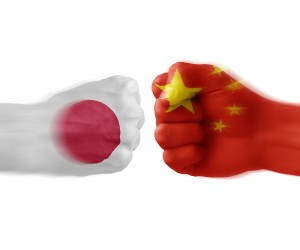
Showing posts with label Senkaku/Diaoyu. Show all posts

Sunday, May 5, 2019

Monday in Washington, May 6, 2019

MUST THE FEDERAL RESERVE RESTRICT ENTRY AND INNOVATION TO ENSURE FINANCIAL STABILITY? 5/6, 9:30am-Noon. Sponsor: AEI. Speakers: Bert Ely, Ely & Co.; Andrew Levin, Dartmouth College; Bill Nelson, Bank Policy Institute; Jerry Dwyer, Clemson University; Jamie McAndrews, The Narrow Bank; George Selgin, Cato Institute; Moderator: Paul H. Kupiec, AEI; Oliver Ireland, Morrison & Foerster.

GROWTH IN GLOBAL ARMS TRANSFERS AND MILITARY SPENDING. 5/6, 10:00-11:30am. Sponsor: Stimson Center. Speakers: Aude Fleurant, Director, Arms and Military Expenditure Programme, SIPRI; Rachel Stohl, Managing Director, Stimson Center.

THE SENKAKU PARADOX: RISKING GREAT POWER WAR OVER SMALL STAKES. 5/6, 10:00-11:15am. Sponsor: CSIS. Speaker: author Dr. Michael O'Hanlon, Senior Fellow, Brookings Institute; Dr. Thomas Karako, Senior Fellow, International Security Program and Director, Missile Defense Project, CSIS.

click to order
KOREA POLICY FORUM: “NORTH KOREA AND MYANMAR: DIVERGENT PATHS”. 5/6, 2:00-4:00pm. Sponsors: GW Institute for Korean Studies; Sigur Center for Asian Studies, GW. Speakers: Andray Abrahamian, 2018-2019 Koret Fellow, Stanford University; Moderator: Jisoo M. Kim, Director, GW Institute for Korean Studies.

CHINA’S ROLE IN NORTH KOREA NUCLEAR AND PEACE NEGOTIATIONS. 5/6, 1:30-3:00pm. Sponsor: US Institute of Peace (USIP). Speakers: Ambassador J. Stapleton Roy, Founding Director Emeritus, Kissinger Institute on China and the United States, and Former U.S. Ambassador to China; Ambassador Joseph Yun, Senior Advisor, USIP, and Former U.S. Special Representative for North Korea Policy; Daniel Russel, Vice President, International Security and Diplomacy, Asia Society Policy Institute, Former U.S. Assistant Secretary of State for East Asian and Pacific Affairs; Ambassador Kathleen Stephens, President, Korea Economic Institute of America, Former U.S. Ambassador to South Korea; Moderator: Jennifer Staats, Director, East and Southeast Asia Programs, USIP. 

Sunday, January 18, 2015

The Shape of Japan to Come


by Alexis Dudden, a professor of history at the University of Connecticut and APP member

First published in The New York Times

January 16, 2015

TOKYO- Bolstered by his party's victory in Diet elections last month, Prime Minister Shinzo Abe has renewed his vow to free Japan from the fetters of the past, especially its defeat in World War II. Mr. Abe and his supporters view the prevailing accounts of that era as "masochistic" and a hindrance to taking pride in what he calls the "new Japan." They propose to modify the article in Japan's Constitution that sates the Japanese people "forever renounce war as a sovereign right of the nation."

These aspirations have been laid out in a map of Japan that the Japanese Foreign Ministry published on its website last April, with translations in 12 languages. The map extends beyond Japan's internationally recognized boundaries, incorporating in the name of ryodo - or the "inherent territory" of Japan - many islands claimed by neighboring countries. Those lands, the argument goes, are integral to Japan's very being.

In fact, the Abe government's expansionist view undermines Japan's interests, both economic and strategic.

Ryodo promotes a notion of Japan's territory that circumvents history, particularly the history of how Japan laid claim to these islands in the first place - through imperial wars with China and Russia, through wars of conquest against Koreans, through the extermination or assimilation of indigenous peoples.

Partly as a result, Japan is embroiled in many territorial disputes. China and Taiwan contest the Senkaku Islands, which Beijing calls the Diaoyu and Taipei and Diaoyutai. South Korea claims Takeshima (calling it Dokdo) where it has stationed military police since 1954. Russia claims sovereignty over what Japanese know as the Northern Territories, four islands in the Kuril chain northeast of Hokkaido where Russians have lived since 1945, numbering about 20,000 today.

Under the terms of the United Nations Convention on the Law of the Sea (UNCLOS), Japan already has access to vast fisheries and rides up to $3.6 trillion in seabed materials. The disputed islands would add much more.

'Inherent' Japan
Tokyo is more aggressively claiming island groups that have long been in territorial dispute. The government highlighted these 3 areas on a new map.


Sources: ministry of Foreign Affairs of Japan: maritimeregions.org
According to some estimates, including by the U.S. Energy Information Administration, the East China Sea holds 200 million barrels in proved and probable oil reserves (the world consumes around 90 million barrels of liquid fuels each day) and between 1 and 2 trillion cubic feet of natural gas (the United States consumed about 26 trillion cubic feet in 2013). Japan and China contest nearly 17 percent of the sea.

A volcano on one of the southern Kurils has rhenium, a rare-earth metal with a melting point that makes jet-engine designers dream. There are also vast quantities of untapped methane hydrate in the seabed between Japan and the Korean Peninsula. After gas was extracted from similar deposits elsewhere for the first time in 2013, a spokesman for the Japan Oil, Gas and Metals National Corporation said, "Japan could finally have an energy source to call its own."

The lure of such riches might seem like reason enough for resource-poor Japan to claim these territories. The government spent $250 billion on imported fuel in 2012. And the cost of decommissioning the nuclear reactors at Fukushima after the meltdown following the March 2011 tsunami is expected to reach at least $90 billion. 

Yet Japan risks losing access to many of these resources because of its brinksmanship. UNCLOS does not determine sovereignty over land, and it allows for joint development agreements in waters around contested territory. When disputes heat up, however, they naturally tend to scuttle any joint schemes.

In 2008 China and Japan agreed to explore together four gas fields in the East China Sea. But the project was scuttled the following year, after China went at it alone. Mr. Abe's maximalist policy only undermines the prospects that his development project could be revived, or that new ones involving Japan might be struck.

The costs of Mr. Abe's territorial revisionism are also strategic. Ryodo implicitly dismisses as partial the terms of the 1951 San Francisco Peace Treaty, which formally ended World War II between Japan and the Allies. The agreement redrew Japan from the massive empire it had become during the war - stretching from northern China to Guadalcanal - more or less into the country familiar today. (Some islands, notably Okinawa, reverted to Japan in the intervening years.) Many Japanese at the time, including Mr. Abe's grandfather, Nobusuke Kishi - who was accused of being a Class A war criminal -  were infuriated, claiming in particular that the Kurils were "essential" to the Japanese.

In a separate agreement that went into force at the same time, the U.S.-Japan Security Treaty of 1951, the United States would "maintain armed forces of its own in and about Japan" in order "to deter armed attack upon Japan." By the time the treaty was revised in 1960, Japan had acquired limited self-defense forces, and the two countries undertook various commitments in case of "an armed attack against either Party in the territories under the administration of Japan." These still stand today, hence the critical importance also for the U.S. government of properly defining what Japan is.

Officials in Washington and Tokyo are currently reviewing each side's responsibilities in the event of the threat of the peace and security of Japan. One fraught issue is the United States' dual obligation, under separate security arrangements, to defend both Japan and South Korea because one could attack the other over territory they both claim. In other words, the very notion of ryodo challenges the United States' postwar security commitments even as it risks triggering them.

Mr. Abe's revanchist view of the past is central to his vision of a future in which Japan "once again shines on the world's center stage." But it distorts history in a way that undermines the country's major interests and, arguably, its identity. The constitutional changes advocated by Mr. Abe's party include an "obligation" for citizens of Japan to "defend the nation's inherent territory, inherent seas and inherent skies," disputed islands and all. The proposed draft adds that, "All citizens must honor the Constitution," suggesting that failure to do so could endanger their rights, maybe their citizenship. In his bid to claim more for Japan, Mr. Abe may reap less.

Tuesday, June 25, 2013

Don't get MAD, get MAP

ties that bind
Mutual Assured Production: Why Trade Will Limit Conflict Between China and Japan

By Richard Katz, 

editor Oriental Economist
APP member
First appeared in the July/August 2013 edition of Foreign Affairs

Last fall, as the countries escalated their quarrel over an island chain that Japan has controlled for more than a century, many Chinese citizens boycotted Japanese products and took to the streets in anti-Japanese riots. This commotion, at times encouraged by the Chinese government, led the Japanese government to fear that Beijing might exploit Japan’s reliance on China as an export market to squeeze Tokyo into making territorial concessions. Throughout the crisis, Japan has doubted that China would ever try to forcibly seize the islands—barren rocks known in Chinese as the Diaoyu Islands and in Japanese as the Senkaku Islands -- if only because the United States has made it clear that it would come to Japan’s defense. Japanese security experts, however, have suggested that China might try other methods of intimidation, including a prolonged economic boycott.During the Cold War, the United States and the Soviet Union carefully avoided triggering a nuclear war because of the assumption of “mutual assured destruction”: each knew that any such conflict would mean the obliteration of both countries. Today, even though tensions between China and Japan are rising, an economic version of mutual deterrence is preserving the uneasy status quo between the two sides.

But these fears have not materialized, for one simple reason: China needs to buy Japanese products as much as Japan needs to sell them. Many of the high-tech products assembled in and exported from China, often on behalf of American and European firms, use advanced Japanese-made parts. China could not boycott Japan, let alone precipitate an actual conflict, without stymieing the export-fueled economic miracle that underpins Communist Party rule.

For the moment, the combination of economic interdependence and Washington’s commitment to Japan’s defense will likely keep the peace. Still, an accidental clash of armed ships around the islands could lead to an unintended conflict. That is why defense officials from both countries have met with an eye to reducing that particular risk. With no resolution in sight, those who fear an escalation can nonetheless take solace in the fact that China and Japan stand to gain far more from trading than from fighting.

THE TIES THAT BIND
Although China first claimed the Diaoyu/ Senkaku Islands in 1971, it never did much to pursue its claim until recently. On the contrary, in the interests of improving economic and political ties, Chinese Premier Zhou Enlai and Japanese Prime Minister Kakuei Tanaka agreed in 1972 to shelve the issue indefinitely. Beijing even stopped Chinese nationalist activists from trying to land on the islands and prevented articles that asserted China’s claim to them from appearing in the Chinese press. In the last few years, however, China has reversed course and started to back up its claims with actions. In 2010, for example, a Chinese fishing boat rammed a Japanese coast guard ship in the waters around the islands. When the coast guard personnel arrested the fishing boat’s captain, Beijing declared that Japan had no jurisdiction in “Chinese territory” and cut off supplies to Japan of vital rare-earth minerals until he was released.

It took until July 2012 for the issue to explode. That month, then Japanese Prime Minister Yoshihiko Noda announced that his government intended to buy some of the islets from their private Japanese owner. Noda’s aim was to prevent them from being sold to the right-wing governor of Tokyo, who had revealed plans for the islands that would certainly have provoked China. But Beijing told Noda that it would see even the government’s purchase as an unacceptable change in the status quo. The Noda administration ignored warnings from both Beijing and the U.S. State Department and deluded itself that China would acquiesce to the purchase.

Then came the riots and the boycotts. For several weeks in August and September, Chinese protesters caused a ruckus, damaging Japanese-made cars, vandalizing stores selling Japanese products, and setting a Panasonic factory on fire. The police vacillated between encouraging and suppressing the riots, and some Chinese state media outlets listed Japanese brands to boycott. By the time the dust settled, Japanese firms operating in China had suffered about $120 million in property damage, and for a few months thereafter, sales of Japanese cars fell by approximately 40–50 percent.

The riots have stopped, but the larger conflict shows no signs of fading. China regularly sends armed surveillance boats into the islands’ territorial waters, and the Chinese Foreign Ministry now calls the islands a “core interest,” a term limited to the most sensitive areas regarding China’s sovereignty, such as Taiwan and Tibet. China’s Commerce Ministry has hinted at the possibility of a prolonged boycott to get Tokyo to concede that China has legitimate claims to the islands. It warned last September that Noda’s purchase of the islands would “inevitably affect and damage . . . Sino-Japanese economic and trade relations.”

A boycott would indeed prove disastrous for Japan’s export-dependent economy. From 2002 to 2007, a third of Japan’s GDP growth came from an increase in its trade surplus, and another third came from capital investment, much of which was tied to exports. And China stands at the center of this picture. From 1995 to 2011, increased shipments to China accounted for 45 percent of the overall growth in Japanese exports. Since the crisis erupted last July, however, Japan’s price-adjusted exports to China have fallen by 20 percent, compared with an 11 percent drop in its global exports (as of March).

Japan’s dependence on China helps explain why the new Japanese prime minister, Shinzo Abe, has not followed through on the hawkish positions he touted during last December’s election campaign, such as his plan to place personnel and facilities on the Senkakus. Abe knows that his popularity hinges on Japan’s economic recovery, and lest he forget it, Japanese businesses have been urging him to refrain from any provocations while still seeking a resolution that maintains the country’s sovereignty over the islands.

But it is not only Tokyo’s behavior that has been tempered by economic interdependence. This year, Chinese censors have blocked the phrase “Boycott Japan” from Weibo, China’s equivalent of Twitter. During February’s New Year’s celebrations, Beijing banned sales of the popular “Tokyo Big Bang” fireworks, which simulate the burning of the Japanese capital. In late March, China even joined Japan and South Korea in long-anticipated talks aimed at forming a trilateral free-trade agreement.

Meanwhile, Chinese provincial governments, hungry for jobs and tax revenue, keep imploring Japanese companies to expand their operations in China. In February, the city of Chongqing hired the Mitsui Group, a Japanese conglomerate, to develop an industrial park aimed at attracting foreign investment. At a March conference of the Japan-China Economic Association in Beijing, China’s new vice president, Li Yuanchao, may have insisted that the media not photograph him shaking hands with Japan’s top business leaders, but he nevertheless asked those leaders to step up their investments. Even on the national level, China is far more pluralistic than it used to be. The Communist Party–owned Global Times published both pro- and anti-boycott op-eds last fall.

Nor do most Chinese consumers seem interested in a boycott. The Japanese products that have lost the most sales during these latest tensions have been the highly visible ones, which are vulnerable to social pressure. Last fall and winter, sales of the popular cosmetics and skin-care products made by the Japanese company Shiseido tumbled, partly because many customers refrained from sending them as holiday gifts. Some stores temporarily displayed Shiseido products less prominently, but very few stopped carrying them altogether.

The worst-hit Japanese products have been cars, since many were vandalized by hooligans during the riots. But sales are recovering. Last fall, Nissan, the Japanese automaker, offered its Chinese customers its new “Promise for Car Security” program, a guarantee of free repairs for vehicles damaged in anti-Japanese riots. That’s one reason why in March, sales at Nissan dealerships finally rose above the previous year’s levels. And as China’s infamous air pollution has worsened, February sales of air purifiers by Panasonic doubled from the year before, and sales of those made by Daikin quadrupled. Both are Japanese companies.

MADE IN CHINA, WITH HELP FROM JAPAN
Why does China, the world’s largest exporter, so badly need what Japan is selling? Put simply, China’s export-driven economic miracle depends on imports. Around 60-70 percent of the goods China imports from Japan are the machinery and parts needed to make China’s own products. China cannot cut off this flow, or risk disrupting it through conflict, without crippling its economy. That is why, during the height of the island crisis last fall, the same Chinese customs officials who sometimes delayed shipments of Japanese consumer goods let industrial parts pass through.

Wednesday, May 29, 2013

Mike Mochizuki in Australia

with

George Washington University


31 May 2013

4:30-5:30pm

Australian National University
Lecture theatre 2, Hedley Bull Centre (Bldg #130)
corner of Liversidge Street and Garran Road, ANU

Why are Japan and China now locked in an intractable conflict regarding the Senkaku/Diaoyu islands? Professor Mike Mochizuki will examine the historical, economic, military, territorial and international legal dimensions of this dispute. After considering power transition and nationalism as possible explanations, he will explain the recent deterioration of Japan-China relations by analysing the interactive dynamics between the two countries and the role of domestic politics. Finally, he will consider possible ways to mitigate the conflict.

Professor Mochizuki holds the Japan-U.S. Relations Chair in Memory of Gaston Sigur at the Elliott School of International Affairs at The George Washington University. Dr. Mochizuki was director of the Sigur Center for Asian Studies from 2001 to 2005. He co-directs the "Memory and Reconciliation in the Asia-Pacific" research and policy project of the Sigur Center. Previously, he was a Senior Fellow at the Brookings Institution. He was also Co-Director of the Center for Asia-Pacific Policy at RAND and has taught at the University of Southern California and Yale University. He is a board member of Asia Policy Point.

You can preview this talk by listening to an interview Professor Mochizuki gave to  Radio Australia on May 27, 2013.

Sunday, May 12, 2013

China’s Evolving ‘Core Interests’

An editorial in The New York Times on May 11, 2013 (in print on May 12, 2013, on page SR10) chastises the Chinese for defining the Senkaku/Diaoyu Islands as "core interests" that will be defended and the Japanese for casting doubt on their willingness to stick to their past war apologies. Neither was necessary and both undermined regional peace and stability.

On the same day, Ian Buruma in The Wall Street Journal had an extensive essay A Dangerous Rift Between China and Japan on how Asia's two great powers play politics with the past and court a crisis.

As he notes: On the surface, the dispute is about history, about which country has the best historical claim to sovereignty over the Senkaku/Diaoyu. In fact, it is more about politics, domestic and international, revealing the tangled relations in a region where history is frequently manipulated for political ends.

Buruma proposes no solution, but laments that
Things, in short, are back to square one: Pax Americana containing China, with Japan as Washington's loyal vassal. This might seem a stable, even comfortable, position from the U.S. point of view. In fact, it isn't. For a long time, the Chinese put up with the U.S. being the policeman of East Asia, because the prospect of a more independent, fully rearmed, even nuclear Japan would be worse. But Japan's role as a kind of cat's paw of American dominance, with Japanese nationalists compensating for their subservience by indulging in bellicose talk, will be the source of ever greater tensions, which are bad for everyone, including the U.S.
In December 2012, Hugh White, a professor of strategic studies at the Australian National University, wrote in an op ed for the The Sydney Morning Herald that the protracted dispute between China and Japan over ownership of the Diaoyu/Senkaku Islands could serve as a flashpoint for military conflict between the two "nuclear" powers this year.

According to Professor White the dispute over the islands is a symptom of tensions engendered by China's rise in the Asia-Pacific, and the challenge it poses to American influence in the region. White believes that China's recent efforts to shore up its claim upon the Diaoyu/Senkaku Islands is a means of "pushing back" against US power in the Asia-Pacific.

Here is the text of The New York Times editorial:

Whenever China wants to identify the issues considered important enough to go to war over, it uses the term “core interests.” The phrase was once restricted to Taiwan, the island nation that China has threatened to forcibly unify with the mainland. About five years ago, Chinese leaders expanded the term to include Tibet and Xinjiang, two provinces with indigenous autonomy movements that Beijing has worked feverishly to control.

Since then, Chinese officials have spoken more broadly about economic growth, territorial integrity and preserving the Communist system. But recently they narrowed their sights again, extending the term explicitly to the East China Sea, where Beijing and Tokyo are dangerously squabbling over some uninhabited islands. Top Chinese military officials first delivered the message to Gen. Martin Dempsey, chairman of the Joint Chiefs of Staff, when he visited Beijing last month. The next day, the Foreign Ministry spokeswoman, Hua Chunying, told reporters that “the Diaoyu Islands are about sovereignty and territorial integrity. Of course it’s China’s core interest.”

This wording, with its threatening implications, is raising new tensions in a region already on edge over North Korea and several other maritime disputes, and it will make it harder to peacefully resolve the dispute over the islands, called Diaoyu in China, and Senkaku in Japan.

While Japan has held the islands for more than a century, China also claims title and has sent armed ships and planes from civilian maritime agencies to assert a presence around them. The waters adjacent to the islands are believed to hold oil and gas deposits.

To some extent, China is simply throwing its weight around, challenging the United States and its regional allies. On Wednesday and Thursday, Chinese state-run newspapers carried commentaries questioning Japan’s sovereignty over the island of Okinawa, where about 25,000 American troops are based. Japan, whose wartime aggression against China and other countries still engenders animosity, has not helped. Last September, the government of Prime Minister Yoshihiko Noda provocatively bought three of the islands from their private owner.

The right-wing nationalists who took power in December may be equally unwilling to put Japan’s past behind it, although the government of the new prime minister, Shinzo Abe, took a positive step on Tuesday when it said it would abide by official apologies that the country made two decades ago to victims of World War II. China and Japan have strong economic ties and are critical to regional stability. Both will lose if they stumble into war or otherwise cannot resolve this escalating dispute. Though efforts are under way to find a mutually face-saving solution, using loaded phrases like “core interests” to describe the islands only adds to the political and emotional sensitivities and will not advance that goal.