Showing posts with label Jewish Issues. Show all posts

Wednesday, July 26, 2023

No surprise here - Chiune Sugihara is not what Conservative Japan wants him to be

Researchers say Japan has exaggerated the story of Chiune Sugihara, 

the ‘Japanese Schindler’

Jewish Telegraphic Agency, BY JORDYN HAIME JULY 19, 2023 

See original for pictures and links

YAOTSU, Japan (JTA) — Three years before the Olympics began in 2021, Tokyo was already developing the national image it would display as the world looked on.

The Tokyo Metropolitan Board of Education issued a handout to the city’s public schools in 2018 highlighting “the outstanding achievements of our predecessors” that were meant to “raise [students’] self-awareness and pride as Japanese.”

Occupying a majority of the four-page handout was the story of diplomat Chiune Sugihara, who wrote thousands of life-saving visas for Jews fleeing Europe in 1940. The pamphlet recreates a dramatized version of Sugihara’s life and actions, bolstered by quotes from nameless descendants of the Jewish refugees he saved.

“Sugihara should be remembered and honored as an amazing hero who sacrificed his profession and family to save strangers from a different ethnicity and culture,” one of the quotes reads.

Sugihara, a Japanese diplomat to Lithuania from 1939 to 1940, helped thousands of Jewish refugees flee wartime Europe by issuing transit visas that allowed them to travel across the Soviet Union to Japan. Today, his name and story can be found all over the country, from his supposed hometown in Yaotsu to a museum at the northern Tsuruga port where Jewish refugees landed.

His likeness is found in memorials in Tokyo and in manga series and films, in addition to nearly every modern history school textbook. In 2017, the Tokyo Weekender magazine dubbed Sugihara the “best Japanese person ever.” Some Catholics have even expressed hope that Sugihara will be officially canonized by the Catholic church as a Saint.

But over the past few years, a growing number of researchers — in addition to his own son — have publicly challenged Sugihara’s superhero status and many details of the version of his story pushed in Japan and around the world. Some researchers say that Japan has used him as a symbol of humanitarianism in the face of criticism of Japan’s World War II record.

And some note that Japan is taking the nationalist narrative one step further, by boosting another World War II-era figure whom they believe can achieve a similar level of national fame and hero status — whether or not his story is verifiable.

The Sugihara story

Issuing visas was not part of Sugihara’s job description. He was stationed in Kaunas, Lithuania, from 1939 to keep an eye on Soviet military activity in the region.

But when rumors spread of a Japanese diplomat issuing transit visas, Sugihara one day found a crowd of Jews lined up outside of his home hoping they would be lucky enough to get one. They were running from the Soviets; no one had yet predicted the havoc that would be unleashed on them by the Germans when they finally invaded one year later.

Sugihara issued some 2,140 transit visas, some used for entire households. But Meron Medzini, professor emeritus at the Hebrew University of Jerusalem’s Department of Asian Studies, wrote in his 2016 book “Under the Shadow of the Rising Sun: Japan and the Jews during the Holocaust Era” that “Not all of the visas were used, and this makes it difficult to substantiate the claim that Sugihara was instrumental in helping [the commonly accepted number of] between 6,000 and 7,000 Jews leave Lithuania.”

Sugihara’s act was also only one step in a series of events that led to the refugees’ escape. Tokyo required them to have a final destination permit as a condition of their transit through Japan, and those were provided by Jan Zwartendijk, a Dutch consul in Kaunas at the time who stamped thousands of Jewish passports to visa-free Dutch Curacao. Jewish organizations stepped in to pay for the refugees’ transit across the Soviet Union, which was miraculously granted by Soviet authorities.

Andrew Jocubowicz, whose parents escaped wartime Europe with the help of a Sugihara visa, emphasized the importance of Zwartendijk’s role in an interview. In recent years, the Dutch consulate has also attempted to boost the profile of their own Holocaust hero, who is often “hidden” in the shadow of Sugihara.

“The critical person in the whole game was really Zwartendijk,” said Jocubowicz, a professor of sociology at the University of Technology Sydney who has spent four decades researching the conditions of his family’s survival. “Without those visas, it would not have happened at all. There’s no way Sugihara could have cooked up something that didn’t have people moving on from Japan.”

After arriving in Japan, Jews left for Australia, Canada, the United States and other countries. Others were later deported to Japanese-controlled Shanghai, where authorities imprisoned them in a ghetto for the remainder of the war.

The hometown museum that isn’t

Claims that Sugihara helped several thousand Jews; that his requests for visas were rejected “three times” by his superiors; and that he was dismissed and punished for his actions are all important details that make Sugihara a hero. But they are also all claims that researchers have debunked.

Jocubowicz said his father barely met Sugihara, whose visa was just one chapter in a long journey to safety. The survival of this group of Jews was “almost pure luck at every point,” he said, especially their allowance by the Soviets to cross through Russia. After several months in Kobe, his family spent the remainder of the war in the Shanghai ghetto before boarding a ship to Australia, where Jocubowicz was raised.

“My feeling is that it was an extraordinary wormhole that opened up through these essentially conflicting empires, and as they crashed into each other, this little hole opened up and people were able to scurry into it,” he said.

Yaotsu’s claim as Sugihara’s birthplace is also disputed, said Nobuki Sugihara, the consul’s only surviving child. Nobuki said that according to family documents, his father was born in Mino, about 30 miles away from Yaotsu.

“It’s shocking. People come from around the world to visit Yaotsu [but] my father was not born there, he has never lived there,” Nobuki told the Jewish Telegraphic Agency. “They made a story that he was born in Yaotsu in order to get tourists because in that village there is nothing.”

The memorial and museum in Yaotsu, despite its distance from a major city, receives 20,000 tourists per year both foreign and domestic, according to Ito Yuko, who works in Yaotsu’s regional development and promotion division. She said the Sugihara family once lived in their small town, and elderly townspeople still remember them.

“For our museum, we are telling the truth that we know. Not exaggerated, not right or left, we just tell the story that we think is true,” she said.

Local tourism officials have also promoted a “Sugihara Remembrance Route,” part of a multimillion-dollar effort promoted widely in Israel that is described as “a nostalgic journey of discovery that will take you to places associated with the great man and areas where the Japan’s [sic] original landscape and traditional culture remain strong.” Although sometimes referred to as the “refugees remembrance route,” the route curiously excludes the city of Kobe, where Jewish refugees lived for months before leaving Japan for other destinations.

Sugihara had no connection to many of the areas on this route, Nobuki said. He explained that much of the common narrative about Sugihara comes from his mother Yukiko’s memoir, published in 1995.

“She didn’t know exactly what happened in Kaunas, in Europe. So she asked a ghostwriter. She wanted to make a novel, not a documentary. So she put here and there some fiction stories. And this became famous in Japan,” he said.

The rise to stardom

A decade or two ago, a much smaller portion of Japanese society knew the Sugihara story. Today, he is a household name.

In a recent article for the academic journal American Historical Review, University of Haifa professor and prominent Japan scholar Rotem Kowner examined how Sugihara became a “Holocaust paragon of virtue.” Sugihara, he wrote, “was not the only consul to issue visas to Jews during this period, and not every consul who issued visas turned into a hero.”

As Japan rebuilt and rebranded into a peace-loving nation after the war, said Chiharu Inaba, a professor who researches Jewish refugees in Japan, “The people didn’t know what a hero was anymore. They needed a new hero.”

The legacy of Japan’s wartime actions, including its military’s sexual “comfort women” system, continues to hinder its relations with China and South Korea.

The start of Sugihara’s rise to hero status can be traced back to his nomination as one of Yad Vashem’s Righteous Among the Nations in 1968. According to Kowner’s research, Sugihara did not earn the honor for 16 years after his initial nomination because of Yad Vashem’s initial doubts over whether he risked his life or professional position to help Jews — normally a requirement of Righteous Among the Nations status. Instead, Sugihara was at first given a certificate of recognition for his actions.

Eventually, though, when a panel was presented with new evidence and testimony from survivors, it determined that Sugihara had taken a career risk, and his Righteous status was granted in 1984. Authorities also saw it as an opportunity to improve Israel’s image in Japan, Kowner argues, as Japanese public opinion about Israel had sharply deteriorated amid the conflict with Lebanon at the time.

A former head of Yad Vashem’s Righteous Among the Nations department recently disputed the claim that political considerations were involved in Sugihara’s nomination.

Recognition of Sugihara remained scant within Japan until 2000, when the Japanese government for the first time officially recognized him at a centennial celebration of his birth. But Prime Minister Shinzo Abe — known throughout his 2012-2020 tenure for his conservative politics, revisionist views of Japan’s World War II activities and desire to ramp up Japan’s military — embraced Sugihara more than any other Japanese leader.

In Sugihara, Abe saw an opportunity to not only boost diplomatic relations with Israel and Lithuania, but to make Sugihara a positive representative of the Japanese people in its darkest historical period.

But the process had already started before Abe’s tenure. In the 2000s, revisionist writers began adding Sugihara’s name into texts that denied the Nanjing Massacre — a Japanese attack on the Chinese city in 1937 that resulted in an estimated 300,000 deaths — “to show that wartime Japan did not resemble Nazi Germany,” Kowner wrote.

Sugihara has been a key component of what some have called Asia’s “memory competition” to have documents and memorials receive recognition from UNESCO, the United Nations’ cultural heritage authority. In 2017, Japan nominated Chiune Sugihara Memorial Hall, the museum at Sugihara’s supposed hometown in Yaotsu, for UNESCO Memory of the World status; the bid failed.

“Sugihara posthumously allowed his country to shed a long-lasting self-justifying policy of victimization and, instead, rebrand itself as possessing proactive humanitarian values,” Kowner wrote. “Critically, Japan could cast itself in the role of a ‘good’ country that helped the Jews rather than that of an Axis villain.”

The next Sugihara

Sugihara’s vast fame has also paved the way for a new World War II-era Japanese hero to emerge: Kiichiro Higuchi.

Higuchi, a general, allegedly defied orders from his superiors to allow between 2,000 and 20,000 stranded Jewish refugees to cross the Russian border into Manchukuo, according to media reports and his supporters in Japan. This path to safety is now known as the “Higuchi route.”

Though far lesser known than Sugihara, efforts to attract attention to Higuchi have received mild success: through a manga series, media reports, and other commemoration efforts, such as a statue in his hometown of Awajishima. The Japanese embassy in Israel has reportedly been in discussions with Yad Vashem since 2005 about Higuchi’s Righteous Among the Nations status, but efforts have been unsuccessful.

When researchers began looking into the Higuchi story, it started to fall apart. Dylan Hallingstad O’Brien, a doctoral candidate at the University of California San Diego, has found that Higuchi likely facilitated the entrance of “at least 18 people” into Manchukuo. “There’s just no record” of more than that, O’Brien said.

“It just doesn’t add up that you have thousands and thousands of people flooding in and then there’s no record,” he said. “Especially when there are records of other Jewish refugee groups, [that have] receipts, letters, communications, and there’s just nothing for this group that supposedly went the ‘Higuchi route.’”

The website for the General Higuchi Association, an organization created to encourage the commemoration of Higuchi in Japan and pursue donations from abroad, is saturated with nationalism and false statements. Hideaki Kase — a right-wing politician who advised Shinzo Abe — chaired the association until his death last year.

“What would have happened if [Anne Frank’s] family knew of the ‘Higuchi Route’?” the website asks. “Perhaps the family would not have lived in the attic but instead would have sought passage for Manchuria, like so many other Jews did, and survived. At the time, neither the United States nor Britain accepted Jews; Japan was the only country in the world that opened its doors to Jews.”

The goal, O’Brien argued, is to promote the idea that Japan had a policy of racial harmony — in this case, of helping Jews during the war.

The consequences

Japan is far from the only country that has faced criticism for promoting Holocaust narratives for nationalist ends that historians disagree with. Poland has been widely derided for denying the part that many Polish citizens played in the killing of local Jews throughout the war. And in China, Shanghai’s history as a former home to thousands of Jewish refugees has been used as a diplomatic tool, at times to deflect from international accusations of genocide against Muslim Uighurs in Xinjiang.

Small inconsistent details or a selective use and omission of certain facts can be dangerous, Jocubowicz said. Holes in Holocaust stories give antisemites and Holocaust deniers ammunition for their arguments that Jews were not in danger, he argued.

“What happens if something is inaccurate and could be corrected is then the readers have no idea whether anything in the story is accurate,” Jocubowicz says. “So anything could be a fake. Maybe it’s all a fake, and maybe this is a signal that the whole Jewish story about the Holocaust is rubbish.”

Rabbi Mendy Sudakevich, a Chabad-Lubavitch movement emissary who has been living in Tokyo since the 1990s, sees the narrative differently. He thinks that the Sugihara story — whether it is 100% true or not — has a positive effect on people and endears them to Jews.

“Kids in Japan grew up not knowing what Japan did in the war. They don’t know the story. And Japan tried to build up a new story,” Sudakevich said. “I want the new generation of Japan to know that saving Jews is an important task. I want them to know that. And if that’s what they know about World War II, it is a good result for me.”

When Russia invaded Ukraine in 2022, many in Japan ventured out to Yaotsu, Kobe or Tsuruga to learn more about Sugihara. Invoking his memory, Inaba and his university students have organized a 5 million yen ($37,490) donation drive for Ukrainian refugees dubbed “donations for life.” The Visas for Life organization, founded by the Sugihara family in 2000, has raised 1.7 million yen ($12,746) for Ukrainian evacuees now living in Japan.

Madoka Sugihara, Chiune Sugihara’s granddaughter and soon-to-be-director of Sugihara Visas for Life, noted the dramatic change in the government’s reception of Sugihara in the past several years.

“The way the government changed their attitude is a very cynical thing,” but “it is a good thing that they regard Sugihara-san’s act very fairly. I’m convinced that it’s a good thing,” she said.

Tuesday, July 25, 2023

Jews and China

Jewish Conspiracy Theories Find an Audience in China

Anti-Jewish content and conspiracies take up significant real estate among the top results on Chinese media platforms including Douyin, WeChat and Bilibili. Though borrowed from the West, they have taken on a localized identity.

First published in the China Media Project, JUL 18, 2023 See original for graphics

Recent news of China’s renewed access to the Russian port of Vladivostok this May sparked celebration among some Chinese netizens. But among others, it was a painful reminder of its “century of humiliation,” beginning in the mid-nineteenth century. At the time, the Qing dynasty’s ruling Manchu royals had reluctantly handed over their homeland, which included the port, to their northern neighbors. More territory was ceded to the Japanese invaders in 1931, resulting in the creation of the puppet state of Manchukuo.

The Vladivostok decision sparked a debate in corners of Chinese social media about whether a debilitated and increasingly reliant Russia would be made to return the stolen land. Surprisingly, a third perpetrator has emerged alongside the Russian and Japanese empires: the Jews.

In the early 20th century, “before moving into Palestine, Jewish capital chose to settle in the Northeast [of China]”, explained a May 19 article by popular WeChat account “Blood Drink” (血饮). It added that the Jews “were even willing to make a Devil’s bargain with the Japanese fascists and give almost all of their money away for this purpose.”

Over one-hundred thousand people have now read the post, many of whom learned for the first time how “during the ensuing eight-year war, Japan’s military industry, which was financed by Jewish capital, massacred tens of millions of Chinese civilians.”

As with most conspiracies, the Jewish-Japanese blood libel contains a kernel of truth. It is based on a little-known episode in World War II known as the “the Fugu Plan” (河豚计划).

In 1939, Japanese “Jewish experts” had proposed to invite 50,000 German-Jewish refugees to Manchukuo with the hope that Jewish capital would help revitalize the territory. Drawing on their expertise of the fabricated antisemitic text The Protocols of the Elders of Zion, they hoped that a “deal” with the Jews would inspire them to help improve Japan’s position in the war due to their supposed power over the West. It was named after the “fugu,” the Japanese blowfish that — like the Jews — was a delicacy when handled correctly, but deadly if not. Although Jews indeed found refuge in Japanese-controlled areas during World War II, they were never seriously involved in the Fugu Plan, and the plan never came to fruition, writes Meron Medzini, a professor of modern Japanese history at the Hebrew University of Jerusalem.

The Fugu Plan, though, takes on a different meaning inside China: It demonstrates a foreign assault on the homeland, with “Jewish capitalists” portrayed as the puppeteers behind Western governments seeking to “contain” China’s rise.

At the time of writing, the Fugu Plan is featured in the top search result for the word “Jew” (犹太人) on Douyin, ByteDance’s Chinese equivalent of TikTok. The video is the first in a three-part series about the historical “mistakes” of the Jews.

In less than eight minutes, the video’s narrator blames the Holocaust on Jewish greed, accuses Jews of starting China’s “century of humiliation” by financing the Opium Wars, and describes their cunning Fugu Plan with the Japanese.

Other videos about the Fugu Plan have received as many as 200,000 likes and 30,000 shares. Millions of others have followed the story on social media, where it can also be found with a simple search on Bilibili, WeChat and Weibo, among other platforms.

The narrative has become so popular that an acclaimed Chinese author Yang Shu (杨树) received state funding to pen a spy novel based on the story, which has been short-listed for television or film adaptation by the state-led Chinese Writers Association.

The conspiratorial spin on the Fugu Plan only scratches the surface. A distinct brand of localized antisemitic conspiracies is thriving on Chinese media platforms. A quick search for “Jews” on WeChat, Douyin, BiliBili, Weibo, or Zhihu, reveals that negative, anti-Jewish content and conspiracies take up significant real estate among the top results.

The economics of antisemitism

Antisemitism is not just a social media phenomenon. Despite Beijing’s tight control of the information space, it can also be found among leading academics, party-state journalists, and military strategists. Whereas benign pro-LGBTQ posts and dissenting political voices are often censored, Jewish hatred is openly propagated.

The mirror image of this phenomenon is more well-known. Any Jew who travels through China and reveals their heritage will be met with an admiring torrent of ostensibly “philosemitic” remarks: Jews are inherently intelligent, clever, business savvy, and wealthy. Today, this attitude is widely understood by outsiders as a harmless admiration of stereotypical Jewish traits.

The issue with this “positive” spin is the very fine line that separates it from overt antisemitism. To those who admire Jews for being inherently intelligent and good with money, holding resentment for their supposed disproportionate power over American institutions like Wall Street, the Federal Reserve, and Hollywood is not a major leap.

None of this is to say that antisemitism is widespread in China, or to suggest the PRC is a uniquely and irrevocably racist country. However, it does beg the question of how a country with a negligible Jewish population and an even smaller indigenous Jewish community could form such strong opinions about people they had never met.

Chinese antisemitism should first be viewed as one manifestation of a broader problem of racist nationalism in Chinese discourse. Earlier this month, many observers were shocked and appalled to see how China’s top diplomat Wang Yi hinted at an East Asian race-based bonhomie against “sharp-nosed” and “yellow-haired” Europeans and Americans, advocating for an East Asian alliance that “can eliminate external interference and achieve sustainable development.”

To those who admire Jews for being inherently intelligent and good with money, holding resentment for their supposed disproportionate power over American institutions like Wall Street, the Federal Reserve, and Hollywood is not a major leap.

The irony is that despite exhibiting some of the most well-documented instances of systemic violence, dehumanization, and discrimination against ethnic minorities, China is rarely called out for racism.

In his seminal book on the subject, historian Frank Dikötter shows how racialized discourse has been a part-and-parcel of Chinese nationalism since its inception in the late nineteenth century. Sun Yat-sen, dubbed “the Father of the Nation,” shared many Chinese revolutionaries’ fear and hatred of the ruling Qing’s “Manchu race.” This led him to incorporate racist nationalism into the bedrock of his political thought. “Sun claimed that only nationalism could forestall racial destruction,” writes Dikötter. Conspiracy theories about the Manchus persist in China to this day.

Sun and his contemporaries among China’s intellectual elites have attempted to construct a sense of national identity by appropriating Western antisemitic representations of Jews. By defining the “Jewish race” as a homogeneous group, argues Zhou Xun (周逊) with the University of Essex, they hoped to create a similar sense of unity among the Han-Chinese race. This process of othering the Jews has allowed the Chinese to project their own anxieties and desires onto a group that is both foreign and familiar.

Chinese nationalism under Mao Zedong viewed racial issues through the prism of class struggle, though there were times when the differences were merely semantic. When socialist Israel aligned itself with the “capitalist” Western Bloc, China gravitated towards the anti-Zionist Muslim world, viewing the Jewish state as “the enemy.” With little to no personal contact with Jews, many Chinese scholars and statesmen came to rely on the deeply antisemitic Soviet and Pan-Arabist anti-Zionism that masqueraded as legitimate criticism of Israel.

The enduring legacy of ultra-leftist “enemy studies” abounds in the works of Beihang University military strategist Zhang Wenmu (张文木). In a series of articles for a peer-reviewed socialist journal under the Chinese Academy of Social Sciences (CASS), Zhang describes Covid-19 as a usurious American-Jewish bioweapon aimed at China and humanity as a whole. In keeping with the teachings of Mao and Karl Marx, Zhang says that “what Jews require most is an environment conducive to borrowing, which includes things like financial crises, pandemics, disasters, and, preferably, war.”

In the early 1990s, during the second coming of reform and opening, opportunistic writers and publishers flooded bookstores with “get-rich-quick” guides in an attempt to profit from the pervasive stereotype of the “Jewish Shylock.” An entire genre of books has emerged that portrays Jews as a wellspring of financial wisdom, a source from which the Chinese could learn valuable lessons.

One of those books is The Jewish Guide to Getting Rich, which includes a seemingly admiring line: “The money of the world is in the pockets of the Americans, but the money of the Americans is in the pockets of the Jews.”

Following this logic, nouveau riche families in Shenzhen can now enroll their kids in posh programs designed to help them “learn from the best” in management, finance, and parenting so that they, too, can carry on a Rothschild-like legacy.

However, these assertions become troubling when they contribute to the notion that Jews are influencing America’s trade war and efforts to contain China. Similar conclusions can be found in viral videos and posts discussing the alleged Jewish-Japanese Fugu Plan, in which “Jewish capital” supposedly supported Japan’s war against China.

Conspiracy theories thrive on ignorance and sensationalized content reaps lucrative clicks and revenues. However, spreading rumors online risks falling afoul of China’s dreaded Cyberspace Administration, inviting charges of “picking quarrels and making trouble” that could lead to imprisonment. Antisemitism avoids this fate, given that these narratives are seamlessly embedded within state-sanctioned nationalistic frameworks, warning against foreign encirclement and influence.

“The issue of Jewish conspiracies in our region is more pervasive and profound than we realize,” Simon K. Li told the JTA wire service last year. Li highlights that these conspiracies find greater expression on social media platforms like Douyin and Tencent QQ, where anonymity allows for open discussions, rather than in direct face-to-face interactions

A prime success story of this tactic is Currency Wars, a five-volume book series by Song Hongbing. Beginning in 2007, its publication represents a significant turning point in the integration of Jews as stakeholders in popular conspiracies.

The series claims to reveal the secrets of an international financial cabal dominated by a small group of wealthy Jewish elites, most notably the Rothschild family. According to the author, their intentional manipulation of the Federal Reserve results in major social, political, and military disasters.

Despite being panned in China and elsewhere for their broad generalizations, factual errors, and overt antisemitism, Song’s books were a commercial success, with over three million copies in circulation as of 2020. They even received endorsements from senior officials in Beijing, including former Chinese Vice President Wang Qishan (王岐山), who reportedly recommended the series to his staff.

Wuhan University professor Sunny Han Han argues that Currency Wars represents a broader trend of Chinese “pop-nationalism.” This phenomenon revolves around conspiracy theories targeting the “hypothetical West,” an abstract force believed to hinder China’s ascent.

It appeals to nativist anxieties over Western influence and globalization, which Han traces to the emergence of early Chinese nationalism in the late Qing. According to Han, such anachronisms perpetuate traditionalist groupthink. Even more concerning, they distort Chinese perceptions, ultimately perverting Beijing’s ability to communicate effectively with the world.

The ultimate Other

Conspiracy theories and racism are prevalent throughout the world, across all cultures and time periods. And yet, the setting in which they evolve is essential to understanding them.

From Sun Yat-sen to Wang Yi, racialized discourse has been an element of Chinese nationalism since the late Qing dynasty. By classifying Jews as innately external and homogeneous group, the PRC’s founding fathers were able to see a reflection of their nation’s own fate. Following decades of humiliation at the hands of foreign powers, it was natural to believe that if the Chinese could be as wealthy as the Jewish Shylock, China would be the most powerful country on the planet; or that in order to create the Chinese “New Man,” one must examine how to avoid being like the subservient weak Jew.

Historical trends also influence the geopolitical landscape. China established diplomatic relations with Israel in 1992, after the Cold War had ended and the Maoist class mentality had subsided. Consequently, antisemitic rhetoric wrapped in anti-imperialist and anti-Zionist language had to be discarded as well. Nevertheless, countless Chinese politicians and academics carry on the Soviet legacy and use the Jewish state as a battering ram against its American “big brother,” in what Glenn Timmermans of the University of Macau refers to as “antisemitism by proxy.”

In China, where there is a minuscule Jewish minority, conspiracy theories about the treatment of the country’s sizable Muslim, Christian, LGBTQ, or African communities face greater scrutiny. Antisemitism, however, is rarely discussed as it exists primarily in elite circles and online. Diplomats from China (and Israel) would even go so far as to claim that “antisemitism has never existed in China.”

The socioeconomics of the country’s rapid development may explain the niche market for books and programs based on the stereotypical Jewish financier. At the same time, the prevalence of antisemitism in the world’s second-largest economy is concerning. China accounts for one-fifth of the world’s internet users, with over a billion active users. As scholars Yang Tian and Fang Kecheng have found, the nationalist “influencers” who coordinate and share content on a daily basis comprise a large, toxic network.

Furthermore, despite their xenophobia, they share ideological ties with the far right in the West and Eastern Europe. According to Yang and Fang, the Chinese Han majority, which accounts for more than 90 percent of the population, claim that their own majority culture is in crisis due to minority groups such as Muslims, Blacks, or, in this case, Jews.

Due to their direct import from the West, many of the aforementioned Chinese conspiracies should be very familiar to Westerners. In his lectures, for example, Jin Canrong (金灿荣), dean of Renmin University’s School of International Studies, has promoted the Great Replacement theory. Popularized by French nationalist Renaud Camus, the theory holds that non-white immigrants are replacing white European societies with the help of Jews.

Nevertheless, when we examine these theories through a historical lens, we can observe their transformation and incorporation of Chinese metaphors and distinct cultural and historical notions. What is the Fugu Plan conspiracy but the Great Replacement with Chinese characteristics?

To rationalize Chinese antisemitism on ignorance is, at best, patronizing. Many of its proponents, including naturalized American citizen Song Hongbing, have resided or attended school in the West. Some have even written extensively about the perils of “Western” antisemitism.

Contemporary antisemitism — whether in the United States, Europe or China — is, in the end, a conspiracy that has proven remarkably useful around the world. As American writer and activist Elad Nehorai writes, antisemitism does not always appear to be Jew hatred: “Jew hatred is actually the end result of antisemitism.” Viewed from this perspective, perhaps no one should be surprised that kitschy admiration for Jews has turned sour; isn’t China just catching up to the rest of us?

Sunday, October 28, 2018

Monday, January 5, 2015

Prime Minister of Japan’s Schedule October 20-26, 2014

Monday, October 20, 2014

AM
12:00 At private residence (no visitors)
07:53 Depart from private residence in Tomigaya, Tokyo
08:09 Arrive at office
08:20 Minister of Economy, Trade and Industry Obuchi Yuko enters
08:50 Ms. Obuchi leaves
09:36 Meet with Minister in charge of the Abduction Issue Yamatani Eriko
10:01 End meeting with Ms. Yamatani
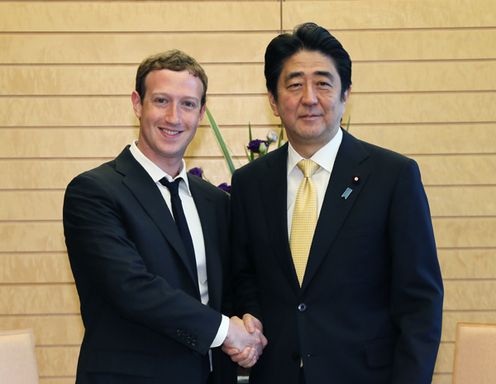
10:05 Meet with American CEO of Facebook Mark Zuckerberg
10:27 End meeting with Mr. Zuckerberg
10:28 Meet with Vice-Minister for Foreign Affairs Saiki Akitaka
10:56 End meeting with Mr. Saiki
11:02 Depart from office
10:10 Arrive at Imperial Palace. Register return to Japan. Attend Empress’s Birthday Celebration

PM
12:14 Depart from Imperial Palace
12:23 Arrive at office
01:09 Minister of Justice Matsushima Midori enters
01:26 Ms. Matsushima leaves
01:42 Interview open to all media: When asked about “Minister of Economy, Trade and Industry Ms. Obuchi and Minister of Justice Ms. Matsushima’s letters of resignation” Mr. Abe answers “I respect the intentions of these two people, and I accept their letters of resignation. As the Prime Minister it is my duty to fill these posts.”
01:45 Interview ends
01:50 Receive courtesy call from Mayor of Nihonmatsu City in Fukushima Prefecture and Chrysanthemum Ambassador Chiba Chie and others. LDP Lower House member Nemoto Takumi also attends
01:56 Courtesy call ends
02:02 Liaison Council of Government and Ruling and Opposition Parties Institutions for Measures against Abduction Issue meeting
02:53 Council meeting ends
02:55 Headquarters for the Abduction Issue meeting
03:16 Meeting ends
03:25 Speak with Ministry of Foreign Affairs (MOFA)’s Director-General of North American Affairs Bureau Tomita Koji, Ministry of Defense (MOD)’s Director-General of Bureau of Defense Policy Kuroe Tetsuro and Director-General of Bureau of Local Cooperation Nakajima Akihiko
03:35 Finish speaking with Mr. Tomita, Mr. Kuroe, and Mr. Nakajima
03:50 Meet with Minister in charge of Total Reform of Social Security and Tax Amari Akira
04:11 End meeting with Mr. Amari
04:12 Meet with Chief of Staff for Joint Staff Council Kawano Katsutoshi
04:27 End meeting with Mr. Kawano
04:39 Courtesy call from US Secretary of Commerce Penny Pritzker and colleagues. Resident US Ambassador to Japan Caroline Kennedy also attends
04:53 Courtesy call ends
04:55 Depart from office
04:56 Arrive at Diet
04:58 Enter LDP Secretary-General’s Room. Endorse candidate for Miyazaki Prefecture’s gubernatorial election. Commemorative photo session with candidates for Okinawa Prefecture’s gubernatorial election and Naha City (Okinawa Prefecture)’s mayoral election
05:04 Leave room
05:05 Enter LDP President’s Room
05:06 LDP Officers Meeting
05:24 Meeting ends
05:27 Leave room
05:28 Depart from Diet
05:30 Arrive at office
05:45 Council for Promoting the Alleviation of the Burden of Futenma Air Station meeting
06:05 Council meeting ends
06:21 Speak with incoming Minister of Economy, Trade and Industry Miyazawa Yoichi
06:33 Finish speaking with Mr. Miyazawa
06:34 Speak with incoming Minister of Justice Kamikawa Yoko
06:46 Finish speaking with Ms. Kamikawa
06:51 Interview open to all media: When asked about “the reason you rushed to appoint new Cabinet Ministers” Mr. Abe answers “Economics are a top priority that we must actively advance. In administration and governance we cannot delay.”
06:53 Interview ends
06:54 Depart from office
06:55 Arrive at official residence. Dinner meeting with Deputy Chief Cabinet Secretary Seko Hiroshige, Secretary-General for LDP in Upper House Date Chuichi, and colleagues
08:11 Everyone leaves

Tuesday, October 21, 2014


AM
12:00 At official residence (no visitors)
08:00 At official residence (no morning visitors)
08:13 Depart from official residence
08:16 Arrive at office
08:29 Speak with Chief Cabinet Secretary Suga Yoshihide
08:39 Finish speaking with Mr. Suga
08:41 Nine Ministers’ Group of National Security Council (NSC) meeting
08:50 Meeting ends
09:02 Cabinet Meeting begins
09:12 Cabinet Meeting ends
09:47 Depart from office
09:56 Arrive at Imperial Palace. Secret report to Emperor, attestation ceremony for Cabinet Ministers for LDP Lower House member Kamikawa Yoko (incoming Minister of Justice) and LDP Upper House member Miyazawa Yoichi (incoming Minister of Economy, Trade and Industry)
10:40 Depart from Imperial Palace
10:51 Arrive at office
11:01 Deliver notices of appointment to Ms. Kamikawa and Mr. Miyazawa
11:02 Finish delivering notices of appointment
11:03 Commemorative photo session with Ms. Kamikawa and Mr. Miyazawa
11:05 Photo session ends
11:24 Meet with Minister of State for Economic and Fiscal Policy Amari Akira, Cabinet Office’s Vice-Minister Matsuyama Kenji, and Director-Generals for Policies on Cohesive Society Maekawa Mamoru and Habuka Shigeki

PM
12:02 End meeting with Mr. Amari, Mr. Matsuyama, Mr. Maekawa and Mr. Habuka
01:35 Informal talk with editors of women’s magazines
02:18 Talk ends
Stanley Berman AJC
02:19 Speak with incoming Justice of Supreme Court Ikegami Masayuki and outgoing Justice Yokota Tomoyuki
02:24 Finish speaking with Mr. Ikegami and Mr. Yokota
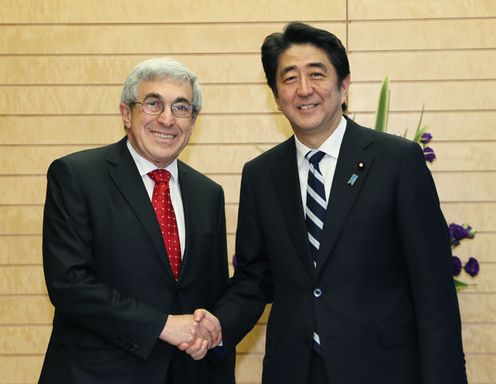
02:35 Meet with President of American Jewish Committee Stanley Bergman
02:58 End meeting with Mr. Bergman
02:59 Meet with Vice-Minister for Foreign Affairs Saiki Akitaka
03:27 End meeting with Mr. Saiki
03:31 Inaugural greeting for Ambassador to Ukraine Sumi Shigeki and colleagues
03:36 Greeting ends
03:37 Director of Cabinet Intelligence Kitamura Shigeru, MOD’s Director of Defense Intelligence Headquarters (DIH) Miyagawa Tadashi, and MOD’s Administrative Vice-Minister Kawashima Takaki enter
03:50 Mr. Miyagawa and Mr. Kawashima leave
04:20 Mr. Kitamura leaves
04:58 Forum for Consultations between the National and Regional Governments
05:03 Forum ends
05:17 Ministerial Council on Monthly Economic Report and Other Relative Issues meeting
05:31 Meeting ends
05:35 Council on Economic and Fiscal Policy meeting
06:27 Meeting ends
07:18 Depart from office
07:40 Arrive at private residence in Tomigaya, Tokyo

Wednesday, October 22, 2014

AM
12:00 At private residence (no visitors)
08:00 At private residence in Tomigaya, Tokyo (no morning visitors)
09:28 Depart from private residence
09:47 Arrive at office
09:57 Meet with Minister of State for Economic and Fiscal Policy Amari Akira and Vice-Minister of Cabinet Office Matsuyama Kenji
10:25 End meeting with Mr. Amari and Mr. Matsuyama
10:26 Science and Technology in Society Forum
10:53 Forum ends
10:54 Meet with LDP Secretary-General Tanigaki Sadakazu
11:28 End meeting with Mr. Tanigaki
11:34 Director of Cabinet Intelligence Kitamura Shigeru and Director of Cabinet Satellite Intelligence Center Shimohira Koji enter
11:44 Mr. Shimohira leaves
11:54 Mr. Kitamura leaves

PM
01:22 Meet with Governor of Nagano Prefecture Abe Shuichi
01:40 End meeting with Mr. Abe
01:52 Meet with LDP Lower House member Noda Takeshi
02:13 End meeting with Mr. Noda
02:23 Meet with LDP Lower House member Kawai Katsuyuki
02:44 End meeting with Mr. Kawai
02:45 Meet with President of Japan-Korea Parliamentarians’ Union [日韓議員連盟 : Nikkan Giin Renmei] Nukaga Fukushiro
03:15 End meeting with Mr. Nukaga
03:37 Interview open to all media: When asked about “the reason for dispatching a group to South Korea” Mr. Abe answers “To those in charge of the special investigative committee, the abduction issue is treated as top priority, and they thought without a dispatch the investigation may become impossible to conduct.”
03:40 End interview
03:43 Government-Labor-Management Meeting
04:38 Meeting ends
04:53 Receive courtesy call from Nobel Prize for Physics award winner Amano Hiroshi, professor at Nagoya University
05:03 Courtesy call ends
05:04 Council for Science, Technology and Innovation meeting
05:29 Meeting ends
05:34 NSC meeting
06:12 NSC meeting ends
06:21 Depart from office
06:26 Arrive at Hotel Okura in Toranomon, Tokyo. Attend dinner party for Tokaido Shinkansen 50th Anniversary of Start of Operations in banquet hall Heian Room, deliver address
07:04 Depart from hotel
07:14 Arrive at hotel Le Port Kojimachi in Hirakawa-cho, Tokyo. Dinner meeting with 1st-time elected LDP Lower House members in banquet hall Shiki-tei
08:53 Depart from hotel
09:12 Arrive at private residence

Thursday, October 23, 2014

AM
12:00 At private residence (no visitors)
08:00 At private residence in Tomigaya, Tokyo (no morning visitors)
09:26 Arrive at private residence
09:43 Arrive at office
10:57 Meet with Director of NSC Yachi Shotaro
11:32 End meeting with Mr. Yachi
11:33 Meet with MOD’s Administrative Vice-Minister Tokuchi Hideshi and Director of DIH Miyagawa Tadashi

PM
12:04 End meeting with Mr. Tokuchi and Mr. Miyagawa
01:17 Depart from office
01:21 Arrive at hotel Grand Arc Hanzomon in Hayabusa-cho, Tokyo. Participate in Memorial Service for Police Officers Who Lost Their Lives on Duty and for Citizens Who Lost Their Lives Assisting with Police Duties in banquet hall Fuji, deliver address, offer flowers
02:02 Depart from hotel
02:06 Arrive at office
03:45 Meet with Singapore’s Minister for Foreign Affairs K. Shanmugam
04:00 End meeting with Mr. Shanmugam
04:30 Meet with Mr. Yachi
05:00 End meeting with Mr. Yachi
05:35 Depart from office
05:42 Arrive at Imperial Hotel in Uchisaiwai-cho, Tokyo. Attend Gathering of Representatives of National Federation of Small Business Associations in banquet hall Fuji, deliver address
06:01 Depart from hotel
06:17 Arrive at Roppongi Hills in Roppongi, Tokyo. Attend Opening Ceremony of Tokyo International Film Festival in movie theater TOHO Cinemas Roppongi Hills, deliver address
06:52 Commemorative photo session with Japanese actor Oka Masi. LDP Upper House member Yamamoto Ichita also attends
06:54 Photo session ends
06:55 Depart from Roppongi Hills
06:56 Arrive at hotel Grand Hyatt Tokyo in Roppongi, Tokyo
07:03 Depart from hotel
07:08 Arrive at (funeral home) Aoyama Sougisho in Minami-Aoyama, Tokyo. Attend wake of the late Sekiguchi Noritaka, President of Bussho-Gonenkai religious organization
07:11 Depart from Aoyama Sougisho
07:20 Arrive at official residence

Friday, October 24, 2014

AM
12:00 At official residence (no visitors)
07:56 Depart from official residence
07:57 Arrive at office
08:02 Cabinet Meeting begins
08:11 Cabinet Meeting ends
10:16 Depart from office
10:25 Arrive at Imperial Palace, secret report to Emperor
11:09 Depart from Imperial Palace
11:17 Arrive at office
11:37 Meet with Secretary-General of Headquarters for the Abduction Issue Ishikawa Shoichiro

PM
12:06 End meeting with Mr. Ishikawa
03:02 Depart from office
03:11 Arrive at Kyodo News in Higashi-Shinbashi, Tokyo
03:12 Informal talk with President of Kyodo News Service Fukuyama Masaki in President’s Reception Room
03:25 Finish talking with Mr. Fukuyama
03:26 Attend Meeting of Managing Editors of Member Companies of Kyodo News in Special Convention Hall, deliver address
03:42 Leave meeting
03:43 Depart from Kyodo News
03:51 Arrive at office
03:57 MOFA’s Vice-Minister Saiki Akitaka and Director-General of Foreign Policy Bureau Hiramatsu Kenji enter
04:23 Mr. Hiramatsu leaves
04:44 Mr. Saiki leaves
04:45 Receive courtesy call from Chiefs of Staff and Other Officials of Air Forces in Indo-Pacific Region
04:59 Courtesy call ends
05:27 Filming for video message regarding Fukuoka 2014 Special Olympics
05:39 Finish filming
06:05 Summit Conference with President of Georgia Giorgi Margvelashvili
06:38 Summit Conference ends
06:41 Joint signing ceremony and joint press release
06:53 Depart from office
06:54 Arrive at official residence. Dinner meeting hosted by Prime Minster Abe Shinzo and his wife
07:59 See off President Margvelashvili
08:02 Finish seeing off President Margvelashvili

Saturday, October 25, 2014

AM
12:00 At official residence (no visitors)
08:00 At official residence (no morning visitors)
09:44 Depart from official residence
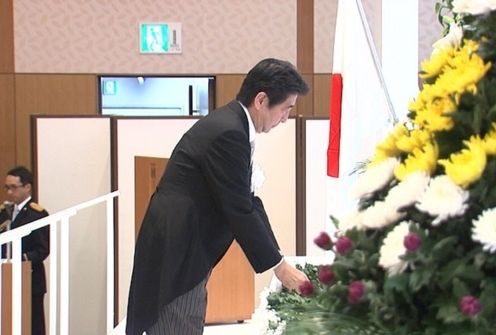
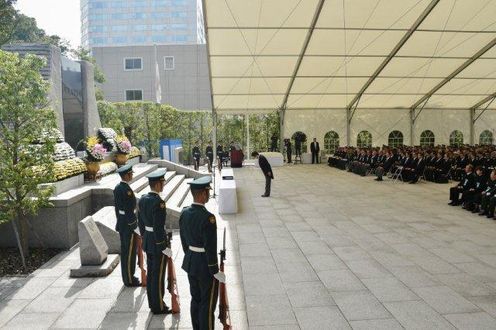
09:58 Arrive at Ministry of Defense in Honmura-cho, Ichigaya, Tokyo. Attend Memorial Service for Members of Self-Defense Force Who Lost Their Lives on Duty, deliver memorial address, offer flowers
10:53 Depart from Ministry of Defense
11:01 Arrive at official residence

PM
Stay at official residence through afternoon and evening

Sunday, October 26, 2014


AM
12:00 At official residence (no visitors)
10:00 Depart from official residence
10:01 Arrive at office
10:11 Depart from Kantei rooftop heliport in Ground Self-Defense Forces’ helicopter. Special Advisors to the Prime Minister Isozaki Yosuke and Hasegawa Eiichi accompany
10:41 Arrive at Hyakuri Base of Air Self-Defense Force (JASDF) in Omitama City, Ibaraki Prefecture
10:51 Meet with Minister of Defense Eto Akinori, MOD’s Chief of Staff for JASDF Saito Harukazu, and Commander of Hyakuri Base Fukazawa Eiichiro at JASDF Air Defense Command’s 7th Air Wing Headquarters Office
11:15 End meeting with Mr. Eto, Mr. Saito, and Mr. Fukazawa
11:19 Arrive at military review site. Attend Air Review Held on 60th Anniversary of Establishment of MOD and Self-Defense Forces, give instruction

PM
01:11 View new US Military transport craft MV-22 Osprey
01:18 Finish viewing craft
01:39 Lunch meeting with Mr. Eto, Chief Representative of New Komeito Yamaguchi Natsuo, MOD’s Administrative Vice-Minister Nishi Masanori, Chief of Staff for Maritime Self-Defense Force Kawano Katsutoshi, Mr. Saito, and colleagues at JASDF Air Defense Command’s 7th Air Wing Headquarters Office
02:13 Lunch meeting ends
02:40 Depart from Hyakuri Air Base by helicopter
03:20 Arrive at Kantei rooftop heliport
03:24 Depart from office
03:40 Arrive at private residence in Tomigaya, Tokyo
04:45 Depart from private residence
04:52 Arrive at salon HAIR GUEST in Shibuya, Tokyo. Hair cut
06:29 Depart from salon
06:40 Arrive at Akasaka Excel Hotel Tokyu in Nagata-cho, Tokyo. Dinner meeting with local supporters in banquet hall Hikari within hotel
08:08 Depart from hotel
08:25 Arrive at private residence


Provisional Translation by: Erin M. Jones