Showing posts with label Meiji Japan. Show all posts

Friday, January 19, 2018

Why modern Japan’s founding moment still divides a nation

Omuta Mine's POW Slave Labor Camp
Mitsui's Miike Mine
UNESCO World Industrial Heritage Site
The Meiji restoration initiated not just modernisation, but also militarism

by Banyan, The Economist, January 11, 2018.

THE story of Japan’s modernisation began 150 years ago this month, when a band of young samurai and their allies overthrew the Tokugawa shogunate and with it seven centuries of feudal rule. Under the shoguns (military rulers), merchant and cultural life—centred upon bustling Edo—had been far from stagnant, as the stunning woodblock prints of Hokusai and Hiroshige attest. But Japan had for more than two centuries been closed and inward-looking. Its stratified society was absurdly rigid.

Above all, the warrior class was ill-equipped to deal with the growing threat posed by the gunboats of America and other Western countries, which had been sailing into Edo Bay and forcing the shoguns to sign treaties opening the country to foreign trade. The contest was unequal. The West had ironclad vessels and the latest guns. The samurai had ceremonial armour with face masks designed to show off impressive false moustaches.

The leaders launched their coup with the slogan “Revere the emperor, expel the barbarians”. For the first part, they called on tradition. They put the imperial line, hitherto mere props in Kyoto, back at the centre of the polity. They brought the 12-year-old emperor, Mutsuhito, up to Edo (now renamed Tokyo, or Eastern Capital), affirmed his unbroken descent from the sun goddess and claimed to rule on his behalf. Mutsuhito died in 1912; posthumously he was given the title of Emperor Meiji. Hence the name for the coup: the Meiji restoration.

As for the second part, far from expelling the barbarians, the new leaders embraced them. In April 1868 a famous “Charter Oath” decreed that “knowledge shall be sought throughout the world” to strengthen imperial rule. Fifty high officials set off on a 22-month world tour to take in everything they could about American and European government, industry, trade, education and warfare. Back in Japan they launched a frenzy of industrial development, administrative reform and military modernisation not even matched by China’s more recent headlong growth. The Meiji restoration was actually a revolution.

For Shinzo Abe, Japan’s current prime minister, the restoration resonates. Mr Abe comes from Yamaguchi, known in feudal times as Choshu. Leaders from Choshu were at the head of the revolution. Mr Abe once told this columnist he identified with them because they did “not simply look inward, but looked…to the world’s wider horizons”. The Choshu men, he explained, saw the threat from Western imperialism. Japan’s harsh choice was either to be the meat served at a Western banquet or a guest at the table. By modernising, Japan became the only big country in Asia to safeguard its independence. It joined the Western high table.

Mr Abe sees lessons in all this, and since he came to office in 2012 he has appeared to be in a tearing hurry to implement them. At home Japan is imperilled by a weak economy, a risk-averse establishment and an ageing, shrinking population. Overseas, China threatens Japan not just in economic terms but, as it grows more assertive, militarily too. A revived economy (with more opportunities for women at work), a vigorous diplomacy and, notwithstanding the constraints of a pacifist post-war constitution, a stronger defence are to him the right responses. (They also help confront the threat posed by a nuclear North Korea.)

The government has gone all-out to promote the 150th anniversary, starting with a push in 2015 to acquire UNESCO “world heritage” status for various spots important in the ensuing industrial revolution. One striking site is Hashima, an island off the coast near Nagasaki that sits above a former coal mine, operated by the Mitsubishi conglomerate, that ran under the sea bed. It was once the most densely populated spot on Earth, housing miners and the families. (Today its post-apocalyptic ruins are best known as the lair of James Bond’s nemesis in “Skyfall”.)

The government website celebrating the Meiji restoration idealises the period as one of grass-roots change and human rights as much as innovation. Yet for ethnic groups whose territory was annexed and culture stifled, such as the Ainu in the north and Okinawans in the south, it was not much fun. The rank-and-file in the new conscript army were brutalised. Workers in the mines and mills led harsh lives. And women, points out Tomomi Yamaguchi of Montana State University, were kept down. They could not vote, divorce or own property. Most Japanese women find little appeal in the nostalgic push by Mr Abe’s Liberal Democratic Party to return to the Meiji era’s “family values”.

Don’t mention the war

There is another problem. The Meiji restoration sowed the seeds of Japan’s 20th-century aggression. The first war dead whose souls were honoured at Tokyo’s Yasukuni shrine, later controversial for honouring war criminals, were those who died fighting for the restoration (though even the losing side was supposedly fighting for the emperor). The authoritarian constitution of 1890, borrowed from that of Bismarck’s Germany, fostered emperor-worship and glorification of the armed forces—powerful features of Japan’s war machine.

By the time of Japan’s defeat in 1945 thousands of Koreans and Chinese had been forced to work the mines in Hashima, among many other sites. [Editor: this was a policy designed by PM Abe's grandfather Kishi.] Mr Abe’s government, after much resistance, promised UNESCO it would reflect this history. Yet on Hashima neither the guides nor the pamphlets and signs refer to it. Members of Mr Abe’s government, and at times the prime minister himself, seem to deny the existence of forced labour at all. [Editor: There was also extensive Allied POW slave labor at most of the UNESCO World Industrial Heritage sites of which there is no mention.]

You can see the conundrum without sympathising with it. Those, like Mr Abe, who are less than frank in acknowledging Japan’s wartime past, are worried about pulling on a thread. No clear event, no Reichstag fire, marked the moment when the country lurched into militarism. If aspects of what the Meiji restoration wrought come into question, what is there left to be proud about? The quest to find a modern identity for Japan continues.

Saturday, June 25, 2016

Prime Minister of Japan’s Schedule July 6-12, 2015

Monday, July 6, 2015 

AM

08:00 At private residence in Tomigaya, Tokyo (no morning visitors)
08:32 Depart private residence
08:48 Arrive at office. Interview to all media: when asked “thoughts on the registering of Japan’s Meiji Industrial Revolution as [UNESCO] World Heritage site,” Mr. Abe answers, “I am immensely delighted that the origin of ‘Monozukuri Japan’ being registered as a World Heritage site. I would like to express my respect including to the locals and each and every business who have strived to protect these sites.”
09:41 Meet with Ministry of Finance Generals Vice-Minister, Kagawa Shunsuke, Senior Deputy Director-General of International Bureau, Yamasaki Tatsuo, Deputy Vice-Minister, Fukuda Junichi and Director-General of International Bureau, Asakawa Masatsugu
10:11 End meeting with Mr. Kagawa, Mr. Yamasaki, Mr. Fukuda and Mr. Asakawa
11:03 Meet with Minister of Health, Labor and Welfare, Shiozaki Yasuhisa. The University of Tokyo lecturer, Shibuya Kenji also attends.
11:43 End meeting with Mr. Shiozaki and Mr. Shibuya

PM
00:01 Ruling Party Liaison Conference
00:32 Conference ends
00:33 Speak with Minister of Foreign Affairs (MOFA), Kishida Fumio
00:42 End speaking with Mr. Kishida
01:24 Meet with Ministry of Defense (DOF)’s Director-General of Bureau of Operational Policy, Miyama Nobuaki and Chief of Staff for Maritime Self-Defense, Kawano Katsutoshi
01:57 End meeting with Mr. Miyama and Mr. Kawano
03:04 Meet with Secretary-General for LDP in Upper House, Date Chuichi
03:37 End meeting with Mr. Date
04:30 Speak with Deputy Chief Cabinet Secretary for Crisis Management, Nishimura Yasuhiko
04:45 End speaking with Mr. Nishimura
05:01 Depart office
05:02 Arrive at National Diet
05:04 Head towards LDP’s President Office
05:05 LDP Officers Meeting
05:31 Meeting ends
05:51 Leave the room
05:52 Depart National Diet
05:54 Arrive at office
06:04 Depart office
06:14 Arrive at Palace Hotel Tokyo. Attend and deliver address at LDP Lower House member, Furuya Keiji 25th year in office celebratory party at banquet hall, Aoi.
06:31 Depart hotel
06:46 Arrive at ‘Eirin’, Chinese restaurant in Akasaka. Dinner meeting with Minister of Land, Infrastructure, Transport and Tourism, Ota Akihiro and New Komeito Lower House member, Toyama Kiyohiko
08:35 Depart restaurant
08:43 Arrive at LDP’s headquarters
08:44 Head towards the President’s Reception Room
08:45 Speak with LDP Upper House member, Onuma Mizuho
08:55 End speaking with Ms. Onuma
08:56 Depart room
09:00 Appear on LDP internet program Café Sta
09:19 Program ends
09:21 Depart headquarters
09:34 Arrive at private residence

Tuesday, July 7, 2015

AM
07:35 Depart private residence at Tomigaya, Tokyo
07:46 Arrive at office
07:57 Attend Nine Minister’s Group of National Security Council meeting
08:04 Meeting ends
08:11 Central Disaster Prevention Council 
08:30 Meeting ends
08:35 Cabinet meeting
08:44 Cabinet meeting ends
09:15 Meet with Secretary-General of Headquarters for Abduction Issue, Ishikawa Shoichiro
09:30 End meeting with Mr. Ishikawa
09:59 Meet with the incoming and outgoing Commissioner of Financial Services Agency Mori Nobuchika and Hosomizu Kiyoshi
10:22 End meeting with Mr. Mori and Mr. Hosomizu
10:23 Meet with Ministry of Finance members, Vice-Minister of Finance, Tanaka Kazuho, Director-General of International Bureau, Asakawa Masatsugu, Chief Cabinet Secretary, Okamoto Shigeaki and, Director-General of Budget Bureau, Fukuda Koichi
10:27 End meeting with Mr. Tanaka, Mr. Asakawa, Mr. Okamoto and Mr. Fukuda
11:07 Depart office
11:22 Arrive at the Tokyo International Forum in Marunouchi, Tokyo. Attend and delivery address at the Opening Ceremony of the 9th UIC World Congress on High Speed Rail
11:49 Depart forum
11:57 Arrive at office

PM
01:15 Minister of Foreign Affairs, Kishida Fumio enters
01:24 Vice-Minister for Foreign Affairs, Saiki Akitaka joins
02:37 End meeting with Mr. Kishida and Mr. Saiki
02:47 National Security Council meeting starts. Minister responsible for Ocean Policy, Yamatani Eriko attends
03:16 End meeting with Ms. Yamatani
03:29 Meeting ends
03:36 Director of Cabinet Intelligence, Kitamura Shigeru, Ministry of Defense members, Director-General of Bureau of Defense Policy, Mr. Kuroe Tetsuro and Director of Defense Intelligence Headquarters, Miyagawa Tadashi enter.
03:46 End meeting with Mr. Kuroe and Mr. Miyagawa
04:06 End meeting with Mr. Kitamura
05:20 Talk with Chief Minister of Andhra Pradesh State of India, Mr. Nara Chandrababu Naidu
05:25 End talk with Mr. Nara
05:48 Depart office
05:53 Arrive at Toranomon Hospital, visit former Private Secretary in hospital
06:15 Depart hospital
06:22 Arrive at The Prince Park Tower Tokyo in Shiba Park, Tokyo. Informal talk with LDP members: Minister of Education, Culture, Sports, Science and Technology, Shimomura Hakubun, Minister of Environment, Mochizuki Yoshio and Chairman of LDP Diet Affairs Committee, Satou Tsutomu in ‘party room’ venue. Chief Cabinet Secretary, Suga Yoshihide also attends
07:15 Depart hotel
07:22 Arrive at hotel Andaz Tokyo. Dinner with LDP Secretary-General, Tanigaki Sadakazu, and New Komeito representative, Yamaguchi Natsuo and Secretary-General of New Komeito, Inoue Yoshihisa at restaurant Andaz Tavern
09:09 Depart hotel
09:15 Arrive at LDP headquarters, appear on LDP internet program Café Sta
09:56 Depart LDP headquarters
10:13 Arrive at private residence

Wednesday, July 8, 2015

AM
08:00 At private residence in Tomigaya, Tokyo (no morning visitors)
08:31 Depart private residence
08:43 Arrive at office
08.53 Meet with Deputy Chief Cabinet Secretary, Seko Hiroshige
09:20 End meeting with Mr. Seko
09:56 Depart office
09:58 Arrive at National Diet
09:59 Head towards Upper House President’s Reception Room
10:06 Depart reception room and head towards Upper House Chamber. Attend Plenary Session of the House of Councillors
11:47 Leave seat during proceedings at Upper House Plenary Session
11:49 Depart National Diet
11:51 Arrive at office

PM
00:27 Meeting with mayors of municipalities. Take commemorative photo including Mayor of Niigata city, Mori Tamio and Mayor of Kawakami village in Nagano prefecture, Fujibara Tadahiko
00:29 Meeting ends
00:30 Informal talk with Mr. Mori and Mr. Fujibara. Minister of Internal Affairs and Communications, Ms. Takaichi Sanae also attends
01:09 Informal talk ends
02:19 Meet with Senior Vice Minister of Ministry of Land, Infrastructure, Transport and Tourism, Kitagawa Issei
02:39 End meeting with Mr. Kitagawa
03:00 Meet with Director of LDP's Division of Education, Culture, Sports, Science, and Technology, Tomioka Tsutomu
03:17 End meeting with Mr. Tomioka
03:39 Meet with LDP Secretary-General, Tanigaki Sadakazu
04:16 End meeting with Mr. Tanigaki
05:08 Education Rebuilding Implementation Council
05:32 Meeting ends
06:29 Depart office
06:31 Arrive at official residence. Dinner meeting with members from Ruling Coalition on the Development of Security Legislation, LDP Vice-President, Komura Masahiko and Deputy Chief Representative of New Komeito, Kitagawa Kazuo. Chief Cabinet Secretary, Suga Yoshihide and Minister of Defense, Nakatani Gen also attend.
07:54 Depart official residence
07:58 Arrive at LDP Headquarters, appear on LDP internet program Café Sta
08:50 Depart headquarters
09:08 Arrive at private residence

Thursday, July 9, 2015

AM
08:00 At private residence in Tomigaya, Tokyo (no morning visitors)
08:41 Depart private residence
08:56 Arrive at Hotel Okura in Toranomon, Tokyo. Attend and give lecture at Japan Summit 2015 in banquet hall Heian Room
09:52 Depart hotel
09:57 Arrive at office
10:26 Speak with Special Advisor to the Prime Minister, Isozaki Yosuke
10:36 End speaking with Mr. Isozaki
10:37 Meet with Vice-Minister for Foreign Affairs, Saiki Akitaka and Ministry of Foreign Affairs (MOFA) Director-General of Asian and Oceanian Affairs Bureau, Ihara Junichi
11:12 End meeting with Mr. Saiki and Mr. Ihara
11:33 Inaugural address to Ambassadors to Tunisia, Hasegawa Susumu
11:37 End meeting with Mr. Hasegawa and others

PM
00:54 Depart office
00:56 Arrive at National Diet
00:57 Head towards Lower House Chamber
00:58 Speak with Deputy Prime Minister and Minister of Finance, Aso Taro and Special Advisor to President of LDP, Haiguda Koichi
01:00 End speaking with Mr. Aso and Mr. Haiguda
01:02 Lower House Plenary Session opens
01:05 Session adjourns, leave the Lower House Chamber
01:08 Depart National Diet
01:10 Arrive at office
01:50 Meet with JR Tokai Honorary President, Kasai Yoshiyuki and board member, Torkel Patterson
02:11 End meeting with Mr. Kasai and Mr. Patterson
02:12 Speak with LDP Lower House member, Kawai Katsuyuki
02:22 End speaking with Mr. Kawai
02:33 Courtesy Call from the President of the Senate of Mexico and His Delegation
02:56 Courtesy Call ends
04:02 Courtesy Call from the All-Japan Ryokan Proprietress Group
04:11 Courtesy Call ends
04:19 Meet with Vice-Minister of Finance, Tanaka Kazuho, financial official, Asakawa Masatsugu and Ministry of Finance’s Director-General of International Bureau, Momma Daikichi
05:06 End speaking with Mr. Tanaka, Mr. Asakawa and Mr. Momma
06:06 Depart office
06:15 Arrive at the headquarters of Yomiuri Newspaper. Attend and deliver address at CSIS Symposium: “Reflections on Global History of the 20th Century- Towards a New Vision for the 21st Century” 
06:31 Depart headquarters
06:43 Arrive at Hotel Andaz Tokyo in Toranomon, Tokyo. Dinner meeting with future generation party leader, Hiranuma Takeo and Secretary Generals including Matsuzawa Shigefumi at restaurant Andaz Tavern. Chief Cabinet Secretary, Suga Yoshihide also attends
08:38 Depart hotel
09:01 Arrive at private residence

Friday, July 10, 2015

AM
06:48 Depart private residence in Tomigaya, Tokyo
07:01 Arrive at office
07:02 Meet with Deputy Chief Cabinet Secretary, Kato Katsunobu
08:07 End meeting with Mr. Kato
08:08 Meeting of the Headquarters for Water Cycle Policy
08:17 Meeting ends
08:21 Cabinet meeting
08:28 Meeting ends
08:29 Speak with Minister in charge of Abduction Issue, Yamatani Eriko
08:30 End speaking with Ms. Yamatani
08:31 Meet with Deputy Chief Cabinet Secretary, Kato Katsunobu
08:52 End meeting with Mr. Kato
08:53 Depart from office
08:54 Arrive at National Diet
08:56 Head towards Lower House Committee Room No.1
09:00 Meeting of the Special Committee of the House of Representatives on the Legislation for Peace and Security of Japan and the International Community

PM
00:05 Lower House of Representatives Recess
00:06 Depart room
00:08 Depart National Diet
00:09 Arrive at office
00:54 Depart office
00:55 Arrive at National Diet
00:57 Head towards Lower House Committee Room No.1
01:00 Meeting of the Special Committee of the House of Representatives resumes
05:02 Meetings ends
05:04 Depart room
05:06 Depart National Diet
05:07 Arrive at office
05:09 Meet with Director of National Security Council, Yachi Shotaro
05:32 End meeting with Mr. Yachi
05:33 Meet with Director of Cabinet Intelligence, Kitamura Shigeru
05:57 End meeting with Mr. Kitamura
06:16 Courtesy Call from a Delegation from the Japan-Korea and Korea-Japan Parliamentarian’s Unions
06:30 Courtesy Call ends
06:40 Depart office
06:42 Arrive at The Capitol Hotel Tokyu, dinner meeting with private secretary at ‘Origami’ restaurant in the hotel
07:42 Depart hotel
07:46 Arrive at LDP Headquarters, appear on LDP internet program Café Sta
08:22 Depart headquarters
08:39 Arrive private residence

Saturday, July 11, 2015

AM
07:07 Depart private residence in Tomigaya, Tokyo
07:26 Arrive at JR Tokyo Station
07:36 Board Hayabusa No. 3, accompany by Minister of Reconstruction, Mr. Takeshita Wataru
09:10 Arrive at JR Sendai Station
09:16 Depart station
09:46 Visit to Miyagi Prefecture. Arrive at Yuriage Memorial at Natori City, Miyagi Prefecture. Reception with Natori City Mayor, Sasaki Isoo, offer flowers and silent pray
09:52 Depart from memorial
10:00 Arrive at Shimomasuda District Emergency Housing. Inspect and discuss with residents
10:11 Depart the area
10:16 Arrive and inspect food complex, ‘Roku Farm Atalata’
10:53 Depart complex

PM
00:31 Arrive at temporary shopping village, ‘Minamisanriku Sun Sun Shopping Village’ in Minamisanriku Town. Reception with Prefectural Governor, Murai Yoshihiro and Minamisanriku Town Mayor, Sato Jin
00:37 Eat lunch at seafood restaurant, ‘Hashimoto’ in shopping village
00:57 Inspect shopping village
01:08 Inspection ends
01:09 Depart shopping village
01:11 Arrive and inspect ‘JA Minamisanriku head store and Shizugawa branch store’
01:16 Depart store
01:26 Arrive and inspect Shizugawa Public Hospital Minamisanriku clinic in Shizugawa Higashi area
01:31 Depart clinic
01:33 Arrive at Minamisanriku provisional government building, exchange of opinions with doctors, NPOs and residents.
02:21 Interview open to all media: ‘Concerning the piece of legislation related to security, won’t the voting unavoidably be by the ruling party alone?’ Mr. Abe answers, ‘I think they will make a decision when the time comes to make a decision.’
02:25 Interview ends
02:26 Depart from government building
04:18 Arrive at JR Sendai station
04:35 Board Hayabusa No.24
06:05 Arrive at JR Tokyo station
06:10 Depart station
06:36 Arrive at private residence

Sunday, July 12, 2015

AM
10:00 At private residence in Tomigaya (no morning visitors)
Stay at private residence throughout the morning

PM
02:11 Depart private residence
02:27 Arrive at ‘Grand Hyatt’ Hotel in Roppongi Tokyo. Exercise at ‘Nagomi Spa and Fitness’
05:05 Depart hotel
05:27 Arrive at private residence

Provisional translation by Kelly Ing

Saturday, July 4, 2015

UNESCO and Japan’s Act of Forgetting

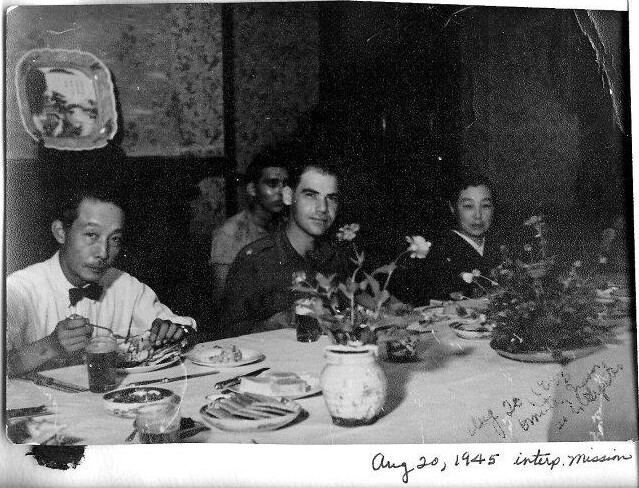
Baron Mitsui hosting a dinner for senior POW officers from Fukuoka #17,
the Miike Omuta Mine, after the war
Designation of Japan’s Meiji-era sites overlooks some important history.

By Mindy Kotler, APP Director
The Diplomat, July 3, 2015

For more on the American POW experience with Imperial Japan see the APP blog American POWs of Japan

This is Karel Aster’s year. In April, the Czech Republic granted the 95-year-old Florida resident the nation’s highest honor, the Gratias Agit, for his valor and bravery during World War II. Aster had volunteered to fight with the Americans in 1941 to defend the Philippines against the Japanese invasion. He survived the battle, the Bataan Death March*, a hell ship to Japan, and years as a slave laborer at a Mitsui coal mine at Omuta, Kyushu Island.

Also at the Mitsui site were American Lester Tenney and Australian Tom Uren. Tenney, another survivor of the Bataan Death March, persuaded the Japanese government in 2009 to apologize to the American POWs of Japan. Uren, who died last January, was a leading Labor Party politician who secured supplementary payment to Australia’s 900 surviving prisoners from World War II and the Korean War.

Account by a Scottish POW
of Mitsui's Miike coal mine
click to order
This coming weekend, UNESCO will designate the Mitsui Miike coal mine as a World Heritage site of Japan’s early modernization. The Japanese nomination, however, makes no mention of the history of any WWII POWs or of the thousands of Asian slave laborers at this site.

UNESCO is expected to approve 23 similar Japanese-nominated sites. Absent will be any accounting of the dark histories associated with these mines, foundries, and shipyards. Silence about the full history of these would-be global landmarks undermines UNESCO’s international goals and the U.S.-Japan alliance.

Lester Tenney's account of
being a  POW at
Mitsui's Miike coal mine
Currently there are 1,007 sites on the UNESCO World Heritage List. They are to serve as “instruments of international understanding and international cooperation.” The World Heritage accolade brings prestige and international attention to unique cultural accomplishments.

World Heritage sites often become tourist attractions and many nations view the designation as a path to reviving fading regions and cities. That is one motive behind Japan’s nomination of its sites. But the selective telling of their history is part of the Abe administration’s broader policy of restoring Japanese pride in their past.

Dr. Thomas Hewlett
Mitsui Omuta POW
Camp doctor
click to read
his account of conditions
The regions of Japan’s UNESCO nominations are in search of tourist dollars as they are among the hardest hit by the country’s economic downturn. Tourism is a growth industry in Japan with visitors from China nearly doubling and Korea not far behind. Many of the nominated sites are also located in the home districts of Prime Minister Shinzo Abe, Deputy Prime Minister and Finance Minister Taro Aso, and Agriculture Minister Yoshimasa Hayashi.

The family companies of Aso and Hayashi, The Aso Group and Ube Industries respectively, used Allied POW slave labor at company sites included among the nominations. Of the eight industrial areas nominated, five held 26 POW camps with nearly 13,000 Allied POWs providing slave labor to Japan’s industrial giants, including Mitsui, Mitsubishi, Sumitomo, Aso Group, Ube Industries, Tokai Carbon, Nippon Coke & Engineering, Nippon Steel & Sumitomo Metal Corporation, Furukawa Company Group, and Denka. The POWs came from the United States, Canada, the United Kingdom, Australia, India, New Zealand, Norway, Jamaica, Portugal, South Africa, Malaya, Arabia, and Czechoslovakia.

In addition, the nominated ports at Kitakyushu, then called Moji, and Nagasaki, were the entry points for nearly 35,000 Allied POWs, of which approximately 11,000 were American. Over 7,000 American and Allied POWs died traveling to Japan aboard the aptly called “hell ships,” and 3,500 more perished in Japan, 25 percent within the first 30 days of arrival.

Slave labor in Japan did not begin with World War II. Forced and conscripted labor was a critical part of the mining and manufacturing industries in nineteenth-century Meiji Japan. From late Meiji (1868-1912) onward, Japan used “industrial prisons” to supply labor to factories and mills at private companies. Up until the 1930s, the majority of the miners were convicts with the rest being peasants made landless by Meiji land reforms and “outcastes.” One-third were women. Cheap Chinese and Korean labor became important in Japan’s mines and factories, and on the docks.

Tokyo’s World Heritage nominations fail to address the full historical significance of these sites. Japan’s industrialization included Japanese and foreigners, nobles and outcasts, POW slaves and conscripted Koreans, as well as women and children. Without taking these into account, the story Japan wants to tell fails to meet UNESCO criteria of “universal value and meaning.”

Japan and UNESCO should look to the perhaps surprisingly positive experience of other World Heritage sites that do acknowledge their darker histories. The Liverpool-Maritime Merchant City site is a striking case in point. The Liverpool port served a key role in the triangular transatlantic slave trade of the eighteenth and early nineteenth centuries.

Liverpool has acknowledged its substantial role in a deplorable (and what would today be a criminal) business. Liverpool opened in 2007 the International Slavery Museum on the dock and, in 2006, a Centre for the Study of International Slavery at the University of Liverpool. Identical memorials to the victims of slavery stand on the docks of Liverpool, Richmond, Virginia, and Cotonou, Benin, linking this shared memory among them. These resources have drawn scholars and others and have in fact bolstered Liverpool’s reputation has a place where history – both good and bad – can be studied and understood.

Of the 21 nations represented on today’s UNESCO World Heritage committee, nationals from six were World War II POWs held on mainland Japan. These are: India, Malaysia, Jamaica, Finland, Poland, and Portugal. A seventh, South Korea, had hundreds of thousands of its men and women conscripted to work in near slavery conditions.

The U.S. does not have a vote in UNESCO. But Washington can speak to its Japanese ally to remind them of the debt they owe American veterans for defending their freedom.

On the morning of August 9, 1945, all the POWs in Omuta saw the red cloud rise from Nagasaki across the bay. Although a very modern weapon ended their ordeal at the Miike mine, they had experienced labor in Japan that had changed little since Meiji times. They would not want such forced labor to be repeated and certainly none would want it forgotten.

As it stands, Japan’s nomination of Meiji industrial sites is an act of forgetting. It omits the full history of Japan’s industrialization. For UNESCO to accept this is a disservice to its charter and to the memory of the thousands that slaved for Imperial Japan.

*Correction: Mr. Aster avoided the Bataan Death March by escaping to Corregidor. He was forced to participate in a "Victory March" of POWs six miles down Manila's Dewey Boulevard to Bilibid Prison. The Corregidor POWs stayed there until they were packed on freight trains for the 90-mile trip to Cabanatuan Prison Camp. Mr. Aster was a POW in the Philippines until October 1944 and did not arrive in Japan until March 1945. Thus, he was less than six months at the Miike Coal mine,  unlike Dr. Tenney who was there nearly three years. Czech government biographies, from which this article drew, are incorrect.

Grammatical corrections made July 7, 2015.

Unesco and the story of Japan's Meiji Era

Front Gate Fukuoka #2 POW Camp - Mitsubishi Shipyards Nagasaki

If badly handled, the World Heritage listing could serve to recouple the impressive Meiji industrial revolution to the slumbering concept of Japan as the glorious "light of Asia".

BY WILLIAM UNDERWOOD
Independent scholar and APP member who completed his PhD at Kyushu University on reparations movements for forced labour in wartime Japan.

THE STRAITS TIMES, June 29, 2015

THE Unesco World Heritage Committee yesterday began considering this year's nominations to the World Heritage List. The 10-day session is normally quiet, and acceptance of the proposals - already vetted by an advisory body called the International Council on Monuments and Sites (Icomos) - is considered routine.

The 500-page Icomos advisory report provides a flavour of the 40-plus nominations slated for approval: rock art sites in Saudi Arabia and Uganda, Viking sites in northern Europe, a bridge in Britain, Spanish missions in the United States, an aqueduct in Mexico, a monastery in Georgia and the Singapore Botanic Gardens.

Then there is Japan's ambitious - even audacious - Unesco bid.

"Sites of Japan's Meiji Industrial Revolution" seek World Heritage status for two dozen mines, factories, ports and shipyards located mainly in the nation's south-west. The Icomos report released last month notes the properties represent the "first successful transfer of industrialisation from the West to a non-Western nation".

The governments of South Korea and China, however, have expressed opposition to the listing, and vigorous lobbying campaigns on both sides of the issue have injected international politics into the upcoming discussion about cultural landmarks.

Critics of the Japanese package view Meiji Era (1868-1912) nation-building as inseparable from 20th-century empire-building, which led inexorably to Japanese colonialism and the Asia-Pacific War. History is never easy in North-east Asia.

Resistance to Japan's plan stems from the fact that some 700,000 Koreans, 40,000 Chinese and 35,000 Allied prisoners of war (POWs) performed forced labour for private industry in wartime Japan.

But there have been almost no corporate acknowledgments, no apologies and no compensation to individual victims.

Fully one-third of Japan's would-be Unesco sites can be directly connected to forced labour, and groups representing US and British former POWs are also sceptical about Tokyo's application.

These nominated venues include port facilities at Moji in Fukuoka prefecture, through which tens of thousands of workers bound for the Kyushu coal mines involuntarily passed. Their toil produced profits for companies like Mitsui and Mitsubishi, the zaibatsu twin pillars of wartime production that owned - or still own - several of the properties slated for Unesco's imprimatur. In fact, Mitsubishi has operated the Nagasaki shipbuilding yard - where hundreds of forced labourers perished in the American atomic bombing that ended the war - for the past 128 years.

Yawata (or Yahata) Steel Works, originally known as Imperial Steel Works, was built by the central government using hefty indemnity payments extracted from China following the First Sino-Japanese War of 1894-1895. The mills were later taken over by Nippon Steel, which ran the enterprise using forced labourers during the war and runs it today as Nippon Steel & Sumitomo Metal Corp. The inclusion in a World Heritage application of working sites belonging to private firms is considered atypical.

Japan's initiative to showcase the remarkable industrial achievements of the Meiji Era represents a focused, sustained public-relations effort. Its stated theme being "From a small Asian nation to world economic power", the Kagoshima-based official website for the global push (with an English version at www. kyuyama.jp/e) recounts the rise of modern Japan beginning with the Opium Wars, which presaged a regional geopolitical upheaval that rightly alarmed the foundering Tokugawa shogunate.

"Emergence of Industrial Japan: Kyushu-Yamaguchi" is a 20-page summary of the original Unesco proposal prepared by Japan in 2009. Japan at the dawn of the Meiji Restoration, according to the promotional piece, "chose rapid industrialisation as a strategy to preserve national independence, free from foreign political and economic subordination. Japan was determined to join the modern world economy on its terms rather than those of a colonial power. It was to become the master of change rather than its victim".

The World Heritage submission bookends the histories of the proposed sites at 1850 and 1910, with the latter year marking (perhaps coincidentally) the start of Japan's formal annexation of Korea. Since the Meiji emperor reigned until 1912, this bracketing may seek to sidestep the contentious history of colonialism on the Korean peninsula, which set the stage for the annexation of Manchuria in 1931 and eventually for total war with China and the West.

To some observers, the nature of Japan's unusual "serial nomination" of 23 sites spread across eight prefectures, intended to highlight 60 years of relatively recent national emergence, suggests an ulterior motive. So does the pending listing of Shokasonjuku Academy in Yamaguchi prefecture. This property, according to the Icomos report, was "one of the bases of the respected royalist teacher, Shoin Yoshida, who aspired to progressive ideas based on Western education, science and industry but with respect to Japanese traditions".

Yoshida himself was executed for his revolutionary activities by the Tokugawa regime in 1859, but he provided the philosophical compass for the core of young samurai leaders who engineered the Meiji Restoration in 1868. Later, however, ideas first expounded at Shokasonjuku Academy morphed into a wellspring of motivation and justification for Japanese militarism and expansion on the Asian mainland - and beyond. Yoshida and his followers were held up as a dynamic contrast to the "backwardness" of other Asians who had not successfully responded to the challenge of Western domination.

There may be a mismatch between the Icomos finding that Japan's package meets the Unesco requirement for "outstanding universal value" and the portrayal in Japan's own pitch of a "unique and exceptional affirmation of the cutting-edge, living, industrial cultural tradition of this small Asian nation".

Similarly, the Japanese website's headline for the boosterish section on Imperial Steel Works reads: "Mighty national enterprise remains testimony to dauntless Meiji spirit."

Unesco is set to confirm the Meiji industrial sites at a moment when historical revisionism related to the Asia-Pacific War is increasing under Prime Minister Shinzo Abe, who has challenged interpretations of Japan's imperialism, colonialism and prosecution of the war that have been accepted as mainstream since 1945.

The World Heritage application was originally submitted during the premiership of Mr Taro Aso, the current Cabinet member who wrote a 2007 book called Japan The Tremendous. In the book, Mr Aso contends Japan is a "fount of moral lessons" for Asia.

The Icomos advisory report, while urging approval of the Japanese bid, also calls on Japan to prepare an interpretive strategy that "allows an understanding of the full history of each site".

By holistically depicting the forced labour-linked sites and adopting best practices for inclusive historical narration, Tokyo's Unesco project could potentially become a model for transnational exchange, understanding and reconciliation.

If badly handled, the World Heritage listing could serve to recouple the impressive Meiji industrial revolution to the slumbering concept of Japan as the glorious "light of Asia". The story of modern Japan might then degenerate into a nationalistic narrative about Imperial Japan's overseas aims and actions. That's the last thing the region needs now.