Showing posts with label Mitsubishi. Show all posts

Sunday, June 14, 2026

Cruciatus in cruce


U.S. Senator Bob Packwood, 93, died on June 6 in California. A relatively liberal Republican senator representing Oregon, he was forced to resign the Senate in 1995 because he accepted a bribe from Mitsubishi Electric Corp (MEC). Although the Justice Department declined to prosecute him, the details of the case combined with multiple accusations of sexual misconduct with female staff to have his fellow Senators to demand his resignation. It is possible that the harassment claims were cover for the more serious charges of bribery. However, his obituaries only mention the "sex scandal."


The lobbyist who worked on Senator Packwood for MEC and many other Japanese companies was Steven Saunders (Saunders & Co. one of the more notorious lobbyists for Japan) . He died last year at 78 in Alexandria, VA. MEC was the focus of congressional inquiry and a Harvard Business School case study on its aggressive and eventually successful effort to co-opt the patent and put out of business Fusion Systems that was then-owned by the rowing legend Don Spero (who is still alive,1964 Olympian and 1966 world champion).

Thursday, August 22, 2024

The Sado Gold Mine Decision

General Masaharu Homma
"Beast of Bataan"
Sado Island was family fiefdo
m
Is Compromise Over History Possible?

First published on the Korea Economic Institute website, August 14, 2024

BY Daniel Sneider, APP Member, is a Lecturer of International Policy and East Asian Studies at Stanford University and a Non-Resident Distinguished Fellow at the Korea Economic Institute of America. The views expressed here are the author’s alone.

The transformation of relations between South Korea and Japan during the past two-plus years is one of the signal accomplishments of the Yoon Suk-yeol administration. However, there remain doubts over the durability of this achievement. A troubling question remains whether the historical past of Japan’s colonial rule over Korea will again roil relations. The ongoing division between the two countries over colonial and wartime history, alongside Korean demands for historical justice, is again on display in recent weeks.

Background and Controversy Surrounding the Sado Gold Mine

On July 27, the World Heritage Committee of the United Nations Educational, Scientific and Cultural Organization (UNESCO) formally granted the prized World Heritage Site status to the gold mines located on Japan’s Sado Island. Submitted to UNESCO in 2015, Japan had included the mines on a list of sites that supported its industrial revolution. The Sado gold mines were developed during the Tokugawa era and played an important role in Japan’s modernization. Although the mines are no longer operational, they have been preserved as a historical site for tourists.

The controversy surrounding Japan’s application centers on the wartime history of the mines and the use of Korean workers to carry out dangerous mining operations. The South Korean government and civic activists opposed the granting of World Heritage status to the gold mines. Koreans, along with numerous Western and Japanese historians, insist that many of the workers were brought to the mines against their will, either through coercion or deception. The objections to the granting of World Heritage status rested on compelling Japan to acknowledge the role of Korean forced labor at the site itself and in its official accounts.

The Sado decision reflected a compromise by Japan that was supported by the South Korean government and reached through diplomatic negotiations. It included an agreement by Japan to present the role of Korean workers and their harsh working conditions, as well as hold an annual ceremony to pay respect to them. An exhibit at a museum near the site was created to provide information on the more than 1,500 Korean laborers who worked there, including the fact that they faced more dangerous conditions than their Japanese counterparts and other harsh measures.

However, it avoided using the term “forced labor,” which the Japanese government has always opposed. Within Korea, this compromise has been assailed, particularly by the opposition Democratic Party and Korean media commentary. The Yoon government has been accused of deliberately and misleadingly claiming that Japan had agreed to fully accept this history.

“The Japanese government had never acknowledged the concept of forced labor,” former Korean Ambassador to Japan Shin Kak-soo told this writer in an email exchange. Even in the case of Battleship Island (discussed below), it tried to find language that avoided the term. “This time, it seemed the negotiations did not squarely address this issue.”

Nonetheless, Ambassador Shin believes that the compromise was justified. “My hunch is that the Korean government strove to put more emphasis on the real teaching of history to the visitors to the site than arguments on the wording,” the former diplomat, who remains active on relations with Japan, said. “We need to assess the outcome as a product of diplomatic compromise, given the big gap between the two sides on their historical views.”

Japan Fails to Fill Out the History

At the time of the 2015 application, the Japanese government, then led by the late Abe Shinzo, denied the forced nature of Korean labor and discrimination against Koreans at the sites. But UNESCO insisted that Japan clearly admit that “a large number of Koreans and others…were brought against their will and forced to work under harsh conditions in the 1940s at some of the sites.”

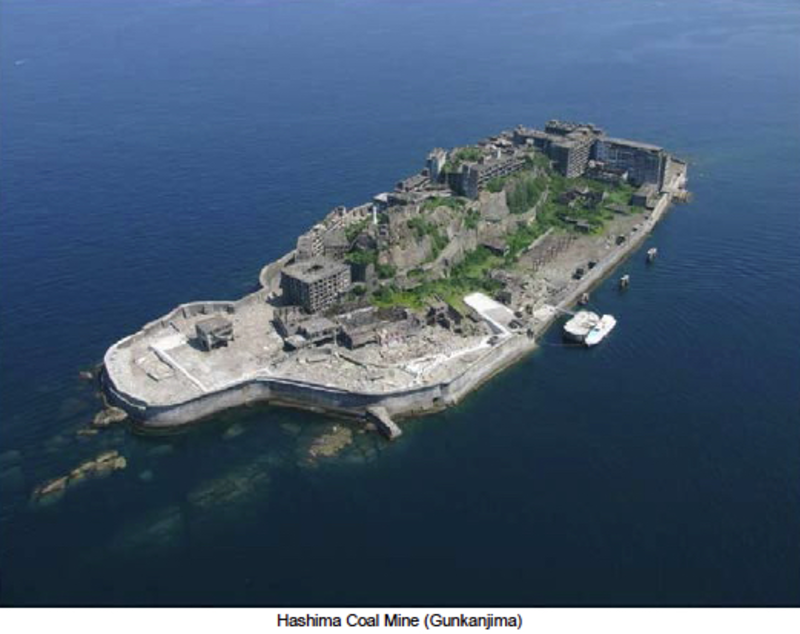
The coal mine operated on Japan’s Hashima Island, popularly known as Battleship Island, was granted World Heritage status in 2015, but only after Japan agreed to include the “full history” that would “allow an understanding that there were a large number of Koreans and others who were brought against their will and forced to work under harsh conditions in the 1940s at some of the sites.” Even then, a follow-up monitoring team found in 2021 that the information center failed to do this.

In the case of the Sado Mine, historians have documented that at least 1,519 Koreans were forced to work from 1939 until the end of World War II. The initial application filed by the local government, which sought the status to promote tourism to the island, made no mention of the wartime era. It confined itself to the history of the mines during the Tokugawa and Meiji era (until 1912), seeking to avoid this controversy.

The Korean government opposed this application, as did UNESCO experts. UNESCO’s International Council on Monuments and Sites requested that the Japanese applicants deal with the wartime period, and a supplemental document was submitted to respond to this issue. The document offers a description of three phases of labor “recruitment” that implies the Korean workers voluntarily agreed to work at the mines until 1944, when labor “requisition” was compulsory. The Japanese official document also asserts that there was no discrimination between Korean and Japanese workers and that the Koreans were paid wages.

The descriptions of the phases of “recruitment” in the document are “misleading,” Dr. Nikolai Johnsen, a British scholar at the University of London who has researched and written extensively on this history, told this writer. The workers were signed up by agents supported by the colonial government “who compelled large groups of men from impoverished Korean villages to take up dangerous work in Japan under false pretenses.” During the second phase, which began in 1942, the colonial regime directly selected the workers, and opposition “often had dire consequences” in the form of “forced mobilization,” the scholar said.

Further, Johnsen explained that “claiming this system was non-discriminatory is simply historical denialism.” Wages and working conditions were far from equal, and much of the wages were never paid, held in accounts by Mitsubishi but never released.

The Japanese account also uses the term “workers from the Korean Peninsula,” a formulation that treats Koreans as subjects of the Japanese Empire and refuses to recognize them as foreign forced laborers. “Recognition of the true character of this history would greatly elevate the universal value of the Sado mines as a UNESCO World Heritage site,” Johnsen wrote in a paper published two years ago. “They cannot be suppressed for the sake of instilling pride in future Japanese generations to the neglect of the victims.”

Lingering Disputes and the Shadow of History

This is not an issue confined to the question of World Heritage status. Suits filed in Korea by Korean workers and their descendants against Japanese companies who used forced labor – and in the case of these mines, Mitsubishi Materials – were a central part of the downturn in Korea-Japan relations in 2018. The successful rulings in favor of the workers, who demanded compensation for unpaid wages, remain an issue despite the Yoon administration’s decision last year to resolve the problem by using a Korean-funded foundation to settle the demands.

That is quite distinct from the way Mitsubishi Materials dealt with a suit filed by Chinese forced laborers that was settled in Chinese courts in 2016 with compensation payments and an apology from the company. The company also offered similar apologies [sic, there was only one apology] to American POWs used as forced labor in their mines during the war. The contrast with Japan’s approach to Korea remains problematic, to say the least.

As noted, the Yoon administration’s drive to improve relations with Tokyo is a signal accomplishment. From the standpoint of geopolitics, the most notable consequence of this improvement has been the deepening of trilateral security cooperation with the United States and Japan. However, both trilateral ties and improved bilateral relations with Japan remain vulnerable not only to a change in political leadership but also to the lingering and potentially explosive effects of unaddressed historical grievances.

Monday, July 26, 2021

UNESCO and Japan's rewriting of history

Baron Mitsui holding a dinner for newly released
senior POWs who were slave laborers
at his Miike Coal Mine
At UNESCO, Japan lays bare the difficulties of achieving shared values within the Quad.

By Mindy L. Kotler

Originally published in The Diplomat, July 23, 2021
This version is slightly revised for clarity

On July 22nd, the Quadrilateral Security Dialogue or Quad, comprising the United States, India, Japan, and Australia, faced its first test. Unexpectedly, it came at the UNESCO World Heritage Committee. The focus was on Japan, not China, and the result reveals how fragile the idea of shared, universal values is for this multilateral coalition. As things stand, Japan is a willful outlier.

At the World Heritage Committee’s 44th virtual session, there was a review of several previously designated Japanese UNESCO World Industrial Heritage sites that were the scene of war crimes in World War II. Americans, Australians, and Indians were among the thousands of Allied prisoners of war (POWs) brought to Japan during the war. They became slave laborers in various private mines, chemical factories, and steel mills, and on docks critical to support Imperial Japan’s war effort.

These very mines, foundries, and wharves were selected by Japan to represent its “Meiji Industrial Revolution: Iron and Steel, Shipbuilding and Coal Mining.” The Japanese, however, left out any mention of this forced labor and abuse, which was the substance of the hundreds of war crimes trials throughout the postwar Pacific.

UNESCO approved the designations in 2015 but conditioned the designations on a promise to provide a “full history” of these sites. Yet, six years later, Japan has not fulfilled this promise. Japan’s forced colonial workers from Korea are given slight mention, although Japan refuses to admit they were unwilling or unhappy. The POWs, which included soldiers, civilians, and mariners from Ireland, Egypt, Norway, Argentina, Jamaica, Portugal, Italy, and Arabia are unmentioned in any official publications, whether at the particular sites or at the Tokyo Industrial Heritage Information Center, which was opened in March 2020.

On July 12, 2021, a UNESCO draft decision noted that Japan still had to improve its interpretive strategy. The reprimand of Japan’s unwillingness to tell the “full history” of these properties was approved July 22. The Committee believes measures are still necessary to “allow an understanding of a large number of Koreans and others” who were forced or slave laborers. 

Unfortunately, UNESCO identifies POWs only as “others. This euphemism affirms Japan’s effort to censor its war crimes and rewrite the history of World War II. UNESCO members Australia, the United Kingdom, India, Norway, and the Netherlands need to insist that “others” means their veterans.

To satisfy UNESCO’s directive to include “others,” it is implied that Japan must acknowledge that five of the UNESCO industrial heritage sites — Hagi, Kamaishi, Miike, Nagasaki, and Yawata — held 26 POW camps during the war and provided more than 13,000 POW slave laborers from over 16 countries to Japan’s industrial giants, including Mitsui, Mitsubishi, Sumitomo, and Nippon Steel.

The Miike Coal Mine (Fukuoka #17) warrants particular attention. The mine, owned by the Mitsui conglomerate, was Japan’s largest. Nearly 2,000 Allied POWs suffered capricious brutality and starvation in deadly and primitive conditions. Hundreds died. American POWs were so desperate for a respite from the coal pits that they traded their meager rice bowls for someone to break their arms or legs.

Kamaishi’s industrial area (Sendai #4B and Sendai #5B) is also illustrative of missing war history. The site was the first to be bombed by U.S. Navy warships off Japan’s unguarded coastline. The iron works at this site, still owned by Nippon Steel, were among Japan’s largest. On July 14, 1945, more than 40 American, Dutch, New Zealand, and British POWs as well as hundreds of Japanese were killed in the bombardment.

Nippon Steel’s Yawata’s steel works (Fukuoka #3) was Japan’s most important armament manufacturer. The workforce was primarily composed of POWs who endured intense manual labor shoveling iron ore and tending the furnaces. Yawata was the primary target for the second atomic bomb. Cloud cover from aerial bombing on August 8, 1945, shifted the mission to Nagasaki, close to the Miike Coal Mine.

Japan’s unstated history of Allied slave labor at its UNESCO sites is part of a larger trend of the government’s rewriting history. The narratives presented at Japan’s industrial heritage sites also diminish the use of Korean forced labor and Chinese slave labor. This all dovetails with the ruling Liberal Democratic Party’s quest to retell Japan’s story in an uncritical, more glorious manner. So important was the UNESCO heritage designation to the former Abe administration that one cabinet adviser had the sole job of shepherding the application through UNESCO.

Highlighting the effort to annul history was last August’s 75th anniversary memorial address for the end of World War II. Prime Minister Abe Shinzo, unlike his predecessors, did not mention, “learning from history” or having “remorse.” Instead, he said “we will never forget that the peace and prosperity we enjoy today was built atop the precious sacrifices of the war dead.”

This ahistorical take on Japan’s disastrous war is not a reassurance to UNESCO that Japan will correct the histories of its industrial heritage sites. Nor does it comfort the Quad allies that their shared history will not be recognized and reflected upon. Upholding historical facts is a value of democracy now being undermined by Japan as rapidly as in authoritarian China or Hungary. Japan’s defiance of UNESCO’s recommendations to explain the “full history” of its cultural properties shows how fragile the Quad’s so-called unifying principles are.

Mindy L. Kotler
 is director and founder of Asia Policy Point, a Washington think tank focused on Northeast Asia. She is also an adviser to the American Defenders of Bataan and Corregidor Memorial Society that represents the American POWs of Japan and their families.

Thursday, August 20, 2015

Prime Minister of Japan’s Schedule July 27-August 2, 2015

Monday, July 27, 2015
AM
12:00 At private residence (no visitors)
08:00 At private residence (no visitors)
09:31 Depart from private residence
09:43 Arrive at office
10:00 Meet with Deputy Chief Cabinet Secretary Seko Hiroshige
11:05 End meeting with Mr. Seko

PM
12:53 Depart from office
12:54 Arrive at Diet
12:56 Enter Reception Room of the House of Councilors
12:57 Leave room. Enter Chamber of the House of Councilors
12:58 Speak with Minister of Defense Nakatani Gen
12:59 Finish speaking with Mr. Nakatani
01:01 Upper House Plenary Session opens
03:19 Upper House Plenary Session adjourns
03:20 Leave Chamber of the House of Councilors
03:21 Depart from Diet
03:23 Arrive at office
03:38 Meet with Senior Vice-Minister for Foreign Affairs Nakayama Yasuhide
03:53 End meeting with Mr. Nakayama
04:05 Meet with Ministry of Foreign Affairs of Japan’s Director-General of Disarmament, Non-Proliferation and Science Department Hikihara Takeshi, and colleagues
04:28 Director of the National Security Council Yachi Shotaro, Director of Cabinet Intelligence Kitamura Shigeru, and Deputy Director-General of Public Security Intelligence Agency Sugiyama Haruki enter
04:43 Mr. Yachi and Mr. Sugiyama leave
04:57 Mr. Kitamura leave
04:58 Depart from office
04:59 Arrive at Diet
05:01 Enter LDP President’s Office
05:02 Attend the meeting of LDP executives
05:16 Meeting ends
05:48 Leave LDP President’s Office
05:49 Depart from Diet
05:51 Arrive at office
06:08 Meet with Administrative Vice Minister of Finance Tanaka Kazuho, Vice Minister of Finance for International Affairs Asakawa Masatsugu, and Director-General of the International Bureau Momma Daikichi
06:21 End meeting with Mr. Tanaka, Mr. Asakawa and Mr. Momma
06:31 Depart from office
06:32 Arrive at official residence

Tuesday, July 28, 2015
AM
12:00 At official residence (no visitors)
07:01 Depart from official residence
07:02 Arrive at office
07:07 Meet with Deputy Chief Cabinet Secretary Seko Hiroshige
08:21 End meeting with Mr. Seko
08:25 Cabinet meeting
08:37 Meeting ends
08:53 Depart from official residence
08:54 Arrive at Diet
08:56 Enter Committee Room No.1 of the House of Councilors
09:02 Attend a meeting of the Special Committee of the House of Councilors on the Legislation for Peace and Security of Japan and the International Community
11:54 The Special Committee recesses
11:56 Leave Committee Room No.1. Enter Prime Minister’s Room

PM
12:06 Leave Prime Minister’s Room
12:07 Enter Chamber of the House of Representatives
12:08 Speak with Deputy Prime Minister, Minister of Finance Aso Taro, Chairman of LDP General Council Nikai Toshihiro
12:09 Finish speaking with Mr. Aso and Mr. Nikai
12:10 Speak with Minister of State for Okinawa and Northern Territories Affairs Yamaguchi Shunichi
12:11 Finish speaking with Mr. Yamaguchi
12:12 Lower House Plenary Session opens
12:17 Lower House Plenary Session adjourns
12:18 Leave Chamber of the House of Representatives. Depart from Diet
12:20 Arrive office
12:54 Depart from office
12:55 Arrive at Diet
12:57 Enter Committee Room No.1 of the House of Councilors
01:00 The meeting of the Special Committee of the House of Councilors on the Legislation for Peace and Security of Japan and the International Community reopens
05:16 Meeting adjourns
05:17 Leave Committee Room No.1 of the House of Councilors
05:19 Depart from Diet
05:21 Arrive at office
05:38 Receive a proposal from the Special Mission Committee for the Restoration of the Honor and Credibility of Japan of LDP
05:57 Finish receiving the proposal
06:00 Meeting with Chairman of LDP General Council Nikai Toshihiro
06:17 End meeting with Mr. Nikai
06:26 Depart from office
06:34 Arrive at restaurant Akasaka Tsutsui in Akasaka, Tokyo. Dinner meeting with Senior Vice-Minister for Cabinet Office Nishimura Yasutoshi, Special Advisor to the Prime Minister Isozaki Yosuke, [Abe aide draws flak over comments on security bills that they do not have to be consistent with the Constitution]
LDP Lower House member Akiba Kenya, and colleagues
08:32 Depart from restaurant
09:00 Arrive at private residence

Wednesday, July 29, 2015
AM
12:00 At private residence (no visitors)
07:16 Depart from private residence
07:28 Arrive at official residence
07:36 Meet with Deputy Chief Cabinet Secretary Seko Hiroshige
08:50 End meeting with Mr. Seko
08:54 Depart from office
08:55 Arrive at Diet
08:57 Enter Committee Room No.1 of the House of Councilors
08:58 Speak with Minister for Foreign Affairs Kishida Fumio, Minister of Defense Nakatani Gen
08:59 Finish speaking with Mr. Kishida and Mr. Nakatani
09:00 Attend a meeting of the Special Committee of the House of Councilors on the Legislation for Peace and Security of Japan and the International Community
11:52 The Special Committee recesses
11:53 Leave Committee Room No.1 of the House of Councilors
11:55 Depart from Diet
11:56 Arrive at official residence

PM
12:54 Depart from office
12:56 Arrive at Diet
12:58 Enter Committee Room No.1 of the House of Councilors
01:00 The meeting of the Special Committee of the House of Councilors on the Legislation for Peace and Security of Japan and the International Community reopens
05:15 Meeting adjourns
05:16 Leave Committee Room No.1 of the House of Councilors
05:18 Depart from Diet
05:20 Arrive at official residence
05:36 Meeting with Director of Cabinet Intelligence Kitamura Shigeru
05:43 End meeting with Mr. Kitamura
05:45 Meet with Minister for Internal Affairs and Communications Takaichi Sanae
06:06 End meeting with Ms. Takaichi
06:29 Depart from office
06:30 Arrive at official residence

Thursday, July 30, 2015
AM
12:00 At official residence (no visitors)
07:16 Depart from official residence
07:17 Arrive at office
07:27 Meet with Deputy Chief Cabinet Secretary Seko Hiroshige
08:44 End meeting with Mr. Seko
08:54 Depart from office
08:55 Arrive at Diet
08:57 Enter Committee Room No.1 of the House of Councilors
09:01 Attend a meeting of the Special Committee of the House of Councilors on the Legislation for Peace and Security of Japan and the International Community
11:15 The Special Committee recesses
11:18 Speak with Minister of Defense Nakatani Gen
11:19 Finishing speak with Mr. Nakatani
11:26 The meeting of the Special Committee of the House of Councilors on the Legislation for Peace and Security of Japan and the International Community reopens
11:48 The Special Committee recesses
11:51 Leave Committee Room No.1 of the House of Councilors. Depart from Diet
11:52 Arrive at office

PM
12:01 Receive a courtesy call from Governor of Fukushima Prefecture Uchibori Masao, the Miss Peach Ladies and others
12:05 Courtesy call ends
12:54 Depart from office
12:56 Arrive at Diet
12:57 Enter Committee Room No.1 of the House of Councilors
01:00 The meeting of the Special Committee of the House of Councilors on the Legislation for Peace and Security of Japan and the International Community reopens
05:36 The meeting adjourns
05:38 Depart from Diet
05:40 Arrive at official residence
05:51 Receive a courtesy call from Deputy Prime Minister and Minister of Foreign Affairs of the Socialist Republic of Viet Nam Pham Binh Minh
06:05 Courtesy call ends
06:06 Meet with Director-General of LDP Election Strategy Committee Modeki Toshimitsu. Chief Cabinet Secretary Suga Yoshihide, also attends
06:40 End meeting with Mr. Modeki and Mr. Suga
06:46 Depart from office
06:54 Arrive at Hotel Toranomon, Tokyo. Attend a party hosted by LDP Member of Lower House, Kawamura Takeo, deliver address
07:02 Depart hotel
07:12 Arrive at Hotel New Otani in Kioicho,Tokyo. Dinner meeting with chairman of Keidanren (Japan Business Federation) Sakakibara Sadayuki; Chairman of Keizai Doyukai (Japan Association of Corporate Executives) Kobayashi Yoshimitsu; Honorary Chairman of Toyota Motor Corporation Cho Fujio; Chairman of the Board of Mitsubishi Corporation Kojima Yorihiko
09:00 Depart from hotel
09:20 Arrive at private residence

Sunday, August 2, 2015

MITSUBISHI CORPORATION'S APOLOGY TO AMERICAN WWII PRISONERS OF WAR

Mr. Murphy's Memoir
click to order
 (Extensions of Remarks - July 29, 2015) [Page: E1170] --- SPEECH OF HON. LOIS CAPPS OF CALIFORNIA IN THE HOUSE OF REPRESENTATIVES WEDNESDAY, JULY 29, 2015 

Mrs. CAPPS. Mr. Speaker, I rise today to honor my constituent, a member of our greatest generation from Santa Maria, California, James T. Murphy . On Sunday, July 19th, 2015, at the age of 94, Mr. Murphy had the historic honor of being offered the first Japanese corporate apology for his forced labor as an American prisoner of war (POW) in Japan during World War II. 

During World War II, Mitsubishi Mining Company Ltd. used the labor of over 900 Americans in four of its coal and copper mines on mainland Japan. Mr. Murphy, one of the last surviving American former POWs to have worked as a slave laborer in one of these mines, graciously accepted an apology from the Mitsubishi Materials Corporation, the successor of Mitsubishi Mining Company, on behalf of his fellow veterans. 

A Texas native, Mr. Murphy fought in the Philippines with the U.S. Army Air Corps beginning with the bombing of Nichols Field on December 8, 1941 until surrender in Bataan on April 9, 1942. He endured the Bataan Death March and a "Hell ship'' to Japan. During the war, Imperial Japan assigned over 13,000 Americans to work in corporate mines, factories, and docks to support the war effort. Mr. Murphy was assigned to POW Camp Sendai #6-B and forced to mine copper at Mitsubishi's Osarizawa mine near the town of Hanawa in Sendai, Japan. 

After liberation, he continued to serve with the then-new U.S. Air Force and retired in 1962 after a 23-year career. Captain Murphy later moved to my district in California, working as a civilian contractor with Lockheed Missile & Space Company at Vandenberg Air Force Base and finally retiring in 1986 to Santa Maria. 

On July 19th 2015 Mr. Hikaru Kimura, a Senior Corporate Executive of Mitsubishi Materials Corporation and Senior General Manager of Global Business Management at the Paint Finishing System Division of Taikisha Ltd, delivered to him the official apology at a ceremony held at the Museum of Tolerance in Los Angeles. 

Mr. Murphy responded, ``it is a glorious day.'' He continued, ``For 70 years, we wanted such action. Today we have it so I'm elated over that, and I hope this historical occasion just spreads out through the world and helps mankind.'' 

And it is with grateful recognition for all our veterans swept up in the Pacific battles of the first months of World War II, many of whom became POWs of Imperial Japan, that I insert both Mitsubishi Materials' historic apology statement and Captain Murphy's acceptance. 

Remembering the stories of these POWs both in Japan and in the United States is important for history, for the U.S.-Japan relationship, and for all those who care about peace.

STATEMENT OF JAMES T. MURPHY , In RESPONSE TO MITSUBISHI APOLOGY TO WWII POWS, Delivered at the Museum of Tolerance, Simon Wiesenthal Center--Los Angeles, CA, July 19, 2015 

This is a great day to be here at the Museum of Tolerance because at this place and at this time, history will truly be made. 

We have just heard Mitsubishi's [Materials Corporation] representative, Mr. [Hikaru] Kimura, present a stirring, heartfelt, warm and sincere apology to former U.S. Prisoners of War who were forced to work for Mitsubishi Mining during World War II. 

His apology meets all the criteria necessary to satisfy the elements of an acceptable apology. It admits to wrongdoing, it makes sincere statements showing a deep remorse for the wrongdoing and it assures that the wrongdoing will not recur. 

As a former Prisoner of War of the Japanese Imperial Armed Forces who was forced to work at the Mitsubishi [Osarizawa] copper mine near Hanawa, Japan during part of 1944 and part of 1945 and being one of the few surviving workers of that time, I find it to be my duty and responsibility to accept Mr. Kimura's apology! 

Hopefully, the acceptance of this sincere apology will bring some closure and relief to the age-old problems confronting the surviving former Prisoners of War and to their family members. 

Additionally, even though the Japanese people and the American people have a long-standing friendly relationship, the action that we are taking today will further enhance, expand and assure an enduring trust and friendship benefitting both nations. 

Furthermore, I join others in this group who foster the idea of encouraging the dozens of other Japanese companies who used forced labor by the Allied Prisoners of War to offset their workforce shortage to follow Mitsubishi Materials' progressive leadership. 

Solving this long overdue problem would permit the companies and their former laborers to look forward to a better future rather than continue to look backward to their differences. 

Such actions would have positive results for both of our nations by strengthening our trust, confidence and friendship. Perhaps other nations with similar problems will follow our example here today with similar actions. 

Such actions would result in the betterment to all mankind. 

Mr. Kimura, we thank you and the other members of your team for your hard work and long hours spent formulating and presenting Mitsubishi Materials' apology. 

Statement by Mitsubishi Materials Corporation, Senior Executive Officer Hikaru Kimura in the Meeting With a Former American POW and Families of Former POWs 

Good afternoon, ladies and gentlemen, speaking on behalf of Mitsubishi Materials, thank you very much for this opportunity to meet with you today at the Museum of Tolerance. 

Mitsubishi Mining Company Limited, the predecessor of Mitsubishi Materials, was engaged in coal and metal mining during World War II. As the war intensified, prisoners of war were placed in a wide range of industries to offset labor shortages. As part of this, close to 900 American POWs were allocated to four mines operated by Mitsubishi Mining in Japan. 

I joined Mitsubishi Materials as a postwar baby-boomer and have worked in the company for 34 years. I have read the memoirs of Mr. James Murphy , who is present here at this ceremony, and those of other former POWs, as well as records of court trials. Through these accounts, I have learned about the terrible pain that POWs experienced in the mines of Mitsubishi Mining. 

The POWs, many of whom were suffering from disease and injury, were subjected to hard labor, including during freezing winters, working without sufficient food, water, medical treatment or sanitation. When we think of their harsh lives in the mines, we cannot help feeling deep remorse. 

I would like to express our deepest sense of ethical responsibility for the tragic experiences of all U.S. POWs, including Mr. James Murphy, who were forced to work under harsh conditions in the mines of the former Mitsubishi Mining. 

On behalf of Mitsubishi Materials. I offer our sincerest apology. 

I also extend our deepest condolence to their fellow U.S. POWs who worked alongside them but have since passed away. 

To the bereaved families who are present at this ceremony, I also offer our most remorseful apology. 

This cannot happen again, and of course, Mitsubishi Materials intends to never let this happen again. 

We now have a clear corporate mission of working for the benefit of all people, all societies and indeed the entire globe. Respecting the basic human rights of all people is a core principle of Mitsubishi Materials, and we will continue to strongly adhere to this principle. Our management team wishes for the health and happiness of our employees every day, and we ask that all of them work not only diligently, but also with a sense of ethics. 

Mitsubishi Materials supplies general materials that enrich people's lives, from cement to cellphone components and auto parts, all of which are closely related to people's lives. We also place a strong emphasis on recycling for more sustainable societies, such as recovering valuable metals from used electrical appliances and other scrapped materials. 

Here in the United States, we have plants for cement and ready-mixed concrete, and a sales headquarters for our advanced materials and tools business, all in California, as well as a polysilicon plant in Alabama. 

We believe that our company provides fulfilling jobs for local employees and contributes to host communities through its business. 

The American Defenders of Bataan & Corregidor Museum in Wellsburg, West Virginia archives extensive records and memorabilia of POWs. These records and memorabilia will be handed down to future generations for educational purposes. 

I will visit the museum the day after tomorrow to view the exhibits and visualize how POWs were forced to work under harsh conditions. For now, however, I am pleased to announce that Mitsubishi Materials has donated 50,000 US dollars to the museum to support its activities. 

Finally, I sincerely thank Ms. Kinue Tokudome and the members of the American Defenders of Bataan & Corregidor Memorial Society for creating this opportunity to meet with you today. 

I also express my sincere thanks to Rabbi Abraham Cooper for offering the Museum of Tolerance as a venue for the ceremony. And I express my deep gratitude to all others involved in arranging this gathering. 

I would also like to thank the family members of a non-U.S. POW [Mr. Stanley Gibson from Scotland, whose father also was a slave laborer in the Mitsubishi Osarizawa mine] who have come from very far away to attend this ceremony. 

I truly hope that this gathering marks the starting point of a new relationship between former POWs and Mitsubishi Materials. Thank you very much.

Tuesday, July 21, 2015

Japan's first public corporate apology to its slave laborers


Former POW of Japan James Murphy who was a slave laborer in Mitsubishi Material's (MMC) Osarizawa Copper Mine in Sendai is sitting before this group of bowing MMC officials who had just delivered to him the company's apology for the inhumane treatment he received during World War II.

Among the officials bowing was MMC board member and fluent English-speaker Yukio Okamoto, a well-known Japanese foreign policy consultant. He has been involved behind the scenes in a number of important Japanese apology initiatives. These include the Kono Statement, the Asian Women's Fund, the 1995 Okinawa Rape incident, and Koizumi's 2005 War Anniversary statement. He is on the current prime minister's committee to help draft a statement to commemorate the 70th anniversary of the end of World War II.

The apology was delivered in Japanese. Although the formal apology word shazai was not used and the POWs were described as being "forced to work" as opposed to "forced" or "slave" labor, the apology was accepted and appreciated. As Mr. Murphy said, "it was a glorious day."

Mitsubishi Material's ambiguous apology, constrained by an impenitent political climate, will be strengthened over time by the truth. The apology is a beginning and an opening. It will allow the POW history to be told and believed. The telling of this history will make it clear that it was Mitsubishi that purchased the men, that forced them to work in horrific conditions, and that allowed them to be beaten and maimed for the war effort. Mitsubishi was not merely a collaborator.

Here is the statement released in Los Angeles, California at the Museum of Tolerance by Mitsubishi Materials Corporation on July 19, 2015. We will post the Japanese as soon as we can obtain it.

Statement by Mitsubishi Materials Corporation 
Senior Executive Officer Hikaru Kimura in the Meeting With 
a Former American POW and Families of Former POWs

Good afternoon, ladies and gentlemen, speaking on behalf of Mitsubishi Materials, thank you very much for this opportunity to meet with you today at the Museum of Tolerance.

Mitsubishi Mining Company Limited, the predecessor of Mitsubishi Materials, was engaged in coal and metal mining during World War II. As the war intensified, prisoners of war were placed in a wide range of industries to offset labor shortages. As part of this, close to 900 American POWs were allocated to four mines operated by Mitsubishi Mining in Japan.

I joined Mitsubishi Materials as a postwar baby-boomer and have worked in the company for 34 years. I have read the memoirs of Mr. James Murphy, who is present here at this ceremony, and those of other former POWs, as well as records of court trials. Through these accounts, I have learned about the terrible pain that POWs experienced in the mines of Mitsubishi Mining.

The POWs, many of whom were suffering from disease and injury, were subjected to hard labor, including during freezing winters, working without sufficient food, water, medical treatment or sanitation. When we think of their harsh lives in the mines, we cannot help feeling deep remorse.

I would like to express our deepest sense of ethical responsibility for the tragic experiences of all U.S. POWs, including Mr. James Murphy, who were forced to work under harsh conditions in the mines of the former Mitsubishi Mining.

On behalf of Mitsubishi Materials, I offer our sincerest apology.

I also extend our deepest condolence to their fellow U.S. POWs who worked alongside them but have since passed away.

To the bereaved families who are present at this ceremony, I also offer our most remorseful apology.

This cannot happen again, and of course, Mitsubishi Materials intends to never let this happen again.

We now have a clear corporate mission of working for the benefit of all people, all societies and indeed the entire globe. Respecting the basic human rights of all people is a core principle of Mitsubishi Materials, and we will continue to strongly adhere to this principle.

Our management team wishes for the health and happiness of our employees every day, and we ask that all of them work not only diligently, but also with a sense of ethics.
Mitsubishi Materials supplies general materials that enrich people’s lives, from cement to cellphone components and auto parts, all of which are closely related to people’s lives. We also place a strong emphasis on recycling for more sustainable societies, such as recovering valuable metals from used electrical appliances and other scrapped materials.

Here in the United States, we have plants for cement and ready-mixed concrete, and a sales headquarters for our advanced materials and tools business, all in California, as well as a polysilicon plant in Alabama. We believe that our company provides fulfilling jobs for local employees and contributes to host communities through its business.

The American Defenders of Bataan & Corregidor Museum in Wellsburg, West Virginia archives extensive records and memorabilia of POWs. These records and memorabilia will be handed down to future generations for educational purposes.

I will visit the museum the day after tomorrow to view the exhibits and visualize how POWs were forced to work under harsh conditions. For now, however, I am pleased to announce that Mitsubishi Materials has donated 50,000US dollars to the museum to support its activities.

Finally, I sincerely thank Ms. Kinue Tokudome and the members of the American Defenders of Bataan & Corregidor Memorial Society for creating this opportunity to meet with you today. I also express my sincere thanks to Rabbi Abraham Cooper for offering the Museum of Tolerance as a venue for the ceremony. And I express my deep gratitude to all others involved in arranging this gathering.

I would also like to thank the family members of a non-U.S. POW who have come from very far away to attend this ceremony.

I truly hope that this gathering marks the starting point of a new relationship between former POWs and Mitsubishi Materials.
Thank you very much.

Saturday, July 4, 2015

Unesco and the story of Japan's Meiji Era

Front Gate Fukuoka #2 POW Camp - Mitsubishi Shipyards Nagasaki

If badly handled, the World Heritage listing could serve to recouple the impressive Meiji industrial revolution to the slumbering concept of Japan as the glorious "light of Asia".

BY WILLIAM UNDERWOOD
Independent scholar and APP member who completed his PhD at Kyushu University on reparations movements for forced labour in wartime Japan.

THE STRAITS TIMES, June 29, 2015

THE Unesco World Heritage Committee yesterday began considering this year's nominations to the World Heritage List. The 10-day session is normally quiet, and acceptance of the proposals - already vetted by an advisory body called the International Council on Monuments and Sites (Icomos) - is considered routine.

The 500-page Icomos advisory report provides a flavour of the 40-plus nominations slated for approval: rock art sites in Saudi Arabia and Uganda, Viking sites in northern Europe, a bridge in Britain, Spanish missions in the United States, an aqueduct in Mexico, a monastery in Georgia and the Singapore Botanic Gardens.

Then there is Japan's ambitious - even audacious - Unesco bid.

"Sites of Japan's Meiji Industrial Revolution" seek World Heritage status for two dozen mines, factories, ports and shipyards located mainly in the nation's south-west. The Icomos report released last month notes the properties represent the "first successful transfer of industrialisation from the West to a non-Western nation".

The governments of South Korea and China, however, have expressed opposition to the listing, and vigorous lobbying campaigns on both sides of the issue have injected international politics into the upcoming discussion about cultural landmarks.

Critics of the Japanese package view Meiji Era (1868-1912) nation-building as inseparable from 20th-century empire-building, which led inexorably to Japanese colonialism and the Asia-Pacific War. History is never easy in North-east Asia.

Resistance to Japan's plan stems from the fact that some 700,000 Koreans, 40,000 Chinese and 35,000 Allied prisoners of war (POWs) performed forced labour for private industry in wartime Japan.

But there have been almost no corporate acknowledgments, no apologies and no compensation to individual victims.

Fully one-third of Japan's would-be Unesco sites can be directly connected to forced labour, and groups representing US and British former POWs are also sceptical about Tokyo's application.

These nominated venues include port facilities at Moji in Fukuoka prefecture, through which tens of thousands of workers bound for the Kyushu coal mines involuntarily passed. Their toil produced profits for companies like Mitsui and Mitsubishi, the zaibatsu twin pillars of wartime production that owned - or still own - several of the properties slated for Unesco's imprimatur. In fact, Mitsubishi has operated the Nagasaki shipbuilding yard - where hundreds of forced labourers perished in the American atomic bombing that ended the war - for the past 128 years.

Yawata (or Yahata) Steel Works, originally known as Imperial Steel Works, was built by the central government using hefty indemnity payments extracted from China following the First Sino-Japanese War of 1894-1895. The mills were later taken over by Nippon Steel, which ran the enterprise using forced labourers during the war and runs it today as Nippon Steel & Sumitomo Metal Corp. The inclusion in a World Heritage application of working sites belonging to private firms is considered atypical.

Japan's initiative to showcase the remarkable industrial achievements of the Meiji Era represents a focused, sustained public-relations effort. Its stated theme being "From a small Asian nation to world economic power", the Kagoshima-based official website for the global push (with an English version at www. kyuyama.jp/e) recounts the rise of modern Japan beginning with the Opium Wars, which presaged a regional geopolitical upheaval that rightly alarmed the foundering Tokugawa shogunate.

"Emergence of Industrial Japan: Kyushu-Yamaguchi" is a 20-page summary of the original Unesco proposal prepared by Japan in 2009. Japan at the dawn of the Meiji Restoration, according to the promotional piece, "chose rapid industrialisation as a strategy to preserve national independence, free from foreign political and economic subordination. Japan was determined to join the modern world economy on its terms rather than those of a colonial power. It was to become the master of change rather than its victim".

The World Heritage submission bookends the histories of the proposed sites at 1850 and 1910, with the latter year marking (perhaps coincidentally) the start of Japan's formal annexation of Korea. Since the Meiji emperor reigned until 1912, this bracketing may seek to sidestep the contentious history of colonialism on the Korean peninsula, which set the stage for the annexation of Manchuria in 1931 and eventually for total war with China and the West.

To some observers, the nature of Japan's unusual "serial nomination" of 23 sites spread across eight prefectures, intended to highlight 60 years of relatively recent national emergence, suggests an ulterior motive. So does the pending listing of Shokasonjuku Academy in Yamaguchi prefecture. This property, according to the Icomos report, was "one of the bases of the respected royalist teacher, Shoin Yoshida, who aspired to progressive ideas based on Western education, science and industry but with respect to Japanese traditions".

Yoshida himself was executed for his revolutionary activities by the Tokugawa regime in 1859, but he provided the philosophical compass for the core of young samurai leaders who engineered the Meiji Restoration in 1868. Later, however, ideas first expounded at Shokasonjuku Academy morphed into a wellspring of motivation and justification for Japanese militarism and expansion on the Asian mainland - and beyond. Yoshida and his followers were held up as a dynamic contrast to the "backwardness" of other Asians who had not successfully responded to the challenge of Western domination.

There may be a mismatch between the Icomos finding that Japan's package meets the Unesco requirement for "outstanding universal value" and the portrayal in Japan's own pitch of a "unique and exceptional affirmation of the cutting-edge, living, industrial cultural tradition of this small Asian nation".

Similarly, the Japanese website's headline for the boosterish section on Imperial Steel Works reads: "Mighty national enterprise remains testimony to dauntless Meiji spirit."

Unesco is set to confirm the Meiji industrial sites at a moment when historical revisionism related to the Asia-Pacific War is increasing under Prime Minister Shinzo Abe, who has challenged interpretations of Japan's imperialism, colonialism and prosecution of the war that have been accepted as mainstream since 1945.

The World Heritage application was originally submitted during the premiership of Mr Taro Aso, the current Cabinet member who wrote a 2007 book called Japan The Tremendous. In the book, Mr Aso contends Japan is a "fount of moral lessons" for Asia.

The Icomos advisory report, while urging approval of the Japanese bid, also calls on Japan to prepare an interpretive strategy that "allows an understanding of the full history of each site".

By holistically depicting the forced labour-linked sites and adopting best practices for inclusive historical narration, Tokyo's Unesco project could potentially become a model for transnational exchange, understanding and reconciliation.

If badly handled, the World Heritage listing could serve to recouple the impressive Meiji industrial revolution to the slumbering concept of Japan as the glorious "light of Asia". The story of modern Japan might then degenerate into a nationalistic narrative about Imperial Japan's overseas aims and actions. That's the last thing the region needs now.

Sunday, June 21, 2015

Japan World Heritage Island

Island of Horror: Gunkanjima and Japan’s Quest for UNESCO World Heritage Status

by Mark Siemons, Frankfurter Allgemeine Zeitung

Introduction by William Underwood, Independent Scholar

First appeared in JapanFocus, June 22, 2015

Seventy years after the end of World War Two, Germany enjoys mostly excellent relations with the rest of Europe, where the history of wartime hostilities is largely a non-issue. The same cannot be said for Japan and its neighbors in Northeast Asia. The UNESCO World Heritage Committee will begin meeting in Bonn on June 28 to consider this year’s nominations for World Heritage status, and a Tokyo-sponsored package called “Sites of Japan’s Meiji Industrial Revolution” is attracting intense attention. Seven of the two dozen properties that make up Japan’s proposal, carefully defined as covering the years from 1850 to 1910, later became the scene of wartime forced labor by Koreans, Chinese and Allied POWs, a history unmentioned in the proposal. For this reason South Korea and China are urging that the UNESCO committee reject the Japanese nomination.
The article below appeared in German in the May 17, 2015, issue of the Frankfurter Allgemeine Sonntagszeitung, as the Sunday edition of the Frankfurter Allgemeine Zeitung (or FAZ) is known. The FAZ is said to have the widest overseas circulation of any German newspaper, and Berlin-based reporter Mark Siemons formerly served as an East Asia correspondent. The Asia-Pacific Journal is providing this English translation of the article, which explores why Japan’s World Heritage bid has become so divisive. The piece focuses on the undersea coal mine beneath Nagasaki’s Hashima Island, popularly known as Gunkanjima (Battleship Island) due to its distinctive shape.
Three days after the FAZ article was published, the German government announced it plans to pay a total of 10 million euros (about $11 million) in symbolic compensation to some 4,000 surviving soldiers of the Soviet Union who became prisoners of war under Nazi Germany. Each survivor is set to receive 2,500 euros (about $2,800) for his suffering. Postwar Germany has reportedly paid out more than 72 billion euros (roughly $80 billion) in total damages for Nazi wrongdoing, with much of the compensation going directly to individuals. Indeed, in recent years it has seemed as if Germany is running out of victim groups to compensate. Japan, on the other hand, has largely evaded facing up to the legacy of the Asia Pacific War. Not surprisingly there is much less warmth in the neighborhood. –William Underwood

Japanese government photo of Gunkanjima in Nagasaki Bay included in “Evaluations of Nominations of Cultural and Mixed Properties to the World Heritage List” (ICOMOS Report for the World Heritage Committee,” 39th ordinary session, Bonn, June - July 2015). During the war hundreds of Koreans and Chinese were forced to work, with either partial payment or no payment at all, at depths of up to 600 meters.
World War II ended in 1945, but there is a place where it still continues.
The South Korean and Japanese governments are engaged in disputes over the proposed inscription on the UNESCO World Heritage List of a place where Koreans were exploited in forced labor during World War II. Japan emphasized that the site is a memorial of its industrialization.
UNESCO is to make a decision on this matter at the end of this coming June in Bonn, Germany.
There is a legitimate reason that Hashima Island was described as the "Island of Horror" in the James Bond film, Skyfall. These ruins soaring from the sea served as an inspiration for the lair of the villain, Raoul Silva, in the film. It is a perfect location to represent an enigmatic place that harbors all kinds of scary secrets. It is no wonder that many companies have found this forgotten island off the coast of the Japanese mainland suitable for their purposes. When filming for Street View, Google showed footage of a lone Google employee wearing a camera on his head and groping his way out of the ruins, which could collapse at any time. Sony chose this island as a location to show how well its aerial drone could function even in an extremely hazardous place.
The Japanese government actually intends to use Hashima Island for a different purpose: a cultural project. It wants to list 22 industrial facilities from the 19th century as UNESCO World Heritage sites. These include the island as well as coal mines operated by Mitsubishi from 1890 to 1974. The final decision on whether to accept them as World Heritage sites will be made in a UNESCO Committee meeting in late June in Bonn, Germany. About 15 km from the coast of Nagasaki, the island is now deserted as it had been before industrial facilities were built here. In its heyday, it was inhabited by more than 5,000 workers who lived in the high-rises constructed in 1916. They were the first high-rise buildings built in Japan. The Japanese government is pressing for the island's designation as a World Heritage site because this and other such industrial facilities provide excellent evidence of the industrial revolution achieved by Japan during the Meiji period. Japan was the first non-Western nation to introduce European technology, economy, and social principles. It achieved the most rapid modernization in the 19th century and emerged as a leader in East Asia.
Nevertheless the tragic fact remains that Hashima Island has a completely different significance to some East Asian nations. On Hashima and at six other facilities proposed for World Heritage listing, Korean and Chinese laborers [as well as Allied POWs] were brought in and forced into labor under deplorable conditions. Many of them did not survive World War II, which is why the South Korean government officially opposes Japan’s proposal.
The South Korean government takes the position that, “designating such a place as a World Heritage site violates the dignity of the survivors of forced labor as well as the spirit and principles of the UNESCO Convention. World Heritage sites should be of outstanding universal value and be acceptable by all peoples across the globe.”
This incident is much more than a matter of academic discussion among historians. It represents the ever-intensifying conservative shift and historical revisionism that have occurred in Japan since the inauguration of the Abe administration as well as the vigilance of the nations once ruled by Japan. Japanese Prime Minister Abe and his cabinet insist on paying respects to Japan's war dead at the Yasukuni Shrine, where a number of Class A war criminals of World War II are enshrined. They are publicly declaring a “new Japan,” according to which view, “Japan should dismiss a historical viewpoint that ideologically torments it.” The Abe government is also attempting to strip its Constitution of the peace clause that was required of Japan after 1945.
Vague, contradictory arguments are ongoing in Japan over the criminal acts by Japan against Korea, China, and other nations starting in the late 19th century. During his visit to the US in late April this year, Abe was unable to offer anything more than uncertain "feelings of deep remorse” over Japan’s role during the Second World War. Just a short time before the US visit, he criticized the description in US textbooks of the comfort women of the Japanese military, namely, the Korean women who were forced into prostitution within the military during the war. It seems that historical revisionism is now widely accepted in Japanese society.
Under undisguised pressure, one Japanese prefecture has already removed a memorial stone that honored Korean forced laborers who died. The stone had been erected in 2004 by a civilian human rights organization and bore the following inscription: “We solemnly pledge that we will not repeat this kind of mistake and remember and deeply ponder the fact that our nation inflicted horrible pain on Koreans in the past.” Apparently, such determination and views are now retreating. In no other country in the world does the Second World War remain an ongoing issue and disputes over the war are yet to be resolved.

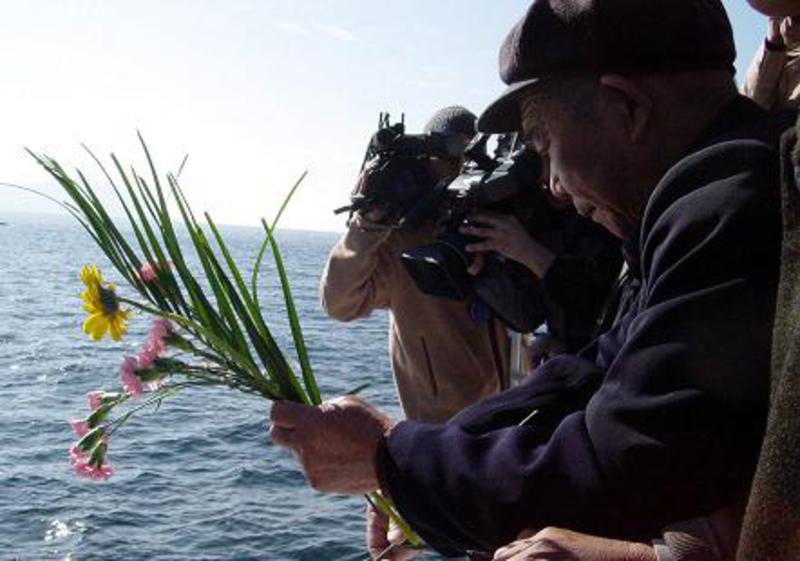
A Chinese survivor of forced labor at Mitsubishi’s Hashima coal mine tosses flowers into Nagasaki Bay in 2004, during a shipboard memorial ceremony for fellow Chinese workers who died at the site that Japan wants to see recognized as a world cultural landmark. The prefectural government rejected the mourners’ request to hold the service on Hashima Island. (Photo by Nagasaki Support Group for Chinese Forced Labor Lawsuits)
The latest front of these disputes is, of all places, an organization that symbolizes solidarity among nations and upholding of mankind’s universal values: UNESCO. On this past May 8 when all of Europe commemorated the end of the war, on this day when it seemed that the war could not assume any more significance, an envoy presented in Berlin South Korea’s position on one of the unresolved disputes from the war. The true measure of the great significance the South Korean government places on this issue can be discerned from the fact that Choi Jong-mun, former ambassador and presently a special aid to the South Korean Foreign Affairs Minister, has handled all matters involving UNESCO since March.
He has travelled around the world to meet politicians, diplomats, and members of the press to let them know about the Korean forced laborers. The Committee session in late June will be attended by 19 nations in addition to Japan and South Korea. The International Council on Monuments and Sites (ICOMOS), which offers advice to UNESCO on World Heritage sites, already made a recommendation last week to accept Japan’s proposal. Thus, the South Korean government still has much persuasion to do. This is why not only Ambassador Choi but also an appropriate Foreign Affairs Ministry official, and a councilor and two staff members of the South Korean Embassy in Germany, came to an interview with just one German journalist to fully explain the issue. This testifies to the importance of the issue to South Korea.
Ambassador Choi emphasized the case of Germany. The Zollverein Coal Mine Industrial Complex (German Zeche Zollverein) in Essen was listed as a World Heritage site in 2001. There, many people were forced into labor during the war. According to Choi, however, there is a difference between Germany and Japan. Germany has squarely faced the injustices it had committed during the war and strived to compensate the victims for their sufferings. Ambassador Choi's intent in mentioning this difference is to show that Japan’s proposal is being called into question not merely because of historial truths. This is related to South Korea’s criticism of Japan: that is, if Japan does not use the island only as an instrument of propaganda about its past glory as it does now and instead recognizes its complex history, the name of Hashima Island will be cleared.
In 2012, the South Korean Supreme Court found invalid the argument by Japanese companies that the right to claim compensation by Korean forced laborers had been rescinded through the South Korea-Japan treaty in 1965, which normalized bilateral diplomatic relations. Since this ruling, many Koreans have claimed damages from Japanese companies such as Mitsubishi and Nippon Steel and South Korean courts have already ruled in favor of some of them.
The South Korean government said in a statement that these compensations for Korean forced laborers are “not related” to Japan’s World Heritage proposal but reveal an aspect of Japan’s attitude toward its history.
Not only disregarding these claims by Koreans, Japan argues that the criticism against its proposal is logically flawed. Several ministers of the Japanese government attribute the blame for the criticism to South Korea and they nonchalantly put a “political spin” on it. They argue that the proposal for Hashima only concerns the time period until 1910, not what happened afterwards. Like China, South Korea also has made efforts to normalize relations with Japan over the last few months. Thus, a polite suggestion was made to Japan to have a bilateral dialogue about the World Heritage proposal. “We hope Japan will appropriately respond to our flexible suggestion,” remarked Ambassador Choi.
Western nations also have a role in the dispute between South Korea and Japan on this issue. The success of Japan in the 19th century was attributable to its acceptance of European technology and modernity. Initially defeated by the Western powers, Japan vigorously pushed forward under the banner of national prosperity and military power. China ventured along the same path as Japan only decades later. Some time later, after having learned from European imperialism, Japan proceeded to expand its sphere of influence by annexing other nations. Now, in 2015, Japan is only inclined to talk about its history of modernization in a very selective way; negative aspects are swept under the rug. Furthermore, Japan argues that others do not properly understand it. Consequently, Hashima Island, also called Gunkanjima (“Battleship Island”), remains a dismal place.
This article originally appeared in German as “Insel des Grauens” (Island of Horror) in Frankfurter Allgemeine Sonntagszeitung (www.faz.net) on May 17, 2015. English translation posted at The Asia-Pacific Journal on June XX, 2015. The original German article is available here.
Mark Siemons is a Berlin-based reporter for Frankfurter Allgemeine Zeitung. William Underwood is a California-based independent researcher of reparations movements for forced labor in wartime Japan.