Showing posts with label G7. Show all posts

Sunday, June 28, 2026

China Strategy Isolates Japan

 Takaichi Goes It Alone at the G7


By Takuya Nishimura, Senior Fellow, Asia Policy Point
Former editorial writer for the Hokkaido Shimbun
You can find his blog, J Update here.
June 21, 2026

 
At this month’s annual Group of Seven (G7) Summit Meeting in Evian-les-Bains, France, Japanese Prime Minister Sanae Takaichi made it clear that she had a quite different concern on international issues than the other leaders did. The summit is traditionally a forum to reconfirm unity of the group to lead the world. Such was the case this year when the group reviewed progress to end the war in Iran. Takaichi, however, emphasized the vulnerability of industrial supply chains and competition with China’s trade strategy. Her tack gained no enthusiastic supporters among the G7 as an explicit supply chain policy would strain rather than ease international tensions.
 
It was obvious at the outset that the Iran war would dominate the discussions. Just before the leaders’ meeting began, the United States and Iran reached an apparent 60-day ceasefire (although not nearly a permanent solution). The memorandum of understanding (MOU) obligates Iran to use its best efforts to ensure safe passage of commercial traffic in the Strait of Hormuz for 60 days. (In fact, Iran has now closed the Strait.) To Iran’s benefit, the MOU also includes – again for a 60-day period – termination of Israel’s military operations in Lebanon, plans (but no financial commitments) for a $300 billion reconstruction program, waivers of U.S. sanctions crude oil exports from Iran, and the return of frozen assets to Iran.
 
On the nuclear issue, Iran “reaffirmed” that it would not procure or develop nuclear weapons; that is, Iran confirmed an earlier commitment. Iran and the U.S. also committed to develop a mechanism to dispose of Iran’s “stockpiled enriched material,” which could mean on-site down-blending, but the MOU does not rule out other disposition methods such as removal. The MOU allows – for the 60 days it is in effect – Iran to maintain its nuclear program and without any new sanctions from the U.S. The MOU does not mention missiles. By many accounts, the MOU considered a victory for Iran.
 
The G7 countries welcomed the deal as an attempt to normalize international relations and the oil trade. A leaders’ statement stressed that the deal was “secured under the strong leadership of President Trump,” noting efforts by France and the United Kingdom to resume maritime traffic in the Strait of Hormuz. The G7 chairman, French President Emmanuel Macron, described the summit as “a moment of unity, of quality discussion, and of genuine cooperation of the leaders.”
 
Upon receiving the news of the U.S.-Iran agreement, Takaichi welcomed it as a major step toward settling the situation in the Middle East. She emphasized the importance of implementing the agreement. But she did not offer any commitment by Japan to the reconstruction of Iran, including mine-sweeping in the strait. “Nothing has been determined for dispatching the Self-Defense Force,” Takaichi stated in a press conference. As readers know, the Constitution of Japan strictly limits sending troops to a battlefield.
 
On the sidelines of the summit, Takaichi had a five-minute conversation with Trump. In his press conference afterward, Trump limited his warmth to Japan by characterizing Takaichi as his “biggest fan.” Otherwise, Trump said, “I’ll be honest, Japan was not willing to get involved during the war.” There was no report that Takaichi affirmed her compliment of Trump in her visit to the White House in March, which was that “Donald is the only person who can bring peace and prosperity across the world.”
 
Instead, Takaichi tried to pursue Japan’s interest by connecting the war in Iran with pressure on China. She put economic security at the center of Japan’s views in the G7 rather than joining with the other members in focusing on ending the war in Iran or post-war reconstruction. Although she proposed building a system of oil reserves for developing countries, Takaichi’s clear goal was to gain support for stockpiling critical minerals and lessening dependence on China. The G7 issued a declaration on supply chains for critical minerals, but it went only as far as to say that the group “will work together with partners to reduce critical dependencies and ensure that attempts or threats to weaponize economic dependencies fail.”
 
China immediately responded to that statement. “It’s leader’s latest G7 remarks on China were particularly obtrusive, exposing that its attempt to rally allies and stir up confrontation wins no support and is bound to fail,” said China’s foreign ministry spokesperson, Lin Jian. Lin said that Takaichi’s posture against China was a “glaring self-contradiction” and an instance of “Japan’s hypocrisy.” Despite her stated willingness to talk, Takaichi has made no serious effort to resume bilateral leaders’ talks and normalize economic relationship with China. Takaichi’s G7 diplomacy seems to have only exacerbated tensions with China.
 
It has not helped Takaichi that other G7 countries, suffering from Trump’s tariff policies, have approached China about trade deals that might restore their economic performance to the pre-U.S. tariff levels (or beyond). Macron visited China last December, calling for efforts to promote multinationalism with Chinese President Xi Jinping. Canadian Prime Minister Mark Carney visited Beijing last January and agreed with Xi on advancing a strategic partnership between the two countries. Carney described relations with China as “more predictable” than those with the Trump administration.
 
Outgoing British Prime Minister Keir Starmer met Xi in Beijing also in January. German Chancellor Friedrich Merz visited China in February. And Italian Prime Minister Giorgia Meloni paid an official visit to China in July 2024.
 
Even worse, from Takaichi’s perspective, Trump himself visited China in May, agreeing with Xi on building a relationship of strategic stability between the two countries. Takaichi is the only G7 leader who has not made a visit to China. All that she has been able to do was to visit the White House before Trump visited China. Japan finds itself uniquely isolated in its adversarial China policy. It is time for Takaichi to emulate her G7 colleagues and improve bilateral relations with China.

Sunday, June 21, 2026

Takaichi's Mercantilism

Japan's PM Takaichi Heads to Europe


By Takuya Nishimura, Senior Fellow, Asia Policy Point
Former editorial writer for the Hokkaido Shimbun
You can find his blog, J Update here.
June 15, 2026


Prime Minister Sanae Takaichi participates in her first Group of Seven (G7) summit in Evian, France from June 15 to 17. The meeting is the last stop for her; in the past few days, she has visited the United Kingdom and Italy. Her top diplomatic priority is securing Japan’s supply chain amid a volatile world order. Although Takaichi says she stands for a “diplomacy that flourishes on the world’s center stage,” her diplomacy is in fact heavily dominated by her own interests.
 
The first stop on her trip to Europe was London from June 13-14. In a meeting with United Kingdom Prime Minister Keir Starmer, Takaichi shared her concern over export restrictions on critical minerals and urged bilateral cooperation on economic security, including strengthening supply chains.
 
Securing supply chains has been a core tenet of Takaichi’s diplomacy. In her individual meetings with the leaders of Vietnam, Australia, the Republic of Korea, and the Philippines in May, Takaichi drew attention to the maintenance of supply chains while criticizing China for its export controls over critical minerals. Aspiring to strengthen her position on international economic security, Takaichi hoped to make up for her irregular comment on the Taiwan contingency last November, which deeply undermined Japan’s relations with China.
 
Takaichi and Starmer also confirmed acceleration of the development of next-generation fighter aircraft under the Global Combat Air Programme (GCAP) with the UK and Italy. This is supposedly the main reason that Takaichi chose to visit London and Rome before the G7 summit.
 
Takaichi has sought to expand Japan’s international trade in defense equipment, expecting it to contribute to her economic growth strategy. She promoted trade in or joint development of destroyers with the Philippines and Australia. GCAP is in the same context. She once said that “Strategic investments that enhance resilience against potential crises are the core focus of the Takaichi Cabinet’s growth strategy.”
 
This approach reverses Japan’s longstanding reluctance to trade in military equipment.  “Even if some foreign exchange surplus could be earned, our nation has not stooped so low as to make money by exporting weapons,” former prime minister Kiichi Miyazawa said when he was foreign minister in 1976. Takaichi now argues that times have changed and that trade with other countries in defense equipment would contribute to the growth of the Japanese economy.
 
While Takaichi was travelling in Europe, U.S. President Donald Trump announced that the U.S. and Iran had reached a deal for ending the war. Takaichi posted on X that she would welcome the agreement as a key step toward a settlement and hoped for free and safe traffic in the Strait of Hormuz. Takaichi must be wishing for the normalization of international trade. “Donald is the only person who can bring peace and prosperity across the world,” Takaichi said to Trump in her visit to the White House in March.
 
The Takaichi administration introduced a subsidy for gasoline as soon as the war in Iran started. To maintain public support for her cabinet, she formulated a supplemental budget to continue this subsidy earlier this month. A subsidy does not cure all ills, however. Opposition lawmakers have questioned Takaichi about oil import shortages that limit production of various goods that are indispensable for manufacturing and that cause prolonged price inflation.
 
That is why she is focusing her diplomatic efforts on securing the supply chain. It is expected that she would propose a joint stockpiling plan for critical minerals at the G7 summit meeting. Takaichi hopes to take the initiative to build a system in which like-minded countries can collaborate to strengthen supply chains. Her proposal would be a countermeasure to China’s coercive trade policy on critical minerals.
 
It is still unclear whether Takaichi’s initiative to secure the supply chain accelerates Plan B of Japan’s diplomacy, which is to move Japan away from excessive dependence upon the United States. It is true that Japan has been seeking alternatives in trade opportunities after Trump imposed additional tariffs in June 2025. The Iran war has proven that Japan cannot secure oil from the Middle East by relying on U.S. dominance in international security. Yet Japan’s national security is still fundamentally based its alliance with the U.S., as seen in efforts to grow the defense budget by current and former administrations.
 
Takaichi has yet to find an exit from Japan’s current diplomatic difficulties: the uncertainty of the Trump administration and the persistent diplomatic pressure from China. Although Takaichi stands by the Free and Open Indo-Pacific (FOIP), which was invented by former Prime Minister Shinzo Abe to expand Japan’s role in the region, it no longer holds much sway. In the current war-based world order, the creation of a democratic bloc of countries may not guarantee stability or prosperity. The FOIP policy may appeal to Japan’s conservative base, but Takaichi does not have a viable grand strategy to give Japan a greater role on the international stage.
 
Turning our eyes to domestic politics, Takaichi faces scandals of her own. Her secretary is thought to be involved in a defamatory social media campaign strategy in the presidential election of the Liberal Democratic Party last October. Although she has denied any misdeeds in her campaign, the opposition parties have demanded that the secretary testify before a Diet committee. Although it may not violate any law, a defamatory strategy could damage Takaichi politically because she depends on support from SNS users.

Her approval rating has suffered a gradual decline according to polls of news organizations because of the defamation scandal or the shortage of naphtha. As former prime ministers have done, Takaichi hopes to achieve diplomatic gains that will change the direction of domestic headwinds. However, it is unlikely that she can attain success in her visit to Europe to a degree that would lead to a resurgence in public support. 

Sunday, June 29, 2025

Monday Asia Policy Events, June 30, 2025

PARTNERS OR RIVALS? AREAS OF CONVERGENCE AND DIVERGENCE OF INTERESTS IN THE INDO-PACIFIC. 6/30, 10:00-11:00am (EDT), VIRTUAL. Sponsor: Foreign Policy Research Institute. Speakers: Dr. Alexander Korolev, Senior Lecturer in Politics and International Relations in the School of Social Sciences, Faculty of Arts and Social Sciences, at the University of New South Wales, Sydney; Thomas J. Shattuck, Fellow in the Eurasia Program at the Foreign Policy Research Institute; Colonel (Retired) Robert E. Hamilton, Ph.D., Head of Research at the Foreign Policy Research Institute’s Eurasia Program. 

BOOK TALK: THE GREAT POWERS, AND IRAN’S SOCIAL AND POLITICAL EVOLUTION. 6/30, Noon (EDT), VIRTUAL. Sponsor: Quincy Institute for Responsible Statecraft. Speakers: author Shireen Hunter, Honorary Fellow, Center for Muslim-Christian Understanding, School of Foreign Service, Georgetown University; Moderator: Roxane Farmanfarmaian, Non-resident Fellow, Quincy Institute, Director, International Studies and Global Politics, University of Cambridge Institute for Continuing Education. PURCHASE BOOK

BOLSTERING THE TRANSATLANTIC PARTNERSHIP AT A GLOBAL INFLECTION POINT. 6/30, 2:45–4:00 pm (EET), 7:45–9:00 am (EDT), ONLINE. Sponsor: Atlantic Council. Speakers: Frederick Kempe, President and Chief Executive Officer, Atlantic Council; Michael Dickerson, Chargé d’Affaires, U.S. Embassy in Romania; H.E. Cătălin Predoiu, Deputy Prime Minister of Romania; Minister Cristian Diaconescu, Presidential Adviser, Department of National Security, Chancellery of the President of Romania; H.E. Alexandru Nazare, Minister of Finance of Romania; H.E. Oana-Silvia Țoiu, Minister of Foreign Affairs of Romania; Landon Derentz, Vice President, Energy and Infrastructure, and Senior Director, Global Energy Center, Atlantic Council; Jörn Fleck, Senior Director, Europe Center, Atlantic Council; Catalina Dodu, Partner and Cybersecurity Leader, EY Romania; Antonia Colibasanu, Senior Geopolitical Analyst, Geopolitical Futures; Ambassador Daniel Fried, Weiser Family Distinguished Fellow, Atlantic Council; Olga Khakova, Deputy Director, European Energy Security, Atlantic Council.

WHAT DO STRIKES ON IRAN MEAN FOR CHINA, RUSSIA, AND NORTH KOREA? 6/30, 3:00-4:00pm (EDT), VIRTUAL. Sponsor: Center for Strategic & International Studies (CSIS). Speakers: Victor Cha, President, Geopolitics and Foreign Policy Department and Korea Chair; Mona Yacoubian, Senior Adviser and Director, Middle East Program; Maria Snegovaya, Senior Fellow, Europe, Russia, and Eurasia Program; Brian Hart, Deputy Director and Fellow, China Power Project. 

INSIGHTS INTO OPERATION RISING LION. 6/30, 3:00pm (EDT), VIRTUAL. Sponsor: Jewish Institute for National Security of America (JINSA). Speakers: IDF BG Effie Defrin, Head, IDF Spokesperson's Unit; Former JINSA Visiting Fellow; Dr. Michael Makovsky, President and CEO, JINSA. 

MYANMAR’S POST-QUAKE ECONOMIC REALITIES. 6/30, 3:00-4:00am (EDT), 3:00-4:00pm (SGT), VIRTUAL. Sponsor: Yusof Ishak Institute (ISEAS). Speakers: Vicky Bowman, Director, Myanmar Centre for Responsible Business (MCRB), Senior Adviser, Institute for Human Rights and Business; Thet Zaw Htwe, Head, Policy and Strategy, EuroCham Myanmar. 

G7 READOUT: IMPLICATIONS OF THE KANANASKIS SUMMIT FOR JAPAN'S RELATIONS WITH US AND CANADA. 6/30, 7:00pm (EDT), VIRTUAL. Sponsors: International House of Japan; American Friends of the International House of Japan. Speakers: Jonathan Berkshire Miller, Co-Founder and Principal, Pendulum Geopolitical Advisory; Emma Chanlett-Avery, Deputy Director and Director for Political-Security Affairs, Asia Society Policy Institute, Washington, DC Office; Kristi Govella, Associate Professor, University of Oxford; Matthew Millar, Chairman and CEO, The Millar Group; Joshua Walker, President and CEO, Japan Society; Ken Jimbo, Managing Director, International House of Japan; Moderator: David Janes, Vice President, North America, International House of Japan.

GREEN TECHNOLOGIES - DECARBONIZING DEVELOPMENT IN EAST ASIA AND PACIFIC. 6/30, 9:00pm (EDT), VIRTUAL. Sponsor: World Bank. Speakers: Martin Raiser, Vice President, South Asia, World Bank Group; Francesca de Nicola, Senior Economist, International Finance Corporation, World Bank Group; Arnunchanog Sakondhavat, Director, Macroeconomic Strategy and Planning Office, NESDC, Thailand; Trang Thu Tran, Senior Economist, International Finance Corporation, World Bank Group; Liew Chin Tong, Deputy Minister of Investment, Trade and Industry Malaysia; Moderator: Aaditya Mattoo, Chief Economist, East Asia and Pacific, World Bank group. 

Wednesday, November 22, 2023

Diplomacy-Kishida's Bright Spot

Japan’s Work in Leading the G7


By Takuya Nishimura
, Senior Fellow, Former Editorial Writer for The Hokkaido Shimbun
The views expressed by the author are his own and are not associated with The Hokkaido Shimbun
You can find his blog, J Update here.
November 12, 2023. Special to Asia Policy Point

Diplomacy is one of the few bright spots for Prime Minister Fumio Kishida, who continues to suffer from a low domestic approval rating. The November 7th and 8th G7 Foreign Ministers’ Meeting held in Tokyo should have been a good opportunity for him to demonstrate his leadership. Japan holds the G7 chair through the end of this year.

In the two-day meeting, Japan, through Foreign Minister Yoko Kamikawa, successfully orchestrated a joint statement that addressed events in Israel, Gaza, and the West Bank and continued to back Ukraine in its resistance to the Russian invasion. The joint statement also promoted an open Indo-Pacific region, made clear that the G7 countries would pursue their national interests in dealing with China, supported the sovereignty of countries in Central Asia and South Caucasus, criticized the destabilizing activities of Iran, and committed to deepening partnerships with African countries.

With respect to the Middle East more specifically, a joint statement called for humanitarian pauses in the war between Israel and Hamas. The chairwoman of the meeting, Foreign Minister Kamikawa, emphasized the significance of the G7 countries having agreed for the first time to issue a “unified message.” In her post-meeting press conference, Kamikawa said, “I think it is an important achievement for G7 to take responsibility on this issue and for Japan in fulfilling our role as the G7 chair this year.”

The inability to issue a unified message earlier lies largely at the feet of the Kishida administration. One month ago, Japan did not join the Joint Statement on Israel on October 9th, in which five leaders of G7 condemned the Hamas’ attack on Israel, calling it terrorist actions and supporting Israel’s right to self-defense. Two weeks later, Japan also opted out of the joint statement by six leaders on October 22nd, which called on Israel to adhere to international humanitarian law including the protection of civilians. Japan at last caught up with G7 at the Tokyo meeting, a month after the Hamas attack.

The joint statement of G7 foreign ministers issued in Tokyo treated Israel and Palestine with greater equivalency than the previous two statements. The November 8 statement expressed sympathy and extended condolences to the victims of the attacks as well as to Palestinians and Israelis who have died or injured. They statement called for “humanitarian pauses and corridors to facilitate urgently needed assistance, civilian movement, and the release of hostages.

Two days before the statement was released, U.S. President Joe Biden had proposed a “humanitarian pause” to Israeli Prime Minister Benjamin Netanyahu. Japan as the chair country for the G7 meeting accordingly was expected include this concept in the statement. The U.S. leader rather than the Kishida administration thus carried the day on this matter.

Since Hamas attack in early October, Japan has been keeping its channels open with both Israeli and Palestinian leaders. In a meeting with the Israeli Foreign Minister on November 3, Foreign Minister Kamikawa stated that all parties to the conflict must act in accordance with international law in. In Gaza, she offered an additional humanitarian support. U.S. Secretary of State Antony Blinken’s visits to Israel and Gaza a few days later overshadowed Kamikawa’s visit, however.

A few days after G7 foreign ministers issued the statement, Israel agreed to four-hour daily humanitarian pauses in its assault on Hamas in northern Gaza. Asked about the pause and humanitarian corridor in a press conference, Kamikawa avoided connecting Israel’s decision with for the G7 joint statement. Thus, Japan’s role in the G7 on the issue of Middle East is still unclear.

Regarding Russia and Ukraine, Japan’s relations with Russia have been deteriorating for some time, including on the issue of the Northern Territory of Japan. As a result, Japan has strongly opposed Russia on the invasion of Ukraine Japan’s position was captured in a sentence in the joint statement: “A just and lasting peace cannot be realized without the immediate, complete, and unconditional withdrawal of Russia’s troops and military equipment from the internationally recognized territory of Ukraine.”

In supporting Ukraine, because constitutional limits prevent Japan from providing much military assistance, Japan has focused on post-war reconstruction efforts. Former Minister for Foreign Affairs Yoshimasa Hayashi visited Kyiv in September with a business delegation from Japan. Hence this sentence in the G7 foreign ministers’ statement: “We are also working to involve our private sectors in the sustainable economic recovery of Ukraine.”

The Kishida administration will send the state ministers Kazuchika Iwata (METI) and Iwao Horii (MOFA) to Ukraine with another business delegation next week. Japan will host a conference for the economic reconstruction of Ukraine next February. But it is too early to talk about business deals while fierce battles rage in the eastern part of Ukraine.

As for the Indo-Pacific region, Japan deserves the credit for including the region’s issues in the G7 agenda. When Hamas attacked Israel in early October, Kamikawa was on a trip to ASEAN countries to reinforce Japan’s ties with them and counteract China’s advance in the region. The G7 foreign ministers’ statement noted that they would continue their endeavors towards a free and open Indo-Pacific, which is inclusive, prosperous, secure, and based on the rule of law.

The statement also supported Japan’s discharge of treated water from crippled Fukushima Daiichi Nuclear Power Plant. “We welcome Japan’s safe, transparent, and science-based process, including the continued monitoring of the situation, to responsibly manage of Advanced Liquid Processing System treated water,” said the statement. Japan’s dispute with China over the treated water remains unresolved.

On China, the G7 foreign ministers expressed their concern “about the situation in the East and South China Seas, strongly opposing any unilateral attempts to change the status quo by force or coercion.” Further, the foreign ministers “reaffirm the importance of peace and stability across the Taiwan Strait as indispensable to security and prosperity in the international community and call for the peaceful resolution of cross-Strait issues.” Those arguments are in harmony with Japan’s interests.

Notwithstanding the many vital world events discussed at the G7 foreign ministers’ meeting, the meeting has not contributed to the Kishida administration’s popular standing so far. Kamikawa observed in her press conference that Japan’s term as the G7 chair remains for as much as two months. She hopes to reach out to the “global south” in the meetings of Asia-Pacific Economic Cooperation (APEC) in San Francisco this week. Kishida will also have important meetings with world leaders in the backdrop to APEC. Success or failure in those meetings may affect the fortunes of the Kishida administration to a much greater degree.

Saturday, June 17, 2023

LGBTQ Rights in Japan Falter

Slow Progress in Japan’s LGBTQ Legislation


By Takuya Nishimura
, Editorial Writer, The Hokkaido Shimbun
The views expressed by the author are his own and are not associated with The Hokkaido Shimbun
June 5, 2023. Special to Asia Policy Point.
 
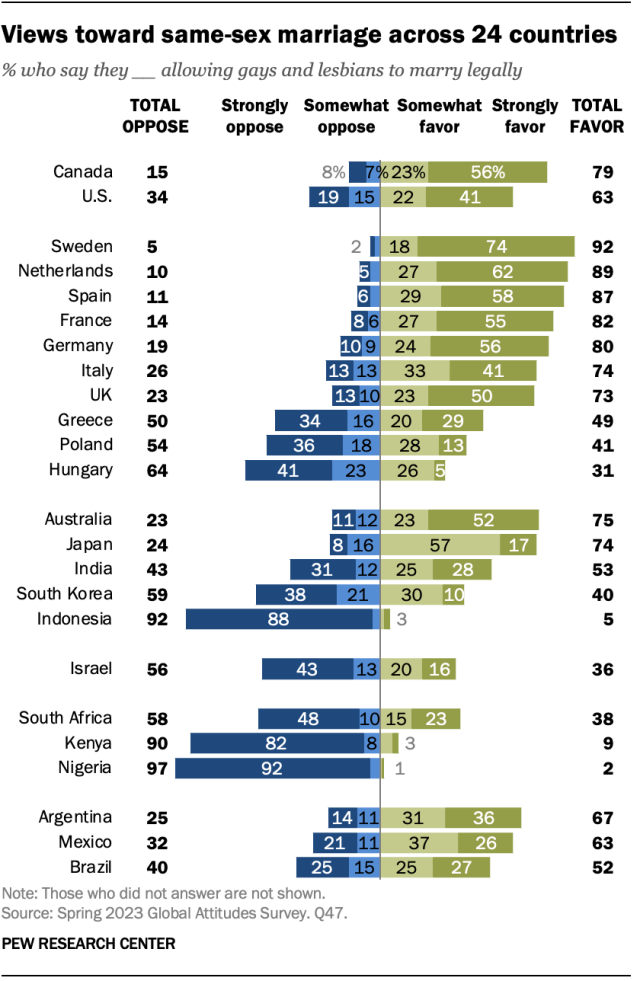
For Japan’s ruling LDP and its government, G7 membership is considered precious for it gives Japan an advantage relative to other Asian nations. However, Japan is the only G7 member without any legislation prohibiting discrimination based on sexual orientation or self-recognition of gender identity, an embarrassment since Japan is the chair of the G7 this year. Although the LDP submitted a new non-discrimination bill to the Diet just before the opening of the G7 Hiroshima Summit, it remains unclear whether it will pass before the end of the current session on June 21. The rightwing powers in the Diet continue their efforts to derail the bill, regardless Japan’s status among developed countries.
 
The discussion over legislation for sexual minorities has been led mainly by Japan’s opposition parties. They submitted a bill to eliminate discrimination based on sexual orientation or self-recognition of gender identity to the Diet in 2016. The movement eventually included some of the LDP lawmakers. Lawmakers on both sides of the aisle reached an agreement on a multi-partisan draft of the new bill in 2021, but it was blocked by the conservative members of the LDP. Earlier this year, after a careless speech by Kishida that same sex marriage would entirely change Japanese society and much-criticized remarks by a staff member in the prime minister’s office on the legitimacy of discrimination against the LGBTQ community, the administration was pressured to do something to protect gender orientation and identification. Kishida further demanded that the LDP pass an LGBTQ law before the G7 summit.
 
Conservative lawmakers who had been blocking LGBTQ legislature have been annoyed by this pressure. In LDP internal meetings on the issue of sexual minorities, they worked hard to dilute expressions that promote understanding of sexual minorities in the multi-partisan agreement under consideration. The most controversial change was the mainline LDP’s willingness to replace the phrase “discrimination on the basis of sexual orientation or self-recognition of gender identity shall not be tolerated” with the more ambiguous “no unfair discrimination on the basis of sexual orientation is allowed.” The opposition parties objected strongly, saying the insertion of “unfair” is needless to say, because there is no such thing as fair discrimination.
 
Other parts of the legislation were watered down as well. All the phrases of “self-recognition of gender identity” in the multi-partisan draft were replaced with “gender identity” on the theory that self-recognition might be interpreted as self-profession. The LDP conservatives’ apparent concern was that someone might be sneaking into the wrong side of public restrooms or baths. The LDP also dropped the words “effort of school administrators [gakkou setchisha]" in education. The argument in the LDP was that teachers were too immature and unskilled in sex education to lecture about LGBTQ.  
 
The LDP submitted a revised version of the bill to the Diet a few days before the Hiroshima Summit, receiving approval from its junior partner of the leading coalition, Komeito. Encouraged by the domestic legislative progress over gender recognition, Kishida, as the chairman of the G7 Summit, succeeded in organizing the leaders’ communiqué, including the section supporting a society where “all people can enjoy vibrant lives free from violence and discrimination independent of gender identity or expression or sexual orientation.”
 
After the summit, work on LGBTQ legislation bills became further complicated by the submission of several related bills. The Constitutional Democratic Party and the Japan Communist Party had already submitted a bill much the same as the multi-partisan draft, and the two parties did so on the same day that LDP submitted its own. The Japan Innovation Party (Ishin-no Kai) and the Democratic Party for the People submitted a third bill, which replaced the words of “gender identity” with “jendaa-aidentiti,” after the summit.

Not all the bills submitted to the Diet were discussed in either the Plenary or committees meetings. The Committee of Rules and Administration is chaired by an LDP lawmaker who selects the bills to be considered. Thus, a number of bills, mainly submitted by the opposition, are rejected even without discussion in every session. With the current Diet session ending June 21, time is running out to select and debate any bill selected.

While the political parties continue to struggle with LGBTQ legislation, the judicial branch is considering lawsuits brought in five Japanese cities by same-sex couples against the state. So far, three out of four courts have said that not allowing same-sex marriage is constitutionally problematic. At the end of May, the Nagoya Regional Court decided that provisions of Japan’s Civil Code or Family Register Act, which did not recognize same-sex marriage, were unconstitutional. The defect in the laws was that, the court said, “the same-sex couple of plaintiffs is excluded from the important personal benefit that is attached to a legal marriage.”

The court recognized the unconstitutionality of laws that do not recognize same-sex marriage, relying on Paragraph 2 of Article 24 of the constitution, which requires that all the laws be based on respect of individuals and the essential equality of both sexes in the choice of spouse. This is the first time for a court in Japan to recognize the unconstitutionality based on that clause. Although the Court did not comment on legislation under consideration in the Diet, the decision should be regarded as an expression of frustration with the slow progress in the legislative branch. This week, a court in Kyushu will issue a ruling on the fifth lawsuit.

UPDATE (6/16/23): After two years of discussion, the Diet passed a bill to promote understanding of sexual minorities. In the House of Councillors, the LDP, Komeito, Innovation Party, and the National Democratic Party (NDP) supported the bill. It was an amended version, actually a mixture of two bills, one submitted by the LDP and Komeito, and another by the Innovation and NDP. These four parties agreed on an amendment before the bill passed the House of Representatives on 13th. After an argument over the interpretation of “gender identity” in the Japanese language, the expression which would confusingly be recognized as allowing a man to enter a woman’s public bath, the four parties agreed on using the term of “jendaa aidentiti.” It also requires educational institutes to make efforts to achieve cooperation of families and local community before approving LGBTQ organizations. It is obvious that the law will be working as an obstruction to promote understanding of sexual minorities.

Fukuoka Regional Court ruled on June 8th that current laws related to marriage were in a “state of unconstitutionality,” because the plaintiffs, requiring the right for same-sex marriage, were suffering from the disadvantage of not being able to take advantage of the institution of marriage. Four out of five regional courts, including Fukuoka, Nagoya, Tokyo and Sapporo, decided that the laws were unconstitutional or in the state of unconstitutional on the lawsuits demanding recognition of the unconstitutionality of existing laws on same-sex marriage, urging the legislative branch to take further action. It is doubtful that the passed bill fulfills that requirement of the judicial branch.


Saturday, June 3, 2023

What did the G7 achieve?

 A World Still with Nuclear Weapons


By Takuya Nishimura, Editorial Writer, The Hokkaido Shimbun
The views expressed by the author are his own and are not associated with The Hokkaido Shimbun
May 22, 2023
 
As the chair of the Group of Seven (G7) Hiroshima Summit, Japanese Prime Minister Fumio Kishida stated that he would use the summit to pave the way to “a world without nuclear weapons.” Although the Leaders’ Communiqué did include those specific words, the G7 leaders did not provide a way to implement of this goal. This leaves one wondering what Kishida did achieve with this high-profile international engagement.
 
The document for nuclear disarmament, called the Hiroshima Vision on Nuclear Disarmament, was issued a day before the Communiqué. It unequivocally declared the indispensability of nuclear weapons in the context of nuclear deterrence. The G7 thus continue to contemplate a world where nuclear weapons still exist. Those who suffered the nuclear bombs, or the Hibakusha, in Hiroshima and Nagasaki were deeply disappointed by how ineffective Kishida had been.
 
While underscoring the importance of the 77-year record of non-use of nuclear weapons, the Hiroshima Vision firmly accuses Russia of its “irresponsible nuclear rhetoric, undermining of arms control regimes, and stated intent to deploy nuclear weapons in Belarus.” With these and other strong words denouncing Russia’s rhetoric, the Vision statement follows: “Our security policies are based on the understanding that nuclear weapons, for as long as they exist, should serve defensive purposes, deter aggression and prevent wars and coercion.”
 
This document, made under the leadership of Kishida, conditionally recognized the role of nuclear weapons without showing any clear roadmap to the world without nuclear weapons. The G7 fundamentally reject the work of Hibakushas. Coming through hardships of losing loved ones, being threatened by the fear of cancer, or discrimination from the fellow citizens, Hibakushas define nuclear weapons as “absolute evil” that kill too many people immediately. Their use can never be justified.
 
The Hiroshima Vision ironically justifies nuclear weapons as a countermeasure to Russian aggression in Ukraine and nuclear saber-rattling. Thus, to 91-year-old atomic bomb survivor, Setsuko Thurlow, the G7 Summit was a “huge failure,” as stated in her press conference on Sunday, May 21. The International Campaign to Abolish NuclearWeapons (ICAN), the 2017 Nobel Peace Prize winner, stated that the G7 fell “far short of providing any meaningful outcomes for nuclear disarmament.”

Mostly ignoring the backlash from the Hibakushas, Kishida said at his post-summit press conference that he was satisfied with the outcome of the G7 Hiroshima Summit. “We shared an ideal for the future of the world without a nuclear weapon.” Recognizing appeals from nuclear-suffered cities, Kishida considers Hiroshima Vision the basis for future actions to attain a world without nuclear weapons. Kishida viewed the visit of Ukrainian President Volodymyr Zelenskyy to Hiroshima as a chance to deliver further a message against threats to use nuclear weapons.
 
Although the G7 Summit was a stage to show that the G7 leaders stand together with Zelenskyy and to condemn Russia for its aggression against international law and order, inviting the Ukrainian president at war nevertheless was questionable. Hiroshima’s significance is as a place once devastated by a nuclear weapon and of the Hiroshima people’s hope for unconditional peace, not war at any cost.
 
After laying flowers at the cenotaph to A-bomb victims, Zelenskyy reflected that “Photographs of ruins of Hiroshima absolutely remind me of Bakhmut and other similar settlements.” For the people in Hiroshima who believe in the principle of “war is not the answer,” the sympathetic comment of Zelenskyy might have brought a sense of discomfort to them.
 
Obviously, Zelenskyy’s purpose in visiting Hiroshima was to continue and win the war with as much support as possible from the G7. U.S. President Joe Biden told Zelenskyy that the US would start training Ukrainian pilots to fly F-16 fighter jets. In a bilateral meeting with Zelenskyy, Indian Prime Minister, Narendra Modi, who is regarded as a key for anti-Russia groups to reach the countries called “global south,” conveyed his clear support for dialogue and diplomacy to find a way forward. Hiroshima had become the place where world leaders were seen deeply engaged in Ukraine’s war strategy.
 
For Kishida who has been promoting his positive pro-active security policies, the appearance of the Ukrainian president must have been a good opportunity to trumpet the “success” of policies to domestic audiences. In the meeting with Zelenskyy, Kishida pledged Japanese assistance by sending trucks and provisions and accepting injured Ukrainian military personnel in the Self-Defense Forces Central Hospital in Tokyo. The Kishida administration is likely to insist that current budget request for security measures or positive involvement in maintaining world order has been necessary.
 
In terms of dealing with China’s advances in Asia-Pacific region, the G7 summit produced some positive outcomes. Zelenskyy’s attendance reinforced the ties of democratic nations. In the outreach meeting attended by the G7 leaders, eight guests and Zelenskyy, Kishida stressed that coercive and unilateral change of status quo would not be tolerated anywhere in the world. It is necessary, he said, to protect free and open world order based on the rule of law.
 
The G7 Leaders’ Communiqué, in contrast to its message to Russia, was toward China, calling on engagement with G7 and recommending “de-risking” for economic resilience instead of decoupling from China. Yet, the leaders of four major powers in the Asia-Pacific region, Japan, United States, India, and Australia (meeting as the quadrilateral security dialog or QUAD), also issued a statement that opposed “destabilizing or unilateral actions that seek to change the status quo by force or coercion,” a suggestion that a Chinese invasion of Taiwan would be unacceptable.
 
Inevitably, Japan will have to deal with further pressure from China. Kishida’s inability to make progress on nuclear disarmament among his peers at the G7 Summit does not engender much confidence on how well he can pursue this. To date, Kishida has yet to offer a concrete vision for a meaningful dialogue with China. By following along with the G7's support of Ukraine and deterrence, Kishida set aside Japan's priority to stabilize the situation in Northeast Asia. China reacted against the G7 Communique with "strong dissatisfaction." It is possible that Kishida has raised the tension in Northeast Asia by introducing the structure of hostility in the Eastern Europe.

Sunday, May 2, 2021

Monday Asia Events, May 3, 2021

May 3-5
- G7 Foreign and Development Minister’s Meeting in London,
invited additional countries to join as guests at the meeting, including Australia, India, South Africa, the Republic of Korea, and Brunei in its capacity as Chair of ASEAN.
May 3 - National Memorial Constitution Day in Japan. Start of Golden Week.

BIDEN AND CONGRESS AT 100 DAYS – ASSESSING ARMS TRADE POLICY. 9:30-11:00am (EDT). ZOOM WEBINAR. Sponsor: Stimson Center. Speakers: Annie Shiel, Senior Advisor for U.S. Policy and Advocacy, Center for Civilians in Conflict (CIVIC); Frank Slijper, Project Leader, Arms Trade, PAX; Rachel Stohl, Vice President, Stimson Center; Akbar Shahid Ahmed, Senior Foreign Affairs Reporter, HuffPost.

ANALYZING BIDEN’S FIRST 100 DAYS. 10:00-11:30am (EDT). WEBCAST. Sponsor: Brookings Institution (Brookings). Speakers: William A. Galston, Ezra K. Zilkha Chair and Senior Fellow, Governance Studies, Brookings; Molly E. Reynolds, Senior Fellow, Governance Studies, Brookings; Camille Busette, Senior Fellow, Economic Studies, Governance Studies, Metropolitan Policy Program, and Director, Race, Prosperity, and Inclusion Initiative, Brookings; John Hudak, Deputy Director, Center for Effective Public Management, and Senior Fellow, Governance Studies, Brookings; Jon Valant, Senior Fellow, Governance Studies, Brown Center on Education Policy, Brookings; Moderator: Elaine Kamarck, Founding Director, Center for Effective Public Management, and Senior Fellow, Governance Studies, Brookings. 

THE FUTURE OF U.S. FOREIGN POLICY. 11:30am-12:30pm (EDT), ZOOM WEBINAR. Sponsor: SAIS, Johns Hopkins University (JHU). Speaker: Richard N. Haass, President of the Council on Foreign Relations (CFR). 

ARAB-ISRAELI NORMALIZATION: A VIABLE AVENUE TOWARDS PEACE? Noon-1:00pm (EDT). ZOOM WEBINAR. Sponsors: Middle East Institute (MEI); Conflict Resolution Program, Georgetown University. Speakers: Mickey Bergman, Vice President and Executive Director, Richardson Center for Global Engagement; Khaled Elgindy, Senior Fellow and Director, Program on Palestine and Palestinian-Israeli Affairs, MEI; Lucy Kurtzer-Ellenbogen, Director, Israeli-Palestinian Conflict Program, United States Institute of Peace; Mohammed Soliman, Non-Resident Scholar, MEI, and Senior Associate, Middle East and North Africa Practice, McLarty Associates; Moderator: Joyce Karam, Washington Correspondent, The National.

CHINESE CONCEPTIONS OF WORLD ORDER. Noon-1:00pm (EDT). WEBINAR. Sponsor: Jackson Institute for Global Affairs, Yale University. Speakers: Bill Hayton, Journalist, BBC World News TV; Eyck Freymann, Doctoral Candidate in China Studies, Balliol College, Oxford; Susan Thornton, Senior Fellow, Paul Tsai China Center, Yale Law School, and Nonresident Senior Fellow, Brookings Institution; Moderator: Arne Westad, Elihu Professor of History and Global Affairs, Jackson Institute for Global Affairs, Yale University. 

BEYOND CIVILIZED AND BARBARIANS: UNDERSTANDING THE SETTLEMENT OF CHINESE MIGRANTS IN SIXTEENTH AND SEVENTEENTH CENTURY CHOSŎN KOREA. 3:00-4:30pm (EDT). ZOOM WEBINAR. Sponsor: Institute for Korean Studies, George Washington University (GW). Speaker: Author, Adam Bohnet, Associate Professor in History, King’s University College; Moderator: Jisoo M. Kim, Korea Foundation Associate Professor of History, International Affairs, and East Asian Languages and Literatures, Director, Institute for Korean Studies, and Co-Director, East Asia National Resource Center, GW. PURCHASE BOOK: https://amzn.to/3tgCAZ2

THE EVER-CHANGING PAST: WHY ALL HISTORY IS REVISIONIST HISTORY. 4:00-5:30pm (EDT), WEBCAST. Sponsor: History and Public Policy Program, Wilson Center (WWC). Speakers: author, James M. Banner, Cofounder, National History Center; Sarah Maza, Jane Long Professor, Arts and Sciences and Professor of History, Northwestern University; Moderators: Christian F. Ostermann, Director, History and Public Policy Program, WWC; Eric Arnesen, former Fellow, Professor of History, George Washington University. PURCHASE BOOK: https://amzn.to/3ap7yYb

THE RELEASE OF FREEDOM IN THE WORLD 2021 ASIA FINDINGS. 9:00pm (EDT). WEBEX. Sponsors: Freedom House; Taiwan Foundation for Democracy. Speakers: Amy Slipowitz, Research Manager, Freedom House; Sumit Ganguly, Professor, Indiana University Bloomington; Alvin Y.H. Cheung, SSHRC Postdoctoral Fellow, McGill University; Moderator: I-Chung Lai, Executive Director, Prospect Foundation.

Saturday, December 23, 2017

Support Lighthouse in Japan


The video above on JK is by Lighthouse, an NPO that works to eliminate human trafficking, especially sex trafficking, in Japan.

Japan remains a Tier Two country on the State Department's Human Trafficking watch list. This means it is not doing enough to hinder and stop the sexual exploitation of girls and boys. Japan is not enforcing the laws that it has nor is it prosecuting the perpetrators. Simply put, Japan has not changed its societal views of sex trafficking. This backwardness helps explain why the Abe government is unable to come to terms with Imperial Japan's Comfort Women history.

It should be noted that South Korea has long pulled itself out of being a Tier Two Country and is now a Tier One. This is a government that fully meet the Trafficking Victims Protection Act’s (TVPA) minimum standards and is expanding its prosecution of traffickers and help for their victims.

It is telling that Japan is the only G7 country not a States Parties to the Protocol to Prevent, Suppress and Punish Trafficking In Persons, Especially Women and Children, supplementing the United Nations Convention against Transnational Organized Crime, commonly known as the Palermo Protocol. This agreement outlines the distinct responsibility governments bear to criminalize human trafficking in all its forms and to prosecute and hold offenders accountable for their crimes.

Japan it seems, can not take responsibility for neither its past nor its future. If the surviving Comfort Women cannot get Japan to be accountable to them, maybe their quest should be, as the Japanese demand, "future oriented." This is to persuade Japan to sign the Palermo Protocol. Such an accomplishment would be the best sign that the rightists of Japan have been buried and that the country now holds a modern understanding of the scourge of sex trafficking.

Thursday, December 10, 2015

Prime Minister of Japan's Schedule June 1 to June 7, 2015

Monday, June 1, 2015

AM
07:10 Depart from private residence in Tomigaya, Tokyo
07:23 Arrive at office
07:24 Meet with Deputy Chief Cabinet Secretary Kato Katsunobu
08:12 End meeting with Mr. Kato
08:54 Depart from office
08:57 Enter Lower House Committee Room No. 1
09:00 Meeting of the Special Committee of the House of Representatives on the Legislation for Peace and Security of Japan and the International Community

PM
12:03 Meeting adjourns
12:04 Leave Lower House Committee Room No. 1
12:06 Depart from Diet
12:08 Arrive at office
12:54 Depart from office
12:55 Arrive at Diet
12:57 Enter Lower House Committee Room No. 1
01:00 Meeting of the Special Committee of the House of Representatives on the Legislation for Peace and Security of Japan and the International Community reopens
05:01 Meeting adjourns
05:02 Leave Lower House Committee Room No. 1
05:03 Enter LDP President’s Office
05:06 LDP Officers Meeting
05:23 Meeting ends
05:24 Speak with LDP Secretary-General Tanigaki Sadakazu, Chairman of LDP General Council Nikai Toshihiro, and LDP Executive Acting Secretary-General Hosoda Hiroyuki
05:32 Leave LDP President’s Office
05:33 Depart from Diet
05:34 Arrive at office
05:35 Interview open to all media: when asked “the feeling of hearing the news of the former Lower House Speaker Machimura Nobutaka’s death,” Mr. Abe answers, “I have been receiving his guidance since I was young. I feel really sorry.”
05:36 Interview ends
05:47 The 8th meeting in 2015 of the Council on Economic and Fiscal Policy
06:46 Meeting ends
06:47 Interview open to all media: when asked, “how will the government respond to the information leak of Japan Pension Service?” Mr. Abe answers, “ I have instructed Minister of Health, Labor and Welfare Shiozaki that we must put the pensioners in first and guarantee the completeness of our measures.”
06:48 Interview ends
06:49 Depart from office
06:52 Arrive at ANA InterContinental Hotel Tokyo in Akasaka, Tokyo. Attend the party hosted by LDP members’ group Yurinkai  [有隣会] that is led by Secretary-General Tanigaki Sadakazu in the banquet hall Prominence within the hotel, deliver an address
06:58 Depart from the hotel
07:05 Arrive at Chinese restaurant Akasaka Hanten in Akasaka, Tokyo. Informal talks with all top reporters of Cabinet Kisha Club
08:32 Depart from the restaurant
08:52 Arrive at the residence of the late former Lower House Speaker Machimura Nobutaka, condolence call
09:11 Depart from the residence
09:28 Arrive at private residence

Tuesday, June 2, 2015

AM
12:00 At private residence (no visitors)
07:46 Depart from private residence
07:59 Interview open to all media: when asked “the feeling of wearing Kariyushi shirt” (a style of dress shirt originating in Okinawa), Mr. Abe answers, “Light and cool, I feel great.”
08:00 Interview ends
08:07 Hold the 29th meeting of the Global Warming Prevention Headquarters
08:20 Meeting ends
08:24 Cabinet meeting
08:37 Meeting ends
08:39 Meet with Commissioner of Japan Tourism Agency Kubo Shigeto and others
08:55 End meeting with Mr. Kubo and others
09:05 Meet with Cabinet Advisor Iijima Isao
09:21 End meeting with Mr. Ijima
09:52 Meet with Chairman of LDP Election Strategy Committee Motegi Toshimitsu
10:31 End meeting with Mr. Motegi
10:32 Vice-Minister for Foreign Affairs Saiki Akitaka, Administrative Vice-Minister for Foreign Affairs Nagamine Yasumasa, and MOFA’s Director-General of Economic Affairs Bureau Saiki Naoko enter
10:52 Mr. Nagamine leaves
11:06 Mr. Saiki and Ms. Saiki leave
11:07 Meet with Cabinet Advisor Sakaiya Taichi
11:15 End meeting with Mr. Sakaiya
11:16 Meet with Cabinet Advisor Honda Etsuro
11:30 End meeting with Mr. Honda
11:31 Meet with President of Parliamentary League for Promotion of Soccer Diplomacy Eto Seishiro
11:44 End meeting with Mr. Eto
11:45 Meet with Cabinet Advisor Kiso Isao
11:47 End meeting with Mr. Kiso
11:48 President of Bank of Japan Kuroda Haruhiko enters

PM
12:47 Mr. Kuroda leaves
01:33 Meet with Cabinet Advisor Hirata Takeo
01:46 End meeting with Mr. Hirata
01:49 Depart from office
02:02 Arrive at Federation of Economic Organizations [Nippon Keidanren] Assembly Hall in Otemachi, Tokyo. Attend the Regular General Meeting of the Nippon Keidanren, deliver an address
02:30 Depart from the hall
02:39 Arrive at office
02:40 Meet with Cabinet Advisor Fuji Satoshi
02:48 End meeting with Mr. Fuji
02:49 Meet with former Lower House member Nishikawa Kyoko
02:57 End meeting with Ms. Nishikawa
02:58 Meet with the Chairman of the Pharmaceutical Research and Manufacturers of America (PhRMA) Kenneth C. Frazier and others
03:12 End meeting with Mr. Frazier and others
03:13 Meet with Minister of Finance Aso Taro, Vice-Minister of Finance for International Affairs Yamasaki Tatsuo, and Ministry of Finance’s Director-General of International Bureau Asakawa Masatsugu
03:45 End meeting with Mr. Aso, Mr. Yamasaki, and Mr. Asakawa
03:50 Meet with Special Advisor to the Prime Minister Kimura Taro
03:54 End meeting with Mr. Kimura
04:02 Receive a courtesy call from the four winners of the 46th National Truck Driver Contes
04:09 Courtesy call ends
04:14 Meet with the CEO of Korean Lotte Group Shigemitsu Akio
04:24 End meeting with Mr. Shigemitsu
04:44 Director of National Security Council (NSC) Yachi Shotaro, Director of Cabinet Intelligence Kitamura Shigeru, and Director of Cabinet Satellite Intelligence Center Shimohira Koji enter
04:55 Mr. Shimohira leaves
04:56 National Police Agency (NPA)’s Director of Security Bureau Takahashi Kiyotaka enters
05:01 Mr. Yachi and Mr. Takahashi leave
05:16 Mr. Kitamura leaves
05:17 Receive a courtesy call from former President of the European Council Herman Van Rompuy
05:38 Courtesy call ends
06:03 Receive a courtesy call from Team Japan of the J7 Summit and Dr. Agnes Chan, Goodwill Ambassador of the Japan Committee for UNICEF
06:19 Courtesy call ends
06:20 Depart from office
06:30 Arrive at wine bar Amuruzu in Ginza, Tokyo. Dinner meeting with President of New Renaissance Party Arai Hiroyuki
08:46 Depart from the bar
09:07 Arrive at private residence

Wednesday, June 3, 2015
AM
12:00 At private residence
08:00 At private residence in Tomigaya, Tokyo (no morning visitors)
08:36 Depart from private residence
08:52 Arrive at Imperial Palace. Reception event for President of the Philippines Benigno Aquino III
09:41 Depart from Imperial Palace
09:51 Arrive at office
10:51 Meet with Cabinet Advisor Yoshimura Yasunori
11:00 End meeting with Mr. Yoshimura
11:01 Meet with Cabinet Advisor Otani Yasuo
11:25 Receive a courtesy call from Minister for Defence of Australia Kevin Andrews MP. Minister of Defense Nakatani Gen
11:47 Courtesy call ends

PM
01:22 Meet with Administrative Vice-Minister for Foreign Affairs Sugiyama Shinsuke, Administrative Vice-Minister for Foreign Affairs Nagamine Yasumasa, MOFA’s Director-General of Asian and Oceanian Affairs Bureau Ihara Junichi, MOFA’s Director-General of European Affairs Bureau Hayashi Hajime, and Ministry of Foreign Affairs (MOFA)’s Director-General of Middle Eastern and African Affairs Bureau Uemura Tsukasa
02:29 End meeting with Mr. Sugiyama, Mr. Nagamine, Mr. Ihara, Mr. Hayashi, and Mr. Uemura
02:30 Meet with Director of National Security Council (NSC) Yachi Shotaro, Director of Cabinet Intelligence Kitamura Shigeru, MOFA’s Director-General of Foreign Policy Bureau Hiramatsu Kenji, Ministry of Defense (MOD)’s Director-General of Bureau of Defense Policy Kuroe Tetsuro, and Chief of Staff for Joint Staff Council Kawano Katsutoshi
02:47 End meeting with Mr. Yachi, Mr. Kitamura, Mr. Hiramatsu, Mr. Kuroe, and Mr. Kawano
02:53 Depart from office
02:54 Arrive at Diet
02:57 Enter Upper House Chamber
03:09 Welcome ceremony for President of the Philippines Benigno Aquino III
03:37 Ceremony ends
03:38 Leave Upper House Chamber
03:40 Depart from Diet
03:42 Arrive at office
04:01 Depart from office
04:09 Arrive at Hotel New Otani in Kioicho, Tokyo. Attend the in the banquet hall Fuyo within the hotel, deliver an address
04:32 Depart from the hotel
04:39 Arrive at office
05:45 Receive a courtesy call from the Editor–in-chief of Bloomberg News Micklethwait. Deputy Chief Cabinet Secretary Seko Hiroshige also attends
06:09 Courtesy call ends
06:31 Depart from office
06:38 Arrive at Imperial Palace. Attend Imperial Banquet Reception for President of the Philippines Benigno Aquino III
09:50 Depart from Imperial Palace
10:03 Arrive at private residence

Thursday, June 4, 2015
AM
12:00 At private residence in Tomigaya, Tokyo (no visitors)
08:00 At private residence (no morning visitors)
09:33 Depart from private residence
09:48 Arrive at office
10:00 Meet with Cabinet Advisor Munakata Norio
10:19 End meeting with Mr. Munakata
10:20 Meet with Chairman of LDP International Intelligence Investigative Committee Harada Yoshiaki and others
10:28 End meeting with Mr. Harada and others
10:29 Meet with Chairman of LDP Headquarters for Regional Diplomatic and Economic Partnership Eto Seishiro, Director of LDP Foreign Affairs Division Akiba Kenya, and others
10:40 End meeting with Mr. Eto, Mr. Akiba, and others
10:41 Meet with Special Advisor to the Prime Minister Eto Seiichi
10:52 End meeting with Mr. Eto
10:59 Meet with The Governor of Maryland of the U.S. Larry Hogan
11:11 End meeting with Mr. Hogan
11:12 Meet with Minister in charge of Economic Revitalization Amari Akira and Acting Director of Bureau of Headquarters for Japan’s Economic Revitalization Sugawara Ikuro
11:46 End meeting with Mr. Amari and Mr. Sugawara

PM
12:04 Meet with LDP Secretary-General Tanigaki Sadakazu
12:37 End meeting with Mr. Tanigaki
12:52 Depart from office
12:54 Arrive at Diet
12:56 Enter Lower House Chamber
12:57 Speak with Deputy Prime Minister and Minister of Finance Aso Taro and Chairman of LDP Diet Affairs Committee Sato Tsutomu
12:59 Finish speaking with Mr. Aso and Mr. Sato
01:00 Speak with LDP Executive Acting Secretary-General Hosoda Hiroyuki and Chairman of LDP Election Strategy Committee Motegi Toshimitsu
01:01 Finish speaking with Mr. Hosoda and Mr. Motegi
01:02 Lower House Plenary Session begins
01:04 Leave in the middle of Lower House Plenary Session
01:05 Depart from Diet
01:07 Arrive at office
01:09 Meet with Cabinet Advisor Nakamura Yoshio
01:14 End meeting with Mr. Nakamura
01:37 Meet with Deputy Chief Cabinet Secretary Seko Hiroshige, Administrative Vice-Minister for Foreign Affairs Nagamine Yasumasa, Vice-Minister of Finance for International Affairs Yamasaki Tatsuo, Ministry of Economy, Trade and Industry‘s Administrative Vice-Minister Ishiguro Norihiko, Ministry of Environment’s Vice-Minister for Global Environment Seki Soichiro
02:59 End meeting with Mr. Seko, Mr. Nagamine, Mr. Yamasaki, Mr. Ishiguro, and Mr. Seki
03:04 Receive a courtesy call from the 67th United States Cherry Blossom Queen Noelle Mary Verhelst and others
03:13 Courtesy call ends
03:17 Send off the funeral procession for the late former Lower House Speaker Machimura Nobutaka in front of Prime Minister’s Office. Deputy Prime Minister and Minister of Finance Aso Taro, Chief Cabinet Secretary Suga Yoshihide also attend
03:19 Send-off ends
03:22 Meet with Deputy Prime Minister and Minister of Finance Aso Taro, Ministry of Finance (MOF)’s Deputy Vice-Minister Fukuda Junichi, MOF’s Director-General of Budget Bureau Tanaka Kazuho, and MOF’s Director-General of Tax Bureau Sato Shinichi
04:19 End meeting with Mr. Aso, Mr. Fukuda, Mr. Tanaka, and Mr. Sato
04:21 The seventh Thematic Meeting of the Industrial Competitiveness Council
04:57 Meeting ends
05:19 Depart from office
05:24 Arrive at Akasaka Palace State Guest House in Moto-akasaka, Tokyo.
05:59 Japan-Philippines Summit Meeting with President of the Republic of the Philippines Benigno S. Aquino III
06:45 Summit meeting ends
06:49 Signing ceremony, exchange of documents, and joint press announcement.
07:11 Joint press announcement ends
07:22 Host a banquet, deliver an address
08:55 Banquet ends
09:08 Depart from Akasaka Palace
09:13 Arrive at Aoyama Funeral Hall in Minamiaoyama, Tokyo. Attend the Tsuya (the Japanese practice of keeping vigil over the dead) for the late former Lower House Speaker Machimura Nobutaka
09:17 Depart from Aoyama Funeral Hall
09:30 Arrive at private residence

Friday, June 5, 2015

AM
12:00 At private residence in Tomigaya, Tokyo (no visitors)
07:47 Depart from private residence
08:00 Arrive at office
08:07 The fifth meeting of the Ministerial Council on the Promotion of Japan as a Tourism-Oriented Country
08:21 Meeting ends
08:26 Cabinet meeting
08:38 Cabinet meeting ends
09:24 Meet with Deputy Chief Cabinet Secretary Seko Hiroshige, Administrative Vice-Minister for Foreign Affairs Nagamine Yasumasa, and MOFA’s Director-General of European Affairs Bureau Hayashi Hajime
10:40 Depart from office
10:51 Arrive at Aoyama Funeral Hall in Minamiaoyama, Tokyo. Attend the funeral for the late former Lower House Speaker Machimura Nobutaka, deliver a memorial address
11:53 Depart from Aoyama Funeral Hall

PM
12:05 Arrive at office
01:01 Ruling Party Liaison Conference
01:23 Conference ends
01:25 Minister of State for Economic and Fiscal Policy Amari Akira, Vice-Minister of Cabinet Office Matsuyama Kenji, Cabinet Office Director-General for Policies on Cohesive Society Maekawa Mamoru, and Cabinet Office’s Director-General for Policies on Cohesive Society Tawa Hiroshi enter
01:46 Mr. Matsuyama, Mr. Maekawa, and Mr. Tawa leave
02:02 Mr. Amari leaves
02:07 Receive a courtesy call from the Miss Plum Girls. Deputy Chief Cabinet Secretary Seko Hiroshige also attends
02:15 Courtesy call ends
02:20 Receive a courtesy call from Sir Philip Craven, President of the International Paralympic Committee (IPC)
02:35 Courtesy call ends
02:40 Receive a courtesy call from the President of International Association of Athletics Federations Lamine Diack, the President of Japan Association of Athletics Federations Yokokawa Hiroshi. Cabinet Advisor Hirata Takeo also attends
03:05 Meet with Director of Cabinet Intelligence Kitamura Shigeru
03:23 End meeting with Mr. Kitamura
03:28 Meet with Deputy Chief Cabinet Secretary Seko Hiroshige, Administrative Vice-Minister for Foreign Affairs Sugiyama Shinsuke, Administrative Vice-Minister for Foreign Affairs Nagamine Yasumasa, MOFA’s Director-General of European Affairs Bureau Hayashi Hajime, MOFA’s Director-General of International Cooperation Bureau Ishikane Kimihiro, and Ministry of Economy, Trade and Industry‘s Administrative Vice-Minister Ishiguro Norihiko
04:10 End meeting with Mr. Seko, Mr. Sugiyama, Mr. Nagamine, Mr. Hayashi, Mr. Ishikane, and Mr. Ishiguro
04:11 Meet with Director of National Security Council (NSC) Yachi Shotaro and Vice-Minister for Foreign Affairs Saiki Akitaka
04:31 End meeting with Mr. Yachi and Mr. Saiki
04:37 Receive a courtesy call from Speaker of the Grand National Assembly of Turkey Cemil Çiçek
04:54 Courtesy call ends
05:14 Depart from office
05:23 Arrive at Hotel New Otani in Kioicho, Tokyo. Attend the party hosted by LDP Faction Nikai in the banquet hall Fuyo within the hotel, deliver an address
05:34 Depart from hotel
06:03 Arrive at Haneda Airport
06:24 Interview open to all media: when asked “where will the G7 Summit be held next year?” Mr. Abe answers, “as we hope to choose a venue where world leaders could feel and enjoy Japan’s rich culture and tradition, along with its beautiful scenery, we decided that Mie prefecture would be hosting the summit.”
06:28 Interview ends
06:54 Depart from airport on personal government aircraft with wife Akie bound for Ukraine in order to attend the 2016 G7 Summit
(Local time in Ukraine)
Arrive at Boryspil International Airport in Kiev, Ukraine. Stay night at Hotel Hyatt Regency Kyiv in Kiev city.

Ukraine Famine Memorial
Saturday, June 6, 2015
AM
(Local time in Ukraine)

Offer flowers at the Tomb of the Unknown Soldier, the Memorial in Commemoration of Famines’ (Holodomor) Victims in Ukraine, and the Maidan memorial
Attend a military parade. Attend a summit meeting with President of Ukraine Petro Poroshenko. Signing ceremony. Joint press announcement
Attend a welcome lunch hosted by President Poroshenko and his wife

PM
(Local time in Ukraine)
Hold talks with Prime Minister of Ukraine Arseniy Yatsenyuk and Chairperson of the Verkhovna Rada Volodymyr Groysman
Observe a hybrid car being used by traffic police. Visit Saint Sophia’s Cathedral
Depart from Boryspil International Airport
(Evening) Arrive at Munich Airport in German
Stay night at Hotel Bayerischer Hof in Munich city

Sunday, June 7, 2015
AM
(Local time in German)
Depart from Hotel Bayerischer Hof in Munich city
Arrive at the venue of the 2015 G7 Summit Schloss Elmau in Bavaria, Southern German by helicopter
Hold talks with President of the French Republic François Hollande

PM
Attend G7 Summit
Welcome ceremony hosted by Chancellor of the Federal Republic of Germany Angela Merkel. Commemoration Photo Session. Discuss on the themes of global economy

Provisional Translation by Pengqiao Lu

Sunday, November 29, 2015

November 25 - International Day for the Elimination of Violence Against Women

Statement by
John Kerry
Secretary of State

Washington, DC

Today we celebrate the many stories of courageous and bold action to end gender-based violence— the nuns helping people escape sex trafficking, the men in Argentina teaching boys in football clubs to treat women with respect, the businesswomen in Detroit raising money to test rape kits, and the college students in India speaking out against gender-based violence and advocating for stronger enforcement of laws and public safety.

This cause is deeply personal to me. When I was a prosecutor outside Boston in the 1970s, I worked to put people behind bars for rape and sexual assault. We were one of the very first jurisdictions in America to set up a witness protection program so that people weren’t twice victimized – once by the crime and once by the system. And we put together a priority prosecution unit that took such cases and put them on a fast track for trial. Because no matter who you are or what you do: “No” means “no”; “against will” means “against will”; and force is never acceptable.

But the truth is that far too many cases of violence continue to occur—the wife beaten by her husband in Papua New Guinea, the college student sexually assaulted on campus in the United States, the women raped by government soldiers in the Democratic Republic of Congo, the 15-year-old girl in Europe at risk of female genital mutilation/cutting, the young Afghan stoned to death because she refused to be married, and the thousands of minority women and girls enslaved by Daesh and subjected to serious human rights abuses.

Gender-based violence is a problem in every country around the globe, including the United States. One in three women around the world will experience gender-based violence in her lifetime. For older women, women with disabilities, transgender women and women in marginalized communities, the reality is even worse. And all of this comes at a terrible cost, not only for women, but for families, communities, economies, and countries the world over.

Each and every one of us can do something to end gender-based violence. The United States is committed to tackling these issues by strengthening the rule of law, extending a hand to survivors, and working to change outdated attitudes about women and girls. We're also working with global partners to eradicate conflict-related sexual violence, and we welcome a new G7 report highlighting the power of collective action.

The bottom line is that we do this work every day, 365 days a year. But on International Day for the Elimination of Violence Against Women, and over the next few weeks during the 16 Days of Activism, we shine a spotlight not only on the deplorable instances of gender-based violence, but also the heroes working to end it. And we pledge to continue our efforts to support survivors, work toward prevention, and make crystal clear that gender is never a justification for violence.

Publication of the G7 Report on the Implementation of the G8 Declaration on Preventing Sexual Violence in Conflict, November 25, 2015

The Chair of the G7 has the honour to present the G7 Report on the Implementation of the G8 Declaration on Preventing Sexual Violence in Conflict.

The Declaration was made in April 2013 to address the prevalence of systematic and widespread sexual violence in situations of armed conflict. We set out to work together, in a concerted campaign, to strengthen prevention and response. Better support needed to be provided to victims, more capacity needed to be built for prevention. We sought to remove barriers that prevent effective monitoring and reporting of sexual violence and improve accountability and access to justice.

This report illustrates the progress that has been made by providing a selection of concrete actions by G7 members and highlighting other major international efforts with G7 participation. It represents an intermediate step and serves as a symbol of renewed commitment by the G7 to the Declaration.
G7 Report on the Implementation of the G8 Declaration on Preventing Sexual Violence in Conflict PDF | 394 KB (9 pages)

Japan as noted in the G-7 report
In the same year [2014], Japan held a public symposium in Tokyo with the International Committee of the Red Cross (ICRC) to discuss and deepen understanding of the main challenges and responses to sexual violence in armed conflict.
Japan made a voluntary contribution of approximately €600,000 to the Trust Fund for Victims at the International Criminal Court (ICC) to support survivors of sexual violence. An additional €400,000 is earmarked to support survivors of SGBV.

In 2015, Japan allocated an additional $2.55 million in 2015, to support the work of the Team of Experts in the DRC and the Central African Republic. Japan became the largest donor to the Office of SRSG on SVC in 2014, with a contribution of $2.15 million in order to bolster the judicial systems in the DRC and Somalia.
Japan's Ministry of Foreign Affairs Page on Women