Showing posts with label Underwood William. Show all posts

Wednesday, December 30, 2015

Japan’s new history rising

Japan's reactionary shift makes it difficult for scholarly inquiry, rational discussion, and meaningful reconciliation over wartime crimes and grievances.

San Francisco Examiner, December 29, 2015


By William Underwood, a Sacramento-based writer, completed his Ph.D. at Kyushu University while researching reparations movements for forced labor in wartime Japan. He is an APP member.

I moved to Japan for the first time in 1991, the year the Cold War ended. The wave of democratization in Asia and new focus on human rights raised expectations about unresolved issues of historical justice related to World War II.

I returned home to California in 1993, which saw the election of Japan’s first non-Liberal Democratic Party (LDP) prime minister in four decades. Morihiro Hosokawa declared in his inaugural press conference that his nation had waged “a war of aggression, a war that was wrong” — an observation both self-evident and unprecedented for a Japanese leader.

The Murayama Statement of 1995, coming 50 years after the war’s end during the brief tenure of Japan’s only socialist prime minister, still represents the clearest apology for Japanese war conduct. The LDP soon regained power in Tokyo, and the fleeting window of Japanese contrition began sliding shut.

Entering 2016, two decades of incremental historical revisionism have trickled down from Japan’s national leadership into much of Japanese society, poisoning the geopolitical well across Northeast Asia — and beyond.

This negative spillover can be seen in Japan’s stepped-up campaign against a proposed “comfort women” memorial in San Francisco, an effort that has included the LDP-linked mass mailing [by the FujiSankei communications company] of two polemical books to Bay Area lawmakers, academics and journalists [as well as members of congress, policy officials, think tankers, and journalists in Washington and across the country].

Getting Over It! Why Korea Needs to Stop Bashing Japan portrays Japan’s brutal colonial rule of the Korean peninsula from 1910 to 1945 as innocuous and even benevolent. History Wars: Japan — False Indictment of the Century, published by Japan’s most influential conservative newspaper [Sankei Shimbun and written by Sankei Washington reporter Komori Yoshihisa], features a subchapter called “‘Anti-Japan Base’ in San Francisco” alleging a plot masterminded by Beijing.

Such well-connected invective makes yesterday’s diplomatic breakthrough between Japan and South Korea on the comfort women issue all the more remarkable. The foreign ministers of the two nations announced in Seoul on Monday a “final and irreversible resolution” to the long-running impasse, consisting of a new Japanese apology and promise to pay $8.3 million for the care of the dwindling number of Korean women coerced into providing sexual services to the Japanese armed forces. The agreement was unexpected because Japanese Prime Minister Shinzo Abe has for years staunchly refuted a 1993 finding by the Japanese government that its wartime military had been directly involved in organizing the forced prostitution enterprise.

Yet until recently, historical awareness at the community level within Japan was relatively enlightened.

I moved back to Japan in 1997 to teach at a university in Fukuoka, after finishing a master’s degree in political science with a thesis on the Japanese American redress movement. When I later entered the Ph.D. program at Kyushu University (a former imperial institution whose medical school had vivisected eight American airmen in 1945), I assumed a WWII-related dissertation would be out of bounds.

But Professor Ishikawa steered me straight toward the war and its lingering legacy. Kyushu had been the backbone of Japan’s wartime coal industry and, for the 11 years I lived there, Fukuoka was a center of vigorous redress activities for forced labor involving Chinese, Korean and Allied POW victims. These movements became my dissertation topic.

It turned out that Ishikawa was born — and orphaned — in the war’s final year; his schoolteacher father had been drafted into the Imperial Japanese Army and dispatched to his death in China. Ishikawa came of political age during the Japanese student movement of the 1960s, which opposed the Japan-U.S. security treaty, the Vietnam War and aspects of society seen as remnants of the prewar establishment.

I attended court hearings for ultimately unsuccessful forced labor compensation lawsuits, spearheaded by Japanese attorneys who mostly resembled my doctoral adviser’s demographic and political profile. During trips to Kyushu’s former coal fields, I met local activists including shop owners, housewives and teachers (typically retired).

The energy and commitment of progressive Japanese citizens concerning a wide range of war responsibility issues was surprising and impressive. Younger Japanese, however, were mostly absent from redress work.

The “Japan and America” course I taught confirmed that Japanese college students were, at best, a blank slate when it comes to history of the Asia Pacific War. My students and I explored the American firebombing of nearly all major Japanese cities late in the war, as well as Japan’s far longer list of transgressions.

One student, upon learning of the 25-percent fatality rate for Chinese workers at the Mitsubishi coal mine in her small hometown, reported: “I live there and didn’t know anything about it.” Another student, a female in her early 20s, more disturbingly informed me that the comfort women were “all prostitutes,” basing her conclusion on Japan’s revisionist comic books that sell briskly among all ages.

Generational turnover bodes ill for Japan’s willingness or ability to address the persistent, legitimate historical grievances of its neighbors. So does Abe’s increasingly nationalistic premiership. Most sitting cabinet members are supporters of Nippon Kaigi (or Japan Conference), an emperor-centric lobbying group that basically contends that any Japanese remorse about WWII should be limited to the outcome.

Last spring, an “Open Letter in Support of Historians in Japan” circulated globally among Japan specialists in response to rising revisionism. Last month, the LDP announced it will “scrutinize” the verdicts of the Tokyo war crimes trials of the late 1940s, said to have produced a “poorly constructed perception of history.”

Japan and South Korea’s fresh accord on the comfort women, while surely welcome, belies the reality. There will be little room for redress-receptive voices within Japan’s new history.

Saturday, July 4, 2015

Unesco and the story of Japan's Meiji Era

Front Gate Fukuoka #2 POW Camp - Mitsubishi Shipyards Nagasaki

If badly handled, the World Heritage listing could serve to recouple the impressive Meiji industrial revolution to the slumbering concept of Japan as the glorious "light of Asia".

BY WILLIAM UNDERWOOD
Independent scholar and APP member who completed his PhD at Kyushu University on reparations movements for forced labour in wartime Japan.

THE STRAITS TIMES, June 29, 2015

THE Unesco World Heritage Committee yesterday began considering this year's nominations to the World Heritage List. The 10-day session is normally quiet, and acceptance of the proposals - already vetted by an advisory body called the International Council on Monuments and Sites (Icomos) - is considered routine.

The 500-page Icomos advisory report provides a flavour of the 40-plus nominations slated for approval: rock art sites in Saudi Arabia and Uganda, Viking sites in northern Europe, a bridge in Britain, Spanish missions in the United States, an aqueduct in Mexico, a monastery in Georgia and the Singapore Botanic Gardens.

Then there is Japan's ambitious - even audacious - Unesco bid.

"Sites of Japan's Meiji Industrial Revolution" seek World Heritage status for two dozen mines, factories, ports and shipyards located mainly in the nation's south-west. The Icomos report released last month notes the properties represent the "first successful transfer of industrialisation from the West to a non-Western nation".

The governments of South Korea and China, however, have expressed opposition to the listing, and vigorous lobbying campaigns on both sides of the issue have injected international politics into the upcoming discussion about cultural landmarks.

Critics of the Japanese package view Meiji Era (1868-1912) nation-building as inseparable from 20th-century empire-building, which led inexorably to Japanese colonialism and the Asia-Pacific War. History is never easy in North-east Asia.

Resistance to Japan's plan stems from the fact that some 700,000 Koreans, 40,000 Chinese and 35,000 Allied prisoners of war (POWs) performed forced labour for private industry in wartime Japan.

But there have been almost no corporate acknowledgments, no apologies and no compensation to individual victims.

Fully one-third of Japan's would-be Unesco sites can be directly connected to forced labour, and groups representing US and British former POWs are also sceptical about Tokyo's application.

These nominated venues include port facilities at Moji in Fukuoka prefecture, through which tens of thousands of workers bound for the Kyushu coal mines involuntarily passed. Their toil produced profits for companies like Mitsui and Mitsubishi, the zaibatsu twin pillars of wartime production that owned - or still own - several of the properties slated for Unesco's imprimatur. In fact, Mitsubishi has operated the Nagasaki shipbuilding yard - where hundreds of forced labourers perished in the American atomic bombing that ended the war - for the past 128 years.

Yawata (or Yahata) Steel Works, originally known as Imperial Steel Works, was built by the central government using hefty indemnity payments extracted from China following the First Sino-Japanese War of 1894-1895. The mills were later taken over by Nippon Steel, which ran the enterprise using forced labourers during the war and runs it today as Nippon Steel & Sumitomo Metal Corp. The inclusion in a World Heritage application of working sites belonging to private firms is considered atypical.

Japan's initiative to showcase the remarkable industrial achievements of the Meiji Era represents a focused, sustained public-relations effort. Its stated theme being "From a small Asian nation to world economic power", the Kagoshima-based official website for the global push (with an English version at www. kyuyama.jp/e) recounts the rise of modern Japan beginning with the Opium Wars, which presaged a regional geopolitical upheaval that rightly alarmed the foundering Tokugawa shogunate.

"Emergence of Industrial Japan: Kyushu-Yamaguchi" is a 20-page summary of the original Unesco proposal prepared by Japan in 2009. Japan at the dawn of the Meiji Restoration, according to the promotional piece, "chose rapid industrialisation as a strategy to preserve national independence, free from foreign political and economic subordination. Japan was determined to join the modern world economy on its terms rather than those of a colonial power. It was to become the master of change rather than its victim".

The World Heritage submission bookends the histories of the proposed sites at 1850 and 1910, with the latter year marking (perhaps coincidentally) the start of Japan's formal annexation of Korea. Since the Meiji emperor reigned until 1912, this bracketing may seek to sidestep the contentious history of colonialism on the Korean peninsula, which set the stage for the annexation of Manchuria in 1931 and eventually for total war with China and the West.

To some observers, the nature of Japan's unusual "serial nomination" of 23 sites spread across eight prefectures, intended to highlight 60 years of relatively recent national emergence, suggests an ulterior motive. So does the pending listing of Shokasonjuku Academy in Yamaguchi prefecture. This property, according to the Icomos report, was "one of the bases of the respected royalist teacher, Shoin Yoshida, who aspired to progressive ideas based on Western education, science and industry but with respect to Japanese traditions".

Yoshida himself was executed for his revolutionary activities by the Tokugawa regime in 1859, but he provided the philosophical compass for the core of young samurai leaders who engineered the Meiji Restoration in 1868. Later, however, ideas first expounded at Shokasonjuku Academy morphed into a wellspring of motivation and justification for Japanese militarism and expansion on the Asian mainland - and beyond. Yoshida and his followers were held up as a dynamic contrast to the "backwardness" of other Asians who had not successfully responded to the challenge of Western domination.

There may be a mismatch between the Icomos finding that Japan's package meets the Unesco requirement for "outstanding universal value" and the portrayal in Japan's own pitch of a "unique and exceptional affirmation of the cutting-edge, living, industrial cultural tradition of this small Asian nation".

Similarly, the Japanese website's headline for the boosterish section on Imperial Steel Works reads: "Mighty national enterprise remains testimony to dauntless Meiji spirit."

Unesco is set to confirm the Meiji industrial sites at a moment when historical revisionism related to the Asia-Pacific War is increasing under Prime Minister Shinzo Abe, who has challenged interpretations of Japan's imperialism, colonialism and prosecution of the war that have been accepted as mainstream since 1945.

The World Heritage application was originally submitted during the premiership of Mr Taro Aso, the current Cabinet member who wrote a 2007 book called Japan The Tremendous. In the book, Mr Aso contends Japan is a "fount of moral lessons" for Asia.

The Icomos advisory report, while urging approval of the Japanese bid, also calls on Japan to prepare an interpretive strategy that "allows an understanding of the full history of each site".

By holistically depicting the forced labour-linked sites and adopting best practices for inclusive historical narration, Tokyo's Unesco project could potentially become a model for transnational exchange, understanding and reconciliation.

If badly handled, the World Heritage listing could serve to recouple the impressive Meiji industrial revolution to the slumbering concept of Japan as the glorious "light of Asia". The story of modern Japan might then degenerate into a nationalistic narrative about Imperial Japan's overseas aims and actions. That's the last thing the region needs now.

Sunday, June 21, 2015

Japan World Heritage Island

Island of Horror: Gunkanjima and Japan’s Quest for UNESCO World Heritage Status

by Mark Siemons, Frankfurter Allgemeine Zeitung

Introduction by William Underwood, Independent Scholar

First appeared in JapanFocus, June 22, 2015

Seventy years after the end of World War Two, Germany enjoys mostly excellent relations with the rest of Europe, where the history of wartime hostilities is largely a non-issue. The same cannot be said for Japan and its neighbors in Northeast Asia. The UNESCO World Heritage Committee will begin meeting in Bonn on June 28 to consider this year’s nominations for World Heritage status, and a Tokyo-sponsored package called “Sites of Japan’s Meiji Industrial Revolution” is attracting intense attention. Seven of the two dozen properties that make up Japan’s proposal, carefully defined as covering the years from 1850 to 1910, later became the scene of wartime forced labor by Koreans, Chinese and Allied POWs, a history unmentioned in the proposal. For this reason South Korea and China are urging that the UNESCO committee reject the Japanese nomination.
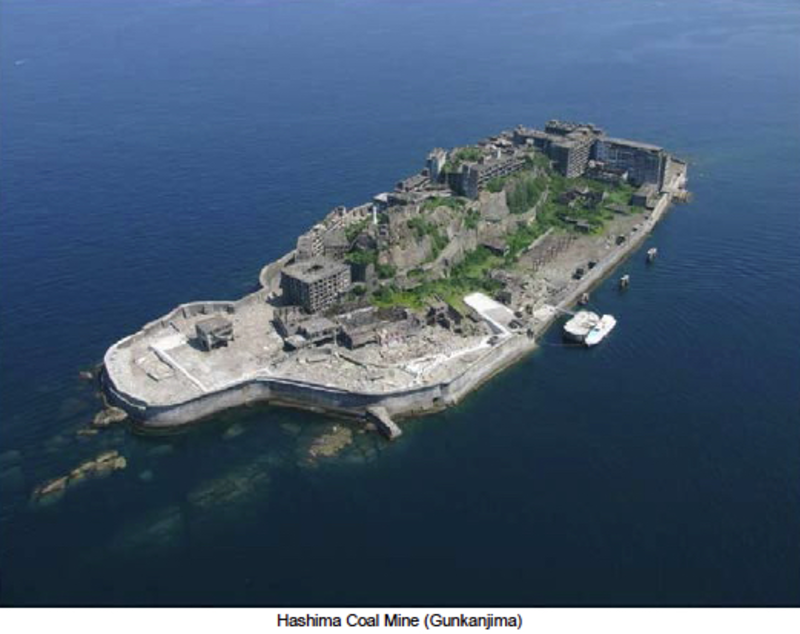
The article below appeared in German in the May 17, 2015, issue of the Frankfurter Allgemeine Sonntagszeitung, as the Sunday edition of the Frankfurter Allgemeine Zeitung (or FAZ) is known. The FAZ is said to have the widest overseas circulation of any German newspaper, and Berlin-based reporter Mark Siemons formerly served as an East Asia correspondent. The Asia-Pacific Journal is providing this English translation of the article, which explores why Japan’s World Heritage bid has become so divisive. The piece focuses on the undersea coal mine beneath Nagasaki’s Hashima Island, popularly known as Gunkanjima (Battleship Island) due to its distinctive shape.
Three days after the FAZ article was published, the German government announced it plans to pay a total of 10 million euros (about $11 million) in symbolic compensation to some 4,000 surviving soldiers of the Soviet Union who became prisoners of war under Nazi Germany. Each survivor is set to receive 2,500 euros (about $2,800) for his suffering. Postwar Germany has reportedly paid out more than 72 billion euros (roughly $80 billion) in total damages for Nazi wrongdoing, with much of the compensation going directly to individuals. Indeed, in recent years it has seemed as if Germany is running out of victim groups to compensate. Japan, on the other hand, has largely evaded facing up to the legacy of the Asia Pacific War. Not surprisingly there is much less warmth in the neighborhood. –William Underwood

Japanese government photo of Gunkanjima in Nagasaki Bay included in “Evaluations of Nominations of Cultural and Mixed Properties to the World Heritage List” (ICOMOS Report for the World Heritage Committee,” 39th ordinary session, Bonn, June - July 2015). During the war hundreds of Koreans and Chinese were forced to work, with either partial payment or no payment at all, at depths of up to 600 meters.
World War II ended in 1945, but there is a place where it still continues.
The South Korean and Japanese governments are engaged in disputes over the proposed inscription on the UNESCO World Heritage List of a place where Koreans were exploited in forced labor during World War II. Japan emphasized that the site is a memorial of its industrialization.
UNESCO is to make a decision on this matter at the end of this coming June in Bonn, Germany.
There is a legitimate reason that Hashima Island was described as the "Island of Horror" in the James Bond film, Skyfall. These ruins soaring from the sea served as an inspiration for the lair of the villain, Raoul Silva, in the film. It is a perfect location to represent an enigmatic place that harbors all kinds of scary secrets. It is no wonder that many companies have found this forgotten island off the coast of the Japanese mainland suitable for their purposes. When filming for Street View, Google showed footage of a lone Google employee wearing a camera on his head and groping his way out of the ruins, which could collapse at any time. Sony chose this island as a location to show how well its aerial drone could function even in an extremely hazardous place.
The Japanese government actually intends to use Hashima Island for a different purpose: a cultural project. It wants to list 22 industrial facilities from the 19th century as UNESCO World Heritage sites. These include the island as well as coal mines operated by Mitsubishi from 1890 to 1974. The final decision on whether to accept them as World Heritage sites will be made in a UNESCO Committee meeting in late June in Bonn, Germany. About 15 km from the coast of Nagasaki, the island is now deserted as it had been before industrial facilities were built here. In its heyday, it was inhabited by more than 5,000 workers who lived in the high-rises constructed in 1916. They were the first high-rise buildings built in Japan. The Japanese government is pressing for the island's designation as a World Heritage site because this and other such industrial facilities provide excellent evidence of the industrial revolution achieved by Japan during the Meiji period. Japan was the first non-Western nation to introduce European technology, economy, and social principles. It achieved the most rapid modernization in the 19th century and emerged as a leader in East Asia.
Nevertheless the tragic fact remains that Hashima Island has a completely different significance to some East Asian nations. On Hashima and at six other facilities proposed for World Heritage listing, Korean and Chinese laborers [as well as Allied POWs] were brought in and forced into labor under deplorable conditions. Many of them did not survive World War II, which is why the South Korean government officially opposes Japan’s proposal.
The South Korean government takes the position that, “designating such a place as a World Heritage site violates the dignity of the survivors of forced labor as well as the spirit and principles of the UNESCO Convention. World Heritage sites should be of outstanding universal value and be acceptable by all peoples across the globe.”
This incident is much more than a matter of academic discussion among historians. It represents the ever-intensifying conservative shift and historical revisionism that have occurred in Japan since the inauguration of the Abe administration as well as the vigilance of the nations once ruled by Japan. Japanese Prime Minister Abe and his cabinet insist on paying respects to Japan's war dead at the Yasukuni Shrine, where a number of Class A war criminals of World War II are enshrined. They are publicly declaring a “new Japan,” according to which view, “Japan should dismiss a historical viewpoint that ideologically torments it.” The Abe government is also attempting to strip its Constitution of the peace clause that was required of Japan after 1945.
Vague, contradictory arguments are ongoing in Japan over the criminal acts by Japan against Korea, China, and other nations starting in the late 19th century. During his visit to the US in late April this year, Abe was unable to offer anything more than uncertain "feelings of deep remorse” over Japan’s role during the Second World War. Just a short time before the US visit, he criticized the description in US textbooks of the comfort women of the Japanese military, namely, the Korean women who were forced into prostitution within the military during the war. It seems that historical revisionism is now widely accepted in Japanese society.
Under undisguised pressure, one Japanese prefecture has already removed a memorial stone that honored Korean forced laborers who died. The stone had been erected in 2004 by a civilian human rights organization and bore the following inscription: “We solemnly pledge that we will not repeat this kind of mistake and remember and deeply ponder the fact that our nation inflicted horrible pain on Koreans in the past.” Apparently, such determination and views are now retreating. In no other country in the world does the Second World War remain an ongoing issue and disputes over the war are yet to be resolved.

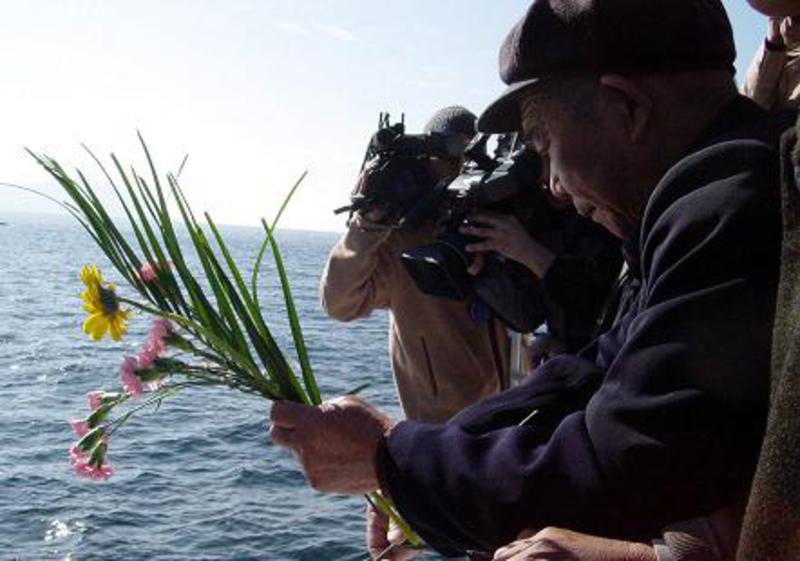
A Chinese survivor of forced labor at Mitsubishi’s Hashima coal mine tosses flowers into Nagasaki Bay in 2004, during a shipboard memorial ceremony for fellow Chinese workers who died at the site that Japan wants to see recognized as a world cultural landmark. The prefectural government rejected the mourners’ request to hold the service on Hashima Island. (Photo by Nagasaki Support Group for Chinese Forced Labor Lawsuits)
The latest front of these disputes is, of all places, an organization that symbolizes solidarity among nations and upholding of mankind’s universal values: UNESCO. On this past May 8 when all of Europe commemorated the end of the war, on this day when it seemed that the war could not assume any more significance, an envoy presented in Berlin South Korea’s position on one of the unresolved disputes from the war. The true measure of the great significance the South Korean government places on this issue can be discerned from the fact that Choi Jong-mun, former ambassador and presently a special aid to the South Korean Foreign Affairs Minister, has handled all matters involving UNESCO since March.
He has travelled around the world to meet politicians, diplomats, and members of the press to let them know about the Korean forced laborers. The Committee session in late June will be attended by 19 nations in addition to Japan and South Korea. The International Council on Monuments and Sites (ICOMOS), which offers advice to UNESCO on World Heritage sites, already made a recommendation last week to accept Japan’s proposal. Thus, the South Korean government still has much persuasion to do. This is why not only Ambassador Choi but also an appropriate Foreign Affairs Ministry official, and a councilor and two staff members of the South Korean Embassy in Germany, came to an interview with just one German journalist to fully explain the issue. This testifies to the importance of the issue to South Korea.
Ambassador Choi emphasized the case of Germany. The Zollverein Coal Mine Industrial Complex (German Zeche Zollverein) in Essen was listed as a World Heritage site in 2001. There, many people were forced into labor during the war. According to Choi, however, there is a difference between Germany and Japan. Germany has squarely faced the injustices it had committed during the war and strived to compensate the victims for their sufferings. Ambassador Choi's intent in mentioning this difference is to show that Japan’s proposal is being called into question not merely because of historial truths. This is related to South Korea’s criticism of Japan: that is, if Japan does not use the island only as an instrument of propaganda about its past glory as it does now and instead recognizes its complex history, the name of Hashima Island will be cleared.
In 2012, the South Korean Supreme Court found invalid the argument by Japanese companies that the right to claim compensation by Korean forced laborers had been rescinded through the South Korea-Japan treaty in 1965, which normalized bilateral diplomatic relations. Since this ruling, many Koreans have claimed damages from Japanese companies such as Mitsubishi and Nippon Steel and South Korean courts have already ruled in favor of some of them.
The South Korean government said in a statement that these compensations for Korean forced laborers are “not related” to Japan’s World Heritage proposal but reveal an aspect of Japan’s attitude toward its history.
Not only disregarding these claims by Koreans, Japan argues that the criticism against its proposal is logically flawed. Several ministers of the Japanese government attribute the blame for the criticism to South Korea and they nonchalantly put a “political spin” on it. They argue that the proposal for Hashima only concerns the time period until 1910, not what happened afterwards. Like China, South Korea also has made efforts to normalize relations with Japan over the last few months. Thus, a polite suggestion was made to Japan to have a bilateral dialogue about the World Heritage proposal. “We hope Japan will appropriately respond to our flexible suggestion,” remarked Ambassador Choi.
Western nations also have a role in the dispute between South Korea and Japan on this issue. The success of Japan in the 19th century was attributable to its acceptance of European technology and modernity. Initially defeated by the Western powers, Japan vigorously pushed forward under the banner of national prosperity and military power. China ventured along the same path as Japan only decades later. Some time later, after having learned from European imperialism, Japan proceeded to expand its sphere of influence by annexing other nations. Now, in 2015, Japan is only inclined to talk about its history of modernization in a very selective way; negative aspects are swept under the rug. Furthermore, Japan argues that others do not properly understand it. Consequently, Hashima Island, also called Gunkanjima (“Battleship Island”), remains a dismal place.
This article originally appeared in German as “Insel des Grauens” (Island of Horror) in Frankfurter Allgemeine Sonntagszeitung (www.faz.net) on May 17, 2015. English translation posted at The Asia-Pacific Journal on June XX, 2015. The original German article is available here.
Mark Siemons is a Berlin-based reporter for Frankfurter Allgemeine Zeitung. William Underwood is a California-based independent researcher of reparations movements for forced labor in wartime Japan.