Showing posts with label Memorial. Show all posts

Saturday, July 18, 2020

Things Japanese in Washington


Japan in DC


JAPAN IN DC is a 128-page full color, high-quality paperback, based on the writing, photography, and creative expressions of Washington, DC students who spent their summer 2017 investigating the presence of Japan in their own hometown. The adventure was coordinated by Globilize DC. It is a quirky, curious albeit heart-felt addition to Washington's travel literature. The students encounter not just the obvious, but discover Japan's complex involvement in the nation's capital.

They visit memorials, museums, theaters, gardens, nonprofits, exchange programs, Japanese markets, Japanese restaurants, veterans groups, foundations, think tanks, companies, and the Embassy of Japan. 

One stop they make is to the Navy Yard where in 1860 the first Japanese delegation to the U.S. arrived to visit Washington. At the Yard's National Museum of the U.S. Navy the students marvel at the WWII guns. Yet, missed was the 14 foot model of the USS Houston (CA-30). The sinking of this heavy cruiser in the Sunda Strait on March 1, 1942 marked the end of the U.S. Asiatic Fleet. Only 368 of the total complement of 1011 men of the Houston managed survive the sinking and machine gun attacks.The survivors became POWs of Japan and most were sent to the Thai-Burma Death Railway as slave laborers. Of this group, 79 died of maltreatment and starvation.

The book is destined to be a significant artifact of Abe Administration public diplomacy. Tourists and historians are encouraged to purchase a copy. A bargain at only $16, your purchase is also a good deed. All proceeds from the sale of the book support Globalize DC's Japanese language and culture programs offered at no cost to DC public high school students.   

Thursday, February 6, 2020

Memorialising and Remembering

Truth-Telling, Victimhood, And Historical Amnesia

Australian Outlook, Australian Institute of International Affairs (AIIA), January 30 2020

By Caitlin O'Brien, Bachelor of Asian Studies/ Bachelor of Laws student at the Australian National University.

Why do some nations seem to be concerned with conflicts which have since ended? What is historical amnesia? Why is victimhood dangerous to national healing? A brief comparison of China, Finland and the Baltic States illustrates the necessary components for the reconciliation of historical injustice.

With extensive research completed on a nation’s conflict, the area of memory and remembering the conflict in contemporary society is a fascinating and intensely complex field. Broadly, nations would rather emphasise memories which evoke pride rather than those which admit guilt and express shame. Engrained within the difficulty of societies memorialising and remembering their history are the concepts of victimhood, reconciliation and truth. These three ideas are essential to the formula a nation must apply in order to successfully heal and progress from the trauma of historical injustice. This healing is vital if a nation’s identity is to be defined without the formative influence of historical injustice. “There cannot be reconciliation without truth” and essential to truth is accurate identification of perpetrators and victims. So often a victor’s history is told and remembered as fact, but, for societal fissures arising from warring parties to be amended, both sides’ history must be told and remembered.

Perpetuating individuals’ identification with victimhood obstructs reconciliation by delegating responsibility for the conflict and dismissing criticism from other groups. The major impediment to truth-telling and the following reconciliation, victimhood, pertains to the “white-washing” of the recollection of historical injustice which prevents an accurate collective memory being formed. Meaningful and long-term reconciliation requires “a changed understanding of the self and other that transcends the narrow roles of victim and perpetrator.”

“Victimhood” refers specifically to collective victimhood, which is “people’s sense of group-based victimisation by virtue of their identification with (that group), even without having been personally harmed.” “Reminding people of historical… victimisation (reduces) their… collective guilt for their group’s harmful actions.” An example of this is China where the perceived victimisation of Mao’s Cultural Revolution felt by all Chinese absolves the perpetrators from taking responsibility for the injustice they committed at the time. By delegating the perpetrating of the injustice to that of the “regime,” individuals are removed from blame and guilt. China’s acknowledgement of wrongdoing has not surpassed the blame of Mao and his Gang of Four. Until the issue of “victimhood,” where everyone suffered but no-one executed the violence of the Cultural Revolution, reconciliation remains elusive.

The complexity of this case stems from the fact that those who experienced the Revolution all see themselves as victims, not as the perpetrators. Arising from the unpredictable political climate at the time, where one day a person could be a victimiser and the next a victim, and vice versa, reconciliation has been unable to progress due to the ambiguity of who is at fault. Qui criticises this saying that “one can be a victim of the propaganda at the time as well as having the courage to admit that they participated in the cultural revolution as well.” An accurate collective history is not achieved as truth has not been discovered. Thus, the trauma of the Cultural Revolution remains an aspect of national identity as the injustice has not been relegated to the realm of memory.

Finland offers a contrary example where the Civil War of 1918 was unable to be reconciled until the official version of history admitted the crimes and violence of the victors, the White army which resulted in the losers, the Reds, being unable to identify with the public recollection of the war. Only in the nineties, following rapid modernisation in Finland which addressed class inequality, which was a precursor to the civil war, when the public began to discuss the war did individual memories contribute to the collective one, facilitating the progression of reconciliation. This changed the public narrative from the one-sided victorious White’s recollection, to one more representative of the experience of the Whites and Reds.

Public commemoration and memorialisation of both the Red and White experience of the war is central to reconciliation. In the decades following the War, only the Whites could memorialise and grieve their dead in a public setting. The repression felt by the Reds and their descendants prevented a peaceful, harmonious society from developing as deep-seated dissatisfaction felt by the Reds inhibited reconciliation. Through the collection of individual testimonies, encouraged by the new generation’s interest in the war, a revised collective memory emerged that incorporated the victorious narrative, and the darker, violent experience of the Reds and Whites. In 2008, 90 years after the civil war, the conflict was mediated through various forms of memory work and finally relegated the associated emotions surrounding to their original historical context.

Unlike Finland, the Baltic States are yet to reconcile with their historical injustice. The devastating annexation of the Baltic States by the Soviet Union in 1939-40 has residual effects on contemporary society. Lithuania, Latvia and Estonia are unable to come to terms with the tens of thousands of deaths of their citizens at the hands of the Soviets primarily because of the historical amnesia surrounding it. Russia refuses to acknowledge that its occupation and annexation on the Baltic States was unlawful and classified as ‘foreign occupation’; Russia insists that it was a peaceful cooperation. Russian history books still educate people of this, which remains a perpetual thorn in the side of the Baltic States. Moscow’s historical amnesia of the Baltic States’ and its own role in occupation and annexation prevents the formation of a collective memory, obstructing the required unified collective memory. External historical amnesia coupled with particularly Estonia’s own national identity of victimhood surrounding the conflict known in Russia as the “Myth of 1939-40” impedes reconciliation.

“Civil wars in particular give rise to complex memory politics, as they often carve deep wounds into a society’s social memory”. The aforementioned cases were civil wars in the 20th century whose effects are being felt even now.

Saturday, October 26, 2019

Can the Statue of Peace find Peace?


On Sunday, October 27, 2019 at 3:00pm on the front lawn of 7601 Little River Turnpike, Annandale, Virginia a Comfort Woman Statue will be unveiled.

Known as the "Statue of Peace," and also called Sonyeo Sang [Statue of a Girl] this is THE Comfort Woman statue. It was designed by the Korean sculptor couple, Kim Seo-Kyung and Kim Un-Sung. The first statue was installed in front of the Embassy of Japan in Seoul, Korea by the Korean Council for Justice and Remembrance for the Issues of Military Sexual Slavery by Japan on December 14, 2011 in commemoration of the 1000th Wednesday demonstration.

This powerful, interactive artwork has been displayed by Asian American civic groups throughout the United States, despite Japanese rightwing and government opposition. The Annandale memorial is the 5th Statue of Peace and the 14th Comfort Women memorial in the U.S. Only a small number, however, are on public land.

Why are these statues necessary? What is it about the visual image--especially one that is well done with artistic grace--that can persuade where words cannot? Why is not recognized that what happened to the women, girls, and boys who were used for sexual service to the Imperial Japanese military is obviously wrong? Why is taking responsibility even harder?

Recently, the Washington Post’s Bob Woodward interviewed the New York Times’s Jodi Kantor and Megan Twohey about their best-selling book, She Said, that discusses their investigation of sexual assault and harassment allegations against Hollywood mogul Harvey Weinstein. The exchange highlights how far we still have to go to educate people, not just men, about sexual violence.

Woodward was genuinely puzzled by Weinstein's motivations and pathology. “If you spent all the time on him, you have to ask the question, which you really don’t address in the book, and that is: Why did he behave this way?” Woodward asked. “I know you’re not psychiatrists or psychologists, but share with us the ‘Why?’ … because there’s so many strange things he does.”

"I’ll tell you what we know. It’s that this story is an X-ray into power, and how power works,” Kantor said, as the crowd erupted into loud applause. “It’s also about sex, isn’t it?” Woodward asked. “No!” several attendees yelled at the same time. “It’s not about sex in the romantic sense,” Kantor said, adding that “part of the way it’s about power is that it’s about work.”

Thus, many people in prominent positions are still going through the motions of understanding how sexual violence works. No more is this true than in Japan as you can see in Abe's recent encounter with Nobel Laureate Nadia Murad. This meeting was only reported by JiJi and is NOT recorded on Abe's social media or official daily news. It is odd that it is not.
Abe Meets Nobel Peace Prize Winner Murad. JiJi, 9/25/19.Japanese Prime Minister Shinzo Abe held talks with Nobel laureate Nadia Murad in New York on Tuesday. Murad, who won the 2018 Nobel Peace Prize, is a human rights activist who drew attention to the use of sexual violence by the Islamic State militant group against members of the Yazidi minority in Iraq. Abe told Murad that Japan will continue to work on efforts to prevent rape in conflict and on support for female victims. [There is no mention of this meeting on the PM's website or MOFA]
Japan [and Korea] will have an opportunity to display its commitment to preventing rape next week, October 29th, at the UN Security Council's annual debate on women, peace and security. You can check up on them at the UNSC news site. They usually publish a good summary of events. You can also watch the debate either live or later. This day is the 19th Anniversary of UNSC Resolution 1325 and the creation of the Women, Peace and Security Agenda.

click to order
The next day, October 30th, will be a celebration for the 10th anniversary of the establishment of the UN Office of the Special Representative of the Secretary-General on Sexual Violence in Conflict by Security Council resolution (SCR) 1888 (2009). All are welcome.

Both 1325 and 1888 are part of a 20 year series of UN resolutions recognizing the detrimental impact that sexual violence in conflict has on communities and acknowledging that this crime undermines efforts to ensure peace and security and rebuild societies once a conflict has ended. These resolutions signal a change in the way the international community views and deals with conflict-related sexual violence. It is no longer seen as an inevitable byproduct of war, but rather a crime that is preventable and punishable under International Human Rights Law and International Criminal Law.

In other words, it was not until 2000 that the UN Security Council began officially to mandate that a gender perspective be integrated throughout all aspects of peace and security. It was not until this century that a political framework was established to recognize that women and sexual violence in warfare are relevant to negotiating peace and reconciliation agreements. There is still much to do to educate that rape is about power. The objections that the Abe government and friends have about recognizing the Comfort Women as sex slaves are products of an antiquated view of women and warfare. Unfortunately, they have not grown with the times.

Wednesday, August 21, 2019

In Memoriam Jan Ruff-O'Herne

Mrs. Jan Ruff-O'Herne died on Monday, August 19, 2019.

Jan was the Dutch Comfort Woman who traveled from her home in Australia to testify to a subcommittee of House of Representatives Foreign Affairs Committee in February 2007 about how she was taken from her internment camp in 1944 on Java by Imperial Japanese Army officers for one of their brothels. Current research estimates that more than 1,000 Dutch, Indo-Dutch, and missionary women in the Japanese occupied Dutch East Indies were forced to be sex slaves to the Japanese military. This number does not include indigenous girls and women forced to become Comfort Women.

Jan was an extraordinarily brave and determined woman who was a civil rights icon and inspiration to women worldwide. Her daughter said that "a warrior has passed." Interview with Jan Ruff-O'Herne.

The 96-year-old International Peace Prize winner and decorated peace activist passed away peacefully surrounded by her family.

In 1992, after seeing on CNN the Bosnia rape victims and the Korean Comfort Women--sex slaves to the Japanese military--come forward to appeal for justice, Jan decided to finally tell her story of rape and survival.

She worked with the UN Human Rights Commission, International Red Cross, and Amnesty International, speaking in Australia, New Zealand, Japan, the US and UK, the Netherlands and many other countries, sharing her incredible story.

Jan’s autobiography, Fifty Years of Silence, published by Random House has been translated into six different languages, including Japanese, Indonesia, Indian, Chinese and Korean.

A documentary film about Mrs Ruff O’Herne, "50 Years of Silence" won numerous accolades, including the 1995 Most Outstanding Documentary TV Logie, winner of the Australian Film Institute Awards, Best Documentary, winner of the 1995 EAC Dendy Awards, winner of the Best Film Non-Fiction, Asia Pacific Film Festival and winner World Film and TV Festival in Japan. Jan's granddaughter, Ruby Challenger, produced a short film, "Daily Bread," on her grandmother's internment.

Jan never believed that Japan had adequately apologized to the Comfort Women and refused to accept the "medical payments" offered by a private Japanese fund in the late-1990s. Of the hundreds of the then-recognized Comfort Women, only 78 men and women accepted these payments. Jan wanted an unequivocal government apology and atonement payment. She was disappointed by Prime Minister Shinzo Abe's backtracking on Japan's limited apology.

Jan received an Order of Australia in 2002, a papal honour from Pope John Paul II, Dame Commander of the Order of Saint Sylvester in the same year and in 2004 received a Centenary medal from Prime Minister John Howard for contributions made to Australian society.

Requiescet in pace

The funeral is on Tuesday, August 27th at 11:00am at Our Lady of Dolours Church, Kingswood,  South Australia, Australia.

Tuesday, February 19, 2019

Friday, November 2, 2018

Remembering Wartime Slave Labor

Nazi slavery recalled at UNESCO-listed Völklinger Ironworks


Deutsche Welle
October 31, 2018

Grenades, aircraft parts and military equipment created in one of Nazi Germany’s largest steel and ironworks were the product of forced laborers. An installation by French artist Christian Boltanski remembers them. Voices whisper their names from all corners of the vast former iron foundry: women, men and children from 20 countries who were transported from across Nazi-occupied Europe and forced to work under inhumane conditions — and ultimately die — at the Völklinger Ironworks.


The French artist Christian Boltanski, in his installations "Forced Laborers" and "Memories," which are on display from November 1 at the site, reminds us of the 12,396 people taken from countries from Albania to Belgium, Bulgaria to France, from Denmark, Serbia, the Ukraine and nearly everywhere in between, to work as slaves as part of the Nazi arms build-up.

The installation employs the actual spoken recollections of former ironworkers, which are emitted from the numbered lockers that form the focal point for the work. Here long-suppressed memories come to life.

Christian Boltanski


➽  CLICK HERE FOR A PDF OF THE EXHIBITION CATALOG. It lists all the names of the forced laborers. This is the English version.


Worked to death

Set in the 19th century German industrial landmark, the installation also features a pile of anonymous black trousers and jackets on the floor surrounded by stacked archive boxes. The light is sparse. Here the visitor understands why, during World War II, forced laborers who were transported to Völklingen near the French border were deprived of their ID cards and made to wear a special badge. A circular forbid staff in the plant from being friendly with the prisoners: "The enemy remains the enemy," it read.

Hermann Röchling was then the head of the iron foundry and a fervent admirer of Adolf Hitler. He was a member of the senior staff of the Nazi department for the "war economy," and thus responsible for the entire armaments industry and the widespread use of imported slave labor. The deaths of 261 forced laborers, including 60 children and infants, occurred under his watch. Some of them did not see their first birthday.


Read more: South Korea court orders Japan's Nippon Steel to compensate forced laborers
      NB: A number of the Nippon Steel and Sumitomo Steel sites in Japan have become, like the Völklinger Ironworks, UNESCO World Industrial Heritage Sites. These sites used Korean forced labor as well as Chinese (there was a policy of abduction toward the end of the war) slave labor and Allied and American POW slave labor. There is NO acknowledgment of this. 

Boltanski, a conceptual artist, painter, sculptor and filmmaker who is a regular at the Documenta art exhibition in Kassel and in 2011 designed the French pavilion of the 54th Biennale in Venice, creates an emotive outlet to understand this dark chapter in the history of the steel plant.

A history of slavery

The Völklinger Ironworks was once the largest manufacturer of iron girders in Germany following its foundation in 1873. It was already producing war equipment during World War I, including 90 percent of the crude steel used to build German army helmets. Forced laborers from Belgium and Italy — in addition to prisoners-of-war from France and Russia — were also employed in the steel factory at the time. Around 10 percent of these slave workers died on site; these victims are also remembered in Boltanski's installation.

"Industrial culture in all European countries was no innocent culture," said general manager and managing director of the Völklinger Hütte, Meinrad Maria Grewenig, at the opening of the installation.

The postwar period was less controversial, with the ironworks booming in the 1960s and employing some 17,000 people before a worldwide steel crisis hit the in the mid-1970s. By 1986, the chimneys in Völklingen had stopped smoking.

In 1994, UNESCO declared the Völklinger Ironworks a World Heritage Site, the first industrial monument to be placed on the prestigious list. But while the site is the only surviving factory from the heyday of iron and steel production in 19th century Germany, the Völklinger Ironworks has a more sinister heritage upon which Christian Boltanski is again shining light.

The Christian Boltanski installation will be on display at the Völklinger Ironworks from November 1 through August 31, 2019.

Sunday, October 28, 2018

Monday, October 16, 2017

Memorializing Sexual Violence in War


Sexual Violence in War
Professor Elisabeth Wood 
Yale University, October 7, 2009
It is not normative

An Important Statue for “Comfort Women” in San Francisco

By Sally McGrane, The New Yorker, October 12, 2017

At the back of St. Mary’s Square in San Francisco’s Chinatown, the retired judge Lillian Sing—who, long a trailblazer, was Northern California’s first Asian-American female judge—unlocked a temporary plywood gate. Behind the gate, in the corner of a terrace, stood a week-old memorial. Against the backdrop of city skyscrapers, three teen-age girls, cast in bronze, stand in a circle, holding hands. Next to them, looking on, stands the figure of an elderly woman in Korean dress—Kim Hak-sun, the first so-called comfort woman to speak out, in 1991, about her horrific sexual enslavement, during the Second World War, by the Imperial Japanese Army.

Sing had come to the park that day with Julie Tang, another retired judge and her co-chair in the project to create the memorial. “What they did was so brave,” Tang said, as she gazed up at the three girls. Chinese, Korean, and Filipino, they represent the estimated two hundred thousand women from countries across East and Southeast Asia occupied by Japan who were held in brutal state-run rape camps—a crime that went largely unacknowledged until the nineties. That was when Kim’s declaration inspired surviving comfort women in Korea, China, and elsewhere to come forward with their stories. Tang shook her head. “They were silent for fifty years, holding this shame inside them,” she said. “Victims think they are to blame. They think they did it to themselves.” With this statue—the first to be erected in a major U.S. city, though smaller memorials to comfort women exist in places like Glendale, California, and Palisades Park, New Jersey—Tang, Sing, and the local coalition they assembled want to change that kind of thinking. By bringing attention to the comfort women’s history, they hope to draw attention to ongoing problems of human trafficking and sex crimes.

This may not be as self-evident as it sounds. Discussing the statue, Dara Kay Cohen, a professor of public policy at the John F. Kennedy School of Government, at Harvard, said, “As a scholar of wartime rape, I think it is extraordinary.” Cohen has interviewed women captured as sex slaves in Sierra Leone; she found their stories of being raped dozens of times a day by fighters, even when the women were sick, “eerily similar” to those of the comfort women. “Publicly memorializing the rape of women is rare,” she said. “Women are half of humanity,” Elaine Kim, a professor of Asian-American and Asian-diaspora studies at U.C. Berkeley, and a supporter of the statue (whose unveiling brings the total number of public statues in San Francisco of real women to three), said. “And women are not represented in history. Nothing will be done about crimes like these if they remain in the shadows.”

The Japanese Army’s “comfort stations,” initiated in the early nineteen-thirties, were expanded extensively following the Nanjing massacre, also known as the Rape of Nanking, in 1937. According to a paper by the Yale political-science professor Elisabeth Jean Wood, the stated goal of the comfort stations was to reduce random civilian rapes. Girls were seized from the local populations. Conditions were brutal, and death rates were high. “In one day, we had to serve forty to fifty soldiers,” Lee Ok-seon, a Korean survivor, who was kidnapped at the age of fifteen, recalled in video testimony. Girls who refused were lined up against the wall and slashed open with knives. “I don’t call it a ‘comfort station.’ I call it a slaughterhouse,” Lee said. Jan Ruff-O’Herne, a Dutch girl, was taken from the Indonesian prisoner-of-war camp where she was living with her family. In a television interview, she recalled arriving at the comfort station: “We started protesting right away. We said we were forced into this, they had no right to do this, it was against the Geneva Convention. And they just laughed at us. They said they could do with us what they liked.”

After the war, survivors risked rejection by their families. Ill and impoverished, many never married or had families of their own. Ruff-O’Herne had two daughters, but did not tell them what happened to her. “You know, how can you tell your daughters?” she said in the same interview. “All these years, I was too ashamed. You think, What will they think of me?” But, after seeing Kim Hak-sun and others come forward and struggle to have their stories heard, Ruff-O’Herne decided that she had to help by speaking up. (Her daughters hugged her.)

The former congressman Mike Honda told me that, in addition to the stigma faced by victims of sexual crimes, the Japanese government’s stance on the issue has been a problem. He said that Prime Minister Shinzo Abe “flip-flops”: “He says, ‘We’re really sorry,’ then, ‘It never happened.’ He’s all over the field.” Honda, who spent his own early years in a Japanese-American internment camp, said that he first heard of the comfort women in the nineties, after an aide returned from an exhibition visibly upset. Honda became determined to learn more. “We know a lot about what happened in the war in Europe, but not a lot about what happened in Asia,” he said.

After he researched the comfort women, he decided to act. “For me, as a Japanese-American, there was a parallel,” he said. “We fought to have the U.S. government apologize to us. Now we have to get the Japanese government to recognize the historical facts.” In 2007, Honda brought survivors—including Ruff-O’Herne—to testify before Congress, and successfully pushed through legislation demanding that the Japanese government apologize. “Telling the story of the comfort women to the public is powerful,” Honda said. “The statue is a physical representation of something that happened in the past that needs to be learned about, in order to prevent violence against women and end human trafficking—which is a one-hundred-and-fifty-billion-dollar industry.”

Steven Whyte, the Carmel-based artist who created San Francisco’s memorial, had a similar learning curve. “I was familiar with the term ‘comfort women,’ but I didn’t realize the extent of the torture,” he said. Once he saw the call for applications, he researched the topic, and wanted the job so much that he reduced his regular prices. “You think of every girl you’ve ever known—your nieces, your daughters, your girlfriends, everything. It’s desperately upsetting.”

While most of the comfort-women statues around the world have been put up by South Koreans or members of the Korean diaspora, the push for this statue was led by San Francisco’s Chinese-American community, with support from several other groups, including members of the Japanese-, Filipino-, Korean-, and Jewish-American communities, Eric Mar, who served as the city supervisor during the planning-and-design process and championed the project, said. “I thought, to be successful, we had to build a pan-Asian coalition,” he explained. Mentioning his own teen-age daughter, Mar began to weep. “It’s very emotional, for a lot of people.”

At the cavernous Cathay House restaurant, just up the street from St. Mary’s Square, Sing and Tang were joined by Judith Mirkinson, the president of the board of the Comfort Women Justice Coalition. Over hot toddies and Chinese chicken salad, the women talked about the challenges they faced in bringing the statue into being—including local Japanese-Americans who say they worry that the statue could give rise to a new wave of discrimination, and a vigorous campaign of condemnation from the Japanese government. Whyte received some twelve hundred negative social-media messages and e-mails, including form letters copied and pasted from a Japanese Web site threatening economic boycotts of his work. Activists attended hearings about the statue and called an elderly survivor a prostitute when she testified before the San Francisco Board of Supervisors. More recently, the mayor of Osaka threatened to end his city’s long-standing sister-city relationship with San Francisco if the statue is not removed—and the Japanese consul-general in San Francisco, Jun Yamada, wrote a letter to the editor of the San Francisco Chronicle calling the statue a “half-told” story, and warning that if the city wants to “give equal treatment to all cases, there will be no free space left anywhere.”

Those spearheading the memorial fear that pressures like these may delay the bureaucratic procedures that still need to take place before the plywood gate comes down and the statue is visible to the public. At lunch, Sing said that she felt that racism in the United States had played a silencing role when it comes to recognizing what happened to the comfort women. “Why did this take so long?” she said. Kim Hak-sun “spoke out in 1991. There is the race issue: Asian women’s lives didn’t matter, like black men’s lives don’t matter.” Still, the three women agreed that it is no accident that this statue is here. “Even if San Francisco is changing, progressivism is still woven into the fabric of this city,” Mirkinson said. “And we are on the Pacific Rim,” Tang said. “We are closer to Asia, and thirty-three per cent of the city is Asian. People bring with them family memory that goes back to World War Two.”

For Lee Yong-soo, an eighty-nine-year-old survivor who flew from Korea for the unveiling, San Francisco seemed dauntingly far away. But when she arrived she was glad she had made the journey. “When I saw the girls holding hands, it brought tears in my eyes because she looked just like the girl I once was,” Lee wrote in an e-mail. “We need more memorials to remember the truth. I am the living proof of the history. But when I’m gone, who will tell the story to the next generation?”

Wednesday, December 28, 2016

Abe at Pearl Harbor

Japanese PM Abe hugs survivor
Abe offers ‘everlasting condolences’ at Pearl Harbor as Obama praises partnership in peace

BY ERIC JOHNSTON, STAFF WRITER

Japan Times, December 28, 2016

HONOLULU – Prime Minister Shinzo Abe’s historic visit to Pearl Harbor wrapped up Tuesday with addresses from the Japanese leader and U.S. President Barack Obama on the power of reconciliation and its ability to transform once-hated enemies into close friends and strategic partners.

Seventy five years after the “day of infamy,” on Dec. 7, 1941, when Japan attacked U.S. forces at Pearl Harbor, Abe and Obama recalled the past but also focused on the importance of the present postwar U.S.-Japan strategic alliance. Abe’s visit and meeting with Obama, who leaves office in less than a month, was an attempt to gird the legacies of both leaders in the Asia-Pacific region in the face of uncertainties surrounding the fate of bilateral relations under President-elect Donald Trump.

In a meeting between the two leaders, Abe thanked Obama for his efforts to work with Japan on a number of issues ranging from dealing with North Korea’s nuclear program to his support for the Trans-Pacific Partnership free trade agreement, despite opposition by congress and large portions of the American public, as well as Trump, who has announced he will cancel the TPP on his first day in office.

For Abe, the hope is that his trip to Pearl Harbor also sends a message to the U.S., and especially to Trump, that the long-standing postwar relationship should continue, and that the military alliance in particular needs to be strengthened in order to deal with a host of challenges relating to regional security.

While U.S. veterans of Pearl Harbor invited to attend Tuesday’s ceremony appreciated Abe’s visit, how it will be received by the larger American public remains uncertain. Some groups expressed disappointment that Abe offered no apology for the attack, or suggested his administration needs to make similar efforts at reconciliation with not only the U.S. but also other nations victimized by Japan during the 1930s and 1940s.

In a carefully worded address that avoided an apology for Japan’s decision to go to war with the U.S., Abe spoke about the necessity of never repeating the horrors of war. [TEXT]

“As prime minister of Japan, I offer my sincere and everlasting condolences to the souls of those who lost their lives here, as well as to the spirits of all the brave men and women whose lives were taken by a war that commenced in this very place, and also to the souls of the countless innocent people who became victims of the war,” he said.

Abe, who favors revising Japan’s postwar pacifist Constitution to allow for a more proactive military, added that since World War II, Japan has resolutely upheld its vow to never again wage war.

“To the souls of the servicemen who lie in eternal rest aboard the USS Arizona, to the American people, and to all peoples around the world, I pledge that unwavering vow as the prime minister of Japan,” he said.

Obama, who hosted the prime minister in Pearl Harbor seven months after Abe hosted him at Hiroshima, called the visit a historic gesture and also spoke of reconciliation and Pearl Harbor’s historical legacy. [TEXT]

“We cannot choose the history that we inherit. But we can choose what lessons to draw from it. The fruits of peace always outweigh the plunder of war. This is the enduring truth of this hallowed harbor,” Obama said in his remarks following Abe’s address.

In a veiled reference to concerns both in and outside the U.S. created by Trump’s election, Obama also referenced the Japanese phrase otagai no tame ni — doing things with and for each other — as words to follow when resisting the urge to demonize others or turn inwards.

“Over the decades, our alliance has made both of our nations more successful. It has helped to underwrite an international order that has prevented another world war and that has lifted more than a billion people out of extreme poverty. And today, the alliance between the United States and Japan — bound not only by shared interests, but also rooted in common values — stands as the cornerstone of peace and stability in the Asia Pacific and a force for progress around the globe. Our alliance has never been stronger,” Obama said.

Following their statements, Abe and Obama shook hands and exchanged greetings with three survivors of the Pearl Harbor attack, who are now in their 90s. All three welcomed Abe’s visit.

“Apologize for the attack on Pearl Harbor? What for? There’s nothing to apologize for. The U.S. and Japan are friends now,” said Everett Hyland, who was on board the USS Pennsylvania when the attack began and was severely injured by a bomb.

Total U.S. casualties for the Pearl Harbor attack were 2,403 dead and 1,178 wounded.

Abe received a brief tour of the Pearl Harbor Visitors Center before proceeding to the Arizona memorial and holding a separate meeting with Obama. He then addressed a crowd that included large numbers of U.S. military personnel and Japanese-American residents of Hawaii.

The visitors center includes displays and explanations of the political situation in the U.S. and in Japan in the 1930s, describing the decisions, especially by Japan, that led to the attack as well as details of the attack itself. It also describes the impact it had in the U.S. as a whole and on Hawaii’s Japanese-American community.

The center’s chief historian, Daniel Martinez, told Abe that “The exhibits reflect the voices and views of people who were involved in the attack or the war, not the opinions of academics.” Abe was accompanied by Defense Minister Tomomi Inada — who in the past has espoused revisionist views of Japan’s wartime history — and Foreign Minister Fumio Kishida.

Abe’s gesture was widely welcomed in Hawaii and among Americans and Japanese who deal directly with each other. Its impact in the U.S. as a whole, three-quarters of a century after the attack, is less clear. For most Americans, Pearl Harbor was a long time ago — a different century.

However, for those concerned about historical reconciliation issues in the Asia-Pacific region, there were calls to continue the reconciliation process, especially with Japan’s Asian neighbors.

In an open letter released on Christmas Day, over 50 international historians, filmmakers — including director Oliver Stone — and others asked the prime minister about his views on Japan’s history and about previous public statements he’d made.

“You state that you are going to visit Pearl Harbor to ‘mourn’ the 2,400 Americans who perished in the attack. If that is the case, will you also be visiting China, Korea, other Asia-Pacific nations, or the other Allied nations for the purpose of ‘mourning’ war victims in those countries who number in the tens of millions?” the group asked.

They added that in Diet questioning on April 23, 2013, Abe, as prime minister, indicated that the definition of what constitutes “aggression” has yet to be established in academia or in the international community.

“Does that mean that you do not recognize Japan’s war against the Allied and Asia-Pacific nations and the preceding war against China as wars of aggression?” the scholars asked.

Jan Thompson, president of the American Defenders of Bataan and Corregidor Memorial Society, said she was impressed by the sincerity of Abe’s speech, saying it took moral courage. She said she knew that he would not apologize for the Pearl Harbor attack but encouraged him to visit other Asian countries as well.

“It’s taken 75 years for us to get to this point where a Japanese prime minister can come to Pearl Harbor and make that kind of a speech. However, while some people are saying that his visit means reconciliation with the wartime past is over, it’s actually only one step on the road. Reconciliation is cross-generational,” she said.

Monday, December 26, 2016

Japan reconsiders and reinterprets the Pearl Harbor attack

And ignores the Prime Minister's upcoming visit

BY MARK SCHREIBER, a Tokyo-based writer

THE JAPAN TIMES, December 24, 2016

In May, U.S. President Barack Obama became the first sitting U.S. president to make a historic visit to Hiroshima, the city that became the birthplace of the age of nuclear warfare. It should come as no surprise that Japan’s prime minister, Shinzo Abe, is scheduled to make a reciprocal gesture of reconciliation this week, possibly making him the first sitting Japanese prime minister to visit the USS Arizona Memorial.

So far, however, news coverage in Japan has been disappointingly spotty, partly because the story has been eclipsed by the usual year-end roundups, interspersed with breaking news stories: the Osprey crash in Okinawa and resulting blowback; the terrorist incident in Berlin; heavy pollution in Beijing; and President-elect Donald Trump’s latest tweet.

In December, the January 2017 issue of prestigious monthly magazine Bungei Shunju was released with a 13-page essay by history critic Masayasu Hosaka titled “Pearl Harbor: The true nature of the blunder.” Though written long before the announcement of Abe’s upcoming visit, it nonetheless provides some scholarly insights into how Japanese reacted to news of the attack 75 years ago.

At 7 a.m., on Monday, Dec. 8, 1941, a young NHK announcer named Morio Tateno told radio listeners, “The Naval department of Imperial headquarters announced that at 6 a.m. today the Imperial Navy, during predawn hours, initiated hostilities with the British and American navies in the Western Pacific.”

On the night of Dec. 8, Prime Minister Hideki Tojo invited the heads of the army and navy to celebrate with a Chinese-style repast at the prime minister’s residence, during which he effused over the “better than anticipated results” of the attack and expressed anticipation of President Franklin Roosevelt’s imminent downfall. Extra editions of newspapers were passed out to pedestrians on the streets and stirring martial tunes such as “Warship March” emanated from loudspeakers. Company workers at their morning assemblies were exhorted to exclaim “banzai” cheers. Stock prices on the Tokyo exchange shot up by 10 percent.

As Hosaka observes in Bungei Shunju, “The exhilaration over the successful attack on Pearl Harbor was the beginning of what was to become a stream of glorified lies on the progression of the war.”

But, unlike Adolf Hitler and Benito Mussolini, who went to war with the specific goal of recovering their former empires’ lost territories, Japan had no clearly defined purpose for initiating hostilities.

“Having gone to war with vague goals,” he wrote, “Japan had no means of determining how to bring the war to an end. Even after Tojo’s Cabinet fell, it could not speedily halt the war.”

This year, several magazines chose to run articles about Pearl Harbor with strongly revisionist slants. The January issue of conservative monthly Rekishi-tu featured two, one that accused the wily President Roosevelt of “maneuvering” Japan into attacking the U.S., and another maintaining U.S. intelligence had broken the Japanese naval code before Pearl Harbor and, therefore, had advance knowledge of the attack. The January issue of Shincho 45 magazine ran an article that claimed British leader Winston Churchill knew of the Japanese plans but chose not to inform the Americans. Move on folks, nothing new here.

In a live telephone interview on New York’s WABC Radio, Tokyo-based American entertainer Dave Spector remarked, “In America, it’s ‘Remember Pearl Harbor.’ In Japan it’s more like ‘Forget Pearl Harbor.’ “

Nonetheless, in a poll of 959 people conducted earlier this month by NHK, 34 percent of respondents said they “strongly approve” of Abe’s visit, with another 48 percent giving their qualified approval. Only 3 percent voiced completely negative opinions.

On the other hand, Sunday Mainichi (Dec. 25) opined, perhaps Abe’s not the right person to go there. After all, over the past several years it has been the Emperor and Empress who traveled to Saipan, Palau and the Philippines to console the war dead. A visitor from the Imperial Family would carry more weight than a prime minister and, Abe’s good intentions notwithstanding, it’s unlikely his visit will erase the lingering U.S. sentiment that the attack on Pearl Harbor was a “cowardly act.”

Contradicting most news reports, meanwhile, it appears that Abe might not necessarily be the first sitting Japanese prime minister to visit the USS Arizona Memorial after all. Shukan Post (Jan. 1-6) claims the former Prime Minister Noboru Takeshita also went there in June 1988, during his tenure as Japan’s leader.

Takeshita, while traveling aboard a government-chartered Japan Airlines DC-10, stopped in Hawaii on the return leg of a summit meeting in Toronto. The magazine’s check of airport flight records notes that Takeshita’s aircraft first flew from Toronto via Chicago to the island of Maui on June 24, for a two-night stay. At 8 a.m. on June 26, he flew to Oahu, and returned to Tokyo’s Haneda at 6:23 p.m.

Allowing for a flight of 30 minutes from Maui to Oahu, and the seven to eight hours flying time between Honolulu and Haneda, Takeshita would have had a stopover of from one to two hours in Oahu. No records exist, however, of his having gone to Pearl Harbor.

“While no record of such a visit exists, there have been cases where visitors do not go through military channels,” Daniel Martinez, chief historian at the USS Arizona Memorial, explained to Shukan Post.

A member of Takeshita’s entourage says that the prime minister slipped away to Pearl Harbor while the others in his entourage went golfing, so only a few Diet members could have accompanied him. Efforts to identify other eyewitnesses were inconclusive, but the story’s source emphasized, “I’ve only been to the Arizona memorial once, so my recollection couldn’t possibly be wrong.”

The Dec. 24 Tokyo Shimbun can claim bragging rights for nick-of-time historical research. It has discovered that two other prime ministers, Ichiro Hatoyama and Nobusuke Kishi, also visited Pearl Harbor during their tenures, in 1956 and 1957 respectively. The Hawaii Hochi newspaper covered the events.

Thursday, December 10, 2015

Prime Minister of Japan's Schedule June 1 to June 7, 2015

Monday, June 1, 2015

AM
07:10 Depart from private residence in Tomigaya, Tokyo
07:23 Arrive at office
07:24 Meet with Deputy Chief Cabinet Secretary Kato Katsunobu
08:12 End meeting with Mr. Kato
08:54 Depart from office
08:57 Enter Lower House Committee Room No. 1
09:00 Meeting of the Special Committee of the House of Representatives on the Legislation for Peace and Security of Japan and the International Community

PM
12:03 Meeting adjourns
12:04 Leave Lower House Committee Room No. 1
12:06 Depart from Diet
12:08 Arrive at office
12:54 Depart from office
12:55 Arrive at Diet
12:57 Enter Lower House Committee Room No. 1
01:00 Meeting of the Special Committee of the House of Representatives on the Legislation for Peace and Security of Japan and the International Community reopens
05:01 Meeting adjourns
05:02 Leave Lower House Committee Room No. 1
05:03 Enter LDP President’s Office
05:06 LDP Officers Meeting
05:23 Meeting ends
05:24 Speak with LDP Secretary-General Tanigaki Sadakazu, Chairman of LDP General Council Nikai Toshihiro, and LDP Executive Acting Secretary-General Hosoda Hiroyuki
05:32 Leave LDP President’s Office
05:33 Depart from Diet
05:34 Arrive at office
05:35 Interview open to all media: when asked “the feeling of hearing the news of the former Lower House Speaker Machimura Nobutaka’s death,” Mr. Abe answers, “I have been receiving his guidance since I was young. I feel really sorry.”
05:36 Interview ends
05:47 The 8th meeting in 2015 of the Council on Economic and Fiscal Policy
06:46 Meeting ends
06:47 Interview open to all media: when asked, “how will the government respond to the information leak of Japan Pension Service?” Mr. Abe answers, “ I have instructed Minister of Health, Labor and Welfare Shiozaki that we must put the pensioners in first and guarantee the completeness of our measures.”
06:48 Interview ends
06:49 Depart from office
06:52 Arrive at ANA InterContinental Hotel Tokyo in Akasaka, Tokyo. Attend the party hosted by LDP members’ group Yurinkai  [有隣会] that is led by Secretary-General Tanigaki Sadakazu in the banquet hall Prominence within the hotel, deliver an address
06:58 Depart from the hotel
07:05 Arrive at Chinese restaurant Akasaka Hanten in Akasaka, Tokyo. Informal talks with all top reporters of Cabinet Kisha Club
08:32 Depart from the restaurant
08:52 Arrive at the residence of the late former Lower House Speaker Machimura Nobutaka, condolence call
09:11 Depart from the residence
09:28 Arrive at private residence

Tuesday, June 2, 2015

AM
12:00 At private residence (no visitors)
07:46 Depart from private residence
07:59 Interview open to all media: when asked “the feeling of wearing Kariyushi shirt” (a style of dress shirt originating in Okinawa), Mr. Abe answers, “Light and cool, I feel great.”
08:00 Interview ends
08:07 Hold the 29th meeting of the Global Warming Prevention Headquarters
08:20 Meeting ends
08:24 Cabinet meeting
08:37 Meeting ends
08:39 Meet with Commissioner of Japan Tourism Agency Kubo Shigeto and others
08:55 End meeting with Mr. Kubo and others
09:05 Meet with Cabinet Advisor Iijima Isao
09:21 End meeting with Mr. Ijima
09:52 Meet with Chairman of LDP Election Strategy Committee Motegi Toshimitsu
10:31 End meeting with Mr. Motegi
10:32 Vice-Minister for Foreign Affairs Saiki Akitaka, Administrative Vice-Minister for Foreign Affairs Nagamine Yasumasa, and MOFA’s Director-General of Economic Affairs Bureau Saiki Naoko enter
10:52 Mr. Nagamine leaves
11:06 Mr. Saiki and Ms. Saiki leave
11:07 Meet with Cabinet Advisor Sakaiya Taichi
11:15 End meeting with Mr. Sakaiya
11:16 Meet with Cabinet Advisor Honda Etsuro
11:30 End meeting with Mr. Honda
11:31 Meet with President of Parliamentary League for Promotion of Soccer Diplomacy Eto Seishiro
11:44 End meeting with Mr. Eto
11:45 Meet with Cabinet Advisor Kiso Isao
11:47 End meeting with Mr. Kiso
11:48 President of Bank of Japan Kuroda Haruhiko enters

PM
12:47 Mr. Kuroda leaves
01:33 Meet with Cabinet Advisor Hirata Takeo
01:46 End meeting with Mr. Hirata
01:49 Depart from office
02:02 Arrive at Federation of Economic Organizations [Nippon Keidanren] Assembly Hall in Otemachi, Tokyo. Attend the Regular General Meeting of the Nippon Keidanren, deliver an address
02:30 Depart from the hall
02:39 Arrive at office
02:40 Meet with Cabinet Advisor Fuji Satoshi
02:48 End meeting with Mr. Fuji
02:49 Meet with former Lower House member Nishikawa Kyoko
02:57 End meeting with Ms. Nishikawa
02:58 Meet with the Chairman of the Pharmaceutical Research and Manufacturers of America (PhRMA) Kenneth C. Frazier and others
03:12 End meeting with Mr. Frazier and others
03:13 Meet with Minister of Finance Aso Taro, Vice-Minister of Finance for International Affairs Yamasaki Tatsuo, and Ministry of Finance’s Director-General of International Bureau Asakawa Masatsugu
03:45 End meeting with Mr. Aso, Mr. Yamasaki, and Mr. Asakawa
03:50 Meet with Special Advisor to the Prime Minister Kimura Taro
03:54 End meeting with Mr. Kimura
04:02 Receive a courtesy call from the four winners of the 46th National Truck Driver Contes
04:09 Courtesy call ends
04:14 Meet with the CEO of Korean Lotte Group Shigemitsu Akio
04:24 End meeting with Mr. Shigemitsu
04:44 Director of National Security Council (NSC) Yachi Shotaro, Director of Cabinet Intelligence Kitamura Shigeru, and Director of Cabinet Satellite Intelligence Center Shimohira Koji enter
04:55 Mr. Shimohira leaves
04:56 National Police Agency (NPA)’s Director of Security Bureau Takahashi Kiyotaka enters
05:01 Mr. Yachi and Mr. Takahashi leave
05:16 Mr. Kitamura leaves
05:17 Receive a courtesy call from former President of the European Council Herman Van Rompuy
05:38 Courtesy call ends
06:03 Receive a courtesy call from Team Japan of the J7 Summit and Dr. Agnes Chan, Goodwill Ambassador of the Japan Committee for UNICEF
06:19 Courtesy call ends
06:20 Depart from office
06:30 Arrive at wine bar Amuruzu in Ginza, Tokyo. Dinner meeting with President of New Renaissance Party Arai Hiroyuki
08:46 Depart from the bar
09:07 Arrive at private residence

Wednesday, June 3, 2015
AM
12:00 At private residence
08:00 At private residence in Tomigaya, Tokyo (no morning visitors)
08:36 Depart from private residence
08:52 Arrive at Imperial Palace. Reception event for President of the Philippines Benigno Aquino III
09:41 Depart from Imperial Palace
09:51 Arrive at office
10:51 Meet with Cabinet Advisor Yoshimura Yasunori
11:00 End meeting with Mr. Yoshimura
11:01 Meet with Cabinet Advisor Otani Yasuo
11:25 Receive a courtesy call from Minister for Defence of Australia Kevin Andrews MP. Minister of Defense Nakatani Gen
11:47 Courtesy call ends

PM
01:22 Meet with Administrative Vice-Minister for Foreign Affairs Sugiyama Shinsuke, Administrative Vice-Minister for Foreign Affairs Nagamine Yasumasa, MOFA’s Director-General of Asian and Oceanian Affairs Bureau Ihara Junichi, MOFA’s Director-General of European Affairs Bureau Hayashi Hajime, and Ministry of Foreign Affairs (MOFA)’s Director-General of Middle Eastern and African Affairs Bureau Uemura Tsukasa
02:29 End meeting with Mr. Sugiyama, Mr. Nagamine, Mr. Ihara, Mr. Hayashi, and Mr. Uemura
02:30 Meet with Director of National Security Council (NSC) Yachi Shotaro, Director of Cabinet Intelligence Kitamura Shigeru, MOFA’s Director-General of Foreign Policy Bureau Hiramatsu Kenji, Ministry of Defense (MOD)’s Director-General of Bureau of Defense Policy Kuroe Tetsuro, and Chief of Staff for Joint Staff Council Kawano Katsutoshi
02:47 End meeting with Mr. Yachi, Mr. Kitamura, Mr. Hiramatsu, Mr. Kuroe, and Mr. Kawano
02:53 Depart from office
02:54 Arrive at Diet
02:57 Enter Upper House Chamber
03:09 Welcome ceremony for President of the Philippines Benigno Aquino III
03:37 Ceremony ends
03:38 Leave Upper House Chamber
03:40 Depart from Diet
03:42 Arrive at office
04:01 Depart from office
04:09 Arrive at Hotel New Otani in Kioicho, Tokyo. Attend the in the banquet hall Fuyo within the hotel, deliver an address
04:32 Depart from the hotel
04:39 Arrive at office
05:45 Receive a courtesy call from the Editor–in-chief of Bloomberg News Micklethwait. Deputy Chief Cabinet Secretary Seko Hiroshige also attends
06:09 Courtesy call ends
06:31 Depart from office
06:38 Arrive at Imperial Palace. Attend Imperial Banquet Reception for President of the Philippines Benigno Aquino III
09:50 Depart from Imperial Palace
10:03 Arrive at private residence

Thursday, June 4, 2015
AM
12:00 At private residence in Tomigaya, Tokyo (no visitors)
08:00 At private residence (no morning visitors)
09:33 Depart from private residence
09:48 Arrive at office
10:00 Meet with Cabinet Advisor Munakata Norio
10:19 End meeting with Mr. Munakata
10:20 Meet with Chairman of LDP International Intelligence Investigative Committee Harada Yoshiaki and others
10:28 End meeting with Mr. Harada and others
10:29 Meet with Chairman of LDP Headquarters for Regional Diplomatic and Economic Partnership Eto Seishiro, Director of LDP Foreign Affairs Division Akiba Kenya, and others
10:40 End meeting with Mr. Eto, Mr. Akiba, and others
10:41 Meet with Special Advisor to the Prime Minister Eto Seiichi
10:52 End meeting with Mr. Eto
10:59 Meet with The Governor of Maryland of the U.S. Larry Hogan
11:11 End meeting with Mr. Hogan
11:12 Meet with Minister in charge of Economic Revitalization Amari Akira and Acting Director of Bureau of Headquarters for Japan’s Economic Revitalization Sugawara Ikuro
11:46 End meeting with Mr. Amari and Mr. Sugawara

PM
12:04 Meet with LDP Secretary-General Tanigaki Sadakazu
12:37 End meeting with Mr. Tanigaki
12:52 Depart from office
12:54 Arrive at Diet
12:56 Enter Lower House Chamber
12:57 Speak with Deputy Prime Minister and Minister of Finance Aso Taro and Chairman of LDP Diet Affairs Committee Sato Tsutomu
12:59 Finish speaking with Mr. Aso and Mr. Sato
01:00 Speak with LDP Executive Acting Secretary-General Hosoda Hiroyuki and Chairman of LDP Election Strategy Committee Motegi Toshimitsu
01:01 Finish speaking with Mr. Hosoda and Mr. Motegi
01:02 Lower House Plenary Session begins
01:04 Leave in the middle of Lower House Plenary Session
01:05 Depart from Diet
01:07 Arrive at office
01:09 Meet with Cabinet Advisor Nakamura Yoshio
01:14 End meeting with Mr. Nakamura
01:37 Meet with Deputy Chief Cabinet Secretary Seko Hiroshige, Administrative Vice-Minister for Foreign Affairs Nagamine Yasumasa, Vice-Minister of Finance for International Affairs Yamasaki Tatsuo, Ministry of Economy, Trade and Industry‘s Administrative Vice-Minister Ishiguro Norihiko, Ministry of Environment’s Vice-Minister for Global Environment Seki Soichiro
02:59 End meeting with Mr. Seko, Mr. Nagamine, Mr. Yamasaki, Mr. Ishiguro, and Mr. Seki
03:04 Receive a courtesy call from the 67th United States Cherry Blossom Queen Noelle Mary Verhelst and others
03:13 Courtesy call ends
03:17 Send off the funeral procession for the late former Lower House Speaker Machimura Nobutaka in front of Prime Minister’s Office. Deputy Prime Minister and Minister of Finance Aso Taro, Chief Cabinet Secretary Suga Yoshihide also attend
03:19 Send-off ends
03:22 Meet with Deputy Prime Minister and Minister of Finance Aso Taro, Ministry of Finance (MOF)’s Deputy Vice-Minister Fukuda Junichi, MOF’s Director-General of Budget Bureau Tanaka Kazuho, and MOF’s Director-General of Tax Bureau Sato Shinichi
04:19 End meeting with Mr. Aso, Mr. Fukuda, Mr. Tanaka, and Mr. Sato
04:21 The seventh Thematic Meeting of the Industrial Competitiveness Council
04:57 Meeting ends
05:19 Depart from office
05:24 Arrive at Akasaka Palace State Guest House in Moto-akasaka, Tokyo.
05:59 Japan-Philippines Summit Meeting with President of the Republic of the Philippines Benigno S. Aquino III
06:45 Summit meeting ends
06:49 Signing ceremony, exchange of documents, and joint press announcement.
07:11 Joint press announcement ends
07:22 Host a banquet, deliver an address
08:55 Banquet ends
09:08 Depart from Akasaka Palace
09:13 Arrive at Aoyama Funeral Hall in Minamiaoyama, Tokyo. Attend the Tsuya (the Japanese practice of keeping vigil over the dead) for the late former Lower House Speaker Machimura Nobutaka
09:17 Depart from Aoyama Funeral Hall
09:30 Arrive at private residence

Friday, June 5, 2015

AM
12:00 At private residence in Tomigaya, Tokyo (no visitors)
07:47 Depart from private residence
08:00 Arrive at office
08:07 The fifth meeting of the Ministerial Council on the Promotion of Japan as a Tourism-Oriented Country
08:21 Meeting ends
08:26 Cabinet meeting
08:38 Cabinet meeting ends
09:24 Meet with Deputy Chief Cabinet Secretary Seko Hiroshige, Administrative Vice-Minister for Foreign Affairs Nagamine Yasumasa, and MOFA’s Director-General of European Affairs Bureau Hayashi Hajime
10:40 Depart from office
10:51 Arrive at Aoyama Funeral Hall in Minamiaoyama, Tokyo. Attend the funeral for the late former Lower House Speaker Machimura Nobutaka, deliver a memorial address
11:53 Depart from Aoyama Funeral Hall

PM
12:05 Arrive at office
01:01 Ruling Party Liaison Conference
01:23 Conference ends
01:25 Minister of State for Economic and Fiscal Policy Amari Akira, Vice-Minister of Cabinet Office Matsuyama Kenji, Cabinet Office Director-General for Policies on Cohesive Society Maekawa Mamoru, and Cabinet Office’s Director-General for Policies on Cohesive Society Tawa Hiroshi enter
01:46 Mr. Matsuyama, Mr. Maekawa, and Mr. Tawa leave
02:02 Mr. Amari leaves
02:07 Receive a courtesy call from the Miss Plum Girls. Deputy Chief Cabinet Secretary Seko Hiroshige also attends
02:15 Courtesy call ends
02:20 Receive a courtesy call from Sir Philip Craven, President of the International Paralympic Committee (IPC)
02:35 Courtesy call ends
02:40 Receive a courtesy call from the President of International Association of Athletics Federations Lamine Diack, the President of Japan Association of Athletics Federations Yokokawa Hiroshi. Cabinet Advisor Hirata Takeo also attends
03:05 Meet with Director of Cabinet Intelligence Kitamura Shigeru
03:23 End meeting with Mr. Kitamura
03:28 Meet with Deputy Chief Cabinet Secretary Seko Hiroshige, Administrative Vice-Minister for Foreign Affairs Sugiyama Shinsuke, Administrative Vice-Minister for Foreign Affairs Nagamine Yasumasa, MOFA’s Director-General of European Affairs Bureau Hayashi Hajime, MOFA’s Director-General of International Cooperation Bureau Ishikane Kimihiro, and Ministry of Economy, Trade and Industry‘s Administrative Vice-Minister Ishiguro Norihiko
04:10 End meeting with Mr. Seko, Mr. Sugiyama, Mr. Nagamine, Mr. Hayashi, Mr. Ishikane, and Mr. Ishiguro
04:11 Meet with Director of National Security Council (NSC) Yachi Shotaro and Vice-Minister for Foreign Affairs Saiki Akitaka
04:31 End meeting with Mr. Yachi and Mr. Saiki
04:37 Receive a courtesy call from Speaker of the Grand National Assembly of Turkey Cemil Çiçek
04:54 Courtesy call ends
05:14 Depart from office
05:23 Arrive at Hotel New Otani in Kioicho, Tokyo. Attend the party hosted by LDP Faction Nikai in the banquet hall Fuyo within the hotel, deliver an address
05:34 Depart from hotel
06:03 Arrive at Haneda Airport
06:24 Interview open to all media: when asked “where will the G7 Summit be held next year?” Mr. Abe answers, “as we hope to choose a venue where world leaders could feel and enjoy Japan’s rich culture and tradition, along with its beautiful scenery, we decided that Mie prefecture would be hosting the summit.”
06:28 Interview ends
06:54 Depart from airport on personal government aircraft with wife Akie bound for Ukraine in order to attend the 2016 G7 Summit
(Local time in Ukraine)
Arrive at Boryspil International Airport in Kiev, Ukraine. Stay night at Hotel Hyatt Regency Kyiv in Kiev city.

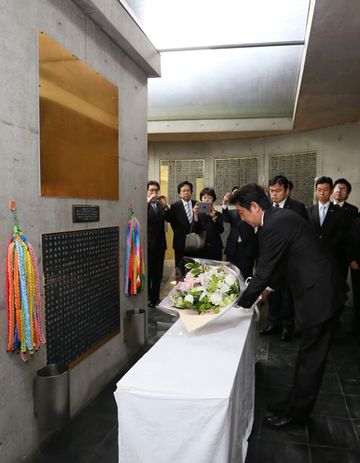
Ukraine Famine Memorial
Saturday, June 6, 2015
AM
(Local time in Ukraine)

Offer flowers at the Tomb of the Unknown Soldier, the Memorial in Commemoration of Famines’ (Holodomor) Victims in Ukraine, and the Maidan memorial
Attend a military parade. Attend a summit meeting with President of Ukraine Petro Poroshenko. Signing ceremony. Joint press announcement
Attend a welcome lunch hosted by President Poroshenko and his wife

PM
(Local time in Ukraine)
Hold talks with Prime Minister of Ukraine Arseniy Yatsenyuk and Chairperson of the Verkhovna Rada Volodymyr Groysman
Observe a hybrid car being used by traffic police. Visit Saint Sophia’s Cathedral
Depart from Boryspil International Airport
(Evening) Arrive at Munich Airport in German
Stay night at Hotel Bayerischer Hof in Munich city

Sunday, June 7, 2015
AM
(Local time in German)
Depart from Hotel Bayerischer Hof in Munich city
Arrive at the venue of the 2015 G7 Summit Schloss Elmau in Bavaria, Southern German by helicopter
Hold talks with President of the French Republic François Hollande

PM
Attend G7 Summit
Welcome ceremony hosted by Chancellor of the Federal Republic of Germany Angela Merkel. Commemoration Photo Session. Discuss on the themes of global economy

Provisional Translation by Pengqiao Lu

Friday, November 13, 2015

Prime Minister of Japan’s Schedule May 11-17, 2015


Monday, May 11, 2015

AM
12:00 At private residence (no visitors)
08:00 At private residence in Tomigaya, Tokyo (no morning visitors)
09:39 Depart from private residence
09:51 Arrive at office
11:05 Meet with Governor of Nagasaki Prefecture Nakamura Hodo and Mayor of Sasebo City (Nagasaki Prefecture) Tomonaga Norio
11:20 End meeting with Mr. Nakamura and Mr. Tomonaga
11:24 Speak with New Grand Chamberlain of Imperial Household Agency Kawai Chikao, former Grand Chamberlain of Imperial Household Agency Kawashima Yutaka, and Grand Master of the Ceremonies of Imperial Household Agency’s Board of the Ceremonies Akimoto Yoshitaka
11:29 Finish speaking with Mr. Kawai, Mr. Kawashima and Mr. Akimoto
11:30 Meet with Chairman of Japan Association of Corporate Executives (Keizai Doyukai) Kobayashi Yoshimitsu, former Chairman of Japan Association of Corporate Executives (Keizai Doyukai) Hasegawa Yasuchika
11:46 End meeting with Mr. Kobayashi and Mr. Hasegawa

PM
12:03 Ruling Party Liaison Conference
12:25 Conference ends
01:50 Meet with Chairman of Science and Technology in Society (STS) Forum and former Minister of State for Science and Technology Policy Omi Koji, and LDP Lower House member Omi Asako
02:05 End meeting with Mr. Omi and Ms. Omi
03:55 Meet with Minister of State for Economic and Fiscal Policy Amari Akira, Vice-Minister of Cabinet Office Matsuyama Kenji, and Cabinet Office Director-Generals for Policies on Cohesive Society Maekawa Mamoru, Habuka Shigeki and Tawa Hiroshi
04:15 End meeting with Mr. Amari, Mr. Matsuyama, Mr. Maekawa, Mr. Habuka, and Mr. Tawa
04:20 Phone Conference with Prime Minister of UK David Cameron. Deputy Chief Cabinet Secretaries Kato Katsunobu and Seko Hiroshige also attend
04:30 Phone Conference ends
04:57 Depart from office
04:58 Arrive at Diet
04:59 Enter LDP President’s Office
05:00 LDP Officers Meeting
05:36 Meeting ends
05:46 Leave LDP President’s Office
05:47 Depart from Diet
05:49 Arrive at office
06:00 Chairman of Panel for Nuclear Power Renaissance Policy, Former President of University of Tokyo Akito Arima and others
06:18 End meeting with Mr. Akito
06:30 Depart from office
06:31 Arrive at official residence. Dinner meeting with Manager of Yomiuri Giants baseball team Tatsunori Hara and Minister in charge of Economic Revitalization Amari Akira
08:16 Mr. Tatsunori and Mr. Amari leave

Tuesday, May 12, 2015

AM
12:00 At official residence (no visitors)
08:00 At official residence (no morning visitors)
08:26 Deaprt from official residence
08:27 Arrive at office
08:32 Cabinet meeting
08:43 Cabinet meeting ends
08:54 Meet with Deputy Chief Cabinet Secretary Kato Katsunobu
09:55 End meeting with Mr. Kato
11:34 Receive a request from the Headquarters for the Revitalization of Education of the LDP
11:52 Finish receiving the request

PM
12:53 Depart from office
12:55 Arrive at Diet
12:56 Enter Lower House Speaker’s Reception Room
01:00 Leave Lower House Speaker’s Reception Room, enter Lower House Chamber 
01:02 Attend the plenary session of the Lower House
02:50 The plenary session of the Lower House adjourns. Leave the Lower House Chamber
02:51 Depart from Diet
02:53 Arrive at office
03:25 Meet with LDP Upper House member Yamamoto Ichita
03:41 End meeting with Mr. Yamamoto
03:42 Meet with Vice-Minister for Foreign Affairs Saiki Akitaka
04:16 End meeting with Mr. Saiki
04:17 Meet with LDP Lower House member Nukaga Fukushiro
04:41 End meeting with Mr. Nukaga
04:42 Director of National Security Council (NSC) Yachi Shotaro, Director of Cabinet Intelligence Kitamura Shigeru, and Deputy Director-General of Public Security Intelligence Agency (PSIA) Sugiyama Haruki enter
04:58 Mr. Yachi and Mr. Sugiyama leave
05:15 Mr. Kitamura leaves
05:17 Hold the 5th meeting in 2015 of the Council on Economic and Fiscal Policy
06:17 Meeting ends
06:19 Depart from office
06:26 Arrive at Tokyo Prince Hotel in Shibakoen, Tokyo. Attend a party hosed by LDP Hosoda faction in banquet hall Ho-Oh-No-Ma within the hotel, deliver address
06:40 Depart from hotel
07:00 Arrive at Building 1-chome 3-bankan in Shinjuku, Tokyo. Informal talk with Minister of Internal Affairs and Communications Takaichi Sanae, Minister of Education, Culture, Sports, Science and Technology Shimomura Hakubun, Chairperson of LDP Policy Research Council Inada Tomomi, and others in commentator Kin Birei’s office within the building
08:33 Depart from the building
08:55 Arrive at private residence in Tomigaya, Tokyo

Wednesday, May 13, 2015

AM
12:00 At private residence (no visitors)
08:00 At private residence in Tomigaya, Tokyo (no morning visitors)
08:32 Depart from private residence
08:47 Arrive at office
08:50 Meet with Deputy Chief Cabinet Secretary Seko Hiroshige
09:31 End meeting with Mr. Seko
09:53 Depart from office
09:54 Arrive at Diet
09:55 Enter Upper House President’s Reception Room
09:57 Leave Upper House President’s Reception Room, enter Upper House Chamber
10:01 Attend the plenary session of the Upper House
11:41 Leave in the middle of the plenary session of the Upper House
11:43 Depart from the Diet
11:45 Arrive at the office

PM
12:56 Meet with LDP Secretary-General Tanigaki Sadakazu
01:30 End meeting with Mr. Tanigaki
02:09 Meet with Minister of Education, Culture, Sports, Science and Technology (MEXT) Shimomura Hakubun
02:36 End meeting with Mr. Shimomura
02:47 Depart from office
02:55 Arrive at Imperial Palace. Secret report to Emperor
04:03 Depart from Imperial Palace
04:12 Arrive at office
04:20 Meet with Director of National Security Council (NSC) Yachi Shotaro, MOFA’s Director-General of Foreign Policy Bureau Hiramatsu Kenji, and Ministry of Defense (MOD)’s Director-General of Bureau of Defense Policy Kuroe Tetsuro
04:45 End meeting with Mr. Yachi, Mr. Hiramatsu, and mr. Kuroe
05:51 Reception for Prime Minister of the Kingdom of Belgium Charles Michel. Commerorative photo session
05:52 Commerorative photo session ends
05:53 Attend a ceremony by the guard of honor
05:58 Ceremony ends
06:00 Japan-Belguim Summit Meeting with Prime Minister Charles Michel
06:50 Summit Meeting ends
06:51 Joint Press Release
07:05 Press Release ends
07:06 Depart from office
07:07 Arrive at official residence. Dinner meeting hosted by Prime Minister Abe Shinzo
08:33 See off Prime Minister Charles Michel

Thursday, May 14, 2015

AM
12:00 At official residence (no visitors)
08:00 At official residence (no morning visitors)
09:17 Depart from offcial residence
09:18 Arrive at office
09:19 Meet with Deputy Chief Cabinet Secretary Kato Katsunobu
10:02 End meeting with Mr. Kato
10:16 Meet with Mayor of Sappora-city Akimoto Katsuhiro, Secretary-General for LDP in Upper House Date Chuichi, LDP Upper House member Hashimoto Seiko, and others
10:29 End meeting with Mr. Akimoto, Mr. Date, and Ms. Hashimoto
10:35 Deliver address for the inauguration of Ambassador of Japan to New Zealand, Cook Islands, and SamoaTakata Toshihisa and others
10:44 Finishing address
10:49 Meet with Minister in charge of Promoting Women’s Empowerment Arimura Haruko. Vice-Minister of Cabinet Office Matsuyama Kenji, Cabinet Office’s Director-General of Gender Equality Bureau Takegawa Keiko also attend
11:22 End meeting with Ms. Arimura
11:56 Receive a report on the development of the Legislation for Peace and Security by the ruling coalition from LDP Vice-President Komura Masahiko and Deputy Chief Representative of Komeito Kitagawa Kazuo. Minister for Foreign Affairs Kishida Fumio, Minister of Defense Nakatani Gen, and Chief Cabinet Secretary Suga Yoshihide also attend

PM
12:15 Finishing receiving the report
12:53 Depart from office
12:54 Arrive at Diet
12:56 Enter Lower House Speaker’s Reception Room
01:00 Leave Lower House Speaker’s Reception Room, enter Lower House Chamber
01:02 Attend the plenary session of the Lower House
03:06 The plenary session of the Lower House adjourns. Leave the Lower House Chamber
03:07 Depart from Diet
03:09 Arrive at office
04:21 The meeting of the Nine Ministers’ Group of National Security Council (NSC)
04:32 Meeting ends
04:41 Extraordinary Cabinet Meeting
04:51 Extraordinary Cabinet Meeting ends
05:03 Hold the 30th meeting of the Education Rebuilding Implementation Council
05:23 Meeting ends
06:00 Hold a press conference to mark the cabinet decision on the Legislation for Peace and Security
06:35 Press conference ends
06:36 Depart from office
06:37 Arrive at official residence

Friday, May 15, 2015

AM
12:00 At official residence (no visitors)
07:56 Depart from official residence
07:57 Arrive at office
08:28 Cabinet meeting
08:42 Cabinet meeting ends
08:44 Meet with Deputy Chief Cabinet Secretary Kato Katsunobu
09:35 End meeting with Mr. Kato
09:54 Depart from office
09:56 Arrive at Diet
09:57 Enter Lower House Committee Room No. 17
10:00 Attend a meeting of the Committee on Economy, Trade and Industry of the Lower House

PM
12:04 Meeting adjourns
12:05 Leave Lower House Committee Room No.17
12:06 Depart from Diet
12:07 Arrive at office
12:09 Meet with Special Advisor to the Prime Minister Kimura Taro
12:15 End meeting with Mr. Kimura
12:53 Depart from office
12:55 Arrive at Diet
12:56 Enter Lower House Speaker’s Reception Room
12:57 Speak with Minister of Defense Nakatani Gen
12:59 Finish speaking with Mr. Nakatani
01:00 Leave Lower House Speaker’s Reception Room, enter Lower House Chamber
01:02 Attend the plenary session of the Lower House
02:42 Leave in the middle of the plenary session of the Lower House
02:43 Depart from Diet
02:44 Arrive at office
03:04 Meet with Director of Cabinet Intelligence Kitamura Shigeru
03:35 End meeting with Mr. Kitamura
03:52 Meet with Vice-Minister for Foreign Affairs Saiki Akitaka, Administrative Vice-Minister for Foreign Affairs Sugiyama Shinsuke, and Administrative Vice-Minister for Foreign Affairs Nagamine Yasumasa
04:24 End meeting with Mr. Saiki, Mr. Sugiyama, and Mr. Nagamine
04:25 Meet with Administrative Vice-Minister for Foreign Affairs Nagamine Yasumasa, Ministry of Foreign Affairs (MOFA)’s Director-General of International Cooperation Bureau Ishikane Kimihiro, Vice-Minister of Finance for International Affairs Yamasaki Tatsuo, Ministry of Finance (MOF)’s Deputy Vice-Minister Fukuda Junichi, and Director-General of MOF’s International Bureau Asakawa Masatsugu
05:06 End meeting with Mr. Nagamine, Mr. Ishikane, Mr. Yamasaki, Mr. Fukuda, and Mr. Asakawa
05:27 Depart from office
05:33 Arrive at Hotel Okura’s annex in Toranomon, Tokyo. Attend a a celebration of the establishment of the Robot Revolution Initiative Council in the banquet hall Orchard Room within the hotel, deliver address
05:46 Depart from hotel
05:51 Arrive at office
05:53 Meet with Vice-Minister for Foreign Affairs Saiki Akitaka
06:25 End meeting with Mr. Saiki
06:28 Depart from office
06:32 Arrive at Nippon Press Center Building in Uchisaiwai-cho, Tokyo. Attend “the gathering in memory of Abe shintaro with Prime Minister Abe Shinzo,” deliver address
08:02 Depart from the building
08:10 Arrive at Starbucks coffee Four Seas Pond Sanno Building Store. Dinner with President of Nippon Television Holdings, Inc Okubo Yoshio and President of Nikkei Visual Images, Inc. Akiyama Teruto, and others from the mass media
09:34 Depart from the store
09:48 Arrive at private residence in Tomigaya, Tokyo (no morning visitors)

Saturday, May 16, 2015

AM
12:00 At private residence in Tomigaya, Tokyo (no visitors)
06:52 Depart from private residence
07:17 Arrive at Haneda Airport
07:44 Depart from Haneda Airport by Flight 103, Japan Airlines. Deputy Chief Cabinet Secretary Seko Hiroshige, Cabinet Advisor Honda Etsuro accompany Prime Minister
08:30 Arrive at Itami Airport
08:44 Depart from Itami Airport
09:28 Arrive at Higashi Yuenchi Park in Chuo-Ku, Kobe. Mayor of Kobe-city Hisamoto Kizo and others receive Prime Minister
09:30 Offer flowers at the Monument of Victims and Reconstruction in Higashi Yuenchi Park. Visit the Lights of Hope Monument. State Minister of Cabinet Office Nishimura Yasutoshi and other colleagues also attend
09:36 Finish vising the Monument
09:38 Depart from park
09:54 Arrive at a company that manufactures women’s shoes in Nagata-cho, Kobe. Visit the company
10:14 Depart from the company
10:33 Arrive at the Disaster Reduction and Human Renovation Institution in Chuo-ku, Kobe. Governor of Hyogo Prefecture Ido Toshizo and Chairman of the Institution Kawata Yoshiaki recevie Prime Minister. Visit the institution.
10:50 Exchange views with volunteers
11:03 Depart from the institution
11:21 Arrive at Kobe Bay Sheraton Hotel in Chuo-ku, Kobe. Meet with female entrepreneurs in the banquet hall Moyasan within the hotel
11:42 Depart from hotel
11:51 Arrive at Nippon Yusen Kabushiki Kaisha (NYK Line) Kobe Container Terminal. Visit

PM
12:02 Depart from Kobe Container Terminal
12:49 Arrive at Hotel Swisshotel Nankai Osaka in Chuo-ku, Osaka-city
12:50 Depart from the hotel
12:51 Arrive at Namba Station
01:00 Depart by Train Koya 9 from Namba Station
02:20 Arrive at Gokurakubashi Station
02:25 Depart from Gokurakubashi Station by cable car
02:31 Arrive at Koyasan Station
02:33 Depart from Koyasan Station
02:44 Arrive at the Koyasan Shingon Sect Main Temple Kongobu-ji in Koya-cho, Wakayama Prefecture. Governor of Wakayama Prefecture Nisaka Yoshinobu and others receive Prime Minister. Meet with members of the temple. Chairman of LDP General Council Nikai Toshihiro also attends
03:50 Depart from the temple
04:00 Arrive at Ekoin Temple in Koya-cho, Wakayama Prefecture. Exchange views with tourists from overseas and members of groups of licensed guide-interpreters
04:30 Interview open to all media: when asked, “how will today’s visit affect the future policy?” Mr. Abe answers, “ It is important to hand down the words and experience I heared from everyone. I will make the most of (the words and experience). And I will work hard to futher increase foreign tourists to Japan.”
04:34 Interview ends
04:35 Depart from the temple
05:27 Arrive at roadside rest area Kinokawa Manyounosato in Katsuragi-cho, Wakayama Prefecture. Rest
05:34 Depart from rest area
07:26 Arrive at Hotel Hamachidoiri-no-Yu-Kaishu
07:45 Dinner with Deputy Chief Cabinet Secretary Seko Hiroshige, Chairman of LDP General Council Nikai Toshihiro, and other colleagues in resturant Shiosai within the hotel
09:44 Dinner ends

Sunday, May 17, 2015

AM
12:00 At hotel (visitors)
08:35 Depart from Hotel Hamachidoiri-no-Yu-Kaishu
09:17 Arrive at a section of National Route 311 in Tanabe City where work is underway to repair the road following a natural disaster. Visit. Deputy Chief Cabinet Secretary Seko Hiroshige, Chairman of LDP General Council Nikai Toshihiro, and Governor of Wakayama Prefecture Nisaka Yoshinobu also attend
09:31 Depart from the site
09:51 Arrive at a forest planted by LDP Wakayama branch. Visit. Commorative photo session with Chairman of LDP General Council Nikai Toshihiro and others
09:54 Depart from the forest
09:57 Arrive at a worksite where the Nakahechi Town Forest Union is thinning forests. Test drove a processor and exchanged views with workers
10:10 Depart from the worksite
10:32 Arrive at Kumano Hongū Taisha (a Shinto shrine) in Tanabe City. Visit the shrine
11:00 Depart from the shrine
11:04 Arrive at Kumano Hongu Heritage Center. Vist the center.
11:17 Exchange views with Mayor of Tanabe City Manago Mitsutoshi and others
11:32 Finish exchanging views
11:41 Arrive at Oyunohara where Kumano Hongu Taisha was originally located at. Visit Oyunohara.
Noon Depart from Oyunohara

PM
12:23 Arrive at tourist facility Kodoaruki-no-sato-chikatsuyu. Lunch at resturant Kumanoji
12:55 Depart from resturant
01:49 Arrive at Hanwa Expressway Inami Service Area in Inami-cho, Wakayama Prefecture. Buy orange juice and other things in a shop
02:04 Depart from the Service Area
03:03 Arrive at fiber products manufacturing machine maker Shima Seiki in Wakayama-city. Visit. Try on a vest made by machine
03:36 Depart from the maker
04:27 Arrive at Kansai Airport
05:23 Depart from Kansai Aiport by Flight 26, StarFlyer
06:22 Arrive at Haneda Airport
06:39 Depart from Haneda Airport
07:11 Arrive at private residence in Tomigaya, Tokyo

Provisional Translation by Pengqiao Lu and Erin M. Jones