Showing posts with label War Statement. Show all posts

Wednesday, September 2, 2015

Prime Minister of Japan’s Schedule August 10-16, 2015

Monday, August 10, 2015

AM

12:00 At private residence (no visitors)
08:42 Depart from private residence
08:54 Arrive at office
09:05 Meet with new Vice-Minister of Agriculture, Forestry and Fisheries Honkawa Kazuyoshi, and former Vice-Minister of Agriculture, Forestry and Fisheries Minagawa Yoshitsugu
09:10 End meeting with Mr. Honkawa and Mr. Minagawa
09:11 Meet with Minister in charge of Tokyo Olympic and Paralympics Endo Toshiaki
09:24 End meeting with Mr. Endo
09:25 Meet with Deputy Chief Cabinet Secretary Seko Hiroshige
10:32 End meeting with Mr. Seko
10:33 Meet with Chairperson of National Public Safety Commission Yamatani Eriko
10:54 End meeting with Ms. Yamatani
10:55 Meet with Minister of Agriculture, Forestry and Fisheries Hayashi Yoshimasa
11:03 End meeting with Mr. Hayashi
11:13 Meet with Minister for Reconstruction Takeshita Wataru
11:28 End meeting with Mr. Takeshita
11:29 Greet new Japanese Ambassador to Rwanda Ohta Kiyokazu and his colleagues
11:40 End greeting Mr. Ohta
11:41 Meet with Minister of Health, Labor and Welfare Shiozaki Yasuhisa

PM
12:00 End meeting Mr. Shiozaki
12:01 Receive a proposal from on the New National Stadium from Chairman of New Komeito Diet Affairs Committee Oguchi Yoshinori, and colleague
12:10 End reception
12:37 Meet with Vice-Minister for Foreign Affairs Saiki Akitaka
12:50 End meeting with Mr. Saiki
12:54 Depart from office
12:55 Arrive at Diet
12:57 Enter Upper House Committee Room No.1
01:00 Meeting of the Budget Committee of the House of Councillors opens
05:17 Meeting adjourns
05:19 Exit Upper House Committee Room No.1
05:20 Enter State Ministers’ Room
05:21 Receive a policy proposal from LDP Lower House member Kawamura Takeo and other Diet members from Nikai Faction
05:27 End reception
05:28 Exit State Ministers’ Room
05:29 Depart from Diet
05:31 Arrive at office
05:32 Meet with Minister in charge of Overcoming Population Decline and Vitalizing Local Economy in Japan Ishiba Shigeru
05:58 End meeting with Mr. Ishiba
05:59 Meet with U.S. Ambassador to Japan Caroline Kennedy
06:32 End meeting with Ms. Kennedy
06:33 Record video message for Japan Tent, an international exchange event
06:39 End recording
06:40 Interview with news reporters. Express support for Kyushu Electric Power Co.’s restart of a reactor at its Sendai plant in southwest Japan, “All measures should be taken to ensure the safety before restarting the plant”
06:41 End interview
06:42 Depart from office
07:00 Arrive at private residence
07:16 Depart from private residence
08:48 Arrive at restaurant Sumibi Kushiyaki I. W in Fujiyoshida city, Yamanashi Prefecture. Dinner with secretaries
10:15 Depart from restaurant
10:25 Arrive at holiday home in Narusawa village, Yamanashi Prefecture

Tuesday, August 11, 2015

AM

12:00 At holiday home (no visitors)
Stay at holiday home throughout morning

PM
02:00 At holiday home
Stay at holiday home throughout afternoon
05:14 Depart from holiday home
05:22 Arrive at Chinese restaurant Isai Chugokusaikan Kokyu in Fujikawaguchiko-machi, Yamanashi Prefecture. Dinner with PM’s mother Abe Yoko
07:36 Depart from restaurant
09:35 Arrive at private residence

Wednesday, August 12, 2015

AM

12:00 At private residence (no visitors)
09:29 Depart from private residence
10:02 Arrive at Haneda Airport
10:37 Depart from Haneda Airport by Flight 693, All Nippon Airways
11:53 Arrive at Yamaguchi Ube Airport

PM
12:03 Depart from Yamaguchi Ube Airport
12:43 Arrive at Yamaguchi Prefectural Office. Meet with Governor of Yamaguchi Prefecture Muraoka Tsugumasa and Chairman of Yamaguchi Prefectural Assembly Hatahara Motonari.
02:00 Depart from prefectural office
02:12 Arrive at Hotel New Tanaka. Attend lecture meeting organized LDP Yamaguchi prefectural chapter.
Sumiyoshi Shrine
one of three
03:20 Depart from Hotel New Tanaka
04:21 Arrive at Sumiyoshi Shrine in Shimonoseki city, Yamaguchi Prefecture. Attend purification ceremony and commemorative photo session
Sumiyoshi Shrine in Shimonoseki worships the aramitama of the Sumiyoshi kami--the warlike, rough, violent side of the spirit--a spirit of victory. From 1871 through 1946, Sumiyoshi Taisha (in Osaka and part of the three Sumiyoshi shrines) was officially designated one of the Kanpei-taisha (官幣大社), meaning that it stood in the first rank of government supported shrines.
04:26 Depart from Sumiyoshi Shrine
05:01 Arrive at welfare facility Freude Konpira in Shimonoseki city. Visit supporters
05:18 Depart from Freude Konpira
05:31 Arrive at personal residence in Shimonoseki city
06:01 Depart from personal residence
06:17 Arrive at wedding hall Seamall Palace. Attend meeting of supporters’ group
08:00 Depart from wedding hall
08:22 Arrive at Iminomiya Shrine. Attend Suhoteisai Festivals and parades with wife Akie
08:44 Depart from Iminomiya Shrine
09:01 Arrive at chicken restaurant Kinkei. Dinner with wife Akie, Yamaguchi Prefectural Assembly member Hiraoka Nozomu, and colleagues
10:04 Depart from restaurant
10:14 Arrive at personal residence

Thursday, August 13, 2015

AM

12:00 At personal residence in Shimonoseki city, Yamaguchi Prefecture (no visitors)
08:05 Depart from personal residence
08:48 Arrive at Mine City Mitou Hospital in Mine city, Yamaguchi Prefecture. Visit secretary
08:59 Depart from hospital
09:46 Visit local supporters’ residence in Shimonoseki city and give condolence call

PM
12:06 End visit
12:18 Arrive at Yamaguchi Prefectural Assembly Member Takase Toshiya’s residence. Give condolence call to his family
12:25 Depart from Mr. Takase’s residence
12:26 Arrive at Japanese restaurant Inamura. Lunch with Mr. Takase and colleagues
01:15 Depart from restaurant
01:33 Visit local supporters’ residence in Shimonoseki city and give condolence call
04:14 End visit
04:33 Arrive at personal residence
04:34 Meet with President of Japan Medical Association Yokokura Yoshitake and President of Fukuoka Prefecture Medical Association Matsuda Shunichiro
04:53 End meeting with Mr. Yokokura and Mr. Matsuda
06:34 Depart from personal residence
06:43 Arrive at Yamagin Archive. Reception by President of Yamaguchi Bank Fukuda Koichi. Visit Yamagin Archive with wife Akie
07:12 Depart from archive
07:25 Attend KANMON 2015 Firework Festival in Shimonoseki city. Deliver speech and watch fireworks with wife Akie
08:17 Depart from firework grounds
08:36 Arrive at barbecue restaurant Yakiniku Ariran. Dinner with wife Akie
09:39 Depart from restaurant
09:49 Arrive at New Miyazaki Building. Informal meeting with President of a supporters’ group
10:28 Depart from New Miyazaki Building
10:35 Arrive at personal residence

Saturday, August 22, 2015

Abe’s WWII statement fails history 101

Dove of Peace at
the Yasukuni Shrine
By Professor Tessa Morris-Suzuki, ARC Laureate Fellow based at the School of Culture, History and Language, at the College of Asia and the Pacific at The Australian National University and APP Member
First appeared in the EastAsiaForum, 18 August 2015

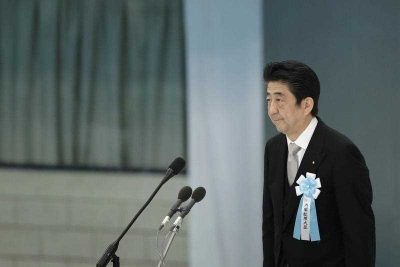
As the clock ticked down to the 70th anniversary of the end of the Asia Pacific War, Japanese Prime Minister Shinzo Abe faced a dilemma. His right-wing supporters were pushing him to produce a commemorative statement that would move away from the apologetic approach of his predecessors and ‘restore Japan’s pride’. Moderates, Asian neighbours and (most importantly) the US government were pushing him to uphold the earlier apologies issued by former prime ministers Tomiichi Murayama and Junichiro Koizumi. Most of the media anticipation centred around the wording of the forthcoming Abe statement. Would it, like the Murayama Statement of 1995 and the Koizumi Statement of 2005, include the words ‘apology’ (owabi) and aggression (shinryaku)?

Abe’s response to this dilemma was clever. First, he established a committee of hand-picked ‘experts’ to provide a report locating Japan’s wartime past in the broad sweep of 20th-century history. Then, drawing heavily on their report, he produced a statement that was more than twice the length of those issued by his predecessors. His statement, to the relief of many observers, did use the words ‘apology’ and ‘aggression’. In fact, it is almost overladen with all the right words: ‘we must learn from the lessons of history’; ‘our country inflict immeasurable damage and suffering’; ‘deep repentance’; ‘deep remorse and heartfelt apology’; ‘we will engrave in our hearts the past’.

But, focusing on the vocabulary, some observers failed to notice that Abe had embedded these words in a narrative of Japanese history that was entirely different from the one that underpinned previous prime ministerial statements. That is why his statement is so much longer than theirs. So which past is the Abe statement engraving in the hearts of Japanese citizens?

The story presented in Abe’s statement goes like this. Western colonial expansionism forced Japan to modernise, which it did with remarkable success. Japan’s victory in the Russo–Japanese War gave hope to the colonised peoples of the world. After World War I, there was a move to create a peaceful world order. Japan actively participated, but following the Great Depression, the Western powers created economic blocs based on their colonial empires. This dealt a ‘major blow’ to Japan. Forced into a corner, Japan ‘attempted to overcome its diplomatic and economic deadlock through the use of force’. The result was the 1931 Manchurian Incident, Japan’s withdrawal from the League of Nations, and everything that followed. ‘Japan took the wrong course and advanced along the road to war’.

The narrative of war that Abe presents leads naturally to the lessons that he derives from history. Nations should avoid the use of force to break ‘deadlock’. They should promote free trade so that economic blocs will never again become a cause of war. And they should avoid challenging the international order.

The problem with Abe’s new narrative is that it is historically wrong. This is perhaps not surprising, since the committee of experts on whom he relied included only four historians in its 16 members. And its report, running to some 31 pages, contains less than a page about the causes and events of the Asia Pacific War.

In effect, the Abe narrative of history looks like an exam script where the student has accidentally misread the question. He has answered the question about the reasons for Japan’s invasion of Manchuria with an answer that should go with the question about the reasons for the attack on Pearl Harbor.

There is widespread consensus that the immediate cause for Japan’s attack on Pearl Harbor was the stranglehold on Japan created by imperial protectionism and economic blockade by the Western powers. But there is equal consensus that the reasons for the Japanese invasion of Manchuria in 1931, and for the outbreak of full-scale war in China in 1937, were different and much more complex.

Key factors at work in 1931 were the troubled relationship between the Japanese military and the civilian government; Japan’s desire for resources, transport routes and living space; rising nationalism in an economically and socially troubled Japan; and corruption and instability in Northeastern China. By the time Japan launched its full scale invasion of China in 1937, global protectionism was becoming a larger issue. But even then, other issues like Japan’s desire to protect its massive investments in China from the rising forces of Chinese nationalism were paramount.

Economic historians note that the Japanese empire was the first to take serious steps towards imperial protectionism. The slide into global protectionism had barely started at the time of the Manchurian Incident. Britain did not create its imperial preference system until 1932. The economic blockade that strangled the Japanese economy in 1940–41 was the response to Japan’s invasion of China, not its cause.

This is not academic quibbling. These things really matter, and vividly illustrate why historical knowledge is vital to any understanding of contemporary international affairs.

The Abe narrative of history fails to address the causes and nature of Japan’s colonisation of Taiwan (in 1895) and Korea (in 1910), and ignores the large presence of Japanese troops in China long before 1931. It says to China: ‘Sorry we invaded you, but those other guys painted us into a corner’. It offers an untenable explanation for Japan’s actions, and blurs the distinction between aggressive and defensive behaviour. Western media commentators who haven’t studied Japanese history may not pick up these flaws in the narrative, but Chinese and South Korean observers (who have their own, sometimes profoundly problematic, versions of this history) will instantly see them and rightly object.

Engraving a factually flawed story of the past in people’s hearts is not going to solve East Asia’s problems, and risks making them worse. Worse still, the Abe statement is generating deeply divergent responses in the countries where East Asian history is not widely taught (most notably the United States) and those where it is (South Korea, China and Japan itself), thus creating even deeper divisions in our already too divided world.

Abe treads a fine line on WWII

By Professor Gerry Curtis, Columbia University and APP member
First appeared in EastAsiaForum, 20 August 2015

Japanese Prime Minister Shinzo Abe’s statement commemorating the 70th anniversary of the end of World War II probably satisfies no constituency — not his right wing base, not the political opposition, not the Chinese nor the Koreans. If the US government has any qualms about it, it is keeping them to itself.

But Abe did invoke the four key words of the Murayama Statement— aggression, colonialism, apology, remorse — even if not in first person declaratory sentences. And he did not say anything so outrageous as to make an angry response unavoidable. In this sense Abe dodged a bullet.

If China and South Korea want to improve relations with Japan, the statement gives them enough to work with — it shows appreciation to the Chinese for the magnanimity they showed to Japanese civilians caught up in the war in China, and sympathy for the Chinese victims of the war. It refers to the ill treatment of women — in lukewarm language to be sure, but better than saying nothing. The influence of the prime minister’s advisory panel led by Professor Shinichi Kitaoka is evident throughout the statement, including its admission that Japan fought a wrong war and that political parties were too weak to control the military.

Abe did try to make the case that Japan went down the road it did because the Great Depression and the trade policies of the western countries were strangling the Japanese economy. This implies that in the end going to war was a defensive action.

But at least he didn’t say what the right wing believes and what was best stated by the previous emperor Hirohito in his radio address accepting the surrender terms of the Potsdam Declaration: ‘we cannot [help] but express the deepest sense of regret to our allied nations of East Asia, who have consistently cooperated with the Empire toward the emancipation of East Asia’.

Abe referenced the Russo–Japanese war as an inspiration for anti-colonial movements from Asia to Africa, which is entirely true. But he did not pay homage to the right-wing view that Japan’s Greater East Asia War had anything to do with liberating Asian countries from western colonialism. Unfortunately and worryingly, in contrast to the expressions of compassion for Chinese victims of the war, he had virtually nothing to say about the Korean victims of harsh Japanese colonial rule.

It is disappointing that he did not say something about what needs to be done now so that future generations are not ‘predestined’ to engage in unending apologies as he put it. The only way to end demands for apology is for the current generation to apologise in so convincing a manner that attacks on Japan’s lack of repentance lose all credibility.

This is not likely to happen as right-wing self-defined defenders of Japanese national pride can be counted on to find a way to provide ammunition for Chinese and Koreans to continue to demand apologies. He also could have used a better writer or a more skilled editor. He could have said what he said in half as many words and have had more of an impact that way. The statement is painfully repetitive and tedious.

The statement in a certain sense reflects the strength of Japan’s democracy. Abe would not have issued this statement if he were unafraid of how the public and the media would react had he given one more in line with the views of the Liberal Democratic Party’s right wing — views he himself has expressed repeatedly in the past. This statement probably won’t help his poll numbers but it is unlikely to hurt them either. It is a wash. And that is probably true for its impact on relations with China and South Korea as well.

Wednesday, May 20, 2015

Japanese Catholics express alarm at Abe Government

Japanese Martyrs February 5, 1597
In February of this year, Catholic leaders in Japan released their statement on the 70th anniversary of the end of World War II. It is surprisingly blunt in expressing their wariness over what they view as the nation's attempts to rewrite history and play a significantly larger defense role in the world.

“We are gravely concerned about the current administration’s move,” Takeo Okada, archbishop of Tokyo and head of the Catholic Bishops’ Conference of Japan said of the statement. “We want to light a flame for a path that people should head to, which is the mission of all religious leaders.” The statement is as follows and below it is an Asahi Shimbun article about it.

Blessed are the peacemakers – Now especially, 
peace must not depend upon weapons

To our Brothers and Sisters in Christ and to All Who Wish for Peace

The Catholic Bishops’ Conference of Japan issued messages marking the end of the Second World War in 1995 (Resolution for Peace -- On the 50th. Anniversary of the End of the War) and 2005 (Peace Message After 60 Years From the End of War World II -- The Road To Peace Based On Nonviolence -- Now Is The Time To Be Prophetic). In this year in which we mark the 70th anniversary of the end of the war, we wish to once again declare our commitment to peace.

1. The Church Cannot Remain Silent in the Face of Threats to Human Life and Dignity

For the Catholic Church, this is a noteworthy year because it marks the 50th anniversary of the closing of the Second Vatican Council (1962-1965).

In the first half of the Twentieth Century the Christian Church centered in Europe experienced two world wars and genocide against the Jews by Nazi Germany. Reflecting on these tragedies, the Church cannot close itself up with merely “religious” concerns. We have realized that the problems of humanity are our problems. The Pastoral Constitution on the Church in the Modern World, Gaudium et Spes, issued at the end of the Second Vatican Council, is a clear example of this insight, opening with the following words.

“The joys and the hopes, the griefs and the anxieties of the men of this age, especially those who are poor or in any way afflicted, these are the joys and hopes, the griefs and anxieties of the followers of Christ. Indeed, nothing genuinely human fails to raise an echo in their hearts.”[1]

From the end of the Second Vatican Council up to the papacy of Pope Francis today, the Church has actively faced the issues of human life and dignity, especially of those who are excluded or oppressed.[2]

2. The Decision to Renounce War

Japanese colonial rule on the Korean Peninsula until 1945 as well as acts of aggression against China and other Asian countries caused great suffering and sacrifice among people. The Second World War was a horrible experience for the Japanese people as well. Beginning with the Tokyo air raid of March 10, 1945, large-scale air raids struck many cities in Japan. In addition to the many Japanese and foreign troops who became casualties during land combat on Okinawa, many civilians suffered as well. Then finally there were the atomic bombings of Hiroshima on August 6 and Nagasaki on August 9, 1945. These experiences gave birth to a desire for peace that was codified in the Constitution of Japan promulgated in 1946 based on the sovereignty of the people, the renunciation of war and respect for basic human rights. Following this peace constitution, Japan has striven to build relationships of trust and friendship with the nations of Asia.

Against the background of the Cold War and the subsequent fall of the Berlin Wall, the Catholic Church throughout the world has made increasingly clear its opposition to the arms race and the use of weapons to resolve disputes.

In his encyclical Pacem in Terris, Pope John XXIII said, "in this age which boasts of its atomic power, it no longer makes sense to maintain that war is a fit instrument with which to repair the violation of justice"[3] Vatican II in Gaudiam et Spes opposed the arms race, and urged peace that does not rely upon military force.[4] In his Appeal for Peace in Hiroshima in 1981, Pope John Paul II demonstrated this clear renunciation of war when he said, "War is the work of man. War is destruction of human life. War is death."

Given this historical background, it is a matter of course that we Japanese bishops respect the ideals of Japan’s no-war Constitution.[5] For Christians, the renunciation of war is demanded by the Gospel of Christ. It is a respect for life that cannot be abandoned by religious people and an ideal that is held firmly by the whole human race.

3. The Japanese Church’s peace vocation

The Catholic Bishops’ Conference of Japan knows that it has a special vocation to work for peace. It is not based upon any political ideology. We continue to appeal for peace not as a political issue, but as a human one. Our awareness of this vocation is, of course, influenced by the horrors inflicted by nuclear weapons on Hiroshima and Nagasaki, but it is also born of deep remorse when we reflect upon the attitude of the Church in Japan before and during the war.

During a Mass celebrated on September 26, 1986, at the plenary meeting of the Federation of Asian Bishops’ Conferences (FABC) held in Tokyo, Archbishop Shirayanagi of Tokyo made the following declaration. “We Catholic bishops of Japan, as Japanese, and as members of the Catholic Church in Japan, sincerely ask forgiveness from God and from our brothers and sisters of Asia and the Pacific Region for the tragedy brought by the Japanese during the Second World War. As parties involved in the war, we share in the responsibility for the more than 20 million victims in Asia and the Pacific. Furthermore, we deeply regret having damaged the lives and cultures of the people of these regions. The trauma of this is still not healed.”

These words were not those of a single bishop. He spoke as president of the bishops’ conference, conveying the opinion of the whole conference.[6] As mentioned above, in their messages on the 50th and 60th anniversaries of the end of the war, the bishops continued to reflect upon the issue of the Church’s responsibility before and during the war and from that standpoint have expressed their determination in favor of peace.

4. Problems such as recognition of history and the exercise of collective self-defense

Seventy years after the war, memory of it is fading along with memories of Japanese colonial rule and aggression with its accompanying crimes against humanity. Now, there are calls to rewrite the history of that time, denying what really happened. The present government is attempting to enact laws to protect state secrets, allow for the right of collective self-defense and change Article 9 of the Constitution to allow the use of military force overseas.

At the same time, we cannot overlook growing nationalism not only in Japan, but among the governments of other countries in this part of the world. As tensions rise between nations, a strong commitment to improved relations through dialogue and negotiation rather than increased militarization becomes more important for regional stability.

Domestically, the situation in Okinawa presents a particularly serious problem. Compared to the rest of the country, the number of military bases there is especially high. New base construction is underway, contrary to the wishes of the citizens of the prefecture. This demonstrates an attitude that puts priority on armaments while ignoring people and efforts to build peace.

5. Amidst the serious crises facing the world today

Viewing the world today, the tragedies of military conflict and terrorism occur over and over again in many places. In addition to conflicts between nations and ethnic groups, now violence in the name of religion makes it increasingly seem as if throughout the world dialogue has become impossible. In that situation, women and children as well as ethnic and religious minorities are especially threatened and many lose their lives.

In the face of such worldwide destructiveness, Pope Francis has expressed concern that some people seem to speak of a “Third World War” rather than making sure we do not repeat the mistakes of the past.[7] The world faces the sorts of crises that cannot but cause people to wonder if force is the answer. What has become of respect for humanity? However, repeatedly answering violence with violence will only lead to the destruction of humanity.

The world is dominated by the globalization of companies and the financial system. Disparities continue to widen and the poor are excluded. Human economic activity is causing climate change and the destruction of biodiversity. If we wish to realize peace, this situation must change. We cannot ignore the problems of poverty and the environment that produce disparity and exclusion. We are each called upon to overcome our indifference to the world’s problems and change our lives. We cannot solve all the world’s problems at once, but we can patiently continue to work toward peace and mutual understanding.

In Conclusion

We recall the words of Pope John Paul II in his Appeal for Peace in Hiroshima: 

“Peace must always be the aim: peace pursued and protected in all circumstances. Let us not repeat the past, a past of violence and destruction. Let us embark upon the steep and difficult path of peace, the only path that befits human dignity, the only path that leads to the true fulfillment of the human destiny, the only path to a future in which equity, justice and solidarity are realities and not just distant dreams.”[8]

We are encouraged by the words of Jesus Christ, “Blessed are the peacemakers” (Mt. 5:9). Seventy years after the end of the war and 50 years after the end of the Second Vatican Council, let us renew our determination to seek peace and to work for peace. We Catholics in Japan are small in number, but in union with other Christians and along with believers of other religions and those throughout the world who wish for peace, we renew our commitment to work to make peace a reality.

February 25, 2015
Catholic Bishops’ Conference of Japan

Notes:
1. Second Vatican Council, Gaudium et Spes 1965 n. 1.Second Vatican Council, Gaudium et Spes 1965 n. 1.[back]
2. Pope Francis, Apostolic Exhortation The Joy of the Gospel (Evangelii Gaudium) (2013) n.182: “The Church’s pastors, taking into account the contributions of the different sciences, have the right to offer opinions on all that affects people’s lives, since the task of evangelization implies and demands the integral promotion of each human being. It is no longer possible to claim that religion should be restricted to the private sphere and that it exists only to prepare souls for heaven.”[back]
3. Pope John XXIII, Encyclical Pacem in Terris (1963) n. 127.[back]
4. Gaudium et Spes, n. 81. [back]
5. The Constitution of Japan, Preamble: “We, the Japanese people, desire peace for all time and are deeply conscious of the high ideals controlling human relationship, and we have determined to preserve our security and existence, trusting in the justice and faith of the peace-loving peoples of the world.” Ibid. Article 9: “Aspiring sincerely to an international peace based on justice and order, the Japanese people forever renounce war as a sovereign right of the nation and the threat or use of force as means of settling international disputes. In order to accomplish the aim of the preceding paragraph, land, sea, and air forces, as well as other war potential, will never be maintained. The right of belligerency of the state will not be recognized.” [back]
6. Catholic Bishops’ Conference of Japan plenary session, June, 1986.[back]
7. Pope Francis, Homily at the Military Memorial in Redipuglia, Italy, on the occasion of the 100th Anniversary of the outbreak of the First World War. (September 13, 2014)[back]
8. Pope John Paul II “Appeal for Peace in Hiroshima” (February 25, 1981) n. 5.[back]


Japanese Catholic leaders voice concern over 
Abe administration in peace message 

Asahi Shimbun, April 28, 2015

By KENTARO ISOMURA/ Staff Writer