Wednesday, August 13, 2014

Asia in Washington in August

Ordinarily August is the Silly Season, meaning it is a slow news month. Unfortunately it was canceled this year in favor of war, pestilence, genocide, ignorance, and just plain pig-headedness.

8/14 - International Comfort Women Day
8/15 - 1945. Japan Surrenders
8/18 - Pope Francis performs Mass in Seoul
8/19 - UN World Humanitarian Day

IRAQ: WHAT IS HAPPENING? 8/14, 12:15-1:45pm. Sponsor: New America Foundation. Speakers: Col. Derek Harvey (Ret.), Professor, University of South Florida, and Former Senior Analyst for Iraq for General David H. Petraeus; Denise Natali, Senior Research Fellow, Institute for Strategic Studies, National Defense University, and author, The Kurdish Quasi-State: Development and Dependency in Post-Gulf War Iraq; Steve Levine, Future Tense Fellow, New America Foundation, and Author, The Oil and the Glory, The Pursuit of Empire and Fortune on the Caspian Sea; and Douglas A. Ollivant, Senior National Security Fellow, International Security Program, New America Foundation, and Former NSC Director for Iraq.

HAS SOUTH KOREA SQUANDERED ITS DEMOGRAPHIC DIVIDEND? 8/18, 12:30-2:00pm. Sponsor: CSIS, Korea Chair. Speaker: Elizabeth Hervey Stephen, Associate Professor of Demography, Edmund A. Walsh School of Foreign Service, Georgetown University.

HISTORY IMPEDES FUTURE PROGRESS IN NORTHEAST ASIA. 8/19, 2:00-5:30pm. Sponsor: Heritage Foundation. Speakers: Admiral Dennis C. Blair, USN (Ret.), Chairman, Sasakawa Peace Foundation USA, former Commander, U.S. Pacific Command, and former Director, National Intelligence; Ahn Ho-Young, Ambassador of the Republic of Korea to the United States; Lee Sung-yoon, Professor, Fletcher School , Tufts University; Scott Snyder, Senior Fellow, Council on Foreign Relations; Yuki Tatsumi, Senior Associate, East Asia Program, Stimson; Victor Cha, Senior Adviser and Korea Chair, CSIS, and former Director for Asian Affairs, National Security Council; Bruce Klingner, Senior Research Fellow, Northeast Asia, Heritage; Evans Revere, Senior Advisor, Albright Stonebridge Group, and former Principal Deputy Assistant Secretary of State; and Walter Lohman, Director, Asian Studies Program, Heritage. 

BEYOND THE QUAGMIRE: THE FUTURE OF MONGOLIA’S UNITED STATES AND JAPAN PARTNERSHIPS. 8/20, Noon-1:30pm. Sponsor: East West Center Washington. Speaker: Mr. Mendee Jargalsaikhan, Visiting Fellow, East-West Center in Washington, Doctoral Candidate, University of British Columbia.

SILICON GLOBALIZATION AND ITS CONSTRAINTS: THE RISE OF CHINA'S AND INDIA’S SEMICONDUCTOR INDUSTRIES. 8/27, 9:00-10:30am. Sponsor: Information Technology and Innovation Foundation (ITIF). Speakers: David M. Hart (moderator), Director, Center for Science and Technology Policy, School of Public Policy, George Mason University; Douglas Fuller, Professor, Department of Business Administration, Zhejiang University’s School of Management; Robert D. Atkinson, President, ITIF; Jimmy Goodrich, Director of Global Policy, Information Technology Industry Council; and Brian Toohey, President & Chief Executive Officer, Semiconductor Industry Association.

WOMEN, PEACE AND SECURITY: PRACTICAL GUIDANCE ON USING LAW TO EMPOWER WOMEN IN POST-CONFLICT SYSTEMS. 8/27, 10:00-11:30pm. Sponsors: Women In International Security, Women's Action for New Directions, and the U.S. Institute of Peace. Speakers: Julie L. Arostegui, Toolkit Author and Director, Women, Peace and Security Policy, Women's Action for New Directions; Sanam Naraghi-Anderlini, Executive Director and Co-Founder, International Civil Society Action Network; Susan Stigant, Senior Program Officer, Rule of Law, US Institute of Peace; Susan Markham, Senior Gender Coordinator, USAID; and Chantal de Jonge Oudraat, President, Women in International Security. 

PUBLIC OPINION AND WAR. 8/28, 2:00-4:00pm. Sponsor: Cato Institute. Speakers: Adam Berinsky, professor of political science, MIT; John Mueller, professor of political science, Ohio State University and senior fellow, Cato; Jason Reifler, senior lecturer, University of Exeter; Trevor Thrall, associate professor of public and international affairs, George Mason University; and Justin Logan, director of foreign policy studies, Cato.

Tuesday, August 12, 2014

It’s time to update our thinking on trade

IT’S TIME TO UPDATE OUR THINKING ON TRADE 

by William H. Overholt, President, Fung Global Institute, Senior Fellow at Harvard’s Asia Center, and APP Board Member
First published by the East Asian Forum, August 3 2014

Our institutions for governing world trade and our thinking about world trade date back to a simpler era. Without a radical rethink, we risk the gradual decay of our most valuable international institutions, loss of extraordinary opportunities to improve global living standards and possibly the sidelining of the West in developing modern institutions.

The GATT and the WTO were devised for a simpler era, when it was possible to think about world trade in the way Ricardo taught — namely that a good is produced in one country and consumed also in a single country. If Portugal was adeptat making wine and England at cloth, it would benefit both to reduce barriers and enhance trade. That two-country model worked relatively well until about 1978, when China started opening its economy by establishing special economic zones across the border from Hong Kong.

By the last decade of the twentieth century, production had become a complex global process. The logic of increasing efficiency by reducing trade barriers remained completely valid, but policy adaptation of that logic to a new era has faltered.

A laptop or a smart phone now is typically made in 15 to 20 countries. When old-style trade thinking is applied to this situation, confusion causes bad policy and gratuitous conflicts. A laptop made in 17 countries might be assembled in China for $2 worth of local wages then exported to the United States, but old two-country thinking leads members of Congress to react as if China had exported $1500 of value to the US. This bolsters protectionism, reduces support for multilateral trade liberalisation and contributes to the fragmentation of the global trade regime.

Because it is difficult to continue the process of trade liberalisation, countries feeling a need for deeper integration form their own regional blocs, inducing further fragmentation.

Regional and bilateral trade negotiations today are focused on ‘country of origin’, by definition a single country or preferential grouping, with the result that it is considered normal to have 500 pages of country of origin rules in a single trade agreement. Since each country has many trade agreements, companies may find the rules so complex that they simply pay high tariffs rather than trying to manage the complex paperwork to prove countries of origin. The complexity of the system discriminates against small, open economies like Singapore, and it discriminates against smaller companies without huge accounting departments. Because it cannot adapt to the globalisation of production, the system is beginning to defeat itself.

Moreover, the addition of over one billion new workers to the globalised workforce entailed very low wages in Eastern countries such as China, flat wages in the West and huge trade imbalances between East and West. This discouraged Western countries from vigorously pursuing the kinds of global agreements that would have eliminated those dozens of separate, conflicting 500-page rule books about countries of origin.

Feeling overwhelmed by Chinese manufactured exports, Western countries have also moved to exclude China from the most important efforts to modernise the global trading system. The proposed Trans-Pacific Partnership (TPP) and Transatlantic Trade and Investment Partnership agreements (TTIP) both seek to exclude the world’s second-largest economy from potential membership, an arrangement that is both economically untenable and a potential geopolitical disaster.

The geopolitical consequences were magnified by the inclusion of Japan in the TPP agreements, even though Japan’s economy is much less open than China’s and historically has been much less willing to reform in the face of domestic interest group pressure than China has. Given Sino-Japanese tensions, this has come across in Asia as part of a strategy to isolate China.

Magnifying Sino-American differences could make a more inclusive, truly multilateral future trade system much harder to negotiate.

While we still flounder over attempts to come to terms with globalised production, we are heading into globalised consumption. Instead of an era with one billion new globalised workers, we are heading into a world that will contain two billion or more new middle class consumers, mainly in Asia and heavily in China. Chinese wages are rising 13 to 20 per cent a year and total compensation is rising even more. This phenomenon should gradually resolve the most serious trade imbalances and begin to allow Western wages to rise.

But Western media, interest groups and politicians remain obsessed with the problems of yesterday. This could lead the West to squander one of the greatest economic opportunities in world history, namely the extraordinary consumer boom in China, India and other emerging markets. It could also disastrously delay responses to the jobs challenge of the new era: a technology-driven transformation of the workplace driven by robots, other automation, the internet of things and 3D printing that will eventually force billions of workers out of old jobs.

We must begin addressing the world as it is and will be, not the world of generations past. Ironically, in the process the WTO remains crucial to a vibrant world economy. Without the WTO’s dispute settlement mechanism, trade wars will ignite everywhere. By allowing the WTO system to decay, and by blaming globalised trade for problems that are unique to the past generation, we risk going back to pre-World War II trade wars. We need a modern, multilateral structure that updates the WTO, not a degeneration of the global trade and investment system based on a failure to recognise the shape of the new world we are entering.

We are now at one of those great historical turning points. Disillusionment, often misplaced, with existing institutions and obsession with obsolescent problems have allowed the process of trade negotiations to decay so far that TPP and TTIP negotiations could fail or, if they succeed, the exclusion of China could make them Pyrrhic victories. Continued Western failure to address the real issues of our emerging world of globalised production and consumption, and the reality of China’s central role, could lead to trade regimes with the most dynamic markets governed by structures like the Regional Comprehensive Economic Partnership promoted by Asian emerging economies.
The views expressed here are personal and not endorsed byDr. Overholt's employers.

The Abe Administration-What you need to know

ABE ADMINISTRATION 2012-14 - A PROFILE

Abe Shinzo began his second term as Prime Minister of Japan on December 26, 2012. His Cabinet – one of the most stable in recent years – is expected to be reshuffled on September 3, 2014. In anticipation of the changes, APP has prepared a report with a detailed 94-page overview of Abe’s 2012-2014 Cabinet personnel. It contains profiles of the 97-member Abe Administration, which includes the 19 top Ministers of the immediate Cabinet (including prime minister), as well as Senior Vice Ministers, Parliamentary Secretaries, Cabinet Secretaries, and Special Advisors. 
 
This report also lists the members’ affiliations with 18 prominent conservative nationalist parliamentary leagues or caucuses (giin renmei, 議員連盟) and issues groups. These are followed by pages of tables and graphs illustrating the extensive membership of the Abe Cabinet in these groups.

It is our contention that in September Abe Shinzo will have to continue to forgo traditional criteria for appointed office, such as faction affiliation and seniority, in favor of ideological similarity. It is, therefore, crucial to have a knowledge of the ideologicalparliamentary leagues, their memberships, and operation.


Japan and the War on Terror: New Book


CLICK TO ORDER
JAPAN AND THE 
WAR ON TERROR
Military Force and Political Pressure in the US-Japanese Alliance 
by
Michael Penn
Journalist and scholar based in Japan; President of the Shingetsu News Agency; APP member

Japan’s economic might and geographic location, close to China and North Korea with American bases across the Japanese archipelego gives the country the potential to be a major ally in the War on Terror. Although Japan’s Constitution does not allow for militarism or acts of war, in the post 9/11 world the use of the Japanese nation’s ‘Self-Defence Forces’ has become increasingly normal – a result of the exploitation of legal loopholes and political double-speak that has been used to bypass Japan’s pacifist ideology.


Michael Penn assesses the role of US diplomats and lobbyists in Tokyo, the Japanese and American politicians who see the War on Terror as a means of self-advancement, and the influence of
Washington's Alliance Managers in the unprecedented 2004 deployment of Japanese troops to Iraq. 

Using a huge range of primary source materials, including interviews with US insiders and Japanese policy makers, the book provides both a scholarly and lucid account of Japan’s relationship with the US and the Middle East from 9/11 to President Barack Obama and the death of Osama Bin Laden. He outlines how the War on Terrorism was used effectively to chip away at both the ideas and practice of Japanese non-involvement in the use of force for their military.

Hardback | 384 pages | 216 x 134 mm | ISBN 9781780763699 | July 2014 release

Xi Jinping’s Anti-Corruption Campaign

Why Xi Jinping’s Anti-Corruption Campaign Won’t Legitimize the CCP
Only improving the lot of China’s poor will ensure the ‘Mandate of Heaven.’


By Yuxin "Anthony" Zhang*
First published in The Diplomat, August 12, 2014

In July 2014, China’s former domestic security chief Zhou Yongkang was jailed on corruption charges, along with at least six other officials at the provincial and ministerial levels. Twenty-five officials at the bureau level are under investigation. So far, over 300 officials at the bureau level or higher have been removed from their positions, are under investigation, or have been sentenced to life in prison or death. The Chinese people are celebrating President Xi Jinping’s courage and determination to fight corruption. Yet Xi’s crusade failed to address some more fundamental problems. The ruling Chinese Communist Party (CCP)’s legitimacy will still be in jeopardy if Xi’s domestic policy fails.

Xi initiated his anti-corruption campaign shortly after the conclusion of the CCP’s 18th National Congress in November 2012. An online survey conducted by Xinhuanet during the conference revealed that “corruption” was among the top 10 issues of concern to the Chinese people. Xi took up the fight against corruption as a way to restore popular confidence in the government. He started with anti-corruption because, compared to issues like income distribution or social justice, it has an immediate and visible benefit for sustaining the regime. It is also a skillful means of adjusting to the hatred-for-the-rich mentality so popular among the Chinese public in recent years.

But Xi’s anti-corruption campaign overlooks the core of the problem. There is a gap between rich and poor, but he should have focused more on the latter. Making the rich less wealthy does not mean the lot of the poor is automatically improved. No matter how many officials are charged or how much of their wealth is confiscated, it does not significantly impact the Chinese people. The intrinsic problems – income distribution, social welfare, educational justice, high prices, medical reform, food safety – remain unsolved.

By shifting public attention from these domestic issues, Xi has become more anxious to make a show of strength in the foreign policy arena. The intensified South China Sea issue and the deterioration in Sino-Japanese relations have been playing their traditional role of fanning nationalism within China. Xi’s tighter control over the internet facilitates this strategy. In June and July, Google Scholar, LINE and Instagram were blocked. Meanwhile, a nationalist Japanese government has helped Xi, making the Chinese government and the Chinese people more cohesive than at any other time in the postwar period.

Some would argue that China’s economic performance could help Xi. He has consolidated China’s relations – both economic and political – with South Korea. President Park Geun-hye is also working hard to create a second “Hangang Miracle,” following in her father’s footsteps by taking advantage of China’s economic growth. So, an unofficial PRC-ROK alliance is forming, with the goal of creating a win-win situation for both economies. Xi has been pushing for the conclusion of a free trade agreement with the ROK and the European Union, as well as rebuilding the Silk Road with Central Asia. His Pan-Asia railway project was welcomed in Thailand, Malaysia and Singapore. Xi’s state visit to Latin America will also expand mutual trade and investment. The Chinese people may believe that they will be the beneficiaries of all these initiatives. However, this is not true.

Economic success will not ensure the CCP’s legitimacy because it does not guarantee equitable income distribution and affordable prices. These problems are not linked so much to China’s economic performance as they are to its political institutions. A thriving economy might continues to enrich those who are already wealthy, who represent a tiny portion of the population, while doing little to benefit the broader population. Hence the rising number of protests and demonstrations against the government even as the country‘s economy has surged over past decade. The Chinese people are showing signs of discontent.

To win full legitimacy, Xi needs to go beyond removing high-level officials and devote more attention to domestic policies and political reforms. Toppling powerful figures might be effective in the short term, but it will not address the true concerns of the Chinese people.

*Yuxin Zhang was a summer research intern from University of Southern California at Asia Policy Point, a think tank based in Washington, DC. He is also the executive director of Heisei Sedai Association of Future Leaders of East Asia, a non-governmental organization that promotes friendship and dialogue between Chinese and Japanese youth.

Monday, August 11, 2014

Prime Minister of Japan's Schedule July 7-13, 2014

Australian War Memorial
Monday, July 7, 2014

AM

(local time in New Zealand)
Reception ceremony at Governor-General’s Government House in Auckland, New Zealand
Summit Conference with Prime Minister of New Zealand John Phillip Key
Joint Press Conference
Perform courtesy call to New Zealand’s national Rugby team All Blacks members at Villa Maria winery
Lunch meeting hosted by Mr. Key

PM
(local time in New Zealand and Australia)
Perform courtesy call to New Zealand Labour Party leader David Richard Cunliffe
Depart from Auckland International Airport on personal government aircraft
Arrive at Christchurch International Airport
Offer flowers at Canterbury Television building accident site
View Christchurch Transitional Cathedral
Depart from Christchurch International Airport
Arrive at Canberra International Airport in Canberra, Australia
Interview with Nihon Keizai Shimbun (Nikkei) at Hyatt Hotel Canberra

Tuesday, July 8, 2014

AM

(local time in Australia)
View Australian War Memorial Hall in Canberra, Australia, and offer flowers at Tomb of the Unknown Australian Soldier
Reception ceremony for Mr. Abe at Parliament House, informal talk with President of the Senate and Speaker of the House of Representatives, deliver address SPEECH

PM
(local time in Australia)
Lunch meeting with Japan-Australia Business Cooperation Committee members at National Gallery of Australia
Summit Conference with Prime Minister Tony Abbot at Parliament House, signing ceremony, and Joint Press Conference. Informal talk with all Australian cabinet ministers
View Australian National University
Reception with authorized business personnel at Parliament House
Perform courtesy call to Australian Labour Party leader Bill Shorten
Dinner party hosted by Mr. Abbot
Stay the night at Hyatt Hotel Canberra

Wednesday, July 9, 2014

AM

(local time in Australia)
Depart from Canberra International Airport with Mr. Abbot in personal Australian government aircraft

PM
(local time in Australia)
Arrive at airport near mine in the Pilbara
View mine with Mr. Abbot
Depart from an airport near mine
Arrive at Perth International Airport
Perform courtesy call to Premier of West Australia Colin Barnett
Reception dinner for Mr. Abe
Spent the night at Hyatt Regency Perth

Thursday, July 10, 2014
AM
(local time in Australia)
Depart from Perth International Airport

PM
(local time in Papua New Guinea)
Arrive at Jackson International Airport at Port Moresby, Papua New Guinea, reception event for Mr. Abe
Perform courtesy call to Governor-General Michael Ogio and his wife at Government House
Summit Conference with Prime Minister Peter O’Neill at National Parliament House, joint press conference
Banquet hosted by Mr. O’Neill
Spend the night at Airways Hotel
Friday, July 11, 2014

AM
(local time in Papua New Guinea)
Attend inaugural meeting of Joint Committee on Japan-Papua New Guinea Investment at Crowne Plaza Hotel in Port Moresby, Papua New Guinea
Depart from Jackson International Airport on Coast Guard aircraft
Arrive at Wewak Airport

Offer flowers and pray at New Guinea Monument to the Japanese War Dead at Wewak
Interview open to all media

PM
(local time in Papua New Guinea)
Lunch meeting hosted by former Prime Minister of Papua New Guinea Sir Michael Somare
Attend unveiling ceremony for plaque to the war dead at a Japanese shrine on Cape Wom, the site
by PNG Piksa
 
of the Japanese Army surrender and near a 

burial site of Japanese. See HERE for incredible pictures by PNG Piksa of the visit.

Informal talk with Kawabata Shizuka, who is involved in recovery of deceased persons’ remains and organizing resting place
Depart from Wewak Airport
Arrive at Jackson International Airport
Informal talk at Gateway Hotel with press groups accompanying Mr. Abe’s travels
Campaign marked by cannibalism 
Spend the night at Airways Hotel

Saturday, July 12, 2014

AM
(local time in Papua New Guinea)
Depart on personal government aircraft from Jackson International Airport in Port Moresby, Papua New Guinea
PM
(Japan time)
03:14 Finish tour to three countries in Oceania, arriving at Haneda Airport in personal government aircraft
03:31 Depart from airport


03:57 Arrive at private residence in Tomigaya, Tokyo
Sunday, July 13, 2014

AM

12:00 At private residence (no visitors)
09:14 Meet with Deputy Chief Cabinet Secretary for Crisis Management Nishimura Yasuhiko and Director of National Security Council Yachi Shotaro at private residence in Tomigaya, Tokyo
09:39 End meeting with Mr. Nishimura and Mr. Yachi
09:40 Depart from private residence
10:00 Arrive at Hotel Grand Pacific Le Daiba in Daiba, Tokyo. Give lecture at International Conference for Women in Business in banquet hall Palais Royal
10:32 Depart from hotel
10:47 Arrive at official residence
10:48 Interview open to all media
10:49 Interview ends
11:15 Interview with Mainichi Shimbun
11:45 Interview ends

PM
Stay at official residence throughout afternoon (no visitors)
06:30 Speak with Director of Cabinet Intelligence Kitamura Shigeru
06:40 Finish speaking with Mr. Kitamura

Mongolian-Japanese Partnership

Mongolian-Japanese Economic Partnership Agreement: 
Counterbalancing China and Russia
By: Alicia J. Campi

First published in the Eurasia Daily Monitor Volume: 11 Issue: 146
August 8, 2014

On the 40th anniversary of establishing bilateral diplomatic relations, Mongolia’s President Tsakhia Elbegdorj and Japan’s Prime Minister Shinzo Abe met in Tokyo on July 22, 2014, to sign a Joint Statement on affirming the final roadmap toward instituting an Economic Partnership Agreement (EPA). Aimed at promoting mutual trade and investment, the agreement could be ratified by the parliaments of both nations in the first quarter of 2015. The EPA would be the first such agreement for Mongolia and the 15th for Japan. Within the EPA, all Mongolian exports to Japan, including meat and raw minerals, and 96 percent of Japanese exports to Mongolia will be exempt from tariffs in the coming decade (ubpost.mongolnews.mn, July 24). Japan pledged to support policies to grow Mongolia’s exports. President Elbegdorj commented, “I believe the bilateral economic partnership agreement would be implemented successfully. We agreed to study, produce and sell together” (Montsame, english.news.mn, July 23).

The Joint Statement is based on three principles: 1) The EPA is key to elevating bilateral economic relations to higher levels and promoting mutually complementary cooperation. 2) The two sides agreed on recommendations of how to proceed with Abe’s previously announced ERCH Plus initiative, proposed during his March 2013 Mongolian visit and aimed at supporting Mongolian industrial diversification and value added, competitive exports. 3) The most intriguing element was that Japan proposed appointing an economic adviser for the Mongolians to work on mid- and long-term economic policy development (The Mongol Messenger, July 25).

President Elbegdorj traveled with a group of 130 Mongolians from the public and private sector. They joined a Mongolia-Japan Business Forum, attended by over 300 participants, which was co-hosted by the Japan Federation of Economic Organizations, KEIDANREN (Japan Business Federation), and the Japan External Trade Organization (JETRO). At the Forum, Elbegdorj praised the strength of Mongolia’s close relations with Japan and expressed special gratitude for Tokyo’s support during the early 1990s when its domestic power stations failed: “Mongolians will never forget your helping hand and your presence at the moments of [our] hardship.” Discussions during this business summit centered around the faltering Mongolian economy, the investment environment (FDI dropped 47 percent in 2013 and 70 percent in the first half of 2014), and specific investment opportunities (Montsame, english.news.mn, July 23).

Japan is ending its generous 23-year-old Mongolian grant aid program this year, so the two governments are exploring new types of private sector cooperation. In June, the Japanese government signed its final grant aid project to repair a hospital, health center, school and school dormitory in different provinces around Mongolia, under Tokyo’s Grassroots Human Security Grant Aid. In 2014, this aid program will provide $631,370 of grants for a total of seven projects (UNFPA Mongolia, June 20).

Elbegdorj also met with Japanese governing party and parliamentary officials involved in inter-parliamentary relations to discuss the new EPA, as well as Heita Kawakatsu, Governor of Shizuoka Prefecture, for discussions about training engineers and other personnel for Mongolia’s coal industry. In addition, the Mongolian head of state visited the Friendship Exchange Council (FEC) of Japan, which undertakes surveys and training seminars to enhance economic cooperation in the Asian region. Furthermore, Nikkei Group’s president, Tsuneo Kita, invited Elbegdorj to the annual “Future of Asia” conference, which attracts heads of state and government members of Asian countries, politicians, scientists and representatives from international economic organizations such as the International Monetary Fund (Montsame, July 25).

Although this trip focused on Mongolian-Japanese economic relations, other issues were discussed by Prime Minister Abe and the Mongolian president. Elbegdorj himself stated that “Mongolia’s bilateral relations with Japan are one of Mongolia’s foreign policy priorities, which are fully consistent with our national interests, with our development interests” (Montsame, July 25). One topic of discussion was Mongolian assistance in the ongoing negotiations between North Korea and Japan for the daughter of Japanese abductee Megumi Yokota to visit Japan in November (Kyodo News International, July 1). Tokyo believes that Ulaanbaatar could serve as a bridge to resolving the ongoing case of Japanese citizens abducted by North Korea and be a constructive influence in the region. Abe told reporters that, “We shared the view that the [Mongolian] president and I will jointly contribute to the stability and prosperity of the region and the global community” (ubpost.mongolnews.mn, July 24).

Among other issues likely covered were the upcoming August visit of Chinese President Xi Jinping and the planned September 3 visit of Russian Vladimir Putin. In June, the Mongolians had announced there would be a “Trilateral Summit” in Mongolia, but Putin delayed the date of his visit so he would miss both meeting Xi and the 75th anniversary date (August 27, 1939) of the Soviet-Mongolian victory over the Japanese in Khalkhin Gol (Nomonhon), which was the ostensible reason for his Mongolian trip (news.mn, August 5). Japanese sanctions against Russia may have been to blame, which now also endanger Putin’s planned September visit to Tokyo.

Regardless of the wider agenda, Elbegdorj’s trip revealed that Japan sees economic cooperation as the key to its future relationship with Mongolia. Even Japanese-Mongolian military cooperation has an economic component. Japanese Army officials, led by General Kiyofumi Iwata, Chief of Staff of the Japan Ground Self Defense Forces, conducted a working visit to Mongolia on June 25–28. Japanese military engineers discussed road construction plans with elements of the Mongolian Armed Forces and professors at the Mongolian University of Defense. General Iwata attended the ground-breaking ceremony for a 15-kilometer paved road to Mongolia’s Five Hills Military Training Center, which will be built by Mongolian and Japanese military engineers before the end of 2016 (infomongolia, July 1).

The Mongolian media cited unnamed experts as saying that mining products will account for a large amount of the future trade between Mongolia and Japan, so “the [EPA] agreement includes an investor-state dispute settlement (ISDS) clause, which makes it possible for firms to seek compensation if government policy hurts their investments” (ubpost.mongolnews.mn, July 24). In 2013, Japanese exports to Mongolia were worth $288 million versus only $21 million of Mongolian imports. The agreement is expected to increase investment in Mongolia and lessen Mongolia’s dependence on China. For Japan, the agreement can greatly benefit the export of automobiles and import of Mongolian minerals.

Saturday, August 2, 2014

Prime Minister of Japan's Schedule June 30-July 6, 2014

Monday, June 30, 2014

AM

12:00 At private residence (no visitors)
08:00 At private residence in Tomigaya, Tokyo (no morning visitors)
09:29 Depart from private residence
09:47 Arrive at U.S. Embassy in Akasaka, Tokyo. Give condolence call in honor of the late Howard Baker, former U.S. Ambassador to Japan. U.S. Ambassador to Japan Caroline Kennedy also attends
10:02 Depart from U.S. Embassy
10:05 Arrive at office
10:11 National Security Council (NSC) meeting with Minister in charge of the Abduction Issue Furuya Keiji
10:27 Meeting ends
11:13 Meet with Director-General of LDP Election Strategy Committee Kawamura Takeo
11:35 End meeting with Mr. Kawamura

PM
12:26 Depart from office
12:27 Arrive at Lower House 1st Committee Members’ Meeting Hall. Receive dental examination at dentist’s office inside meeting hall
12:47 Depart from Lower House 1st Committee Members’ Meeting Hall
12:49 Arrive at office
01:45 Depart from office
01:56 Arrive at event-hosting facility complex Ginza Blossom in Ginza, Tokyo. Attend Decentralization Reform Symposium in the hall there, deliver address
02:08 Depart from Ginza Blossom
02:20 Arrive at office
03:03 Receive courtesy call from Japan’s badminton team of the Badminton Men’s World Team Championships, winners of the Thomas Cup, and team captain Hayakawa Kenichi. Minister of Education, Culture, Sports, Science and Technology Shimomura Hakubun also attends
03:14 Courtesy call ends
03:21 Meet with LDP Lower House member Akiba Kenya and Japanese Ambassador for 3rd UN World Conference on Disaster Risk Reduction Suganuma Kenichi
03:36 End meeting with Mr. Akiba and Mr. Suganuma
05:10 Meet with Chairman of LDP National Vision Project Headquarters Yamaguchi Shunichi
05:29 End meeting with Mr. Yamaguchi
06:04 Summit Conference with Prime Minister of Bhutan Tshering Tobgay
06:42 Summit Conference ends
06:45 Joint press conference with Mr. Tobgay
06:56 Joint press conference ends
06:57 Depart from office
06:58 Arrive at official residence, dinner meeting hosted by Prime Minister Abe Shinzo
08:14 See off Mr. Tobgay
08:17 Finish seeing off Mr. Tobgay

Tuesday, July 1, 2014
AM12:00 At official residence (no visitors)
08:00 At official residence (no morning visitors)
09:46 Depart from official residence
09:47 Arrive at office
10:02 Cabinet Meeting begins
10:16 Cabinet Meeting ends
10:50 Summit Conference with Prime Minister of Macedonia Nikola Gruevski
11:25 Summit Conference ends
11:31 Awards Ceremony for Contributors to Public Safety
11:47 Ceremony ends

PM
01:43 Speak with National Security Council Director Yachi Shotaro and Vice-Minister for Foreign Affairs Saiki Akitaka
01:53 Finish speaking with Mr. Yachi and Mr. Saiki
01:54 Meet with Mr. Saiki and Ministry of Foreign Affairs (MOFA)’s Director-General of Intelligence and Analysis Service Matsutomi Shigeo
02:30 End meeting with Mr. Saiki and Mr. Matsutomi
02:33 Director of Cabinet Intelligence Kitamura Shigeru, Mr. Yachi, and Director of Cabinet Satellite Intelligence Center Shimohira Koji enter
02:44 Mr. Yachi and Mr. Shimohira leave
03:02 Mr. Kitamura leaves
03:16 Meet with Chairman Emeritus of Chicago Mercantile Exchange Group Leo Melamed
03:31 End meeting with Mr. Melamed
04:12 Ruling Party-Leader Coalition with Chief Representative of New Komeito Yamaguchi Natsuo. LDP Vice-President Komura Masahiko, LDP Secretary-General Ishiba Shigeru, Deputy Chief Representative of New Komeito Kitagawa Kazuo, Secretary-General of New Komeito Inoue Yoshihisa, and Chief Cabinet Secretary Suga Yoshihide also attend
04:26 Ruling Party-Leader Coalition ends
04:37 Nine Ministers’ Group of NSC meeting
04:48 Meeting ends
04:57 Extraordinary Session Cabinet Meeting
05:20 Cabinet Meeting ends
06:00 Press conference
06:25 Press conference ends
06:46 Filming for Nippon TV news program
07:04 Finish filming
07:08 Depart from office
07:09 Arrive at official residence, dinner meeting with Governor of Kyoto Prefecture Yamada Keiji, President of Keio University Seike Atsushi, Representative Director of Obayashi Corporation Obayashi Takeo, President of Sapporo Holdings Kamijyo Tsutomu, President of Kobe Steel, Ltd. Kawasaki Hiroya, and colleagues
08:56 Everyone leaves

Wednesday, July 2, 2014

AM
12:00 At official residence (no visitors)
06:10 Depart from official residence
06:22 Arrive at JR Tokyo Station
06:32 Depart from JR Tokyo Station on Hayabusa no. 1
08:45 Arrive at JR Morioka Station, reception by Governor of Iwate Prefecture Tasso Takuya
08:50 Depart from the station, Minister for Reconstruction Nemoto Takumi and Parliamentary Secretary for Reconstruction and Sakai Manabu accompany
10:05 Arrive and go shopping at roadside station Tono Kaze no Oka in Tono City, Iwate Prefecture
10:14 Depart from Tono Kaze no Oka
11:22 Arrive at emergency housing in Otsuchi-cho, Iwate Prefecture, and inspect condition of the establishment. Mayor of Otsuchi-cho Ikarigawa Yutaka and Lower House member Hashimoto Hidenori accompany
11:35 Depart from emergency housing
11:39 Arrive at Japanese restaurant Kappo Iwato in Otsuchi-cho, have lunch

PM
12:09 Depart from Kappo Iwato
12:13 Arrive at Ogakuchi Nursery, commemorative photo session with pupils
12:26 Depart from Ogakuchi Nursery
12:34 Arrive at Otsuchi-cho Reconstruction Quilt Project [大槌復興刺し子プロジェクト] office, try traditional handicraft Sashiko, and buy goods
12:58 Depart from project office
01:05 Arrive at seafood company Ito Shoten’s refrigeration and processing plant Otsuchi in Otsuchi-cho, sample cooking using wakame seaweed
01:26 Interview open to all media: When asked “How should reconstruction be approached?” Mr. Abe answers “I want to start a new fund structure to support resuscitation of livelihood [in the area].”
01:30 Interview ends
01:32 Depart from Otsuchi refrigeration and processing plant
04:30 Arrive at JR Morioka Station
04:31 Meet with Mr. Nemoto and colleagues in VIP room at station
04:44 End meeting with Mr. Nemoto
04:50 Depart from station on Hayabusa no. 26
07:07 Arrive at JR Tokyo Station
07:10 Depart from station
07:24 Arrive at official residence
07:25 Meet with Vice-Minister for Foreign Affairs Saiki Akitaka and MOFA’s Asian and Oceanian Affairs Bureau Director-General Ihara Junichi
07:46 End meeting with Mr. Saiki and Mt. Ihara
07:48 Depart from official residence
07:58 Arrive at Japanese restaurant Arisugawa Shimizu in Minami-Azabu, Tokyo. Dinner with Lower House Speaker Ibuki Bunmei and former Chief Justice of the Supreme Court Takesaki Hironobu
09:08 Depart from restaurant
09:26 Arrive at private residence in Tomigaya, Tokyo

Thursday, July 3, 2014

AM
12:00 At private residence (no visitors)
08:00 At private residence (no morning visitors)
09:09 Depart from private residence
09:24 Arrive at office
09:57 Headquarters for the Abduction Issue meeting
10:17 Meeting ends
10:20 Nine Ministers’ Group of NSC meeting. Minister of Justice Tanigaki Sadakazu and Minster of Health, Labour and Welfare Tamura Norihisa also attend
10:34 Meeting ends
10:49 Interview open to all media: When asked “What was decided in the NSC meeting?” Mr. Abe answers “Concerning North Korea, we have decided to rescind some of the sanctions we put in place.”
10:50 Interview ends
11:11 Speak with Minister of Agriculture, Forestry and Fisheries Hayashi Yoshimasa
11:21 Finish speaking with Mr. Hayashi
11:22 Meet with Director of Cabinet Intelligence Kitamura Shigeru and Bureau of Defense Policy Director-General Tokuchi Hideshi
11:50 End meeting with Mr. Kitamura and Mr. Tokuchi

PM
12:03 Lunch with National Defense Academy of Japan Alumni Association President Nagaiwa Toshimichi and colleagues
01:09 Finish lunch
01:10 Meet with LDP Vice-President Komura Masahiko
01:30 End meeting with Mr. Komura
01:31 Speak with Special Advisor to the Prime Minister Kimura Taro
01:38 Finish speaking with Mr. Kimura
01:39 Speak with Minister in charge of Ocean Policy and Territorial Issues Yamamoto Ichita
01:50 Finish speaking with Mr. Yamamoto
02:01 Education Rebuilding Implementation Council meeting
02:08 Meeting ends
02:21 Meet with Minister of Land, Infrastructure, Transport and Tourism Ohta Akihiro
03:06 End meeting with Mr. Ohta
03:10 Speak with President of Japan Commercial Broadcasters Association Inoue Yoshihisa
03:15 Finish speaking with Mr. Inoue
03:37 Meet with Minister for Foreign Affairs Kishida Fumio
03:59 End meeting with Mr. Kishida
04:04 Depart from office
04:05 Enter Lower House 1st Diet Members’ Meeting Hall. Receive dental examination at dentist’s office inside meeting hall
04:45 Depart from meeting hall
04:46 Arrive at office
05:14 Meet with Chairperson of LDP Policy Bureau Takaichi Sanae
05:32 End meeting with Ms. Takaichi
05:33 Meet with LDP Secretary-General Ishiba Shigeru
06:23 End meeting with Mr. Ishiba
06:28 Depart from office
06:42 Arrive at Japanese restaurant Botan in Shibaura, Tokyo. Have dinner with Vice-President of Imagica Robot Holdings and colleagues
08:44 Depart from restaurant
08:59 Arrive at private residence

Friday, July 4, 2014

AM
12:00 At private residence (no visitors)
08:00 At private residence in Tomigaya, Tokyo (no morning visitors)
09:25 Depart from private residence
09:41 Arrive at office
10:03 Cabinet Meeting begins
10:17 Cabinet Meeting ends
10:21 Headquarters for Ocean Policy meeting
10:29 Meeting ends
10:30 Deliver notices of personnel change to Advisor to Federation of Economic Organizations [Keidanren] Nakamura Yoshio and Vice-Minister of Finance for International Affairs Furusawa Mitsuhiro
10:37 Film video message aimed at industrial organizations
10:44 Finish filming
10:55 Meet with Vice-Minister for Foreign Affairs Saiki Akitaka and Deputy Minister for Foreign Affairs Nagamine Yasumasa
11:17 End meeting with Mr. Saiki and Mr. Nagamine
11:42 Speak with incoming Commissioner of Financial Services Agency Hosomizu Kiyoshi and outgoing Commissioner Hatanaka Ryutaro
11:45 Finish speaking with Mr. Hosomizu and Mr. Hatanaka
11:46 Speak with incoming Vice-Minister of Finance Kagawa Shunsuke and outgoing Vice Minister of Finance Kinoshita Yasushi
11:51 Finish speaking with Mr. Kagawa and Mr. Kinoshita
11:58 Meet with Advisory Panel on Reconstruction of the Legal Basis for Security Chairman Yanai Shunji and Acting Chair Kitaoka Shinichi. NSC Director Yachi Shotaro also attends

PM
01:08 End meeting with Mr. Yanai and Mr. Kitaoka
01:20 Speak with President of Japan Medical Association Yokokura Yoshitake
01:34 Finish speaking with Mr. Yokokura
01:35 Meet with Board Chairman of Science and Technology in Society forum Omi Koji
01:53 End meeting with Mr. Omi
01:54 Meet with Representative of LDP Osaka 19th Electoral District Branch Office Tanigawa Tom
02:10 End meeting with Mr. Tanigawa
02:12 Meet with Deputy Ministers for Foreign Affairs Sugiyama Shinsuke and Nagamine Yasumasa; Ministry of Finance’s Yamasaki Tatsuo; Ministry of Agriculture, Forestry and Fisheries‘ Vice-Minister for International Affairs Harihara Hisao; Ministry of Economy, Trade and Industry‘s Vice-Minister for International Affairs Ishiguro Norihiko; and Ministry of Land, Infrastructure, Transport and Tourism’s Director-General for International Affairs Inaba Kazuo. Director-General of Personnel Affairs Bureau Kato Katsunobu and Special Advisor to the Prime Minister Eto Seiichi also attend
03:09 End meeting with Mr. Sugiyama, Mr. Nagamine, Mr. Yamasaki, Mr. Harihara, Mr. Ishiguro, and Mr. Inaba
03:10 Meet with MOFA’s Director-General of Foreign Policy Bureau Hiramatsu Kenji
03:39 End meeting with Mr. Hiramatsu
03:44 Receive written request from Parliamentary League for Early Repatriation of Japanese Citizens Kidnapped by North Korea, National Association for the Rescue of Japanese Kidnapped by North Korea, Association of the Families of Victims Kidnapped by North Korea, and Investigation Commission on Missing Japanese Probably Related to North Korea
03:58 Finish request reception
04:01 Speak with LDP Director of Special Committee on North Korean Abduction Issue and Related Matters Yamatani Eriko, Minister for Foreign Affairs Kishida Fumio, and Minister in charge of the Abduction Issue Furuya Keiji
04:13 Finish speaking with Ms. Yamanaki, Mr. Kishida, and Mr. Furuya
04:14 Speak with Minister of Defense Onodera Itsunori and Mr. Hiramatsu
04:27 Finish speaking with Mr. Onodera and Mr. Hiramatsu
04:44 Receive report from International disaster relief unit for Malaysian plane search upon its return to Japan
04:56 Report concludes
04:58 Meet with Director of Cabinet Intelligence Kitamura Shigeru
05:28 End meeting with Mr. Kitamura
05:42 Phone conference with Chancellor of Germany Angela Merkel
06:02 Phone conference ends
06:26 Depart from office
06:27 Arrive at official residence
06:30 Interview with NHK
06:54 Interview ends
06:55 Dinner meeting with TV Asahi’s President and CEO Hayakawa Hiroshi, Representative Director Yoshida Shinichi, and President of Gentosha Kenjo Toru
08:45 Dinner meeting ends
08:46 Depart from official residence
09:04 Arrive at private residence

Saturday, July 5, 2014

AM
12:00 At private residence (no visitors)
08:00 At private residence in Tomigaya, Tokyo (no morning visitors)
10:26 Depart from private residence
10:56 Arrive a Kabukiza Theatre in Ginza, Tokyo. Enjoy watching “Shofuda Tsukikon Genkusazuri” [正札附根元草摺] and “Natsumatsuri Naniwa Kagami” [夏祭浪花鑑] with Mr. Abe’s wife Akie and U.S. Ambassador to Japan Caroline Kennedy

PM
03:33 Depart from Kabukiza
03:52 Arrive at salon HAIR GUEST in Shibuya, Tokyo, for hair cut
05:54 Depart from HAIR GUEST
06:04 Arrive at official residence
06:30 Interview with Yomiuri Shimbun
07:02 Finish interview
07:04 Depart from official residence
07:18 Arrive at private residence

Sunday, July 6, 2014

AM

12:00 At private residence (no visitors)
08:01 Depart from private residence in Tomigaya, Tokyo
08:29 Arrive at Haneda Airport
08:37 Interview open to all media: When asked “Will you name a Minister in charge of Security Legislation?” Mr. Abe answers “It is a significant [policy] shift, so I do want to put a cabinet minister in charge of it.”
08:40 Interview ends
09:08 Depart fro Haneda Airport with wife Akie toward New Zealand on a trip bound for Australia, New Zealand, and Papua New Guinea

PM
Arrive at Auckland International Airport, New Zealand
Arrive at Skycity Grand Hotel

Monday in Washington, August 4, 2014

This week in Washington is dominated (August 4-6) by the first U.S.-Africa Leaders Summit hosted by the White House. Many think tanks and NGOs will have Africa-focused programs and host individual African leaders. For many, it will be the first time that they feature more than one speaker of color.

Over 50 African heads of state are expected at the Summit. Not invited are the presidents of four countries with a record of human rights violations – Eritrea, Zimbabwe, Sudan and Central African Republic.

On Monday, President Obama's birthday, there will be a civil society forum. The U.S. emphasis on human rights and good governance separates this gathering from recent Africa investment summits held by China, India, Japan and Russia.

Also Monday, August 4th is the anniversary of the 1993 Kono Statement providing an unofficial apology to the Comfort Women. Through Prime Minister Abe's two terms in office the Kono Statement has been methodically deconstructed to remove the focus on apology and the involvement of the Japanese Government. No member of the current Abe Administration uses the word apology when referring to the Kono Statement. Chief Cabinet Secretary Suga also says the government is working off of the March 2007 revision of the Kono Statement saying that the Japanese government did not coerce women and that the Statement is a non-binding announcement of the conclusion of a study.

August 6th is the 69th anniversary of the dropping of the atomic bomb on Hiroshima, Japan and August 9th on Nagasaki, Japan. There will be a number of activities organized by the Hiroshima/Nagasaki Peace Committee of the National Capital Area.

Congress is in recess and will not return until September 7th. Washington will be quiet in August and hopefully there will be no "August Surprise."

THE GAME HAS CHANGED: THE NEW LANDSCAPE FOR INNOVATION AND BUSINESS IN AFRICA. 8/4, 9:15am-5:00pm, Washington, DC. Sponsor: Brookings. Speakers: Karen R. Bass (D-CA), U.S. House of Representatives; Christopher Smith (R-NJ), U.S. House of Representatives; Vera Songwe, nonresidential senior fellow, Global Economy and Development, Africa Growth Initiative, Brookings; Carolyn Cambell, managing director and general counsel, Emerging Capital Partners; Donald Kaberuka, president, African Development Bank; Mo Lbrahim, founder and chair, Mo Ibrahim Foundation; Jason Njokum founder and CEO, iROKO Partners; Amadous Sy, senior fellow, Global Economy and Development, Africa Growth Initiative; Fernando de Sousa, general manager, African Initiatives; Jay Ireland, president and CEO, GE Africa; Robert Collymore, CEO, Safaricom; Strive Masiyiwa, executive chairman, Econet Wireless International; Kemal, vice president and director, Global Economy and Development, Brookings; Helene Cooper, White House correspondent, New York Times; William Sallis, writer and former editor, African Affairs, Financial Times; Alaune “Akon” Thiam, recording artist and philanthropist; and Witney Schneidman, nonresident fellow, Global Economy and Development, Africa Growth Initiative, Brookings.

EVERYTHING YOU ALWAYS WANTED TO KNOW ABOUT NATIONAL SECURITY LAW (BUT WERE AFRAID TO ASK). 8/4, Noon-1:00pm. Sponsor: Center for Human Rights & Humanitarian Law and Tom Lantos Human Rights Commission. Speaker: Stephen Vladeck, professor, Washington College of Law, American University. 

Wednesday, July 30, 2014

Prime Minister of Japan's Schedule June 23-29, 2014

Monday, June 23, 2014

AM

12:00 At private residence (no visitors)
07:05 Depart from private residence in Tomigaya, Tokyo
07:33 Arrive at Haneda Airport
08:03 Depart from Haneda Airport on ANA Flight 125. Special Advisor to the Prime Minister Hasegawa Eiichi accompanies
10:25 Arrive at Naha Airport
10:42 Depart from Naha airport
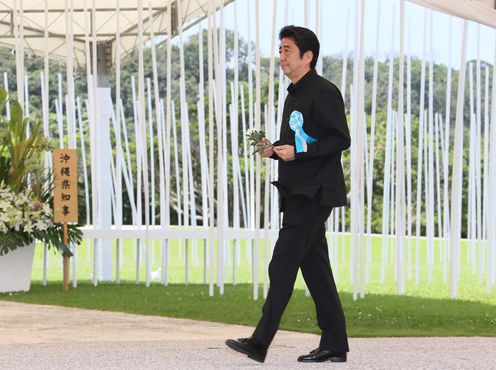
11:08 Arrive at Peace Memorial Park in Itoman City, offer flowers at National War Dead Peace Mausoleum. Governor of Okinawa Prefecture Nakaima Hirokazu accompanies
11:12 Depart from mausoleum
11:16 Arrive at Okinawa Peace Hall within Peace Memorial Park
11:45 Depart from Okinawa Peace Hall
11:50 Within the Peace Memorial Park, attend memorial service for all dead from the Battle of Okinawa, offer flowers, and deliver address

PM
12:51 Memorial service ends
12:57 Interview open to all media: When asked “By when will the Cabinet make a decision on the right to collective self-defense?” Mr. Abe answers “I want the Cabinet to start deciding when that becomes its political duty.”
01:01 Interview ends
01:04 Depart from Peace Memorial Park
01:31 Arrive at Crowne Plaza ANA Okinawa Harborview Hotel
01:59 Lunch meeting with Mr. Nakaima commences. Minister of State for Okinawa and Northern Territories Affairs Yamamoto Ichita and Vice Governor of Okinawa Prefecture Takara Kurayoshi also attend
02:51 Lunch meeting ends
02:53 Depart from hotel
03:00 Arrive at Naha Airport cargo terminal in Naha City, view the terminal
03:26 Leave cargo terminal
03:35 Arrive at Naha Airport grounds for planned extension to 2nd runway, view the area
03:44 Leave 2nd runway extension grounds
04:04 Arrive at Naha Airport proper
05:07 Depart from Naha Airport on ANA Flight 132. Mr. Yamamoto accompanies
07:02 Arrive at Haneda Airport
07:25 Depart from Haneda Airport
08:07 Give condolence call in honor of former Cabinet Legislation Bureau Director-General Komatsu Ichiro at his house in Zenbukuji, Tokyo
08:15 Depart from Mr. Komatsu’s house
08:45 Arrive at official residence
08:46 Interview open to all media: When asked “Please give us a single word concerning the news of former Cabinet Legislation Bureau Director-General Komatsu’s death.” Mr. Abe answers “For respect of the way Mr. Komatsu lived his life, I bow my head. I give my thanks to him, and pray for his well-earned happiness in the next world.”
08:47 Interview ends

Tuesday, June 24, 2014

AM

12:00 At official residence (no visitors)
08:00 At official residence (no morning visitors)
08:16 Depart from official residence
08:17 Arrive at office
08:23 Council for Science, Technology and Innovation meeting
08:40 Meeting ends
08:42 Headquarters on Creating Dynamism through Agriculture, Forestry and Fishery Industries and Local Communities meeting
08:49 Meeting ends
08:54 Cabinet Meeting begins
09:14 Cabinet Meeting ends
09:27 Depart from office
09:29 Arrive at LDP Party Headquarters
09:33 LDP Officers Meeting begins
10:02 Meeting ends
10:03 Depart from LDP Party Headquarters
10:05 Arrive at office
10:16 Depart from office
10:17 Arrive at Diet
10:19 Make rounds to all political parties in the Lower House with Lower House Speaker Ibuki Bunmei and Vice-Speaker Akamatsu Hirotaka
10:46 Finish making rounds in Lower House
10:47 Make rounds to all political parties in the Upper House with President of Upper House Yamazaki Masaki and Vice-President Koshiishi Azuma
11:00 Finish making rounds in Upper House
11:02 Depart from Diet
11:04 Arrive at official residence
11:50 Summit Conference with President of the Philippines Benigno Aquino III

PM
12:35 Summit with Mr. Aquino ends
12:36 Working lunch with Mr. Aquino
01:21 Working lunch ends
01:22 Joint press release
01:42 Joint press release ends
01:44 See off Mr. Aquino
01:45 Finish seeing off Mr. Aquino
01:46 Depart from official residence
01:47 Arrive at office
02:34 Exchange of views with Federation of Economic Organizations [Keidanren], Japan Chamber of Commerce and Industry, and Japan Association of Corporate Executives
02:51 Exchange ends
04:05 Interview with Bloomberg News
04:19 Interview ends
04:31 Council for Promoting the Alleviation of the Burden of Futenma Air Station meeting
05:05 Meeting ends
05:13 Joint meeting of the Council on Economic and Fiscal Policy and the Industrial Competitiveness Council
05:35 Joint meeting ends
05:41 Extraordinary Session Cabinet Meeting begins
05:47 Cabinet Meeting ends
06:30 Press conference
06:58 Press conference ends
08:29 Depart from office
08:30 Arrive at official residence
08:33 Filming for TV Tokyo News Program
08:55 Finish filming for TV Tokyo

Wednesday, June 25, 2014
AM
12:00 At official residence (no visitors)
08:00 At official residence (no morning visitor)
09:01 Depart from official residence
09:02 Arrive at office
09:38 Meet with Minister in charge of Support for Women’s Empowerment and Child Rearing Mori Masako
09:59 End meeting with Ms. Mori

10:00 National Security Council (NSC) Director Yachi Shotaro, Ministry of Foreign Affairs (MOFA)’s Vice-Ministers for Foreign Affairs Saiki Akitaka and Sugiyama Shinsuke, and Asian and Oceanian Affairs Bureau Director-General Ihara Junichi enter
10:07 Mr. Ihara leaves
10:20 Mr. Sugiyama leaves
10:37 Everyone leaves
10:40 Meet with Minister in charge of Total Reform of Social Security and Tax Amari Akira
10:55 End meeting with Mr. Amari
10:56 Meet with former US National Security Advisor Stephen J. Hadley
11:36 End meeting with Mr. Hadley

PM
02:00 Interview with journalist Godo Kenji
02:50 Interview ends
02:51 Speak with Chief Cabinet Secretary Suga Yoshihide
03:01 Finish speaking with Mr. Suga
03:02 Meet with Director of Kyoto University Kokoro Research Center Yoshikawa Sakiko
03:32 End meeting with Ms. Yoshikawa
04:56 Director of Cabinet Intelligence Kitamura Shigeru and Mr. Yachi enter
05:06 Mr. Yachi leaves
05:25 Mr. Kitamura leaves
06:00 Summit Conference with President of Paraguay Horacio Cartes
06:32 Summit Conference ends
06:36 Joint press conference
06:47 Joint press conference ends
06:48 Depart from office
06:49 Arrive at official residence. Dinner meeting hosted by the Prime Minister
08:11 See off Mr. Cartes
08:12 Finish seeing off Mr. Cartes

Thursday, June 26, 2014

AM

12:00 At official residence (no visitors)
08:00 At official residence (no morning visitors)
09:31 Depart from official residence
09:32 Arrive at office
11:30 Meet with of UK-Japan 21sy Century Group’s Japanese-side President and Lower House member Shiozaki Yasuhisa and President of Japan Center for Intercultural Exchange Okawara Akio
11:57 End meeting with Mr. Shiozaki and Mr. Okawara

PM
01:49 Meet with international petrochemical group of companies Royal Dutch Shell CEO Ben van Beurden
02:24 End meeting with Mr. van Beurden
02:25 Meet with Japan Productivity Center incoming Chairman Mogi Yuzaburo and outgoing Chairman Ushio Jiro
02:50 End meeting wit Mr. Mogi and Mr. Ushio
03:07 Meet with President and Editor-in-Chief of Forbes magazine Steve Forbes
03:22 End meeting with Mr. Forbes
03:23 Deputy Prime Minister and Minister of Finance Aso Taro, Vice-Minister of Finance Kinoshita Yasushi, Deputy Vice-Minister of Finance Sato Shinichi, Ministry of Finance’s Budget Bureau Director-General Kagawa Shunsuke and Tax Bureau Director-General Tanaka Kazuho enter
03:59 Mr. Kinoshita, Mr. Sato, Mr. Kagawa, and Mr. Tanaka all leave
04:23 Mr. Aso leaves
04:35 Meet with Chairman of Interchange Association representative office of Japan in Taiwan Ohashi Mitsuo
04:50 End meeting with Mr. Ohashi
04:51 Speak with MOFA’s Asian and Oceanian Affairs Bureau Director-General Ihara Jyunichi
04:54 Finish speaking with Mr. Ihara
05:01 Meet with International Olympic Committee Coordination Commission (for the Games of the XXXII Olympiad in Tokyo in 2020) Chairman John D. Coates. Tokyo 2020 Organizing Committee of the Olympic and Paralympic Games President Mori Yoshiro also attends
05:16 Meeting ends
05:21 NSC meeting commences. National Public Safety Commission Chairman Furuya Keiji attends
05:59 Mr. Furuya leaves NSC meeting
06:14 NSC meeting ends
06:41 Depart from office
06:42 Arrive at official residence

Friday, June 27, 2014

AM

12:00 At official residence (no visitors)
08:00 At official residence (no morning visitors)
09:23 Depart from official residence
09:24 Arrive at office
09:46 Headquarters for Promoting Decentralization Reform meeting
09:55 Meeting ends
10:01 Cabinet Meeting begins
10:20 Cabinet Meeting ends
10:37 Meet with Mexican Secretary of Foreign Affairs José Antonio Meade Kuribreña
10:53 End meeting with Mr. Meade
10:54 Meet with Vice-Minister for Foreign Affairs Saiki Akitaka and MOFA’s Asian and Oceanian Affairs Bureau Director-General Ihara Jyunichi
11:25 Meet with Administrative Vice-Minister of Defense Nishi Masanori
11:43 End meeting with Mr. Nishi
11:44 Meet with Chairman of Project Team for nonpartisan Diet Members’ Caucus on Sports Endo Toshiaki. Director-General of Personnel Affairs Bureau Kato Katsunobu attends

PM
12:04 End meeting with Mr. Kato
12:06 Receive courtesy call from a joint group of elementary and middle school students of Great Falls Elementary School in Virginia USA and Eisugakkan Elementary and Middle Schools in Fukuyama City, Hiroshima Prefecture
12:09 Courtesy call ends
12:10 Speak with Minister in charge of Ocean Policy and Territorial Issues Yamamoto Ichita
12:15 Finish speaking with Mr. Yamamoto
01:19 Meet with Minister in charge of TPP Amari Akira, Deputy Chief Negotiator of Government Headquarters for the TPP Oe Hiroshi, and Vice-Minister of Agriculture, Forestry and Fisheries Minagawa Yoshitsugu
02:02 End meeting with Mr. Amari, Mr. Oe, and Mr. Minagawa
02:03 Meet with Vice-Minister of Internal Affairs and Communications Okazaki Hiromi
02:32 End meeting with Mr. Okazaki
02:37 Meet with Minister for Reconstruction Nemoto Takumi
03:02 End meeting with Mr. Nemoto
03:53 Vice-Minister for Foreign Affairs Saiki Akitaka, MOFA’s Director-General of the European Affairs Bureau Kozuki Toyohisa, Director-General of Middle Eastern and African Affairs Bureau Uemura Tsukasa, and Director-General of the International Legal Affairs Bureau Ishii Masafumi enter
04:23 Mr. Kozuki and Mr. Ishii leave
04:35 Everyone leaves
05:18 Meet with Director of Cabinet Intelligence Kitamura Shigeru
05:46 End meeting with Mr. Kitamura
05:55 Depart from office
06:14 Arrive at private residence in Tomigaya, Tokyo
06:38 Depart from private residence
08:00 Arrive at Chinese restaurant Isaichugokusaikan Kokyu in Fujikawaguchiko-cho, Yamanashi Prefecture. Dinner with Special Advisor to President of the LDP Hagiuda Koichi and colleagues
10:24 Depart from restaurant
10:35 Arrive at holiday home in Narusawa Village Yamanashi Prefecture
10:42 Mr. Hagiuda enters

Saturday, June 28, 2014

AM

12:00 At holiday home (no new visitors). Mr. Hagiuda stays the night
06:57 Depart from holiday home in Narusawa Village, Yamanashi Prefecture
07:01 Arrive at Fujizakura Country Club golf course, play golf with Special Advisor to President of the LDP Hagiuda Kochi and colleagues

PM
02:53 Depart from Fujizakura Country Club
04:20 Arrive at private residence in Tomigaya, Tokyo
05:48 Depart from private residence
05:59 Arrive at sushi restaurant Sushi Kuon Hanare in Nishihara, Shibuya-ku, Tokyo. Have dinner with mother Kishi Yoko
07:26 Depart from Sushi Kuon Hanare
07:33 Arrive at private residence

Sunday, June 29, 2014

AM

12:00 At private residence (no visitors)
09:16 Deputy Chief Cabinet Secretary for Crisis Management Nishimura Yasuhiko and Director of NSC Yachi Shotaro enter Mr. Abe’s private residence in Tomigaya, Tokyo
09:59 Mr. Nishimura and Mr. Yachi leave

PM
Stay at private residence throughout the afternoon, no visitors
06:05 Depart from private residence
06:29 Arrive at Mitsubishi Kaitokaku, former residence of Iwasaki Koyata of Mitsubishi Corporation, in Takanawa, Tokyo. Dinner meeting with Deputy Prime Minister and Minister of Finance Aso Taro and Keio University emeritus professor Iwasaki Koko
08:38 Depart from Mitsubishi Kaitokaku
09:02 Arrive at private residence

Saturday, July 26, 2014

Monday in Washington, DC July 28, 2014


US Congress goes on summer recess at the end of this week.

July 27th is the anniversary of the 1953 Armistice of the Korean War.

July 30th is the anniversary of the 2007 passage of the House Resolution 121 calling on Japan to give an unequivocal apology to the Comfort Women.

FINAL DEAL WITH IRAN: OUTCOMES AND NEXT STEPS. 7/28, Noon-1:30pm. Sponsor: Gemunder Center for Defense and Strategy, Jewish Institute for National Security Affairs (JINSA). Speakers: Dennis Ross, counselor, Washington Institute for Near East Policy and co-chair, Iran Task Force; Eric Edelman, fellow, Center for Strategic and Budgetary Assessments and co-chair, Iran Task Force; Stephen Rademaker, senior adviser, Gemunder Center for Defense and Strategy, JINSA; and Ray Takeyh, senior fellow for Middle Eastern Studies, Council on Foreign Relations.

CHANGING SECURITY ENVIRONMENT AND GEOPOLITICAL DYNAMICS OF EAST ASIA. 7/28, 1:15-2:45pm. Sponsor: US-Korea Instiute, Johns Hopkins, SAIS; Institute for Corean-American Studies (ICAS). Keynote Speaker: The Honorable Jung Hoon Kim, ICAS Fellow, Member National Assembly, South Korea; Discussants: Joseph Bosco (ICAS Fellow; Senior Associate CSIS); David Maxwell (ICAS Fellow; Associate Director Security Studies Program Georgetown University); Larry Niksch (ICAS Fellow; Senior Associate CSIS).

NUCLEAR POLITICS ON THE KOREAN PENINSULA. 7/28, 3:00-5:15pm. Sponsor: Korea Economic Institute (KEI). Speakers: Park Jin, Former Chairman of Foreign Affairs, Trade, and Unification Committee, South Korean National Assembly; Donald Manzullo, Korea Economic Institute; Choi Kang, Asan Institute for Policy Studies; Lee Chung-min, Yonsei University; James L. Schoff, Carnegie Endowment for International Peace; and Troy Stangarone, Korea Economic Institute.