Monday, August 11, 2014

Mongolian-Japanese Partnership

Mongolian-Japanese Economic Partnership Agreement: 
Counterbalancing China and Russia
By: Alicia J. Campi

First published in the Eurasia Daily Monitor Volume: 11 Issue: 146
August 8, 2014

On the 40th anniversary of establishing bilateral diplomatic relations, Mongolia’s President Tsakhia Elbegdorj and Japan’s Prime Minister Shinzo Abe met in Tokyo on July 22, 2014, to sign a Joint Statement on affirming the final roadmap toward instituting an Economic Partnership Agreement (EPA). Aimed at promoting mutual trade and investment, the agreement could be ratified by the parliaments of both nations in the first quarter of 2015. The EPA would be the first such agreement for Mongolia and the 15th for Japan. Within the EPA, all Mongolian exports to Japan, including meat and raw minerals, and 96 percent of Japanese exports to Mongolia will be exempt from tariffs in the coming decade (ubpost.mongolnews.mn, July 24). Japan pledged to support policies to grow Mongolia’s exports. President Elbegdorj commented, “I believe the bilateral economic partnership agreement would be implemented successfully. We agreed to study, produce and sell together” (Montsame, english.news.mn, July 23).

The Joint Statement is based on three principles: 1) The EPA is key to elevating bilateral economic relations to higher levels and promoting mutually complementary cooperation. 2) The two sides agreed on recommendations of how to proceed with Abe’s previously announced ERCH Plus initiative, proposed during his March 2013 Mongolian visit and aimed at supporting Mongolian industrial diversification and value added, competitive exports. 3) The most intriguing element was that Japan proposed appointing an economic adviser for the Mongolians to work on mid- and long-term economic policy development (The Mongol Messenger, July 25).

President Elbegdorj traveled with a group of 130 Mongolians from the public and private sector. They joined a Mongolia-Japan Business Forum, attended by over 300 participants, which was co-hosted by the Japan Federation of Economic Organizations, KEIDANREN (Japan Business Federation), and the Japan External Trade Organization (JETRO). At the Forum, Elbegdorj praised the strength of Mongolia’s close relations with Japan and expressed special gratitude for Tokyo’s support during the early 1990s when its domestic power stations failed: “Mongolians will never forget your helping hand and your presence at the moments of [our] hardship.” Discussions during this business summit centered around the faltering Mongolian economy, the investment environment (FDI dropped 47 percent in 2013 and 70 percent in the first half of 2014), and specific investment opportunities (Montsame, english.news.mn, July 23).

Japan is ending its generous 23-year-old Mongolian grant aid program this year, so the two governments are exploring new types of private sector cooperation. In June, the Japanese government signed its final grant aid project to repair a hospital, health center, school and school dormitory in different provinces around Mongolia, under Tokyo’s Grassroots Human Security Grant Aid. In 2014, this aid program will provide $631,370 of grants for a total of seven projects (UNFPA Mongolia, June 20).

Elbegdorj also met with Japanese governing party and parliamentary officials involved in inter-parliamentary relations to discuss the new EPA, as well as Heita Kawakatsu, Governor of Shizuoka Prefecture, for discussions about training engineers and other personnel for Mongolia’s coal industry. In addition, the Mongolian head of state visited the Friendship Exchange Council (FEC) of Japan, which undertakes surveys and training seminars to enhance economic cooperation in the Asian region. Furthermore, Nikkei Group’s president, Tsuneo Kita, invited Elbegdorj to the annual “Future of Asia” conference, which attracts heads of state and government members of Asian countries, politicians, scientists and representatives from international economic organizations such as the International Monetary Fund (Montsame, July 25).

Although this trip focused on Mongolian-Japanese economic relations, other issues were discussed by Prime Minister Abe and the Mongolian president. Elbegdorj himself stated that “Mongolia’s bilateral relations with Japan are one of Mongolia’s foreign policy priorities, which are fully consistent with our national interests, with our development interests” (Montsame, July 25). One topic of discussion was Mongolian assistance in the ongoing negotiations between North Korea and Japan for the daughter of Japanese abductee Megumi Yokota to visit Japan in November (Kyodo News International, July 1). Tokyo believes that Ulaanbaatar could serve as a bridge to resolving the ongoing case of Japanese citizens abducted by North Korea and be a constructive influence in the region. Abe told reporters that, “We shared the view that the [Mongolian] president and I will jointly contribute to the stability and prosperity of the region and the global community” (ubpost.mongolnews.mn, July 24).

Among other issues likely covered were the upcoming August visit of Chinese President Xi Jinping and the planned September 3 visit of Russian Vladimir Putin. In June, the Mongolians had announced there would be a “Trilateral Summit” in Mongolia, but Putin delayed the date of his visit so he would miss both meeting Xi and the 75th anniversary date (August 27, 1939) of the Soviet-Mongolian victory over the Japanese in Khalkhin Gol (Nomonhon), which was the ostensible reason for his Mongolian trip (news.mn, August 5). Japanese sanctions against Russia may have been to blame, which now also endanger Putin’s planned September visit to Tokyo.

Regardless of the wider agenda, Elbegdorj’s trip revealed that Japan sees economic cooperation as the key to its future relationship with Mongolia. Even Japanese-Mongolian military cooperation has an economic component. Japanese Army officials, led by General Kiyofumi Iwata, Chief of Staff of the Japan Ground Self Defense Forces, conducted a working visit to Mongolia on June 25–28. Japanese military engineers discussed road construction plans with elements of the Mongolian Armed Forces and professors at the Mongolian University of Defense. General Iwata attended the ground-breaking ceremony for a 15-kilometer paved road to Mongolia’s Five Hills Military Training Center, which will be built by Mongolian and Japanese military engineers before the end of 2016 (infomongolia, July 1).

The Mongolian media cited unnamed experts as saying that mining products will account for a large amount of the future trade between Mongolia and Japan, so “the [EPA] agreement includes an investor-state dispute settlement (ISDS) clause, which makes it possible for firms to seek compensation if government policy hurts their investments” (ubpost.mongolnews.mn, July 24). In 2013, Japanese exports to Mongolia were worth $288 million versus only $21 million of Mongolian imports. The agreement is expected to increase investment in Mongolia and lessen Mongolia’s dependence on China. For Japan, the agreement can greatly benefit the export of automobiles and import of Mongolian minerals.

Saturday, August 2, 2014

Prime Minister of Japan's Schedule June 30-July 6, 2014

Monday, June 30, 2014

AM

12:00 At private residence (no visitors)
08:00 At private residence in Tomigaya, Tokyo (no morning visitors)
09:29 Depart from private residence
09:47 Arrive at U.S. Embassy in Akasaka, Tokyo. Give condolence call in honor of the late Howard Baker, former U.S. Ambassador to Japan. U.S. Ambassador to Japan Caroline Kennedy also attends
10:02 Depart from U.S. Embassy
10:05 Arrive at office
10:11 National Security Council (NSC) meeting with Minister in charge of the Abduction Issue Furuya Keiji
10:27 Meeting ends
11:13 Meet with Director-General of LDP Election Strategy Committee Kawamura Takeo
11:35 End meeting with Mr. Kawamura

PM
12:26 Depart from office
12:27 Arrive at Lower House 1st Committee Members’ Meeting Hall. Receive dental examination at dentist’s office inside meeting hall
12:47 Depart from Lower House 1st Committee Members’ Meeting Hall
12:49 Arrive at office
01:45 Depart from office
01:56 Arrive at event-hosting facility complex Ginza Blossom in Ginza, Tokyo. Attend Decentralization Reform Symposium in the hall there, deliver address
02:08 Depart from Ginza Blossom
02:20 Arrive at office
03:03 Receive courtesy call from Japan’s badminton team of the Badminton Men’s World Team Championships, winners of the Thomas Cup, and team captain Hayakawa Kenichi. Minister of Education, Culture, Sports, Science and Technology Shimomura Hakubun also attends
03:14 Courtesy call ends
03:21 Meet with LDP Lower House member Akiba Kenya and Japanese Ambassador for 3rd UN World Conference on Disaster Risk Reduction Suganuma Kenichi
03:36 End meeting with Mr. Akiba and Mr. Suganuma
05:10 Meet with Chairman of LDP National Vision Project Headquarters Yamaguchi Shunichi
05:29 End meeting with Mr. Yamaguchi
06:04 Summit Conference with Prime Minister of Bhutan Tshering Tobgay
06:42 Summit Conference ends
06:45 Joint press conference with Mr. Tobgay
06:56 Joint press conference ends
06:57 Depart from office
06:58 Arrive at official residence, dinner meeting hosted by Prime Minister Abe Shinzo
08:14 See off Mr. Tobgay
08:17 Finish seeing off Mr. Tobgay

Tuesday, July 1, 2014
AM12:00 At official residence (no visitors)
08:00 At official residence (no morning visitors)
09:46 Depart from official residence
09:47 Arrive at office
10:02 Cabinet Meeting begins
10:16 Cabinet Meeting ends
10:50 Summit Conference with Prime Minister of Macedonia Nikola Gruevski
11:25 Summit Conference ends
11:31 Awards Ceremony for Contributors to Public Safety
11:47 Ceremony ends

PM
01:43 Speak with National Security Council Director Yachi Shotaro and Vice-Minister for Foreign Affairs Saiki Akitaka
01:53 Finish speaking with Mr. Yachi and Mr. Saiki
01:54 Meet with Mr. Saiki and Ministry of Foreign Affairs (MOFA)’s Director-General of Intelligence and Analysis Service Matsutomi Shigeo
02:30 End meeting with Mr. Saiki and Mr. Matsutomi
02:33 Director of Cabinet Intelligence Kitamura Shigeru, Mr. Yachi, and Director of Cabinet Satellite Intelligence Center Shimohira Koji enter
02:44 Mr. Yachi and Mr. Shimohira leave
03:02 Mr. Kitamura leaves
03:16 Meet with Chairman Emeritus of Chicago Mercantile Exchange Group Leo Melamed
03:31 End meeting with Mr. Melamed
04:12 Ruling Party-Leader Coalition with Chief Representative of New Komeito Yamaguchi Natsuo. LDP Vice-President Komura Masahiko, LDP Secretary-General Ishiba Shigeru, Deputy Chief Representative of New Komeito Kitagawa Kazuo, Secretary-General of New Komeito Inoue Yoshihisa, and Chief Cabinet Secretary Suga Yoshihide also attend
04:26 Ruling Party-Leader Coalition ends
04:37 Nine Ministers’ Group of NSC meeting
04:48 Meeting ends
04:57 Extraordinary Session Cabinet Meeting
05:20 Cabinet Meeting ends
06:00 Press conference
06:25 Press conference ends
06:46 Filming for Nippon TV news program
07:04 Finish filming
07:08 Depart from office
07:09 Arrive at official residence, dinner meeting with Governor of Kyoto Prefecture Yamada Keiji, President of Keio University Seike Atsushi, Representative Director of Obayashi Corporation Obayashi Takeo, President of Sapporo Holdings Kamijyo Tsutomu, President of Kobe Steel, Ltd. Kawasaki Hiroya, and colleagues
08:56 Everyone leaves

Wednesday, July 2, 2014

AM
12:00 At official residence (no visitors)
06:10 Depart from official residence
06:22 Arrive at JR Tokyo Station
06:32 Depart from JR Tokyo Station on Hayabusa no. 1
08:45 Arrive at JR Morioka Station, reception by Governor of Iwate Prefecture Tasso Takuya
08:50 Depart from the station, Minister for Reconstruction Nemoto Takumi and Parliamentary Secretary for Reconstruction and Sakai Manabu accompany
10:05 Arrive and go shopping at roadside station Tono Kaze no Oka in Tono City, Iwate Prefecture
10:14 Depart from Tono Kaze no Oka
11:22 Arrive at emergency housing in Otsuchi-cho, Iwate Prefecture, and inspect condition of the establishment. Mayor of Otsuchi-cho Ikarigawa Yutaka and Lower House member Hashimoto Hidenori accompany
11:35 Depart from emergency housing
11:39 Arrive at Japanese restaurant Kappo Iwato in Otsuchi-cho, have lunch

PM
12:09 Depart from Kappo Iwato
12:13 Arrive at Ogakuchi Nursery, commemorative photo session with pupils
12:26 Depart from Ogakuchi Nursery
12:34 Arrive at Otsuchi-cho Reconstruction Quilt Project [大槌復興刺し子プロジェクト] office, try traditional handicraft Sashiko, and buy goods
12:58 Depart from project office
01:05 Arrive at seafood company Ito Shoten’s refrigeration and processing plant Otsuchi in Otsuchi-cho, sample cooking using wakame seaweed
01:26 Interview open to all media: When asked “How should reconstruction be approached?” Mr. Abe answers “I want to start a new fund structure to support resuscitation of livelihood [in the area].”
01:30 Interview ends
01:32 Depart from Otsuchi refrigeration and processing plant
04:30 Arrive at JR Morioka Station
04:31 Meet with Mr. Nemoto and colleagues in VIP room at station
04:44 End meeting with Mr. Nemoto
04:50 Depart from station on Hayabusa no. 26
07:07 Arrive at JR Tokyo Station
07:10 Depart from station
07:24 Arrive at official residence
07:25 Meet with Vice-Minister for Foreign Affairs Saiki Akitaka and MOFA’s Asian and Oceanian Affairs Bureau Director-General Ihara Junichi
07:46 End meeting with Mr. Saiki and Mt. Ihara
07:48 Depart from official residence
07:58 Arrive at Japanese restaurant Arisugawa Shimizu in Minami-Azabu, Tokyo. Dinner with Lower House Speaker Ibuki Bunmei and former Chief Justice of the Supreme Court Takesaki Hironobu
09:08 Depart from restaurant
09:26 Arrive at private residence in Tomigaya, Tokyo

Thursday, July 3, 2014

AM
12:00 At private residence (no visitors)
08:00 At private residence (no morning visitors)
09:09 Depart from private residence
09:24 Arrive at office
09:57 Headquarters for the Abduction Issue meeting
10:17 Meeting ends
10:20 Nine Ministers’ Group of NSC meeting. Minister of Justice Tanigaki Sadakazu and Minster of Health, Labour and Welfare Tamura Norihisa also attend
10:34 Meeting ends
10:49 Interview open to all media: When asked “What was decided in the NSC meeting?” Mr. Abe answers “Concerning North Korea, we have decided to rescind some of the sanctions we put in place.”
10:50 Interview ends
11:11 Speak with Minister of Agriculture, Forestry and Fisheries Hayashi Yoshimasa
11:21 Finish speaking with Mr. Hayashi
11:22 Meet with Director of Cabinet Intelligence Kitamura Shigeru and Bureau of Defense Policy Director-General Tokuchi Hideshi
11:50 End meeting with Mr. Kitamura and Mr. Tokuchi

PM
12:03 Lunch with National Defense Academy of Japan Alumni Association President Nagaiwa Toshimichi and colleagues
01:09 Finish lunch
01:10 Meet with LDP Vice-President Komura Masahiko
01:30 End meeting with Mr. Komura
01:31 Speak with Special Advisor to the Prime Minister Kimura Taro
01:38 Finish speaking with Mr. Kimura
01:39 Speak with Minister in charge of Ocean Policy and Territorial Issues Yamamoto Ichita
01:50 Finish speaking with Mr. Yamamoto
02:01 Education Rebuilding Implementation Council meeting
02:08 Meeting ends
02:21 Meet with Minister of Land, Infrastructure, Transport and Tourism Ohta Akihiro
03:06 End meeting with Mr. Ohta
03:10 Speak with President of Japan Commercial Broadcasters Association Inoue Yoshihisa
03:15 Finish speaking with Mr. Inoue
03:37 Meet with Minister for Foreign Affairs Kishida Fumio
03:59 End meeting with Mr. Kishida
04:04 Depart from office
04:05 Enter Lower House 1st Diet Members’ Meeting Hall. Receive dental examination at dentist’s office inside meeting hall
04:45 Depart from meeting hall
04:46 Arrive at office
05:14 Meet with Chairperson of LDP Policy Bureau Takaichi Sanae
05:32 End meeting with Ms. Takaichi
05:33 Meet with LDP Secretary-General Ishiba Shigeru
06:23 End meeting with Mr. Ishiba
06:28 Depart from office
06:42 Arrive at Japanese restaurant Botan in Shibaura, Tokyo. Have dinner with Vice-President of Imagica Robot Holdings and colleagues
08:44 Depart from restaurant
08:59 Arrive at private residence

Friday, July 4, 2014

AM
12:00 At private residence (no visitors)
08:00 At private residence in Tomigaya, Tokyo (no morning visitors)
09:25 Depart from private residence
09:41 Arrive at office
10:03 Cabinet Meeting begins
10:17 Cabinet Meeting ends
10:21 Headquarters for Ocean Policy meeting
10:29 Meeting ends
10:30 Deliver notices of personnel change to Advisor to Federation of Economic Organizations [Keidanren] Nakamura Yoshio and Vice-Minister of Finance for International Affairs Furusawa Mitsuhiro
10:37 Film video message aimed at industrial organizations
10:44 Finish filming
10:55 Meet with Vice-Minister for Foreign Affairs Saiki Akitaka and Deputy Minister for Foreign Affairs Nagamine Yasumasa
11:17 End meeting with Mr. Saiki and Mr. Nagamine
11:42 Speak with incoming Commissioner of Financial Services Agency Hosomizu Kiyoshi and outgoing Commissioner Hatanaka Ryutaro
11:45 Finish speaking with Mr. Hosomizu and Mr. Hatanaka
11:46 Speak with incoming Vice-Minister of Finance Kagawa Shunsuke and outgoing Vice Minister of Finance Kinoshita Yasushi
11:51 Finish speaking with Mr. Kagawa and Mr. Kinoshita
11:58 Meet with Advisory Panel on Reconstruction of the Legal Basis for Security Chairman Yanai Shunji and Acting Chair Kitaoka Shinichi. NSC Director Yachi Shotaro also attends

PM
01:08 End meeting with Mr. Yanai and Mr. Kitaoka
01:20 Speak with President of Japan Medical Association Yokokura Yoshitake
01:34 Finish speaking with Mr. Yokokura
01:35 Meet with Board Chairman of Science and Technology in Society forum Omi Koji
01:53 End meeting with Mr. Omi
01:54 Meet with Representative of LDP Osaka 19th Electoral District Branch Office Tanigawa Tom
02:10 End meeting with Mr. Tanigawa
02:12 Meet with Deputy Ministers for Foreign Affairs Sugiyama Shinsuke and Nagamine Yasumasa; Ministry of Finance’s Yamasaki Tatsuo; Ministry of Agriculture, Forestry and Fisheries‘ Vice-Minister for International Affairs Harihara Hisao; Ministry of Economy, Trade and Industry‘s Vice-Minister for International Affairs Ishiguro Norihiko; and Ministry of Land, Infrastructure, Transport and Tourism’s Director-General for International Affairs Inaba Kazuo. Director-General of Personnel Affairs Bureau Kato Katsunobu and Special Advisor to the Prime Minister Eto Seiichi also attend
03:09 End meeting with Mr. Sugiyama, Mr. Nagamine, Mr. Yamasaki, Mr. Harihara, Mr. Ishiguro, and Mr. Inaba
03:10 Meet with MOFA’s Director-General of Foreign Policy Bureau Hiramatsu Kenji
03:39 End meeting with Mr. Hiramatsu
03:44 Receive written request from Parliamentary League for Early Repatriation of Japanese Citizens Kidnapped by North Korea, National Association for the Rescue of Japanese Kidnapped by North Korea, Association of the Families of Victims Kidnapped by North Korea, and Investigation Commission on Missing Japanese Probably Related to North Korea
03:58 Finish request reception
04:01 Speak with LDP Director of Special Committee on North Korean Abduction Issue and Related Matters Yamatani Eriko, Minister for Foreign Affairs Kishida Fumio, and Minister in charge of the Abduction Issue Furuya Keiji
04:13 Finish speaking with Ms. Yamanaki, Mr. Kishida, and Mr. Furuya
04:14 Speak with Minister of Defense Onodera Itsunori and Mr. Hiramatsu
04:27 Finish speaking with Mr. Onodera and Mr. Hiramatsu
04:44 Receive report from International disaster relief unit for Malaysian plane search upon its return to Japan
04:56 Report concludes
04:58 Meet with Director of Cabinet Intelligence Kitamura Shigeru
05:28 End meeting with Mr. Kitamura
05:42 Phone conference with Chancellor of Germany Angela Merkel
06:02 Phone conference ends
06:26 Depart from office
06:27 Arrive at official residence
06:30 Interview with NHK
06:54 Interview ends
06:55 Dinner meeting with TV Asahi’s President and CEO Hayakawa Hiroshi, Representative Director Yoshida Shinichi, and President of Gentosha Kenjo Toru
08:45 Dinner meeting ends
08:46 Depart from official residence
09:04 Arrive at private residence

Saturday, July 5, 2014

AM
12:00 At private residence (no visitors)
08:00 At private residence in Tomigaya, Tokyo (no morning visitors)
10:26 Depart from private residence
10:56 Arrive a Kabukiza Theatre in Ginza, Tokyo. Enjoy watching “Shofuda Tsukikon Genkusazuri” [正札附根元草摺] and “Natsumatsuri Naniwa Kagami” [夏祭浪花鑑] with Mr. Abe’s wife Akie and U.S. Ambassador to Japan Caroline Kennedy

PM
03:33 Depart from Kabukiza
03:52 Arrive at salon HAIR GUEST in Shibuya, Tokyo, for hair cut
05:54 Depart from HAIR GUEST
06:04 Arrive at official residence
06:30 Interview with Yomiuri Shimbun
07:02 Finish interview
07:04 Depart from official residence
07:18 Arrive at private residence

Sunday, July 6, 2014

AM

12:00 At private residence (no visitors)
08:01 Depart from private residence in Tomigaya, Tokyo
08:29 Arrive at Haneda Airport
08:37 Interview open to all media: When asked “Will you name a Minister in charge of Security Legislation?” Mr. Abe answers “It is a significant [policy] shift, so I do want to put a cabinet minister in charge of it.”
08:40 Interview ends
09:08 Depart fro Haneda Airport with wife Akie toward New Zealand on a trip bound for Australia, New Zealand, and Papua New Guinea

PM
Arrive at Auckland International Airport, New Zealand
Arrive at Skycity Grand Hotel

Monday in Washington, August 4, 2014

This week in Washington is dominated (August 4-6) by the first U.S.-Africa Leaders Summit hosted by the White House. Many think tanks and NGOs will have Africa-focused programs and host individual African leaders. For many, it will be the first time that they feature more than one speaker of color.

Over 50 African heads of state are expected at the Summit. Not invited are the presidents of four countries with a record of human rights violations – Eritrea, Zimbabwe, Sudan and Central African Republic.

On Monday, President Obama's birthday, there will be a civil society forum. The U.S. emphasis on human rights and good governance separates this gathering from recent Africa investment summits held by China, India, Japan and Russia.

Also Monday, August 4th is the anniversary of the 1993 Kono Statement providing an unofficial apology to the Comfort Women. Through Prime Minister Abe's two terms in office the Kono Statement has been methodically deconstructed to remove the focus on apology and the involvement of the Japanese Government. No member of the current Abe Administration uses the word apology when referring to the Kono Statement. Chief Cabinet Secretary Suga also says the government is working off of the March 2007 revision of the Kono Statement saying that the Japanese government did not coerce women and that the Statement is a non-binding announcement of the conclusion of a study.

August 6th is the 69th anniversary of the dropping of the atomic bomb on Hiroshima, Japan and August 9th on Nagasaki, Japan. There will be a number of activities organized by the Hiroshima/Nagasaki Peace Committee of the National Capital Area.

Congress is in recess and will not return until September 7th. Washington will be quiet in August and hopefully there will be no "August Surprise."

THE GAME HAS CHANGED: THE NEW LANDSCAPE FOR INNOVATION AND BUSINESS IN AFRICA. 8/4, 9:15am-5:00pm, Washington, DC. Sponsor: Brookings. Speakers: Karen R. Bass (D-CA), U.S. House of Representatives; Christopher Smith (R-NJ), U.S. House of Representatives; Vera Songwe, nonresidential senior fellow, Global Economy and Development, Africa Growth Initiative, Brookings; Carolyn Cambell, managing director and general counsel, Emerging Capital Partners; Donald Kaberuka, president, African Development Bank; Mo Lbrahim, founder and chair, Mo Ibrahim Foundation; Jason Njokum founder and CEO, iROKO Partners; Amadous Sy, senior fellow, Global Economy and Development, Africa Growth Initiative; Fernando de Sousa, general manager, African Initiatives; Jay Ireland, president and CEO, GE Africa; Robert Collymore, CEO, Safaricom; Strive Masiyiwa, executive chairman, Econet Wireless International; Kemal, vice president and director, Global Economy and Development, Brookings; Helene Cooper, White House correspondent, New York Times; William Sallis, writer and former editor, African Affairs, Financial Times; Alaune “Akon” Thiam, recording artist and philanthropist; and Witney Schneidman, nonresident fellow, Global Economy and Development, Africa Growth Initiative, Brookings.

EVERYTHING YOU ALWAYS WANTED TO KNOW ABOUT NATIONAL SECURITY LAW (BUT WERE AFRAID TO ASK). 8/4, Noon-1:00pm. Sponsor: Center for Human Rights & Humanitarian Law and Tom Lantos Human Rights Commission. Speaker: Stephen Vladeck, professor, Washington College of Law, American University. 

Wednesday, July 30, 2014

Prime Minister of Japan's Schedule June 23-29, 2014

Monday, June 23, 2014

AM

12:00 At private residence (no visitors)
07:05 Depart from private residence in Tomigaya, Tokyo
07:33 Arrive at Haneda Airport
08:03 Depart from Haneda Airport on ANA Flight 125. Special Advisor to the Prime Minister Hasegawa Eiichi accompanies
10:25 Arrive at Naha Airport
10:42 Depart from Naha airport
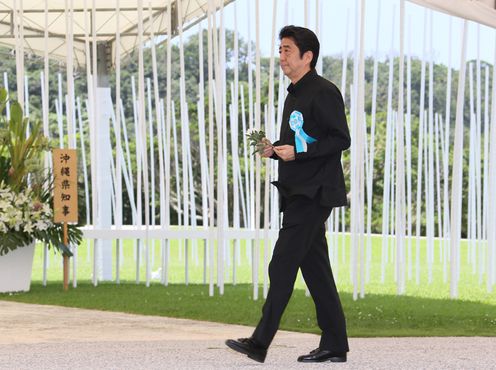
11:08 Arrive at Peace Memorial Park in Itoman City, offer flowers at National War Dead Peace Mausoleum. Governor of Okinawa Prefecture Nakaima Hirokazu accompanies
11:12 Depart from mausoleum
11:16 Arrive at Okinawa Peace Hall within Peace Memorial Park
11:45 Depart from Okinawa Peace Hall
11:50 Within the Peace Memorial Park, attend memorial service for all dead from the Battle of Okinawa, offer flowers, and deliver address

PM
12:51 Memorial service ends
12:57 Interview open to all media: When asked “By when will the Cabinet make a decision on the right to collective self-defense?” Mr. Abe answers “I want the Cabinet to start deciding when that becomes its political duty.”
01:01 Interview ends
01:04 Depart from Peace Memorial Park
01:31 Arrive at Crowne Plaza ANA Okinawa Harborview Hotel
01:59 Lunch meeting with Mr. Nakaima commences. Minister of State for Okinawa and Northern Territories Affairs Yamamoto Ichita and Vice Governor of Okinawa Prefecture Takara Kurayoshi also attend
02:51 Lunch meeting ends
02:53 Depart from hotel
03:00 Arrive at Naha Airport cargo terminal in Naha City, view the terminal
03:26 Leave cargo terminal
03:35 Arrive at Naha Airport grounds for planned extension to 2nd runway, view the area
03:44 Leave 2nd runway extension grounds
04:04 Arrive at Naha Airport proper
05:07 Depart from Naha Airport on ANA Flight 132. Mr. Yamamoto accompanies
07:02 Arrive at Haneda Airport
07:25 Depart from Haneda Airport
08:07 Give condolence call in honor of former Cabinet Legislation Bureau Director-General Komatsu Ichiro at his house in Zenbukuji, Tokyo
08:15 Depart from Mr. Komatsu’s house
08:45 Arrive at official residence
08:46 Interview open to all media: When asked “Please give us a single word concerning the news of former Cabinet Legislation Bureau Director-General Komatsu’s death.” Mr. Abe answers “For respect of the way Mr. Komatsu lived his life, I bow my head. I give my thanks to him, and pray for his well-earned happiness in the next world.”
08:47 Interview ends

Tuesday, June 24, 2014

AM

12:00 At official residence (no visitors)
08:00 At official residence (no morning visitors)
08:16 Depart from official residence
08:17 Arrive at office
08:23 Council for Science, Technology and Innovation meeting
08:40 Meeting ends
08:42 Headquarters on Creating Dynamism through Agriculture, Forestry and Fishery Industries and Local Communities meeting
08:49 Meeting ends
08:54 Cabinet Meeting begins
09:14 Cabinet Meeting ends
09:27 Depart from office
09:29 Arrive at LDP Party Headquarters
09:33 LDP Officers Meeting begins
10:02 Meeting ends
10:03 Depart from LDP Party Headquarters
10:05 Arrive at office
10:16 Depart from office
10:17 Arrive at Diet
10:19 Make rounds to all political parties in the Lower House with Lower House Speaker Ibuki Bunmei and Vice-Speaker Akamatsu Hirotaka
10:46 Finish making rounds in Lower House
10:47 Make rounds to all political parties in the Upper House with President of Upper House Yamazaki Masaki and Vice-President Koshiishi Azuma
11:00 Finish making rounds in Upper House
11:02 Depart from Diet
11:04 Arrive at official residence
11:50 Summit Conference with President of the Philippines Benigno Aquino III

PM
12:35 Summit with Mr. Aquino ends
12:36 Working lunch with Mr. Aquino
01:21 Working lunch ends
01:22 Joint press release
01:42 Joint press release ends
01:44 See off Mr. Aquino
01:45 Finish seeing off Mr. Aquino
01:46 Depart from official residence
01:47 Arrive at office
02:34 Exchange of views with Federation of Economic Organizations [Keidanren], Japan Chamber of Commerce and Industry, and Japan Association of Corporate Executives
02:51 Exchange ends
04:05 Interview with Bloomberg News
04:19 Interview ends
04:31 Council for Promoting the Alleviation of the Burden of Futenma Air Station meeting
05:05 Meeting ends
05:13 Joint meeting of the Council on Economic and Fiscal Policy and the Industrial Competitiveness Council
05:35 Joint meeting ends
05:41 Extraordinary Session Cabinet Meeting begins
05:47 Cabinet Meeting ends
06:30 Press conference
06:58 Press conference ends
08:29 Depart from office
08:30 Arrive at official residence
08:33 Filming for TV Tokyo News Program
08:55 Finish filming for TV Tokyo

Wednesday, June 25, 2014
AM
12:00 At official residence (no visitors)
08:00 At official residence (no morning visitor)
09:01 Depart from official residence
09:02 Arrive at office
09:38 Meet with Minister in charge of Support for Women’s Empowerment and Child Rearing Mori Masako
09:59 End meeting with Ms. Mori

10:00 National Security Council (NSC) Director Yachi Shotaro, Ministry of Foreign Affairs (MOFA)’s Vice-Ministers for Foreign Affairs Saiki Akitaka and Sugiyama Shinsuke, and Asian and Oceanian Affairs Bureau Director-General Ihara Junichi enter
10:07 Mr. Ihara leaves
10:20 Mr. Sugiyama leaves
10:37 Everyone leaves
10:40 Meet with Minister in charge of Total Reform of Social Security and Tax Amari Akira
10:55 End meeting with Mr. Amari
10:56 Meet with former US National Security Advisor Stephen J. Hadley
11:36 End meeting with Mr. Hadley

PM
02:00 Interview with journalist Godo Kenji
02:50 Interview ends
02:51 Speak with Chief Cabinet Secretary Suga Yoshihide
03:01 Finish speaking with Mr. Suga
03:02 Meet with Director of Kyoto University Kokoro Research Center Yoshikawa Sakiko
03:32 End meeting with Ms. Yoshikawa
04:56 Director of Cabinet Intelligence Kitamura Shigeru and Mr. Yachi enter
05:06 Mr. Yachi leaves
05:25 Mr. Kitamura leaves
06:00 Summit Conference with President of Paraguay Horacio Cartes
06:32 Summit Conference ends
06:36 Joint press conference
06:47 Joint press conference ends
06:48 Depart from office
06:49 Arrive at official residence. Dinner meeting hosted by the Prime Minister
08:11 See off Mr. Cartes
08:12 Finish seeing off Mr. Cartes

Thursday, June 26, 2014

AM

12:00 At official residence (no visitors)
08:00 At official residence (no morning visitors)
09:31 Depart from official residence
09:32 Arrive at office
11:30 Meet with of UK-Japan 21sy Century Group’s Japanese-side President and Lower House member Shiozaki Yasuhisa and President of Japan Center for Intercultural Exchange Okawara Akio
11:57 End meeting with Mr. Shiozaki and Mr. Okawara

PM
01:49 Meet with international petrochemical group of companies Royal Dutch Shell CEO Ben van Beurden
02:24 End meeting with Mr. van Beurden
02:25 Meet with Japan Productivity Center incoming Chairman Mogi Yuzaburo and outgoing Chairman Ushio Jiro
02:50 End meeting wit Mr. Mogi and Mr. Ushio
03:07 Meet with President and Editor-in-Chief of Forbes magazine Steve Forbes
03:22 End meeting with Mr. Forbes
03:23 Deputy Prime Minister and Minister of Finance Aso Taro, Vice-Minister of Finance Kinoshita Yasushi, Deputy Vice-Minister of Finance Sato Shinichi, Ministry of Finance’s Budget Bureau Director-General Kagawa Shunsuke and Tax Bureau Director-General Tanaka Kazuho enter
03:59 Mr. Kinoshita, Mr. Sato, Mr. Kagawa, and Mr. Tanaka all leave
04:23 Mr. Aso leaves
04:35 Meet with Chairman of Interchange Association representative office of Japan in Taiwan Ohashi Mitsuo
04:50 End meeting with Mr. Ohashi
04:51 Speak with MOFA’s Asian and Oceanian Affairs Bureau Director-General Ihara Jyunichi
04:54 Finish speaking with Mr. Ihara
05:01 Meet with International Olympic Committee Coordination Commission (for the Games of the XXXII Olympiad in Tokyo in 2020) Chairman John D. Coates. Tokyo 2020 Organizing Committee of the Olympic and Paralympic Games President Mori Yoshiro also attends
05:16 Meeting ends
05:21 NSC meeting commences. National Public Safety Commission Chairman Furuya Keiji attends
05:59 Mr. Furuya leaves NSC meeting
06:14 NSC meeting ends
06:41 Depart from office
06:42 Arrive at official residence

Friday, June 27, 2014

AM

12:00 At official residence (no visitors)
08:00 At official residence (no morning visitors)
09:23 Depart from official residence
09:24 Arrive at office
09:46 Headquarters for Promoting Decentralization Reform meeting
09:55 Meeting ends
10:01 Cabinet Meeting begins
10:20 Cabinet Meeting ends
10:37 Meet with Mexican Secretary of Foreign Affairs José Antonio Meade Kuribreña
10:53 End meeting with Mr. Meade
10:54 Meet with Vice-Minister for Foreign Affairs Saiki Akitaka and MOFA’s Asian and Oceanian Affairs Bureau Director-General Ihara Jyunichi
11:25 Meet with Administrative Vice-Minister of Defense Nishi Masanori
11:43 End meeting with Mr. Nishi
11:44 Meet with Chairman of Project Team for nonpartisan Diet Members’ Caucus on Sports Endo Toshiaki. Director-General of Personnel Affairs Bureau Kato Katsunobu attends

PM
12:04 End meeting with Mr. Kato
12:06 Receive courtesy call from a joint group of elementary and middle school students of Great Falls Elementary School in Virginia USA and Eisugakkan Elementary and Middle Schools in Fukuyama City, Hiroshima Prefecture
12:09 Courtesy call ends
12:10 Speak with Minister in charge of Ocean Policy and Territorial Issues Yamamoto Ichita
12:15 Finish speaking with Mr. Yamamoto
01:19 Meet with Minister in charge of TPP Amari Akira, Deputy Chief Negotiator of Government Headquarters for the TPP Oe Hiroshi, and Vice-Minister of Agriculture, Forestry and Fisheries Minagawa Yoshitsugu
02:02 End meeting with Mr. Amari, Mr. Oe, and Mr. Minagawa
02:03 Meet with Vice-Minister of Internal Affairs and Communications Okazaki Hiromi
02:32 End meeting with Mr. Okazaki
02:37 Meet with Minister for Reconstruction Nemoto Takumi
03:02 End meeting with Mr. Nemoto
03:53 Vice-Minister for Foreign Affairs Saiki Akitaka, MOFA’s Director-General of the European Affairs Bureau Kozuki Toyohisa, Director-General of Middle Eastern and African Affairs Bureau Uemura Tsukasa, and Director-General of the International Legal Affairs Bureau Ishii Masafumi enter
04:23 Mr. Kozuki and Mr. Ishii leave
04:35 Everyone leaves
05:18 Meet with Director of Cabinet Intelligence Kitamura Shigeru
05:46 End meeting with Mr. Kitamura
05:55 Depart from office
06:14 Arrive at private residence in Tomigaya, Tokyo
06:38 Depart from private residence
08:00 Arrive at Chinese restaurant Isaichugokusaikan Kokyu in Fujikawaguchiko-cho, Yamanashi Prefecture. Dinner with Special Advisor to President of the LDP Hagiuda Koichi and colleagues
10:24 Depart from restaurant
10:35 Arrive at holiday home in Narusawa Village Yamanashi Prefecture
10:42 Mr. Hagiuda enters

Saturday, June 28, 2014

AM

12:00 At holiday home (no new visitors). Mr. Hagiuda stays the night
06:57 Depart from holiday home in Narusawa Village, Yamanashi Prefecture
07:01 Arrive at Fujizakura Country Club golf course, play golf with Special Advisor to President of the LDP Hagiuda Kochi and colleagues

PM
02:53 Depart from Fujizakura Country Club
04:20 Arrive at private residence in Tomigaya, Tokyo
05:48 Depart from private residence
05:59 Arrive at sushi restaurant Sushi Kuon Hanare in Nishihara, Shibuya-ku, Tokyo. Have dinner with mother Kishi Yoko
07:26 Depart from Sushi Kuon Hanare
07:33 Arrive at private residence

Sunday, June 29, 2014

AM

12:00 At private residence (no visitors)
09:16 Deputy Chief Cabinet Secretary for Crisis Management Nishimura Yasuhiko and Director of NSC Yachi Shotaro enter Mr. Abe’s private residence in Tomigaya, Tokyo
09:59 Mr. Nishimura and Mr. Yachi leave

PM
Stay at private residence throughout the afternoon, no visitors
06:05 Depart from private residence
06:29 Arrive at Mitsubishi Kaitokaku, former residence of Iwasaki Koyata of Mitsubishi Corporation, in Takanawa, Tokyo. Dinner meeting with Deputy Prime Minister and Minister of Finance Aso Taro and Keio University emeritus professor Iwasaki Koko
08:38 Depart from Mitsubishi Kaitokaku
09:02 Arrive at private residence

Saturday, July 26, 2014

Monday in Washington, DC July 28, 2014


US Congress goes on summer recess at the end of this week.

July 27th is the anniversary of the 1953 Armistice of the Korean War.

July 30th is the anniversary of the 2007 passage of the House Resolution 121 calling on Japan to give an unequivocal apology to the Comfort Women.

FINAL DEAL WITH IRAN: OUTCOMES AND NEXT STEPS. 7/28, Noon-1:30pm. Sponsor: Gemunder Center for Defense and Strategy, Jewish Institute for National Security Affairs (JINSA). Speakers: Dennis Ross, counselor, Washington Institute for Near East Policy and co-chair, Iran Task Force; Eric Edelman, fellow, Center for Strategic and Budgetary Assessments and co-chair, Iran Task Force; Stephen Rademaker, senior adviser, Gemunder Center for Defense and Strategy, JINSA; and Ray Takeyh, senior fellow for Middle Eastern Studies, Council on Foreign Relations.

CHANGING SECURITY ENVIRONMENT AND GEOPOLITICAL DYNAMICS OF EAST ASIA. 7/28, 1:15-2:45pm. Sponsor: US-Korea Instiute, Johns Hopkins, SAIS; Institute for Corean-American Studies (ICAS). Keynote Speaker: The Honorable Jung Hoon Kim, ICAS Fellow, Member National Assembly, South Korea; Discussants: Joseph Bosco (ICAS Fellow; Senior Associate CSIS); David Maxwell (ICAS Fellow; Associate Director Security Studies Program Georgetown University); Larry Niksch (ICAS Fellow; Senior Associate CSIS).

NUCLEAR POLITICS ON THE KOREAN PENINSULA. 7/28, 3:00-5:15pm. Sponsor: Korea Economic Institute (KEI). Speakers: Park Jin, Former Chairman of Foreign Affairs, Trade, and Unification Committee, South Korean National Assembly; Donald Manzullo, Korea Economic Institute; Choi Kang, Asan Institute for Policy Studies; Lee Chung-min, Yonsei University; James L. Schoff, Carnegie Endowment for International Peace; and Troy Stangarone, Korea Economic Institute. 

Monday, July 21, 2014

Prime Minister of Japan's Schedule June 16-22, 2014

Monday, June 16, 2014

AM

12:00 At official residence (no visitors)
08:00 At official residence (no morning visitors)
09:27 Depart from official residence
09:28 Arrive at office
10:30 Meet with Vice-Minister of Cabinet Office Matsuyama Kenji, Director-General for Policy on Cohesive Society Ishii Hiroaki, and Ministry of Health, Labor and Welfare’s Director of Employment Security Bureau Okazaki Junichi
10:47 End meeting with Mr. Matsuyama, Mr. Ishii and Mr. Okazaki
10:54 Meet with Vice-Minister for Foreign Affairs Saiki Akitaka
11:35 End meeting with Mr. Saiki
11:36 Meet with Vice-Minister of Economy, Trade and Industry Tatsuoka Tsuneyoshi and Ministry of Economy, Trade and Industry’s Director-General of Manufacturing Industries Bureau Miyagawa Tadashi
11:57 End meeting with Mr. Tatsuoka and Mr. Miyagawa

PM
12:54 Depart from office
12:55 Arrive at Diet
12:57 Enter Lower House 1st Committee Members’ Room
12:58 Speak with Deputy Prime Minister and Minister of Finance Aso Taro
12:59 Cease speaking with Mr. Aso
01:00 Lower House Committee on Audit and Oversight of Administration commences
05:01 Leave seat during committee proceedings
05:03 Enter LDP President’s Room
05:04 LDP Officers Meeting begins
05:19 Meeting ends
05:20 Speak with LDP Vice-President Komura Masahiko and LDP Secretary-General Ishiba Shigeru
05:24 Cease speaking with Mr. Komura and Mr. Ishiba
05:25 Leave LDP President’s Room
05:26 Enter LDP Secretary-General’s Conference Room
05:27 Endorse candidate for Nagano Prefecture’s gubernatorial election
05:30 Leave room
05:31 Depart from Diet
05:35 Arrive at office
05:42 Industrial Competitiveness Council meeting
06:22 Meeting ends
06:35 Depart from office
06:41 Arrive at Akasaka Estate in Moto-Akasaka, Tokyo, attend Prince Katsura’s wake
07:29 Depart from Akasaka Estate
07:32 Arrive at Hotel New Otani in Kioi-cho, Tokyo. In hotel guest room have informal talk with AOKI Holdings Chairman Aoki Hironori; Nitori Holdings CEO Nitori Akio; FANCL Corporation Chairman Ikemori Kenji; Doutor Coffee Honorary President Toriba Hiromichi; and Starts Corporation Chairman and CEO Muraishi Hisaji. Chief Cabinet Secretary Suga Yoshihide also attends
09:10 Depart from Hotel New Otani
09:27 Arrive at private residence in Tomigaya, Tokyo

Tuesday, June 17, 2014

AM

12:00 At private residence (no visitors)
07:17 Depart from private residence in Tomigaya, Tokyo
07:30 Arrive at office
07:35 Ministerial Council on the Promotion of Japan as a Tourism-Oriented Country meeting
07:48 Meeting ends
07:52 Cabinet Meeting begins
08:03 Meeting ends
08:55 Depart from office
09:13 Arrive at Toshimagaoka Imperial Cemetery in Otsuka, Tokyo, attend Prince Katsura’s burial ceremony
10:51 Depart from cemetery
11:06 Arrive at office

PM
01:23 Depart from office
01:25 Arrive at Diet
01:27 Enter Upper House 43rd Member’s Room
01:28 Speak with Minister of Health, Labor and Welfare Tamura Norihisa
01:33 Finish speaking with Mr. Tamura
01:34 Upper House Committee on Health, Labour, and Welfare commences
03:37 Leave seat during committee proceedings
03:38 Depart from Diet
03:40 Arrive at office
03:41 Meet with Vice-Minister for Foreign Affairs Saiki Akitaka
04:10 End meeting with Mr. Saiki
04:11 Director of Cabinet Intelligence Kitamura Shigeru, Director of National Security Council (NSC) Yachi Shotaro, and Director of Cabinet Satellite Intelligence Center Shimohira Koji enter
04:25 Mr. Yachi and Mr. Shimohira leave
04:51 Mr. Kitamura leaves
05:13 Council on National Strategic Special Zones meeting
05:39 Meeting ends
05:59 Meet with Mr. Saiki
06:11 End meeting with Mr. Saiki
06:19 Depart from office
06:30 Arrive at French restaurant “The Crescent” in Shiba Park, Tokyo. Dinner meeting with Mitsui Sumitomo Banking Corporation Deputy-President Takahashi Seiichiro, Kake Educational Institution Board of Trustees Chairman Kake Kotaro, and colleagues
09:05 Depart from “The Crescent”
09:21 Arrive at private residence

Wednesday, June 18, 2014

AM

12:00 At private residence (no visitors)
08:00 At private residence in Tomigaya, Tokyo (no morning visitors)
09:40 Depart from private residence
09:54 Arrive at office
10:05 Meet with Special Advisor to the Prime Minister Kimura Taro
10:15 End meeting with Mr. Kimura
10:48 Meet with Minister of Defense Onodera Itsunori and Ministry of Defense (MOD)’s Vice Chief of Joint Staff Iwata Kiyofumi
11:08 End meeting with Mr. Onodera
11:26 Meet with President of LDP Kinki Bloc Conference of Both Houses of the Diet Nikai Toshihiro, Chairman of LDP Special Committee on Superconducting Maglev Linear Motor-Car Train Takemoto Naokazu, and colleagues. Chief Cabinet Secretary Suga Yoshihide also attends
11:47 End meeting with Mr. Nikai, Mr. Takemoto, and colleagues
11:48 Meet with LDP Lower House member Nukaga Fukushiro

PM
12:00 End meeting with Mr. Nukaga
01:18 Meet with President of SoftBank Corporation Son Masayoshi and former US Secretary of State and independent board member of Bloom Energy Corporation Colin Powell
02:10 Minister of Education, Culture, Sports, Science and Technology Shimomura Hakubun, Vice-Minister of Education, Culture, Sports, Science and Technology Yamanaka Shinichi, and Commissioner of Agency for Cultural Affairs Aoyagi Masanori enter
02:23 Mr. Yamanaka leaves
02:32 Mr. Shimomura and Mr. Aoyagi leave
02:34 National Security Secretariat Advisory Board meeting
03:22 Meeting ends
04:31 Meet with Director of Cabinet Intelligence Kitamura Shigeru, Director of NSC Yachi Shotaro, Ministry of Foreign Affairs (MOFA)’s Director-General of Foreign Policy Bureau Hiramatsu Kenji, MOD’s Bureau of Defense Policy Director-General Tokuchi Hideshi, and Chief of Staff of Joint Staff Council Iwasaki Shigeru
05:12 End meeting with Mr. Kitamura, Mr. Yachi, Mr. Hiramatsu, Mr. Tokuchi, and Mr. Iwasaki
06:45 Depart from office
06:56 Arrive at Teppanyaki restaurant Ginza Ukai-tei in Ginza, Tokyo. Dinner meeting with President of Jiji Press Ltd. Nishizawa Yukata, Commentary Committee member Tazaki Shiro, Editor for Political News Desk Watanabe Yuji, and colleagues
09:09 Depart from Ginza Ukai-tei
09:29 Arrive at private residence

Thursday, June 19, 2014

AM

12:00 At private residence (no visitors)
08:00 At private residence in Tomigaya, Tokyo (no morning visitors)
08:10 Depart from private residence
09:11 Arrive at money handling machine company GLORY manufacturing plant in Kazo City, Saitama Prefecture, view the plant
09:40 Depart from GLORY manufacturing plant
10:47 Arrive at Narihira Home nursing home in Sumida district, Tokyo
10:48 View and personally test out nursing care robot. Senior Vice Minister of Economy, Trade and Industry Matsushima Midori accompanies
11:12 Finish testing out robot
11:13 Interview open to all media: When asked “what were your thoughts viewing the nursing care robots?” Mr. Abe answers “I am convinced that use of these robots has the potential to greatly change quality of life [for those in the robots’ care].”
11:16 Interview ends
11:19 Depart from Narihira Home
11:40 Arrive at office

PM
12:29 Party-Leader Conference with Representative of New Komeito Yamaguchi Natsuo
01:29 Conference with Mr. Yamaguchi ends
03:00 Meet with Chairman of LDP International Intelligence Investigative Committee Harada Yoshiaki and colleagues
03:18 End meeting with Mr. Harada
03:39 Meet with Chairman of New Japan-China Friendship Committee for the 21st Century Nishimuro Taizo, and committee members Asada Jiro and Takahara Akio. MOFA’s Director-General of Asian and Oceanian Affairs Bureau Ihara Jyunichi also attends
04:10 End meeting with Mr. Nishimura, Mr. Asada, Mr. Takahara, and Mr. Ihara
04:28 Meet with Minister of Education, Culture, Sports, Science and Technology Shimomura Hakubun
05:06 End meeting with Mr. Shimomura
05:17 Education Rebuilding Implementation Council meeting
05:38 Meeting ends
05:45 Depart from Diet
05:53 Arrive at traditional Japanese restaurant Kioicho Kissho in Kioi-cho, Tokyo. Informal talk with Deputy Prime Minister and Minister of Finance Aso Taro, LDP Lower House member Suzuki Keisuke, LDP Upper House member Oie Satoshi, and colleagues
06:27 Depart from Kioicho Kissho
06:35 Arrive at official residence, dinner meeting with Chairman of Lower House Budget Committee Nikai Toshihiro and Director Hayashi Moto
08:29 Mr. Nikai and Mr. Hayashi leave

Friday, June 20, 2014

AM

12:00 At official residence (no visitors)
07:53 Depart from official residence
07:54 Arrive at office
08:02 Intellectual Property Strategy Headquarters meeting
08:07 Meeting ends
08:13 Cabinet Meeting begins
08:29 Cabinet Meeting ends
08:30 Meet with Minister of Economy, Trade and Industry Motegi Toshimitsu
08:34 End meeting with Mr. Motegi
08:35 Speak with Minister in charge of Information Technology Policy Yamamoto Ichita
08:40 Finish speaking with Mr. Yamamoto
08:49 Speak with Minister for Reconstruction Nemoto Takumi
08:59 Finish speaking with Mr. Nemoto
09:02 Speak with Minister in charge of Civil Service Reform Inada Tomomi and Director-General of Cabinet Personnel Affairs Bureau Kato Katsunobu
09:13 Finish speaking with Ms. Inada and Mr. Kato
09:22 Speak with Imperial Household Agency Grand Steward Kazaoka Noriyuki
09:35 Finish speaking with Mr. Kazaoka
09:36 Meet with Ministry of Finance’s Senior Deputy Director-General of International Bureau Yamasaki Tatsuo
09:57 End meeting with Mr. Yamasaki
11:00 Meet with Vice-Minister for Foreign Affairs Saiki Akitaka and MOFA’s Director-General of Middle Eastern and African Affairs Bureau Uemura Tsukasa
11:15 End meeting with Mr. Saiki and Mr. Uemura
11:30 Speak with Special Advisor to the Prime Minister Kimura Taro
11:33 Finish speaking with Mr. Kimura

PM
01:16 Depart from office
01:18 Arrive at Diet
01:19 Enter Lower House Plenary Meeting Hall, attend Lower House Plenary Session
02:34 Speak with LDP Vice-President Komura Masahiko, Secretary-General Ishiba Shigeru, and Chairperson of General Council Noda Seiko
02:36 Finish speaking with Mr. Komura, Mr. Ishiba and Ms. Noda
02:51 Lower House Plenary Session recess
02:52 Leave Lower House Plenary Meeting Hall
02:53 Depart from Diet
02:55 Arrive at office
03:11 Depart from office
03:20 Arrive at Federation of Economic Organizations [Keidanren] Assembly Hall in Otemachi, Tokyo. Attend convention for all credit unions in Japan, deliver address
03:43 Depart from assembly hall
03:52 Arrive at office
04:13 Meet with MOFA’s Director-General of North American Affairs Bureau Tomita Koji and MOD’s Bureau of Defense Policy Deputy Director-General Manabe Ro
04:28 End meeting with Mr. Tomita and Mr. Manabe
05:17 Ministerial Council on Monthly Economic Report and Other Relative Issues meeting
05:31 Meeting ends
05:34 Meet with Director of Cabinet Intelligence Kitamura Shigeru
06:03 End meeting with Mr. Kitamura
06:05 Depart from office
06:15 Arrive at Palace Hotel Tokyo in Marunouchi, Tokyo. In banquet hall Aoi, attend a gathering to Express Gratitude for the Enhancement of Policies for the Promotion of Small-Sized Enterprises, deliver address
06:27 Depart from hotel
06:37 Arrive at office
06:53 Depart from office
06:55 Arrive at LDP Party Headquarters. Attend general meeting of LDP Internet Supporters Club [ネットサポーターズクラブ], deliver address
07:04 Depart from headquarters
07:09 Arrive at Ark Mori Building in Akasaka, Tokyo. Dinner meeting with President of Kyodo News Service Fukuyama Masaki and press colleagues
09:50 Depart from Ark Mori Building
10:09 Arrive at private residence in Tomigaya, Tokyo

Saturday, June 21, 2014
AM
12:00 At private residence in Tomigaya, Tokyo (no visitors)
08:00 At private residence in Tomigaya, Tokyo (no morning visitors)
Stays at private residence throughout the morning (no visitors)

PM
02:09 Depart from private residence
02:21 Arrive at hotel Grand Hyatt Tokyo in Roppongi, Tokyo. Exercise at NAGOMI Spa and Fitness
05:40 Depart from hotel
06:06 Arrive at private residence
06:07 Interview open to all media: When asked about “the decision to register Tomioka Silk Mill as a UNESCO World Heritage Site,” Mr. Abe answers “I expect that many people will come to see Tomioka Silk Mill from all across the world.”
06:08 Interview ends

Sunday, June 22, 2014

AM

12:00 At private residence (no visitors)
10:00 At private residence in Tomigaya, Tokyo (no morning visitors)
Stays at private residence throughout the morning (no visitors)

PM
Stays at private residence throughout the afternoon and evening (no visitors)

Sunday, July 20, 2014

Monday in Washington, July 21, 2014

THE ENEMY OF MY ENEMY: AN UNEASY COALITION AND THE THREAT OF ISIS. 7/21, 10:00-11:30am. Sponsor: Atlantic Council. Speakers: Lukman Faily, ambassador, Embassy of the Republic of Iraq to the United States; Frederic Hof, senior fellow, Rafik Hariri Center for the Middle East, Atlantic Council; Bilal Saab, senior fellow for Middle East Security, Brent Scowcroft Center on International Security, Atlantic Council; Michael Singh, managing director, Washington Institute for Near East Policy; Matthew Spence, deputy assistant secretary, Defense for Middle East Policy, US Department of Defense; and Barry Pavel, vice president and director, Brent Scowcroft Center on International Security, Atlantic Council.

THE AIR FORCE RESERVE AT A CROSSROADS. 7/21, 9:30-10:30am. Sponsor: Air Force Association's (AFA) Mitchell Institute for Aerospace Studies. Speaker: Lt. Gen. James "JJ" Jackson, chief of the Air Force Reserve.

ISIS (ISLAMIC STATE OF IRAQ AND SYRIA), IRAQ AND THE GULF STATES. 7/21, 10:00-11:30am. Sponsor: The Institute for Gulf Affairs. Speakers: Shireen Hunter, visiting professor at Georgetown University; Abbas Kadhim, senior fellow at the Johns Hopkins University Paul H. Nitze School of Advanced International Studies' Foreign Policy Institute; Kadhim Al-Waeli, Iraq military analyst; and Ali AlAhmed, director of the Institute for Gulf Affairs.

PAKISTAN'S VISION FOR REGIONAL PEACE, PROSPERITY, AND ECONOMIC DEVELOPMENT. 7/21, 10:30am-Noon. Sponsor: Carnegie Endowment for International Peace (CEIP). Speakers: Tariq Fatemi, special assistant to the prime minister of Pakistan; and Frederic Grare, director of the South Asia Program at CEIP.

IRAN'S NUCLEAR CHESS: CALCULATING AMERICA'S MOVES. 7/21, Noon-1:15pm. Sponsor: The Woodrow Wilson Center's (WWC) Middle East Program. Speakers: Mitchell Reiss, president of Washington College; David Sanger, chief Washington correspondent at The New York Times; Robert Litwak, director of international security studies at WWC; and Haleh Esfandiari, director of the WWC Middle East Program.

LESSONS FOR INCLUSIVE GROWTH FROM THE U.S. AND THE WORLD. 7/21, 1:00-2:00pm. Sponsor: World Bank. Speakers: Council of Economic Advisers Chairman Jason Furman; and Kaushik Basu, senior vice president and chief economist at the World Bank.

OBAMA'S FOREIGN POLICY AND THE FUTURE OF THE MIDDLE EAST. 7/21, 2:00-4:30pm. Sponsor: Middle East Policy Council. Speakers: Kenneth Pollack, senior fellow in the Center for Middle East Policy at the Brookings Institution; Paul Pillar, nonresident senior fellow at the Center for Security Studies at Georgetown University; Amin Tarzi, director of Middle East studies at Marine Corps University; Charles Freeman, chair of Projects International Inc.; and Thomas Mattair, executive director of the Middle East Policy Council.

LIVING WITH CYBER INSECURITY: REDUCING THE NATIONAL SECURITY RISKS OF AMERICA'S CYBER DEPENDENCIES. 7/21, 4:00-5:30pm. Sponsor: The Center for a New American Security (CNAS). Speakers: Dan Kaufman, director of the Information Innovation Office at the Defense Advanced Research Projects Agency (DARPA); Mike Walker, program manager at the DARPA Information Innovation Office; Melissa Hathaway, president of Hathaway Global Strategies LLC, former cyber coordination executive and director of the Joint Interagency Cyber Task Force and former acting senior director for cyberspace at the National Security Council; Gary McGraw, CTO of Cigital; and Ben FitzGerald, director of the Technology & National Security Program at CNAS.


THE NEXT ECONOMIC DISASTER: WHY IT'S COMING AND HOW TO AVOID IT. 7/21, 5:00-7:00pm, Washington, DC. Sponsor: New America Foundation. Speakers: Steve Clemons, Washington Editor, The Atlantic, Senior Fellow, American Strategy Program, New America Foundation; Sherle R. Schwenninger, Director, Economic Growth Program, New America Foundation; and Richard Vague, Author, The Next Economic Disaster: Why It's Coming and How to Avoid It.

Sunday, July 13, 2014

Louis Zamperini Unbroken

On July 3rd, Louis Zamperini died. He had faced death many times as a young man. And defied the "odds" many more. As a POW of Japan he was beaten, starved, experimented upon, and dehumanized. It was with God's grace that he survived to be 97. You can sign the guest book HERE.

The video documentary is an excellent snapshot of Zamperini's life as portrayed in the still, after four years, best-seller Unbroken.

It is hoped that the movie will inspire the many, still-existing Japanese corporations that used and abused the POWs they requested from Imperial Japan's Army Ministry to finally acknowledge how they treated POWs and to offer an apology. Zamperini, like all POW slave laborers, was tormented by Japanese corporate employees as much as by Japanese soldiers.

In Japan, after a brutal interrogation at the infamous Naval Interrogation Center in Ofuna in Kamakura, Zamperini was sent to Tokyo Base Camp # 1 Omori. There he was a slave laborer for Nippon Express. In March 1945, Zamperini was sent north to Niigata to Tokyo-04-Branch Camp where he was a slave laborer for ShinEtsu Chemical and Nippon Steel & Sumikin Stainless Corp. Naoetsu (NSSC, formerly Nippon Stainless). Although Bird was a military POW guard, his job was to ensure discipline among the POW laborers for the company and it is possible that he was paid by the company and not the government as many were. 

To date, no Japanese company has formally, officially acknowledged or offered an apology for their use and abuse of Allied POW slave labor. Two current Abe Cabinet members, ASO Taro (Finance) and HAYASHI Yoshimasa (Agriculture) have direct family ties and stock holdings in companies that used POW slave labor. 


At both the Omori and Naeotsu POW slave labor camps, Zamperini was singled out for special torture by Mutsuhiro Watanabe, know as "The Bird." In explicably, he followed Zamperini to Naeotsu. Although, both Japanese guards and POWs acknowledged that Watanabe as a cruel psychopath, no superior ever tried to stop him. As Watanabe observes, he was not given any military orders on how to treat the POWs. Yet, as you see below, Zamperini found it possible to forgive him. Watanabe refused to meet with Zamperini and felt it only natural to beat and kick POWs. In the interview above, Watanabe brushes off his cruelty as simply the judgement of Westerners.

Ulaanbaatar Dialogue on Northeast Asian Security


This article on the first international Ulaanbaatar Dialogue was published in The Jamestown Foundation's Eurasia Daily Monitor Volume: 11 Issue: 126 on July 11, 2014.

On June 17, the Mongolian Ministry of Foreign Affairs and Mongolia’s Institute for Strategic Studies (ISS) organized an international seminar entitled “Ulaanbaatar Dialogue on Northeast Asia.” The brainchild of Mongolian President Tsakhia Elbegdorj, this new security dialogue mechanism was announced in 2013 at the VII Ministerial Conference of the Community of Democracies. At that time Elbegdorj proclaimed the conference goal was to assist and facilitate a peaceful solution to the confrontation on the Korean peninsula, therefore “Mongolia is willing to open up new gateways for the issues at a standstill” (infomongolia.mn, April 29, 2013). Speakers included researchers from nine nations (Mongolia, North Korea, South Korea, China, Russia, Japan, US, the Netherlands, Germany and the United Kingdom) and among the more than 100 attendees were diplomats, military specialists and academics. The unusual mix of participants led the Mongols to dub the meeting a “Track 1.5” gathering.

At the outset ISS officials announced that there would be a first-ever trilateral summit in late August between Elbegdorj, Russian President Vladimir Putin and Chinese President Xi Jinping (infomongolia.com, May 26). The Ulaanbaatar Dialogue came on the heels of a secret “Track 1.5” meeting that took place in Ulaanbaatar on May 21 between North Korean Deputy Foreign Minister Ri Yong-ho and three former US officials: Robert Einhorn, former Obama administration Special Advisor for Non-Proliferation and Arms Control at the US Department of State; Joel Witt, former State Department official who is now Director of the SAIS/Johns Hopkins’ US–Korea Institute; and Robert Carlin, a former Central Intelligence Agency analyst (hani.co.kr, May 22; voanews.com, May 28).

At the June 17 conference, keynote speaker Migeddorj Batchimeg, a Mongolian parliamentarian and member of the ISS policy council, emphasized Mongolia’s belief that there is no single formal mechanism for the Six Party Talks—aimed at ending North Korea’s nuclear program—and the Ulaanbaatar Dialogue should been seen as just one venue: “Solutions to big problems do not have to start big.” The other keynote speaker, ISS Director Damba Ganbat, outlined how Mongolia seeks to build a regional security platform. Conference discussion was focused on the present Northeast Asia security situation, the reasons for the absence of a regional security mechanism, the role of economic and environmental factors in promoting regional cooperation and confidence as well as suggestions on how to promote trust and closer regional cooperation.

The major surprise at the conference was that more than half of the time was devoted to historical Asian disputes, including heated exchanges involving Chinese and Japanese speakers, instead of nuclear proliferation and increasing militarization of the Korean peninsula. General Huang Baifu, Vice Chairman of China Institute for International Strategic Studies, harshly criticized the Japanese for WWII atrocities and defended the policies of the Democratic People's Republic of Korea (DPRK). Qu Xing, President of the China Institute for International Studies, claimed that Northeast Asia had the largest amount of conventional and nuclear weapons in the world and the situation was complicated by the presence of US alliances, which made it counterproductive for China to end its protective relationship with North Korea.

One highlight of the discussion was the participation of a North Korean official, Lee Yong Phil, former researcher at the country’s Institute for Peace and Disarmament, who is presently a diplomat assigned to Ulaanbaatar. His presentation attacked the US for ‘hegemonism’ and asserted that tension and instability on the peninsula was rooted in the American attempt to create a NATO-like system in the Asian region through the US—South Korea—Japan alliance. He said that since the US was not an Asian country, it did not have the right to speak on Korean issues, but nevertheless asked for a positive signal from Washington, such as stopping military exercises in the region and normalizing relations with North Korea. Despite his pointed criticisms, Lee Yong Phil supported the Ulaanbaatar Dialogue mechanism and was eager to engage US presenters in private conversations. He also publicly announced that he would convey to his government the idea of working on small, clearly defined economic cooperation projects as a way to ease regional tensions.

On the Americans side, speeches were made by Dr. Alicia Campi, President of The Mongolia Society; Dr. Kent Calder, Director of the Reischauer Center at SAIS/Johns Hopkins; Dr. T.J. Pempel of the University of California Berkeley; and Peter Beck of the Asia Foundation in Seoul. All the Americans except for Beck were upbeat about the possibilities of small inter-regional economic projects as a first step in building infrastructure and confidence between the Northeast Asian states. The Russian delegation consisted of two well-known Mongolian specialists from the Institute of Oriental Studies in the Russian Academy of Sciences in Moscow and two professors from Ulan Ude’s Buriat State University. Delegation head Vladimir Grayvoronskiy suggested the Mongols were moving from bilateral to trilateral strategic partnerships such as Russia–China–Mongolia and maintained that the stagnation in Russian–Mongolian relations had ended with the beginning of a “new wave” of cooperation.

Notable for their reluctance to overtly support the Ulaanbaatar Dialogue was the South Korean delegation. The representatives from the South Korean Institute for National Security Strategy (INSS) were particularly pessimistic about any Mongolian contribution to Northeast Asia’s security and warned that serious territorial disputes in the region are creating the danger of hyper-nationalism. General Ki-Duk Lee, General Director of the INSS Research Planning and Administration, noted the paradox that now there is more instability in the region, even though there is more economic integration. Calling for patience and a step-by-step approach, he suggested working on non-traditional security issues first and then creating a multilateral security consultation body. On the second day of the conference, the international presenters had a photo opportunity with President Elbegdorj and visited a Chinggis Khaan statue and museum complex in the countryside.

While the harsh tone of some of the conference rhetoric discomforted many recipients, the Mongolian side was pleased with the results and even saw the angry exchanges as a positive development. The new Mongolian activism toward the Korean peninsula was generally supported by the international researchers in attendance. Officially, the Mongolian government continued to emphasize that the Ulaanbaatar Dialogue “is not a single action, but a mechanism of trilateral or multilateral dialogue depending on the agenda” (The Mongol Messenger, June 19) and announced that the conference will be organized regularly in the future.

Monday in Washington, July 14, 2014


Bastille Day!

ENDING WARS TO BUILD PEACE. 7/14, 8:30am-12:45pm. Sponsors: United States Institute of Peace (USIP); Rand Arroyo Center; and Center for the Study of Civil-Military Operations, U.S. Military Academy. Speakers: Gideon Rose, Author, How Wars End; Lt. Gen. Robert Caslenl, Superintendent, U.S. Military Academy; Jim Jeffery, Former United States Ambassador to Iraq; James Kunder, Former Deputy Administrator, United States Agency for International Development; Army Lt. Gen. Mark Milley, Commander, U.S. Army III Corps; Rick Brennan, Senior Political Scientist, RAND; and Tara Sonenshine, Distinguished Fellow, George Washington University. Location: USIP, 2301 Constitution Ave., NW. Contact:

2014 EIA ENERGY CONFERENCE. 7/14-7/15. Sponsor: U.S. Energy Information Administration (EIA), Department of Energy. Speakers: John Auers, Turner Mason; Justin Baca, Solar Energy Industries Association; Bill Booth, U.S. Energy Information Administration; Jason Bordoff, Columbia University Center on Global Energy Policy; Gwen Bredehoeft, U.S. Energy Information Administration; Sam Brooks, ClearRock; Beth Calabotta, Monsanto; José Manuel Carrera Panizzo, PMI Comercio Internacional; Jim Diefenderfer, U.S. Energy Information Administration; Jacob Dweck, Sutherland Asbill & Brennan LLP; Ramón Espinasa, Inter-American Development Bank; Mindi Farber-DeAnda, U.S. Energy Information Administration; Samuel Gorgen, U.S. Energy Information Administration; Susan Grissom, U.S. Energy Information Administration; Sidhant Gupta, Microsoft Research; Antoine Halff, International Energy Agency; Gustavo Hernández-García, Pemex; Trisha Hutchins, U.S. Energy Information Administration; Valerie Karplus, MIT China Energy and Climate Project; Robert Kleinberg, Schlumberger; Tom Leckey, U.S. Energy Information Administration; John Maples, U.S. Energy Information Administration; Silvia de Marucci, Panama Canal Authority; Brewster McCracken, Pecan Street Inc.; Nancy McGuckin, Travel Behavior Associates; Pamela Morgan, Graceful Systems LLC; Chris Namovicz, U.S. Energy Information Administration; Shirley Neff, U.S. Energy Information Administration; Don Pickrell, Volpe; Edward Randolph, California Public Utilities Commission; Joanne Shore, American Fuel and Petrochemical Manufacturers; Eric Slifka, Global Partners LP; Paul Sotkiewicz, PMJ Interconnection; John Staub, U.S. Energy Information Administration; Jim Turnure, U.S. Energy Information Administration; Fred Upton, House Energy and Commerce Committee; Maria van der Hoeven, International Energy Agency; Jamie Webster, IHS; William Woebkenberg, Daimler; Jonathan Woetzel, McKinsey & Company; Lynn Westfall, U.S. Energy Information Administration; Xiaojie Xu, Chinese Academy of Social Sciences, Daniel Yergin, IHS; Nancy Young, Airlines for America.

UKRAINE: THE MAIDAN AND BEYOND. 7/14, Noon-2:00pm. Sponsor: National Endowment for Democracy (NED). Speakers: Anders Aslund, Senior Fellow, Peterson Institute for International Economics; Serhiy Kudelia, Professor Of Political Science, Baylor University; Lucan Way, Associate Professor of Political Science, University of Toronto; Nadia Diuk, Vice President for Europe, Eurasia, Africa and Latin America, NED; and Marc Plattner, Co-Editor, Journal of Democracy.

WEBCAST: EMERGING INTERNET TRENDS THAT WILL SHAPE THE GLOBAL ECONOMY. 7/14, 12:30-2:00pm. Sponsor: World Bank. Speakers: Vint Cerf, Vice President and Chief Internet Evangelist, Google; and Kaushik Basu, Senior Vice President and Chief Economist, World Bank Group.

WHEN IS FOREIGN INTERNAL DEFENSE (FID) A SMART POLICY TOOL FOR WASHINGTON? 7/14, 11:00am-12:30pm. Sponsor: Cato. Speakers: David S. Maxwell, Associate Director, Center for Security Studies & Security Studies Program, Edmund A. Walsh School of Foreign Service, Georgetown University; Sean McFate, Senior Fellow, Africa Center, Atlantic Council; Vanda Felbab-Brown, Senior Fellow, Foreign Policy, Brookings; James B. Story, Director, Office of Western Hemisphere Programs, Bureau of International Narcotics and Law Enforcement Affairs, U.S. Department of State; and Jennifer Keister, Visiting Research Fellow, Cato. 

THE EICHMANN TRIAL. 7/14, Noon-1:30pm. Sponsor: Program for Jewish Civilization, Edmund A. Walsh School of Foreign Service, Georgetown University. Speaker: Deborah Lipstadt, author, Dorot Associate Professor of Modern Jewish and Holocaust Studies, Emory University. 

POST-CRISIS FISCAL POLICY. 7/14, 12:15pm. Sponsor: Peterson Institute for International Economics (IIE). Speakers: Philip Gerson, deputy director, European Department, IMF; Abdelhak Senjadji, assistant director, Fiscal Affairs Department, IMF; Carlo Cottarelli, Italian Commissioner of Public Spending; Vitor Gaspar, director, Fiscal Affairs Department, IMF; Maya MacGuineas, president, Committee for a Responsible Federal Budget; and Adam Posen, president, IIE.

THE SCIENTIFIC AND TECHNOLOGICAL ROADMAP THAT WILL LEAD TO THE DISCOVERY OF POTENTIALLY HABITABLE WORLDS AMONG THE STARS. 7/14, 2:00-3:30pm. Sponsor: National Aeronautics and Space Administration (NASA). Speakers: Charles Bolden, NASA Administrator; Ellen Stofan, Chief Scientist, NASA; John Grunsfeld, Astronaut And Associate Administrator, Science Mission Directorate, NASA; John Mather, Senior Project Scientist, Webb Telescope, NASA's Goddard Space Flight Center; Sara Seager, Professor Of Planetary Science And Physics, Massachusetts Institute of Technology; Dave Gallagher, Director Of Astronomy And Physics, NASA's Jet Propulsion Laboratory; and Matt Mountain, Director, Space Telescope Science Institute.

WOMEN OF WASHINGTON. 7/14, 4:30-5:30pm. Sponsor: The Atlantic. Speakers: Rep. Ileana Ros-Lehtinen, R-FL; and Steve Clemons, Editor-At-Large, The Atlantic.

Wednesday, July 9, 2014

Japan and the art of un-apologising

Japan and the art of un-apologising is an Op Ed published first in The Canberra Times, June 29, 2014 By Dr. Tessa Morris-Suzuki, APP member and an Australian National University College of Asia and the Pacific Japanese history professor and an Australian Research Council Laureate Fellow.

The Japanese government has long had difficulties coming up with effective apologies for the wartime misdeeds of the country’s military.

For decades, while many ordinary Japanese grassroots groups worked tirelessly to right the wrongs of the past, the silence from the corridors of power in Tokyo was deafening.

But then in the 1990s all that changed, and the Japanese government issued a series of statements on the events of the war. Like official apologies elsewhere, these were not perfect. Turning words into deeds proved to be a challenge. But the apologies enhanced Japan's standing in the eyes of the world; above all, they made a very big difference to many of the surviving victims.

Now the world is confronted with the spectacle of a Japanese government caught up in a contorted process of un-apologising; and a very strange and disturbing spectacle it is too.

The issue at stake is the Kono Declaration of 1993, an apology issued by Chief Cabinet Secretary Yohei Kono to the so-called "comfort women", women who suffered terrible sexual and other abuse in an empire-wide network of wartime military brothels.

Sexual violence in war is not a problem unique to Japan. Many countries have ugly stains on their history. But the "comfort station" system was remarkable in its size – tens of thousands of women were recruited. And there is abundant testimony from victims and others that many of the women were recruited by force or trickery.

The 1993 Kono Declaration was a forthright apology for these events. Though it focused particularly on Korean women, it was also addressed to former "comfort women" in other countries including Australia. It admitted that they were "recruited against their own will, through coaxing, coercion, and so on" and "lived in misery at comfort stations under a coercive atmosphere". It went on to promise that Japan would "forever engrave such issues in our memories through the study and teaching of history".

The Japanese government refused to provide direct monetary compensation to former "comfort women". But, following the Kono Declaration, it did offer welfare and medical support, while "atonement money" was paid from a non-governmental fund. This response, sadly, created divisions among the survivors: some welcomed the payments; others rejected them on the grounds that the Japanese state should pay direct compensation itself.

During the late 1990s, some Japanese history texts were extended to include a very brief mention of the "comfort women" issue, but this aroused the ire of Japanese nationalists, who launched a fierce campaign for more "patriotic" history education. All mention of the issue has now disappeared from textbooks, and the promise to engrave the issue in public memory has simply not been kept.

Meanwhile, the "comfort women" issue had become a political football in both Japan and Korea, being used by nationalists on both sides to enhance their popularity. In Japan some prominent conservative politicians launched fierce attacks on the Kono Declaration, which they regarded as an insult to the memory of Japan's war dead.

Japan's Prime Minister Shinzo Abe has always been uncomfortable with the declaration's references to coercion. But Abe is also an eager supporter of Japan's alliance with the US; and the US government, concerned to maintain good relations between Japan and South Korea, insists that Japan stand by the declaration.

This left the government with a dilemma: how to undo the words of the Kono Declaration without officially withdrawing the declaration. Here is the solution.

Step one: create a committee to "re-examine" the process by which the apology was put together. This, not surprisingly, finds evidence that the Japanese and Korean governments negotiated about the wording of the apology before it was released. Now the apology can be presented, not as a truly Japanese document, but as a compromise worked out by a Japanese government that lacked the will to stand up to pressure from the Koreans.

Step two: cast doubt on the veracity of victims. The Japanese committee's "re-examination" of the Kono Declaration does this by stressing the fact that some of the former comfort women whose testimony was collected had "quite confused memories", and that the Japanese government did not fact-check their stories.

Step three: define the word "force" extremely narrowly, so that it applies only to situations where women were marched out of their homes at gunpoint by members of the Japanese military. This allows your committee to inform the world that, according to the studies conducted by Japan, it is, after all, "not possible to confirm that women were 'forcefully recruited'".

The result is the un-apology that you make when you are not un-apologising. Now the Japanese government can truthfully insist that it has not withdrawn the Kono Declaration; all it has done is very effectively to demolish its credibility.

Prime Minister Abe has repeatedly stated that the "comfort women" issue should be left to the scholarly judgment of historians, but the government's committee contained just one historian, Ikuhiko Hata, who had been campaigning for years to have the Kono Declaration rewritten.

Hata, who has also made an art form of combing through the testimony of former "comfort women" for any inconsistency that may cast doubt on their truthfulness, publicly predicts that the committee's report is likely to make some Japanese people "so enraged that their hair will stand on end" and "conclude that Japan was duped by Korea". "Maybe," he adds, "a new public view will emerge that the Kono Declaration should be withdrawn."

The next step, foreshadowed by the prime minister's key political confidant Koichi Hagiuda, may be official tours to countries including Australia to present them with the "facts" revealed by the new committee report.

How Prime Minister Abe handles this issue on his impending visit to Australia will be watched with great interest – and at least some discomfort.