Japanese Skeptical about National ID Number
By Takuya Nishimura, Editorial Writer, The Hokkaido Shimbun
The views expressed by the author are his own and are not associated with The Hokkaido Shimbun
June 25, 2023. Special to Asia Policy Point.
One of Prime Minister Fumio Kishida’s major domestic policy objectives has been the introduction and distribution of a national identification card called “My Number.” Although he seemed to have attained this objective when the Diet passed a bill to fold the national health insurance card into the My Number card, the rollout caused more problems than it solved.
The transition was inadequate and resulted in many errors. The public quickly began to distrust the program and blamed the government for incompetence. Kishida’s My Number campaign has the potential to be fatal to his administration.
My Number was originally introduced under the Shinzo Abe administration in 2013. It provided Japanese citizens with a 12-digit identification number to make administrative procedures such as taxation or social security efficient. Although the government distributed the number to every citizen, My Number card was not accepted as widely as the government expected.
The government hoped that My Number would be used for health insurance and drivers’ licenses. Instead, many felt these tie-ins would jeopardize their privacy. In 2020, Abe’s successor Yoshihide Suga, offered incentives to encourage acceptance. New card holders were offered 5,000 shopping points called “Maina Point” or the equivalent to ¥5,000.
Kishida began a second campaign of Maina Point last year, giving 5,000 points for obtaining the card, 7,500 points for integrating it with health insurance and 7,500 points for connection to a personal bank account. He also announced that the current health insurance card would be scrapped by the fall of 2024, integrating it with My Number card. Earlier this month, the Diet passed an amendment to the My Number Act, which expanded the utility of the card, confirmed the integration of the health insurance card with the My Number card, and established a new system to promote the linkage of the My Number with a holder’s personal bank account.
Although some operational flaws in My Number system had been reported before enactment of the amendment, several instances of the mishandling of personal data were reported after the the enactment. In the process of registering personal bank accounts in order to receive public benefits, there were many examples of incorrect linkages with family accounts. These mistakes occurred mainly when parents registered their accounts for their children, violating the rule of one account for one person. The rule makes no sense as long as young children, who are entitled to receive governmental benefits, cannot open their own bank accounts.
Despite the fact that the My Number system is a national policy, implementation was left to local governments. In some cases, personal data was registered to wrong person. Such data included medical history, the history of pension payment, and benefits for raising children or handicapped persons. As result of mishandling MyNumber accounts, some hospital patients were charged 100% for their medical bills even though such charges must normally be 30% or less by using health insurance. Unlike the ID systems in other countries, including social security numbers in the United States, according to the report of Mainichi Shimbun, Japan’s My Number system is not controlled in a unified manner. Since many ministries hope to utilize My Number in their programs, they dividedly hold the citizens’ personal data for protecting privacy.
The political impact of the system errors of My Number is not small. The Digital Minister, Taro Kono, apologized for the consecutive failures in My Number registration. Kishida established a special inspection team in an effort to cool down the public opposition. Nevertheless, the Kishida government fully intends to scrap the current health insurance card and integrate it into the My Number card in the fall of 2024. Polls conducted on June 17th and 18th showed a steep decline in support for Kishida. In the Kyodo poll, support dropped by 6.2 points to 40.8%. The Asahi poll that approval had dropped by 4 percentage points to 42%. Mainichi’s poll showed a drop of 12 points to 33%. Most people, as well as most newspapers’ editorials, are demanding the cancellation or postponement of the integration plan of the health insurance card with the My Number card.
Kishida promised that he would not scrap the current health insurance card until popular anxiety about integration has eased. However, an integrated personal identification number has been a long-cherished wish of the central government. When the government considered introduction of an integrated ID number in 1970s, it faced firm opposition from the public worried about growing governmental control and the loss of the security of confidential personal information. The Democratic Party of Japan renewed discussion of the common ID number in the integrated reform of taxation and social security in early 2010’s.
My Number originated as an attempt to protect low-income families from the negative impact of consumption tax hikes under the DPJ administration. One possible solution at that time was a “tax credit with benefits,” which would have been accompanied by a common ID number. My Number has also been discussed as a method for delivering government benefits. But the unchanged hidden intention appears to be stronger and easier governmental control over the people. The government’s haste in implementing My Number has resulted in confusion and error capped by weak, gimmicky incentives. As a result, Kishida’s government looks weak with no easy way for the Prime Minister to regain public credibility for the My Number system.
Friday, June 30, 2023


Sunday, June 25, 2023
Monday Asia Events June 26, 2023
REFLECTIONS ON U.S.-ROK ALLIANCE IN THE HUMANITIES. 6/26, 8:30am-5:30pm (EDT), IN PERSON ONLY. Sponsor: Korean Library Association (KLA); Library of Congress. Speakers: Dr. Stella Xu, John Turbyfill Endowed Chair of History, Roanoke College; Owen Rogers, Liaison Specialist, Veterans History Project Megan Harris, Senior Reference Specialist, Veterans History Project; Dr. Jaechan Jeong, Professor of Korean Language Education, Hanyang University; Joseph Juhn, documentary filmmaker.
MEKONG WATER DATA HOUR: DAM DEVELOPMENT & FISH BIODIVERSITY LOSS. 6/26, 9:00-10:00am (EDT), VIRTUAL ONLY. Sponsor: Stimson Center. Speakers: Dr. Ratha Sor, Director of Graduate School, National University of Cheasim Kamchaymear; Sarah Null, Associate Professor, Watershed Sciences Department at Utah State University.
RIPPLE EFFECT: EXPLORING THE INTERSECTION OF WATER INSECURITY AND DISPLACEMENT IN THE MIDDLE EAST. 6/26, 9:30-10:30am (EDT), VIRTUAL. Sponsor: CSIS Middle East Program. Speakers: Natasha Hall, Senior Fellow, Middle East Program; Giorgi Gigauri, Chief of Mission, The International Organization for Migration in Iraq; Michael Talhami, Senior Program Manager, The International Committee of the Red Cross; Niku Jafarnia, Yemen and Bahrain Researcher, Human Rights Watch.
MEI CLIMATE WEEK 2023: WATER MANAGEMENT & ENVIRONMENTAL SUSTAINABILITY. 6/26, 10:00am-Noon (EDT), VIRTUAL. Sponsor: Middle East Institute (MEI). Speaker: Diana Francis, Assistant Professor & Head of ENGEOS Lab, Khalifa University.
A CONVERSATION WITH DR. KURT CAMPBELL AND ADMIRAL MICHAEL GILDAY ON THE STRATEGIC AND MILITARY IMPLICATIONS OF AUKUS. 6/26, 2:00-3:00pm (EDT), VIRTUAL. Sponsor: CSIS Australia Chair. Speakers: Kurt Campbell, Deputy Assistant to the President and Coordinator for the Indo-Pacific, The White House; Charles Edel, Senior Adviser and Australia Chair; Michael Gilday, Admiral Michael Gilday, Chief of Naval Operations, U.S. Navy.
TRANSFORMING EUROPEAN DEFENSE REPORT LAUNCH. 6/26, 2:00-3:00pm (EDT), VIRTUAL. Sponsor: CSIS Europe, Russia, and Eurasia Program. Speakers: Max Bergmann, Director of the Stuart Center and the Europe, Russia, and Eurasia Program at CSIS; Marie Jourdain, visiting fellow at the Atlantic Council’s Europe Center; Sean Monaghan, visiting fellow in the Europe, Russia, and Eurasia Program at CSIS, where he focuses on NATO, European security, and defense.

MEKONG WATER DATA HOUR: DAM DEVELOPMENT & FISH BIODIVERSITY LOSS. 6/26, 9:00-10:00am (EDT), VIRTUAL ONLY. Sponsor: Stimson Center. Speakers: Dr. Ratha Sor, Director of Graduate School, National University of Cheasim Kamchaymear; Sarah Null, Associate Professor, Watershed Sciences Department at Utah State University.
RIPPLE EFFECT: EXPLORING THE INTERSECTION OF WATER INSECURITY AND DISPLACEMENT IN THE MIDDLE EAST. 6/26, 9:30-10:30am (EDT), VIRTUAL. Sponsor: CSIS Middle East Program. Speakers: Natasha Hall, Senior Fellow, Middle East Program; Giorgi Gigauri, Chief of Mission, The International Organization for Migration in Iraq; Michael Talhami, Senior Program Manager, The International Committee of the Red Cross; Niku Jafarnia, Yemen and Bahrain Researcher, Human Rights Watch.
MEI CLIMATE WEEK 2023: WATER MANAGEMENT & ENVIRONMENTAL SUSTAINABILITY. 6/26, 10:00am-Noon (EDT), VIRTUAL. Sponsor: Middle East Institute (MEI). Speaker: Diana Francis, Assistant Professor & Head of ENGEOS Lab, Khalifa University.
A CONVERSATION WITH DR. KURT CAMPBELL AND ADMIRAL MICHAEL GILDAY ON THE STRATEGIC AND MILITARY IMPLICATIONS OF AUKUS. 6/26, 2:00-3:00pm (EDT), VIRTUAL. Sponsor: CSIS Australia Chair. Speakers: Kurt Campbell, Deputy Assistant to the President and Coordinator for the Indo-Pacific, The White House; Charles Edel, Senior Adviser and Australia Chair; Michael Gilday, Admiral Michael Gilday, Chief of Naval Operations, U.S. Navy.
TRANSFORMING EUROPEAN DEFENSE REPORT LAUNCH. 6/26, 2:00-3:00pm (EDT), VIRTUAL. Sponsor: CSIS Europe, Russia, and Eurasia Program. Speakers: Max Bergmann, Director of the Stuart Center and the Europe, Russia, and Eurasia Program at CSIS; Marie Jourdain, visiting fellow at the Atlantic Council’s Europe Center; Sean Monaghan, visiting fellow in the Europe, Russia, and Eurasia Program at CSIS, where he focuses on NATO, European security, and defense.
(CIVIL) WAR AND (NOW) PEACE? THE WAGNER GROUP REBELLION AND RUSSIA'S FUTURE. 6/26, 3:00pm (EDT), VIRTUAL. Sponsor: Jewish Institute for National Security of America. Speakers: Gen Philip M. Breedlove, USAF (ret.), Former Supreme Allied Commander of NATO; Amb. Stephen Sestanovich, George F. Kennan Senior Fellow for Russian and Eurasian Studies; The Honorable Stephen Rademaker, Former Assistant Secretary of State for International Security and Nonproliferation, Member, JINSA's Iran Policy Project; Senior Advisor, JINSA Gemunder Center.
BUILDING U.S. SPACE FORCE COUNTERSPACE CAPABILITIES: AN IMPERATIVE FOR AMERICA’S DEFENSE. 6/26, 3:00pm (EDT), VIRTUAL. Sponsor: Mitchell Institute for Aerospace Studies. Speakers: Maj Gen David N. Miller Jr., Director of Operations, U.S. Space Force; Robert Atkin, Vice President, Special Space Systems, General Atomics.
REVITALIZING NATIONAL SECURITY AMIDST SUPPLY CHAIN DISRUPTIONS. 6/26, 5:00-6:00pm (EDT), VIRTUAL. Sponsor: Institute of World Politics. Speaker: Chris Garcia, former national deputy director of the U.S. Department of Commerce and acting national director of the Minority Business Development Agency.
REVITALIZING NATIONAL SECURITY AMIDST SUPPLY CHAIN DISRUPTIONS. 6/26, 5:00-6:00pm (EDT), VIRTUAL. Sponsor: Institute of World Politics. Speaker: Chris Garcia, former national deputy director of the U.S. Department of Commerce and acting national director of the Minority Business Development Agency.
Wednesday, June 21, 2023
Kishida's population strategy
Introduced Without A Firm Basis
By Takuya Nishimura, Editorial Writer, The Hokkaido Shimbun
The views expressed by the author are his own and are not associated with The Hokkaido Shimbun
June 19, 2023. Special to Asia Policy Point.
Prime Minister Fumio Kishida announced his plan, the Children’s Future Strategy Policy, for dealing with Japan’s declining population on June 13. Recognizing the urgency of turning the current trend around, Kishida offered an “acceleration plan” to fix the problem of a declining birthrate by 2028. His policy package, which includes subsidies for families with children, met immediate skepticism as it did not include credible budgetary resources. Experts on Japan’s demography believe that policy is misguided, arguing that the measures wrongly focused on the existing children instead of encouraging childbirth.
Financial benefits for children currently are available only to those families beneath an income cap. The acceleration plan removes that cap. Benefits will also be expanded to include families with a high school student in addition to those with a middle-school student or younger. Every child between the ages of 0 and 2 will receive ¥15,000 monthly, and she or he between 3 and 18 will receive ¥10,000. The amount will be raised to ¥30,000 monthly for the third child or more. For the families with a student in higher education, the plan streamlines the application process for student loans and scholarships. The system of nursery schools will also be improved for the workers with small children.
Recommending that all fathers take time off from work to help raise new-born babies, the plan aims for a society in which male workers’ recess for a new baby is nothing strange. The policy sets a target of 85% of all male workers taking the new-baby leave by 2030 and offers public financial support to guarantee nearly 100% of the family’s income. Mid- or small businesses that provide their own additional measures for the new-baby leave will receive subsidies from the government.
Those policies require certain amounts of budgetary resources to be viable. One thing clear is that the plan requires ¥3.5 trillion annually for the concentration period between FY2024-26. While the plan assumes ¥1.5-1.6 trillion for financial supports for children, ¥700-800 billion for improving nursery services, ¥700-800 billion for the families with double income and ¥500 billion for poverty or abuse on child, there is no explanation of how the government will fund the budget. First, Kishida rejected any tax increase, including a consumption tax, and stressed the necessity of reforming the whole structure of current expenditures. One option on the table is the creation of a new budget for child support, supported by cuts in the social security budget or reforms to the social insurance system. Because the social insurance system supported by payments from both employers and employees, increasing those payments may contradict the current governmental policy of raising worker salaries. Although the plan mandates that the government find stable financial resources by the end of FY 2028 and offers a bridge bond until then, the anxiety about possible additional tax burdens on old agers cannot be removed.
Kishida’s seriousness about the decline of interest in parenthood, which the policy describes as “the biggest crisis we are facing,” is not baseless. The Ministry of Health, Labor and Welfare released the annual population trend statistics of 2022, which indicate that Japan’s total birth rate – the average number of children a woman will bear in her lifetime – hit a record-tying low of 1.26. While a nation needs 2.07% to maintain its population, the statistics shows consecutive drops for in the past seven years. The number of new-born babies in 2022 was 770,747, falling below 800,000 for the first time.
One of the biggest questions on Kishida’s demographic policy is whether the measures for existing children are effective enough to change the negative trend on childbearing. According to the study by Kenji Kamata, Assistant Professor at Meiji University, non-marriages or late marriages account for 90% of the downward trend and the remaining 10% is the decline in the number of children each married couple has. A policy to support child-raising accordingly will not improve the birth rate. Rather, closing the gap between the regular and non-regular employment and remedying the disparity between male and female workers are more to change the course of demographic downturn.
By Takuya Nishimura, Editorial Writer, The Hokkaido Shimbun
The views expressed by the author are his own and are not associated with The Hokkaido Shimbun
June 19, 2023. Special to Asia Policy Point.
Prime Minister Fumio Kishida announced his plan, the Children’s Future Strategy Policy, for dealing with Japan’s declining population on June 13. Recognizing the urgency of turning the current trend around, Kishida offered an “acceleration plan” to fix the problem of a declining birthrate by 2028. His policy package, which includes subsidies for families with children, met immediate skepticism as it did not include credible budgetary resources. Experts on Japan’s demography believe that policy is misguided, arguing that the measures wrongly focused on the existing children instead of encouraging childbirth.
Financial benefits for children currently are available only to those families beneath an income cap. The acceleration plan removes that cap. Benefits will also be expanded to include families with a high school student in addition to those with a middle-school student or younger. Every child between the ages of 0 and 2 will receive ¥15,000 monthly, and she or he between 3 and 18 will receive ¥10,000. The amount will be raised to ¥30,000 monthly for the third child or more. For the families with a student in higher education, the plan streamlines the application process for student loans and scholarships. The system of nursery schools will also be improved for the workers with small children.
Recommending that all fathers take time off from work to help raise new-born babies, the plan aims for a society in which male workers’ recess for a new baby is nothing strange. The policy sets a target of 85% of all male workers taking the new-baby leave by 2030 and offers public financial support to guarantee nearly 100% of the family’s income. Mid- or small businesses that provide their own additional measures for the new-baby leave will receive subsidies from the government.
Those policies require certain amounts of budgetary resources to be viable. One thing clear is that the plan requires ¥3.5 trillion annually for the concentration period between FY2024-26. While the plan assumes ¥1.5-1.6 trillion for financial supports for children, ¥700-800 billion for improving nursery services, ¥700-800 billion for the families with double income and ¥500 billion for poverty or abuse on child, there is no explanation of how the government will fund the budget. First, Kishida rejected any tax increase, including a consumption tax, and stressed the necessity of reforming the whole structure of current expenditures. One option on the table is the creation of a new budget for child support, supported by cuts in the social security budget or reforms to the social insurance system. Because the social insurance system supported by payments from both employers and employees, increasing those payments may contradict the current governmental policy of raising worker salaries. Although the plan mandates that the government find stable financial resources by the end of FY 2028 and offers a bridge bond until then, the anxiety about possible additional tax burdens on old agers cannot be removed.
Kishida’s seriousness about the decline of interest in parenthood, which the policy describes as “the biggest crisis we are facing,” is not baseless. The Ministry of Health, Labor and Welfare released the annual population trend statistics of 2022, which indicate that Japan’s total birth rate – the average number of children a woman will bear in her lifetime – hit a record-tying low of 1.26. While a nation needs 2.07% to maintain its population, the statistics shows consecutive drops for in the past seven years. The number of new-born babies in 2022 was 770,747, falling below 800,000 for the first time.
One of the biggest questions on Kishida’s demographic policy is whether the measures for existing children are effective enough to change the negative trend on childbearing. According to the study by Kenji Kamata, Assistant Professor at Meiji University, non-marriages or late marriages account for 90% of the downward trend and the remaining 10% is the decline in the number of children each married couple has. A policy to support child-raising accordingly will not improve the birth rate. Rather, closing the gap between the regular and non-regular employment and remedying the disparity between male and female workers are more to change the course of demographic downturn.
Sunday, June 18, 2023
Monday Asia Events June 19, 2023

THE SEMICONDUCTOR SUPPLY CHAIN. 6/19, 5:30-7:00pm (GMT +10), HYBRID. Sponsors: Australian Institute of International Affairs; Taipei Economic and Cultural Office in Australia. Speaker: Terry Tsao, Global Chief Marketing Officer, SEMI.
REFORMING AMERICA'S AILING MONEY REGIME. 6/19, 3:00-4:00pm (EDT), VIRTUAL. Sponsor: Hudson. Speakers: Brendan Brown, Senior Fellow; Alex J. Pollock, Senior Fellow, Mises Institute; Harold Furchtgott-Roth, Senior Fellow and Director, Center for the Economics of the Internet.
Saturday, June 17, 2023
LGBTQ Rights in Japan Falter

By Takuya Nishimura, Editorial Writer, The Hokkaido Shimbun
The views expressed by the author are his own and are not associated with The Hokkaido Shimbun
June 5, 2023. Special to Asia Policy Point.
For Japan’s ruling LDP and its government, G7 membership is considered precious for it gives Japan an advantage relative to other Asian nations. However, Japan is the only G7 member without any legislation prohibiting discrimination based on sexual orientation or self-recognition of gender identity, an embarrassment since Japan is the chair of the G7 this year. Although the LDP submitted a new non-discrimination bill to the Diet just before the opening of the G7 Hiroshima Summit, it remains unclear whether it will pass before the end of the current session on June 21. The rightwing powers in the Diet continue their efforts to derail the bill, regardless Japan’s status among developed countries.
The discussion over legislation for sexual minorities has been led mainly by Japan’s opposition parties. They submitted a bill to eliminate discrimination based on sexual orientation or self-recognition of gender identity to the Diet in 2016. The movement eventually included some of the LDP lawmakers. Lawmakers on both sides of the aisle reached an agreement on a multi-partisan draft of the new bill in 2021, but it was blocked by the conservative members of the LDP. Earlier this year, after a careless speech by Kishida that same sex marriage would entirely change Japanese society and much-criticized remarks by a staff member in the prime minister’s office on the legitimacy of discrimination against the LGBTQ community, the administration was pressured to do something to protect gender orientation and identification. Kishida further demanded that the LDP pass an LGBTQ law before the G7 summit.
Conservative lawmakers who had been blocking LGBTQ legislature have been annoyed by this pressure. In LDP internal meetings on the issue of sexual minorities, they worked hard to dilute expressions that promote understanding of sexual minorities in the multi-partisan agreement under consideration. The most controversial change was the mainline LDP’s willingness to replace the phrase “discrimination on the basis of sexual orientation or self-recognition of gender identity shall not be tolerated” with the more ambiguous “no unfair discrimination on the basis of sexual orientation is allowed.” The opposition parties objected strongly, saying the insertion of “unfair” is needless to say, because there is no such thing as fair discrimination.
Other parts of the legislation were watered down as well. All the phrases of “self-recognition of gender identity” in the multi-partisan draft were replaced with “gender identity” on the theory that self-recognition might be interpreted as self-profession. The LDP conservatives’ apparent concern was that someone might be sneaking into the wrong side of public restrooms or baths. The LDP also dropped the words “effort of school administrators [gakkou setchisha]" in education. The argument in the LDP was that teachers were too immature and unskilled in sex education to lecture about LGBTQ.
The LDP submitted a revised version of the bill to the Diet a few days before the Hiroshima Summit, receiving approval from its junior partner of the leading coalition, Komeito. Encouraged by the domestic legislative progress over gender recognition, Kishida, as the chairman of the G7 Summit, succeeded in organizing the leaders’ communiqué, including the section supporting a society where “all people can enjoy vibrant lives free from violence and discrimination independent of gender identity or expression or sexual orientation.”
After the summit, work on LGBTQ legislation bills became further complicated by the submission of several related bills. The Constitutional Democratic Party and the Japan Communist Party had already submitted a bill much the same as the multi-partisan draft, and the two parties did so on the same day that LDP submitted its own. The Japan Innovation Party (Ishin-no Kai) and the Democratic Party for the People submitted a third bill, which replaced the words of “gender identity” with “jendaa-aidentiti,” after the summit.
Not all the bills submitted to the Diet were discussed in either the Plenary or committees meetings. The Committee of Rules and Administration is chaired by an LDP lawmaker who selects the bills to be considered. Thus, a number of bills, mainly submitted by the opposition, are rejected even without discussion in every session. With the current Diet session ending June 21, time is running out to select and debate any bill selected.
While the political parties continue to struggle with LGBTQ legislation, the judicial branch is considering lawsuits brought in five Japanese cities by same-sex couples against the state. So far, three out of four courts have said that not allowing same-sex marriage is constitutionally problematic. At the end of May, the Nagoya Regional Court decided that provisions of Japan’s Civil Code or Family Register Act, which did not recognize same-sex marriage, were unconstitutional. The defect in the laws was that, the court said, “the same-sex couple of plaintiffs is excluded from the important personal benefit that is attached to a legal marriage.”
The court recognized the unconstitutionality of laws that do not recognize same-sex marriage, relying on Paragraph 2 of Article 24 of the constitution, which requires that all the laws be based on respect of individuals and the essential equality of both sexes in the choice of spouse. This is the first time for a court in Japan to recognize the unconstitutionality based on that clause. Although the Court did not comment on legislation under consideration in the Diet, the decision should be regarded as an expression of frustration with the slow progress in the legislative branch. This week, a court in Kyushu will issue a ruling on the fifth lawsuit.
UPDATE (6/16/23): After two years of discussion, the Diet passed a bill to promote understanding of sexual minorities. In the House of Councillors, the LDP, Komeito, Innovation Party, and the National Democratic Party (NDP) supported the bill. It was an amended version, actually a mixture of two bills, one submitted by the LDP and Komeito, and another by the Innovation and NDP. These four parties agreed on an amendment before the bill passed the House of Representatives on 13th. After an argument over the interpretation of “gender identity” in the Japanese language, the expression which would confusingly be recognized as allowing a man to enter a woman’s public bath, the four parties agreed on using the term of “jendaa aidentiti.” It also requires educational institutes to make efforts to achieve cooperation of families and local community before approving LGBTQ organizations. It is obvious that the law will be working as an obstruction to promote understanding of sexual minorities.
Fukuoka Regional Court ruled on June 8th that current laws related to marriage were in a “state of unconstitutionality,” because the plaintiffs, requiring the right for same-sex marriage, were suffering from the disadvantage of not being able to take advantage of the institution of marriage. Four out of five regional courts, including Fukuoka, Nagoya, Tokyo and Sapporo, decided that the laws were unconstitutional or in the state of unconstitutional on the lawsuits demanding recognition of the unconstitutionality of existing laws on same-sex marriage, urging the legislative branch to take further action. It is doubtful that the passed bill fulfills that requirement of the judicial branch.
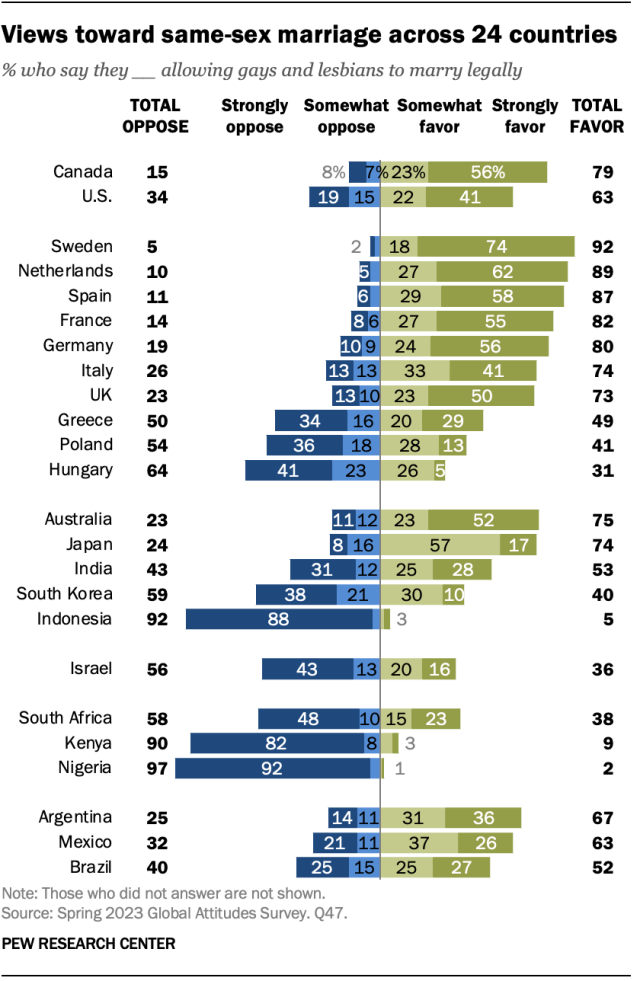
According to a Pew Research survey this spring of 24 countries, Japanese people have a 74% acceptance rate of same-sex marriage. This is not reflected in the Diet legislation.
Saturday, June 3, 2023
What did the G7 achieve?
A World Still with Nuclear Weapons
By Takuya Nishimura, Editorial Writer, The Hokkaido Shimbun
The views expressed by the author are his own and are not associated with The Hokkaido Shimbun
May 22, 2023
As the chair of the Group of Seven (G7) Hiroshima Summit, Japanese Prime Minister Fumio Kishida stated that he would use the summit to pave the way to “a world without nuclear weapons.” Although the Leaders’ Communiqué did include those specific words, the G7 leaders did not provide a way to implement of this goal. This leaves one wondering what Kishida did achieve with this high-profile international engagement.
The document for nuclear disarmament, called the Hiroshima Vision on Nuclear Disarmament, was issued a day before the Communiqué. It unequivocally declared the indispensability of nuclear weapons in the context of nuclear deterrence. The G7 thus continue to contemplate a world where nuclear weapons still exist. Those who suffered the nuclear bombs, or the Hibakusha, in Hiroshima and Nagasaki were deeply disappointed by how ineffective Kishida had been.
While underscoring the importance of the 77-year record of non-use of nuclear weapons, the Hiroshima Vision firmly accuses Russia of its “irresponsible nuclear rhetoric, undermining of arms control regimes, and stated intent to deploy nuclear weapons in Belarus.” With these and other strong words denouncing Russia’s rhetoric, the Vision statement follows: “Our security policies are based on the understanding that nuclear weapons, for as long as they exist, should serve defensive purposes, deter aggression and prevent wars and coercion.”
This document, made under the leadership of Kishida, conditionally recognized the role of nuclear weapons without showing any clear roadmap to the world without nuclear weapons. The G7 fundamentally reject the work of Hibakushas. Coming through hardships of losing loved ones, being threatened by the fear of cancer, or discrimination from the fellow citizens, Hibakushas define nuclear weapons as “absolute evil” that kill too many people immediately. Their use can never be justified.
The Hiroshima Vision ironically justifies nuclear weapons as a countermeasure to Russian aggression in Ukraine and nuclear saber-rattling. Thus, to 91-year-old atomic bomb survivor, Setsuko Thurlow, the G7 Summit was a “huge failure,” as stated in her press conference on Sunday, May 21. The International Campaign to Abolish NuclearWeapons (ICAN), the 2017 Nobel Peace Prize winner, stated that the G7 fell “far short of providing any meaningful outcomes for nuclear disarmament.”
Mostly ignoring the backlash from the Hibakushas, Kishida said at his post-summit press conference that he was satisfied with the outcome of the G7 Hiroshima Summit. “We shared an ideal for the future of the world without a nuclear weapon.” Recognizing appeals from nuclear-suffered cities, Kishida considers Hiroshima Vision the basis for future actions to attain a world without nuclear weapons. Kishida viewed the visit of Ukrainian President Volodymyr Zelenskyy to Hiroshima as a chance to deliver further a message against threats to use nuclear weapons.
Although the G7 Summit was a stage to show that the G7 leaders stand together with Zelenskyy and to condemn Russia for its aggression against international law and order, inviting the Ukrainian president at war nevertheless was questionable. Hiroshima’s significance is as a place once devastated by a nuclear weapon and of the Hiroshima people’s hope for unconditional peace, not war at any cost.
After laying flowers at the cenotaph to A-bomb victims, Zelenskyy reflected that “Photographs of ruins of Hiroshima absolutely remind me of Bakhmut and other similar settlements.” For the people in Hiroshima who believe in the principle of “war is not the answer,” the sympathetic comment of Zelenskyy might have brought a sense of discomfort to them.
Obviously, Zelenskyy’s purpose in visiting Hiroshima was to continue and win the war with as much support as possible from the G7. U.S. President Joe Biden told Zelenskyy that the US would start training Ukrainian pilots to fly F-16 fighter jets. In a bilateral meeting with Zelenskyy, Indian Prime Minister, Narendra Modi, who is regarded as a key for anti-Russia groups to reach the countries called “global south,” conveyed his clear support for dialogue and diplomacy to find a way forward. Hiroshima had become the place where world leaders were seen deeply engaged in Ukraine’s war strategy.
For Kishida who has been promoting his positive pro-active security policies, the appearance of the Ukrainian president must have been a good opportunity to trumpet the “success” of policies to domestic audiences. In the meeting with Zelenskyy, Kishida pledged Japanese assistance by sending trucks and provisions and accepting injured Ukrainian military personnel in the Self-Defense Forces Central Hospital in Tokyo. The Kishida administration is likely to insist that current budget request for security measures or positive involvement in maintaining world order has been necessary.
In terms of dealing with China’s advances in Asia-Pacific region, the G7 summit produced some positive outcomes. Zelenskyy’s attendance reinforced the ties of democratic nations. In the outreach meeting attended by the G7 leaders, eight guests and Zelenskyy, Kishida stressed that coercive and unilateral change of status quo would not be tolerated anywhere in the world. It is necessary, he said, to protect free and open world order based on the rule of law.
The G7 Leaders’ Communiqué, in contrast to its message to Russia, was toward China, calling on engagement with G7 and recommending “de-risking” for economic resilience instead of decoupling from China. Yet, the leaders of four major powers in the Asia-Pacific region, Japan, United States, India, and Australia (meeting as the quadrilateral security dialog or QUAD), also issued a statement that opposed “destabilizing or unilateral actions that seek to change the status quo by force or coercion,” a suggestion that a Chinese invasion of Taiwan would be unacceptable.
Inevitably, Japan will have to deal with further pressure from China. Kishida’s inability to make progress on nuclear disarmament among his peers at the G7 Summit does not engender much confidence on how well he can pursue this. To date, Kishida has yet to offer a concrete vision for a meaningful dialogue with China. By following along with the G7's support of Ukraine and deterrence, Kishida set aside Japan's priority to stabilize the situation in Northeast Asia. China reacted against the G7 Communique with "strong dissatisfaction." It is possible that Kishida has raised the tension in Northeast Asia by introducing the structure of hostility in the Eastern Europe.
Monday, April 24, 2023
Kishida's non-surprise
The Not Surprising Visit
But was it constitutional?By Takuya Nishimura, Editorial Writer, The Hokkaido Shimbun
The views expressed by the author are his own and are not associated with The Hokkaido Shimbun
April 3, 2023
News organizations in Japan reported with sensational headlines the visit of Prime Minister Fumio Kishida, as the chairman of Group 7, to the capital of Ukraine. At the time the Russian invasion was showing signs of a quagmire, and Western support was indispensable. In the meeting with Volodymyr Zelenskyy, Kishida pledged multiple forms of assistance to support Ukraine its historic conflict to maintain democratic ties in the world.
The real surprise of the visit was that most people in Japan, known as a nation whose constitution adopts strict pacifism, approved of his visit to the place where an actual war was being waged. The Japanese people appear to be accustomed to the real world that is confused by unilateral Russian aggression to Ukraine.
Prime Minister Kishida’s visit has at least one precedent. In 2003, the Koizumi Administration decided to support U.S. President George W. Bush’s “War on Terror” by sending Japanese Self-defense Forces to Samawah, Iraq. This decision led to a broad argument whether the forces’ activities would be made only within the non-combat zone. Sending the forces to a combat zone was recognized as a violation of the constitution of Japan, which renounces war as a measure of settling international conflicts. When the Ministry of Defense disclosed in 2018 the official records of SDF activities in Iraq, the opposition parties accused the government of breaching the constitution, because the description included the word “combat” around the camp.
A similar question arises here: is the PM's visit to the combat zone constitutional? As long as Kyiv was exposed to Russian missile or drone strikes, it could be said that Kishida's visit was made in the combat zone. The PM commands and controls the Self-defense Forces under Article 7 of the Self-defense Forces Act. Even though actual troops did not accompany him, Kishida’s visit means that Japan's supreme commander is not neutral in the conflict and is supporting one of the combatants that is engaged in a war (as is its enemy) as a measure of settling an international conflict.
However, the legitimacy or implications of the PM’s visit was not discussed in Japan. It is likely that the unjust invasion by the Russians offset the uncertain constitutionality of Kishida’s visit to a country at war. And, maybe, accepting the responsibilities of being a G7 country.
During the visit, both leaders delivered a joint statement on “the special global partnership” between Japan and Ukraine. The statement denounced Russia for its baseless aggression against Ukraine, declared that Russia’s threat to use nuclear weapons was unacceptable, and increased the G7 commitment to $39 billion for fiscal and economic support of Ukraine. The leaders also shared serious concerns on the situation in the East and South China Seas. Zelenskyy pronounced Kishida a protector of Ukraine and international order and accepted Kishida’s invitation to G7 Hiroshima Summit in May (Zelenskyy will attend virtually.) Before the meeting, Kishida visited the city of Bucha where Russian troops had massacred Ukrainians, and displayed solidarity with the people of Ukraine.
Among the reasons why there were no active arguments on the constitutionality of the visit is that Kishida has maintained from the beginning a relatively firm position against the Russian invasion. The Japanese people could easily understand the visit as a diplomatic activity. Indeed, Kishida was the last leader among G7 nations to visit the capital of Ukraine after he had received an invitation from Zelenskyy in a telephone conversation in January. The surprise visit was therefore not surprising for Japanese people.
One possible negative aspect of the visit is the impact on Japan’s relationship with China. On the same day that Kishida met with Zelenskyy in Kyiv, Chinese President Xi Jinping was in Moscow in talks with Putin. Thus, two leaders of major powers in Asia were visibly standing on opposite sides of a war. A spokesperson for Foreign Ministry of China said that China hoped Japan would help settle the conflict in Ukraine rather than to do the opposite. It is obvious that Kishida has more diplomatic work to do in terms of managing Japan’s relationship with China, as the day of G7 Summit meeting in Hiroshima is approaching.
Saturday, April 22, 2023
Rescinding Japan's War Apology
What Will Kishida Say on August 15 at Japan’s National Memorial Ceremony for the War Dead?
Kishida has an opportunity to demonstrate his independence now that Abe is gone. Will he return to the legacy of the Murayama statement?
By Mindy Kotler, Asia Policy Point
The Diplomat, August 13, 2022
What Will Kishida Say on August 15 at Japan's National Memorial Ceremony for the War Dead?
In the immediate aftermath of former Prime Minister Abe Shinzo’s murder, Japan’s current leader Kishida Fumio promised to honor Abe’s legacy by building upon his accomplishments. The reportedly more liberal Kishida, however, came to power expected to do the opposite and dial back some of his predecessor’s more provocative stances. His room to maneuver was limited, however, by the ruling Liberal Democratic Party’s right wing and Abe’s own constant public hectoring on hewing to the course.
With Abe’s untimely death, Kishida has an opportunity to demonstrate his independence. The first indication of a new course may come with his August 15 address at the National Memorial Ceremony for the War Dead.
A crucial objective of Abe’s two terms was the freeing of Japan from “masochistic” history. This odd expression was a call to arms advocating both amending the U.S.-imposed “mind-control” constitution and ending Japan’s war apology diplomacy. Although constitutional amendment was not accomplished, the latter objective has been achieved.
Abe led an aggressive campaign to reconstruct history and monitor its telling at home and aboard. Diplomats asked the governments of the Philippines and Germany to remove statues memorializing the “comfort women” and other victims of sexual violence. Abe ordered the creation of commissions questioning the legitimacy of Japan’s 1995 official war apology, known as the Murayama statement, and the 1993 provisional apology to the comfort women, known as the Kono statement. (Here it should be noted that this particular statement is no longer prominently noted on the Foreign Ministry’s webpage explaining their position regarding the comfort women. Instead, it is buried in another document and only the knowledgeable and persistent can find it.)
Cabinet level officials squired applications for UNESCO World Heritage recognition of culturally dubious and politically fraught sites. One was an island shrine inaccessible to women. Another glorified Japan’s industrialization while disregarding the troubled use and abuse of convicts, the underclasses, children, Koreans, Chinese, and prisoners of war. Government promises to UNESCO to include this missing history have not been kept.
The Foreign Ministry was pressed into defending false history in an amicus brief to the U.S. Supreme Court, scrubbing its website of historical documents containing embarrassing details, and asking the public to report historical narratives contradicting the new official positions. The Abe government used budget allocations to hire public relations firms and amateur historians to cast doubt on widely respected historians.
In talks with the Park Geun-hye administration in South Korea seeking to resolve the disagreements over the proper means of recognizing the dignity of the comfort women, the Abe government resorted to an unprecedented diplomatic diversion. Despite announcing an “agreement,” the 2015 comfort women talks resulted in two competing unsigned memoranda distributed at a “Joint Press Occasion.” The Japanese memorandum, in particular, contains an impossible demand that “this issue is resolved finally and irreversibly.” The “Press Occasion” document was furthermore not Cabinet approved, unlike every other diplomatic agreement the government of Japan has ever announced.
The crowning moment of Abe’s revisionism was his 2020 August 15th address at the National Memorial Ceremony for the War Dead. His remarks were the culmination of a seven-year effort to completely revise, if not indeed rescind, the 1995 Murayama statement, the cabinet-approved apology for World War II released by Prime Minister Murayama Tomiichi. Until Abe, the Murayama statement was the template for all Japanese apologies. The 2020 statement, however, had many of Murayama’s key phrases removed. The new statement was not an apology to Japan’s victims. Instead, it paid tribute to the Japanese people for their resilience.
As early as 2013, on August 15, Abe stopped expressing his “deep remorse” and “heartfelt apology.” He replaced “colonial rule and aggression” in the Murayama statement with the milder “Japan took the wrong course and advanced along the road to war” causing “immeasurable damage and suffering.” The main focus shifted away from Japan’s victims to turning the war into a positive transformation where “the peace and prosperity that we now enjoy have been built upon the sacrifices of you who gave up your precious lives.” And the four mentions of unfortunate history in the Murayama statement were reduced to just one promising blandly to “face history with humility and engrave deeply into our hearts the lessons that we should learn.”
Abe tried to codify these changes with a Cabinet-approved statement issued the day before the 2015 August 15th memorial. He explained that his Advisory Panel on the History of the 20th Century and on Japan’s Role and the World Order in the 21st Century had reevaluated Japan’s post-war period. The conclusion was that today’s Japanese are not “predestined to apologize.” Instead, “Japanese, across generations, must squarely face the history of the past” only because the peace enjoyed today “exists only upon such precious sacrifices” that are “the origin of postwar Japan.”
Abe’s last memorial statement was in 2020 for the 75th anniversary of Japan’s surrender ending World War II. It made no reference to history or remorse at all. The pledge to take “the lessons of history deeply into our hearts” vanished. In its place, Abe introduced a new, “forward-looking” phrase – that Japan was ready to make a “proactive contribution to peace.”
In 2021, Prime Minister Suga Yoshihide substantially repeated Abe’s 2020 reconstruction of Japan’s war apology. History remained now only with the Japanese. Like his predecessor, Suga insisted that the lesson learned from WWII was “We will not forget, even for a moment, that the peace and prosperity we enjoy today was built atop the precious lives and the history of suffering of the war dead. I express my deepest respect and gratitude once more.”
Come August 15, Kishida has a decision to make. He can choose to accept Abe’s unrepentant, nationalistic war remembrance. This would of course please the Abe faction and revisionist pressure organization Nippon Kaigi, whose legislative wing includes Kishida and most of the members of his new Cabinet.
Or Kishida, a legislator from Hiroshima, can reassert the centrality of the Murayama statement and the honest, forthright contrition it represents. If he does so, he would send a powerful signal to South Korea and Imperial Japan’s other victims that Japan is willing to confront its dark history.
UPDATE: August 15, 2022
On August 15th, Japan’s Prime Minister Fumio Kishida repeated Abe's unrepentant statement remembering, but not apologizing for WWII. With his statement, Kishida completed the undoing of the Murayama Statement of apology and remorse.
Kishida largely focused on the damage Japan suffered on its Home Islands — the U.S. atomic bombings on Hiroshima and Nagasaki, the massive fire-bombings across Japan, and the bloody ground battle on Okinawa. He said the peace and prosperity that the country enjoys today is built on the suffering and sacrifices of those who died in the war. The Japanese, he like Abe implied, were the victims. There was no mention of the harm Imperial Japan inflicted upon others. He repeated Abe's pledge for Japan to make "Proactive Contribution to Peace," which implies military involvement in upcoming world conflicts.
Kishida did, however, return to the August 15th statement a mention of history, however stopping short of actually learning from it: "Taking the lessons of history deeply into our hearts."
Sunday, March 19, 2023
Abe Government's War on the Press
Biased Pressure on Broadcasters
By Takuya Nishimura, Chief Editorial Writer, The Hokkaido Shimbun
The views expressed by the author are his own and are not associated with The Hokkaido Shimbun
March 12, 2023
It should be pointed out that the former administration led by Shinzo Abe did not fully understand what democracy was. Last week, a lawmaker from the main opposition party revealed a document that described attempts by Abe's colleagues to pressure broadcasters that they thought were biased against the administration. While the minister who was in charge of the issue argued that the document was fabricated, the ministry admitted it as authentic. It is highly strange that a minister denies the truthfulness of a ministry’s document. But the point is not about whether it was true or not, but whether the Abe administration tried to oppress the freedom of expression.
A member of the House of Councillors, Hiroyuki Konishi, exposed a document of the Ministry for Internal Affairs and Communications that indicated that the Abe administration tried to change the interpretation of the Broadcasting Act on political impartiality. Article 4 of the law requires every broadcaster to be politically impartial in producing the programs and the government had been interpreting the provision as applied to the broadcasting station's programs as a whole. According to the revealed document, an adviser to the prime minister, Yosuke Isozaki, in a meeting with the officials of the ministry in 2014, questioned that interpretation and argued that there were obviously inappropriate cases among actual broadcasting programs.
The meetings on the interpretation were consecutively held and some secretaries of the Prime Minister's Office often joined. In one meeting in 2015, a secretary warned Isozaki that if the government, which had the authority to stop the broadcasting wave, would assess political impartiality by only one program, it might be an oppression of freedom of speech. Not only Isozaki, however, then Prime Minister Abe was willing to review the interpretation to make things straight, arguing he would be right to say no to some extreme programs. Among the programs discussed in the series of meetings, there were Sunday Morning and News 23 of TBS or Hodo Station of TV Asahi.
"Is there any unbiased program in TV Asahi, anyway?" was the words of Sanae Takaichi, Minister for Internal Affairs and Communities at the time, in a meeting. She was willing to answer the questions on revising the interpretation in Diet discussion, expecting positive support from Prime Minister Abe. After the documents including those exchanges were revealed, Takaichi, the current Minister in charge of Economic Security, immediately denied the description and dismissed her conversation as fabricated.
Asked whether she would resign as the minister and lawmaker if the documents were found not to be fabricated, she said "Very well." But, a few days later, the documents were acknowledged as made in the ministry. There appeared a great contradiction that the head of the ministry denied the credibility of documents made by the ministry officials, because every policy delivered by the minister would be based on such documents.
Takaichi still insists that the description in the documents was incorrect and refused to resign. It is possible that she hoped the ministry would protect her by admitting their fabrication, as the Ministry of Finance did for Abe by admitting manipulation of internal documents on the Moritomo scandal in 2018. Upon refusing to resignation, she apologized for the incorrectness of the documents under her leadership.
What we can see in the documents is an amazing fact that Abe's colleagues believed that they could, with the approval of Abe, pressure the broadcasters they didn't like. Abe had been a politician who had a tendency of intolerance of criticisms against him and showed little hesitation in blaming news organizations skeptical of him. That kind of approach reminds of the oppression of the Hong Kong media by the Xi Jinping administration of China or the strong grip on the media by Vladimir Putin in Russia. What is biased is such a kind of politics. It might be inappropriate for Japan to advise some foreign countries to share common values of freedom of speech, rule of law and human rights.
Monday, February 6, 2023
Asia History Events February 2023
KENNAN: A LIFE BETWEEN WORLDS. 2/6, 4:00-5:30pm (EST), ZOOM. Sponsor: Washington History Seminar, Wilson Center. Speaker: author, Frank Costigliola, University of Connecticut; Beverly Gage, Yale University; Barbara Keys, Durham University.
PURCHASE BOOK: https://amzn.to/3x0u18J
PERFORMATIVE RECOLLECTION AND PARALLAX MEMORY: PERPETRATOR AND VICTIM WAR MEMORY IN CONTEMPORARY JAPANESE VIDEO ART DESCRIPTION. 2/8, 5:00-7:00pm (GMT), HYBRID. Sponsor: SOAS Japan Research Centre. Speaker: Ayelet Zohar, Tel Aviv University.
PRISONERS OF THE ASIA-PACIFIC WAR: HISTORY, MEMORY, AND FORGETTING. 2/7, JAPAN 4:00-7:30pm (JST), 2/8, 9:00am-5:00pm (JST); US EAST COAST 2/7, 2:00-5:30am (EST), 2/7 7:00-10:30pm (EST). ZOOM. Sponsor: Kyoto University and JSPS (Japan Society for the Promotion of Science). This symposium brings together scholars researching the histories, memorialization and forgetting of prisoners and prison camps of the Asia Pacific War. Speakers include: Robert Cribb, Australian National University; Sarah Kovner, Columbia University; Anoma Pieris, Melbourne University; Taeko Sasamoto, POW Research Network, Japan. Organizer: Daniel Milne, Kyoto University. [THIS CONFERENCE WILL NOT BE RECORDED]
THE 30 ANNIVERSARY OF WASHINGTON COALITION FOR COMFORT WOMEN ISSUES: CELEBRATING THE LEGACY OF COMFORT WOMEN. 2/7, 11:00am–1:00pm (EST). IN PERSON ONLY, 2168 Rayburn House Office Building (The Gold the Room). Speakers: Margaret Stetz, Professor of Humanities at the University of Delaware; Yangmo Ku, Associate Director of the
Peace and War Center at Norwich University; Bonnie Oh, Georgetown University Emeritus; Dennis Halpin, former staff member of the House Foreign Affairs Committee. Screening of a clip from the documentary: Cry Out: The 30 Years of Comfort Women Redress Movement, Written and Directed by Professor Jungsil Lee, George Washington University.
PURCHASE BOOK: https://amzn.to/3WN9jUB
2/14, 5:00-6:00pm (JST), 3:00-4:00am (EST), 12:00-1:00am (PST). IN PERSON ONLY. Sponsor: Temple University Japan. SPEAKERS AND POW PROFILES. [THIS CONFERENCE MIGHT NOT BE RECORDED]
MILITARY HISTORY FOR THE MODERN STRATEGIST: AMERICA’S MAJOR WARS SINCE 1861. 2/15, 6:30-7:30pm (EST), IN-PERSON AND ONLINE. Sponsor: New-York Historical Society. Speakers: Author Michael E. O’Hanlon, Phil Knight Chair in Defense and Strategy at Brookings; Moderator: General David H. Petraeus (U.S. Army, Ret.), Commander of coalition forces during the Surges in both Iraq and Afghanistan and Former Director of the CIA.
PURCHASE BOOK: https://amzn.to/3XyOjRX
THE GENERAL VS. THE PRESIDENT: MACARTHUR AND TRUMAN AT THE BRINK OF NUCLEAR WAR. 2/16, Noon (EST), LIVE WEBCAST. Sponsor: Korea Society. Speaker: author, Dr. Henry W. Brands, Professor and Jack S. Blanton Sr. Chair in History at the University of Texas at Austin.
PURCHASE BOOK: https://amzn.to/3HGDSXr
IMPERIAL GATEWAY: COLONIAL TAIWAN AND JAPAN’S EXPANSION IN SOUTH CHINA AND SOUTHEAST ASIA, 1895-1945. 2/24, 4:30PM (EST), IN PERSON ONLY. Sponsor: Sigur Center, GW. Speaker: author, Seiji Shirane, Assistant Professor of Japanese History, City College of New York.
PURCHASE BOOK: https://amzn.to/400aHFW
Monday, January 30, 2023
Monday January 30, 2023 Event on Asia

WESTERN AID FOR THE WAR IN UKRAINE AND RUSSIAN MILITARY SHAKE-UP. 1/30, 10:00am (EST), ONLINE. Sponsor: Washington Post Live. Speaker: Gen. David H. Petraeus (U.S. Army, Ret.), Partner, KKR & Chair, KKR Global Institute.
BEFORE THE WEST. 1/30, Noon-1:30pm (EST), IN-PERSON AND ZOOM. Sponsor: American University School of International Service (SIS). Speakers: Author Dr. Ayse Zarakol, Professor of International Relations at the University of Cambridge, Before the West: The Rise and Fall of Eastern World Orders; Amitav Acharya, SIS; Yang Zhang, SIS; Moderator: Ji-young Lee, SIS.
PURCHASE BOOK
PURCHASE BOOK
BLINKEN’S TRIP TO BEIJING: U.S.–CHINA RELATIONS AT A CROSSROADS. 1/30, Noon-1:00pm (EST), ZOOM WEBINAR. Sponsor: Quincy Institute. Speakers: Michael Swaine, Senior Fellow, Quincy Institute’s East Asia Program; Kendra Schaefer, Head of Tech Policy Research at Trivium China; and Michael Davidson, Assistant Professor, UC San Diego School of Global Policy and Strategy and Jacobs School of Engineering; Moderator: Jake Werner, Research Fellow in the Quincy Institute’s East Asia Program.
BUCHA AFTER RUSSIAN OCCUPATION: BUCHA’S MAYOR ON THE DESTRUCTION OF HIS CITY AND HOPES FOR THE FUTURE. 1/30, 12:30-1:30pm (EST), IN-PERSON AND ONLINE. Sponsors: Kennan Institute, Wilson Center; Global Europe Program, Wilson Center. Speakers: Anatolii Fedoruk, Mayor of Bucha, Ukraine; Ambassador Mark Green, President, Director, & CEO, Wilson Center; Mykhailyna Skoryk-Shkarivska, Deputy Mayor, Bucha City Council; Robin S. Quinville, Director, Global Europe Program; Moderator: Brock Bierman, CEO, Ukraine Friends.
CHINA’S TECHNO-DEVELOPMENTAL STATE: ACHIEVING THE FUTURE. 1/30, 5:30-7:00pm (AEDT), IN-PERSON AND ONLINE. Sponsor: Australian Centre on China in the World, Australian National University. Speakers: Rogier Creemers, Assistant Professor, Leiden University.
A SOUTH KOREAN NUCLEAR PROGRAM? ASSESSING THE RISKS. 1/30, 7:00-8:30pm (EST), ONLINE. Sponsor: 38 North Program, Stimson. Speakers: Siegfried S. Hecker, Distinguished Professor of Practice, James Martin Center for Nonproliferation Studies; Robert Gallucci, Distinguished Professor, Georgetown University School of Foreign Service; Jamie Kwong, Fellow, Nuclear Policy Program, Carnegie Endowment for International Peace; Moderator: Jenny Town, Senior Fellow, Stimson Center and Director, 38 North.
BUCHA AFTER RUSSIAN OCCUPATION: BUCHA’S MAYOR ON THE DESTRUCTION OF HIS CITY AND HOPES FOR THE FUTURE. 1/30, 12:30-1:30pm (EST), IN-PERSON AND ONLINE. Sponsors: Kennan Institute, Wilson Center; Global Europe Program, Wilson Center. Speakers: Anatolii Fedoruk, Mayor of Bucha, Ukraine; Ambassador Mark Green, President, Director, & CEO, Wilson Center; Mykhailyna Skoryk-Shkarivska, Deputy Mayor, Bucha City Council; Robin S. Quinville, Director, Global Europe Program; Moderator: Brock Bierman, CEO, Ukraine Friends.
LESSONS FROM THE RUSSO-UKRAINE WAR AND ITS U.S.-CHINA CONFLICT APPLICATION. 1/30, 5:00-6:00pm (EST), IN-PERSON ONLY. Sponsor: Institute of World Politics. Speaker: Mr. Robert Roseberry, IWP M.A. Candidate for Strategic Intelligence Studies.
EUROMISSILES: THE NUCLEAR WEAPONS THAT NEARLY DESTROYED NATO. 1/30, 4:00pm (EST), ONLINE. Sponsors: American Historical Association; Wilson Center. Speakers: Author Susan Colbourn, Associate Director, Program in American Grand Strategy, Duke University; Giordana Pulcini, Global Fellow, Wilson Center's Nuclear Proliferation International History Project; Aaron Bateman, Assistant professor of history and international affairs, George Washington University.
PURCHASE BOOK
EUROMISSILES: THE NUCLEAR WEAPONS THAT NEARLY DESTROYED NATO. 1/30, 4:00pm (EST), ONLINE. Sponsors: American Historical Association; Wilson Center. Speakers: Author Susan Colbourn, Associate Director, Program in American Grand Strategy, Duke University; Giordana Pulcini, Global Fellow, Wilson Center's Nuclear Proliferation International History Project; Aaron Bateman, Assistant professor of history and international affairs, George Washington University.
PURCHASE BOOK
CHINA’S TECHNO-DEVELOPMENTAL STATE: ACHIEVING THE FUTURE. 1/30, 5:30-7:00pm (AEDT), IN-PERSON AND ONLINE. Sponsor: Australian Centre on China in the World, Australian National University. Speakers: Rogier Creemers, Assistant Professor, Leiden University.
A SOUTH KOREAN NUCLEAR PROGRAM? ASSESSING THE RISKS. 1/30, 7:00-8:30pm (EST), ONLINE. Sponsor: 38 North Program, Stimson. Speakers: Siegfried S. Hecker, Distinguished Professor of Practice, James Martin Center for Nonproliferation Studies; Robert Gallucci, Distinguished Professor, Georgetown University School of Foreign Service; Jamie Kwong, Fellow, Nuclear Policy Program, Carnegie Endowment for International Peace; Moderator: Jenny Town, Senior Fellow, Stimson Center and Director, 38 North.
Subscribe to:
Posts (Atom)