Thursday, April 11, 2013

Outlook for the Abe Cabinet


On February 28, APP member Michael Cucek, who writes the Shisaku blog on Japanese politics, gave an analysis of the early successes of the Abe Cabinet to Temple University's Institute of Contemporary Asian Studies (ICAS) in Tokyo that is headed by APP member Robert Dujarric. Cucek reviews the carefully choreographed and sophisticated politics of Abe's first moves. 

He is impressed by Abe's new ability at stage-managing appointments, especially that the of new Bank of Japan president. Cucek was stunned by the passage by of the supplemental budget, which should have been rejected by the House of Councilors. Instead, Abe cobbled together a victory with a deft dealing of favors and promises to even the most adamant opposition that ended in destroying a number of small parties. This clever ploy was not expected of Abe from his past performances.

Cucek predicts, as others, that the LDP will sweep the July Upper House elections. The Abe Cabinet has maintained an unusual popularity to which Chinese and North Korean provocations have contributed.

What could go wrong for Abe? 1. A reversal of market sentiment; 2. Scandals; 3. International incident; 4. Internal dissension; 5. Policy overreach; 

What could go right? 1. DPJ remains in disarray; 2. Neither Ishihara nor Hashimoto can touch Abe's rightwing credentials; 3. a proper policy mix--here Cucek points points out Abe's oft-called pragmatism. Economics of the extreme left while playing on a fear of change in Asia. The Japanese people have come around to accepting Abe's belief in the importance of a more robust military presence. They have not come to this way of thinking because of any rightward shift in thinking or by "coming home" to Abe's radical path to a pre-1945 glory. They have done so because the world is a dangerous place. 4. focusing on wanting to win the Upper House elections.

Cucek concludes that Abe will do well over the next few months, win the July Upper House elections, and then will visit Yasukuni in August as he needs to be true to himself.

Prime Minister of Japan's Schedule Feb 18-March 10, 2013


February 18, 2013 (Mon)

AM

07:12 Office
07:14 Mr. Sekou, Deputy Chief Cabinet Secretary
08:29 Mr. Sekou leaves
08:52 Parliament
09:00 The Upper House Budget Committee
11:58 Office

PM
12:02 Mr. Kishida, Foreign Minister
12:20 Mr. Kitamura, Director of Cabinet Intelligence
12:52 Parliament
01:00 The Upper House Budget Committee
05:34 LDP Executive Officers’ Meeting
05:57 Office
06:17 Mr. Komura, LDP Vice President
06:56 Industrial Competitiveness Council
07:50 The Imperial Hotel, Dinner with Ms. Noda, LDP General Affairs Chief; Mr. Nikai, Deputy Chief; and Mr. Kaneko
09:00 Home in Tomigaya, Tokyo

February 19, 2013 (Tue)

AM

07:15 Office
07:17 Mr. Sekou, Deputy Chief Cabinet Secretary
08:19 Mr. Sekou leaves
08:22 Parliament
08:27 Ministerial meeting
09:00 The Upper House Budget Committee
11:57 Office

PM
12:32 Mr. Masset, Ambassador of France
12:53 Parliament
01:00 The Upper House Budget Committee
05:28 Office
05:35 Mr. Kitamura, Director of Cabinet Intelligence
06:07, Mr. Katou, Mr. Sekou, and Mr. Sugita, Deputy Chief Cabinet Secretaries
06:31 Mr. Keiichi Hayashi, Ambassador for UK, and others who attend European Ambassadors’ Meeting
06:55 Mr. Kawai, Administrative Vice Foreign Minister; Mr. Saiki, Deputy Foreign Minister, Mr. Hiramatsu, Director General, General Foreign Policy Bureau; and Mr. Ihara, Director General, North American Affairs Bureau
07:32 Dinner with Ms. Seiko Noda, LDP General Affairs Chief; Ms. Yuriko Koike, LDP PR Chief; and others at Restaurant Voie Lacte in Toranomon, Tokyo
07:57 Dinner with Mr. Tsuyoshi Iwaya, Yoshio Mochizuki, and other LDP Lower House members, in Japanese Restaurant Ori Ori, in Akasaka, Tokyo
09:24 Home in Tomigaya

February 20, 2013 (Wed)

AM

07:29 Office
07:30 Mr. Sekou, Deputy Chief Cabinet Secretary
08:49 Mr. Sekou leaves
08:54 Parliament
09:00 The Upper House Budget Committee
11:59 Office

PM
12:10 Mi Yin Wei, Former Myanmar Students Association in Japan President
12:54 Parliament
01:00 The Upper House Budget Committee
05:07 Office
05:08 Mr. Manago, Administrative Vice Finance Minister; Mr. Nakao, Director General, Finance Bureau; Mr. Yamazaki, Director General, International Bureau
05:31 Mr. Sugita, Deputy Chief Cabinet Secretary
06:09 Mr. Kato and Mr. Sekou, Deputy Chief Cabinet Secretaries; Mr. Saiki, Deputy Foreign Minister; Mr. Ihara, Director General, MoFA North American Affairs Bureau; Mr. Nakao, Director General, MoF Finance Bureau; and Mr. Ueda, Director General, METI Trade and Commerce Policy Bureau
06:35 All leave
07:16 Interview with Asahi Shimbun
08:15 Home in Tomigaya

February 21, 2013 (Thu)

AM

09:23 Office
09:24 Mr. Minamigawa, Administrative Vice Environment Minister; and Mr. Suzuki, Environment Ministry Secretary
09:57 Mr. Kishida, Foreign Minister; Mr. Kawai, Administrative Vice Foreign Minister; Mr. Saiki, Deputy Foreign Minister; Mr. Hiramatsu, Director General, MoFA, General Foreign Policy Bureau; Mr. Ihara, Director General, MoFA, North American Affairs Bureau; and Mr. Nishi, Director General, MoD Policy Bureau
10:13 Mr. Nishi leaves
11:10 All leave

PM
12:00 Mr. Ishiba, LDP Secretary General
12:45 Mr. Yamaguchi, President of New Komei Party; Ruling Party Leaders’ meeting; Mr. Ishiba and Mr. Inoue, Secretary Generals of each party, also attend
01:10 Mr. Saiki, Deputy Foreign Minister
01:56 Mr. Yamamoto, Minister of State for Science and Technology Policy
02:20 Mr. Yamamoto leaves
05:02 Press interviews
05:25 Haneda Airport
05:51 Leave the airport for the United States; Foreign Minister Kishida accompanies

February 22, 2013 (Fri) Visits the United States
(Local time February 21 PM)
Arrive at Andrews AFB
Stay in the Blair House (Guest House) in DC

(Local time February 22) AM
Lay wreath in the Arlington National Cemetery

February 23, 2013 (Sat) Visits the United States
(Local Time February 22)PM

Meeting with President Obama in the White House.
Press interview with President Obama
Lunch hosted by President Obama
Policy speech at CSIS
Press conference at Hotel Renaissance Washington.
Reception at Hotel Willard Intercontinental
Dinner at Ambassador’s Residence
Stay in the Blair House

Wednesday, April 10, 2013

Using belligerence to forget


On April 8th,  U.S. Deputy Secretary of Defense Ashton Carter gave a speech to CSIS outlining American military capabilities and plans in the Indo-Pacific region. [TRANSCRIPT] He emphasized that "U.S. interests in the region are enduring, and so also will be our political and economic presence." Five times "enduring" was mentioned in the speech.

He justified American presence in the region as a responsibility accompanied by values worth defending:
I'm more accustomed to listening to people question why the U.S. spends more on defense than the next 16 largest militaries in the world combined. This statistic is true and won't change much in coming years. It's also worth noting that most of the rest of the money that the world spends on defense is spent by countries that are allies and friends of the United States. These levels of defense spending are a reflection of the amount of responsibility that the U.S. and its friends and allies share for providing peace and security.
It was not, however, until nearly the last question in the Qs&As that he said something substantive about Japan. Australian National University Professor Rikki Kersten asked "how important is it for Japan to embrace collective self-defense for the American rebalancing to work effectively" [53.09 in the video above].

He responded that it would be very constructive for Japan to open the way to exercising its right to collective self-defense. "Japan's increasing awareness of their own abilities, their own capabilities and their increasing freeing of themselves from the strictures they imposed upon themselves some decades ago...is a constructive thing. They're doing that with respect to arms exports, with respect to the kinds of activities that they are willing to engage in internationally," he said, adding that "I think that's a good thing."

But then he added something unexpected. He implied that the militarily stronger Japan would supersede regional hesitations about trusting Japan. And this is the strategy that the U.S. is encouraging Japan to pursue.
It's part of the U.S.-assisted, if I may be so bold, process of healing and putting history behind in that part of the world. It gives Japan the opportunity to play a role that it can, which is a very constructive one around the world in security affairs. They are already involved in counter-piracy activities,  maritime domain awareness, and so forth. These are areas where the world has a need, and if Japan can be a part of fulfilling that need,  that is good for everyone.
This answer startled many. What exactly is the Defense Department doing to help Japan address its history of aggression and unhealed wounds? And how is this expected to encourage Japan's neighbors to welcome the country's more overt military presence? And does this mean that the United States will be signing on to Prime Minister Abe's constitutional change campaign?

Later: As reported by Kyodo in the Japan Times, April 9th.

Tuesday, April 9, 2013

Abenomics - Seminar


with

Richard Katz 
APP Member 

April 11, 4:30-6:00pm 
Washington, DC 

Sponsor
Reischauer Center for East Asia Studies
SAIS, Johns Hopkins

National Former POW Recognition Day

In 2009, President Barak Obama proclaimed April 9th to be National Former POW Day. This is an especially historic day for American and Filipino POWs of Japan.

On April 9, 1942, after four months of brutal fighting against a superior Japanese invasion force, exhausted, starving, and out of ammunition American forces on Bataan, The Philippines were surrendered by their commanding officers. It was the beginning of the infamous Bataan Death March--65 miles of Hell resulting in thousands of deaths of unarmed, sick American and Filipino prisoners of war. Japanese troops tortured, starved, looted, raped, humiliated, and murdered the POWs at will.

In Washington, DC, the Embassy of The Philippines will hold its annual memorial to the heroes of Bataan at the World War II Memorial followed by a reception and a showing of the documentary Forgotten Soldiers about the Filipino Scouts.

Over the weekend, in Chicago, the documentary film of the POW experience, Never the Same premiered. It will show again on May 25th at the MacArthur Museum in Norfolk, Virginia.

NATIONAL FORMER PRISONER OF WAR RECOGNITION DAY, 2013

- - - - - - -

BY THE PRESIDENT OF THE UNITED STATES OF AMERICA


From the days of the Revolutionary War to the trials of our times, America has been blessed with an unbroken chain of patriots who have always stepped forward to serve. Whenever our country has come under attack, our men and women in uniform have risen to its defense. And whenever our freedoms have been threatened, they have responded with unyielding resolve -- sometimes trading their liberty to secure our own.

Today, we pay tribute to former prisoners of war who made that profound sacrifice. Caught behind enemy lines and stripped of their rights, these service members endured trials few of us can imagine. Many lost their lives. But in reflecting on the tragic price they paid, we also remember how their courage lit up even the darkest night. Where others might have given up or broken down, they dug in. They summoned an iron will. In their strength, we see the measure of their character; in their sacrifice, we see the spirit of a Nation.

As we express our gratitude to heroes who gave so much for their country, we remain mindful that no one gesture is enough to truly honor their service. For that, we must recommit to serving our veterans as well as they served us -- not just today, but every day. We must pursue a full accounting of those who are still missing. And for service members who have come home, we must never stop fighting to give them the stability and the support they have earned. That is the promise we renew today -- for former prisoners of war, for their families, and for every American who has sworn an oath to protect and defend.

NOW, THEREFORE, I, BARACK OBAMA, President of the United States of America, by virtue of the authority vested in me by the Constitution and the laws of the United States, do hereby proclaim April 9, 2013, as National Former Prisoner of War Recognition Day. I call upon all Americans to observe this day of remembrance by honoring all American prisoners of war, our service members, and our veterans. I also call upon Federal, State, and local government officials and organizations to observe this day with appropriate ceremonies and activities.

IN WITNESS WHEREOF, I have hereunto set my hand this eighth day of April, in the year of our Lord two thousand thirteen, and of the Independence of the United States of America the two hundred and thirty-seventh.

Sunday, April 7, 2013

Monday in Washington

The cherry blossoms did not bloom last week in Washington, but most certainly will this week. Congress is back. The 2013 Sakura Matsuri will end the week on Saturday April 13th. HERE you can find the history of Japan's gift of the cherry trees to the city of Washington.

MARITIME CROSSROADS: STRATEGIES FOR ACTION. 4/8-10, 7:30am-5:00pm, National Harbor, MD. Sponsor: Navy League. Speakers: Former Navy Secretary John Lehman Jr.; Chief of Naval Operations Adm. Jonathan Greenert; Marine Corps Commandant Gen. James Amos; Coast Guard Vice Commandant Vice Adm. John Currier; Joe Wilkers, director of Maritime Systems Integration at Northrop Grumman; Rear. Adm. John Ailes, program manager of Mission Module Integration; Chief of Naval Operations Adm. Jonathan Greenert; Tom Jones, vice president of Undersea Systems at Northrop Grumman; Steve Squires, director of the C-2 program at Northrop Grumman; Naval Surface Forces Vice Adm. Richard Hunt.

CARNEGIE INTERNATIONAL NUCLEAR POLICY CONFERENCE. 4/8, 8:00am - 8:00pm; 4/9, 8:00am-7:00pm. Keynotes: U.S. Nuclear Regulatory Commission Chairman Allison Macfarlane, IAEA Director General Yukiya Amano, and Swedish Foreign Minister Carl Bildt.

CLIMATE AND ENERGY RISKS: A TRANSATLANTIC COMPARISON. 4/8, 9:00am-5:00pm. Sponsors: American Institute for Contemporary German Studies (AICGS), SAIS; Stiftung Wissenschaft und Politik (SWP). Speakers: Jack Janes, AICGS; Stormy-Annika Mildner, SWP; Paul Sullivan, Georgetown University; Oliver Geden, SWP; Dan Milstein, U.S. Department of Energy; Alan Krupnick, Resources for the Future; Roderick Kefferpütz, European Parliament; Karen Florini, Environmental Defense Fund; Kirsten Verclas, AICGS; Wilfrid Kohl, Johns Hopkins University; Severin Fischer, SWP; Mark Holt, Congressional Research Service; Thomas Peterson, Center for Climate Strategies; Susanne Dröge, SWP; Kara Allen, House of Representatives Sustainable Energy & Environment Coalition.

RESEARCH'S VALUE IN ADVANCING NATIONAL GOALS. 4/8, 9:30am-8:00pm. Sponsor: National Research Council (NRC). Speakers: John Kelley, III, Committee member, Senior Vice President and Director of Research, IBM Corporation; Jeff Wadsworth, Committee member, President and Chief Executive Officer Battelle Memorial Institute, Inc.; Regina Dugan, Senior Vice President for Advanced Technology & Projects, Motorola Mobility, and former Director of the Defense Advanced Research Projects Agency (DARPA); Bruce B. Darling, Executive Officer, National Academy of Sciences and National Research Council, and former University of California Vice President for Laboratory Management.

JURISDICTION FOR MASS ATROCITIES. 4/8, 9:30-11:00am, Washington, DC. Sponsor: Georgetown Univeristy Law Center. Speakers: William Treanor, Dean, Georgetown University Law Center; James Bair, Associate, Brown Rudnick LLP; Adjunct Professor, Georgetown University Law Center; Liadan Donnelly, Georgetown Law Class of 2014; Andrew Mosher, Georgetown Law Class of 2014; Nina Sudhakar, Georgetown Law Class of 2013; Sadia Hameed, Director, Crimes Against Humanity Program, Human Rights First; Victoria Holt, Deputy Assistant Secretary, Bureau of International Organization Affairs, U.S. Department of State; Paul Williams, Rebecca I. Grazier Professor of Law and International Relations, American University; President and Co-founder, Public International Law & Policy Group; Rosa Brooks, Professor, Georgetown University Law Center; Elena Baylis, Associate Professor, University of Pittsburgh Law School, Washington Center; Christine Alai, former Acting Head, International Center for Transitional Justice Kenya Office; Fellow, Leadership and Advocacy for Women in Africa, Georgetown University Law Center; Susana SaCouto, Professorial Lecturer-in-Residence and Director, War Crimes Research Office, American University Washington College of Law; Jane Stromseth, Professor, Georgetown University Law Center; Luis Moreno Ocampo, former Chief Prosecutor, International Criminal Court; John Bellinger, Partner, Arnold & Porter LLP; former Legal Adviser to the U.S. Department of State.

U.S. MILITARY TRAINING IN ASIA: THE SUCCESSES AND PROBLEMS OF THE IMET (INTERNATIONAL MILITARY EDUCATION AND TRAINING) PROGRAM. 4/8, 10:00-11:00am. Sponsor: CSIS, Sumitro Chair for Southeast Asia Studies. Speakers: retired Marine Lt. Gen. Wallace Gregson, senior fellow for Avascent International and former assistant Defense secretary for Asian and Pacific security affairs; John Sifton, Asia advocacy director at Human Rights Watch; Murray Hiebert, deputy director, senior fellow and chair for Southeast Asia studies at CSIS.

CHINA’S DEFENSE BUDGET. 4/8, 10:00-11:30am. Sponsor: CSIS, Freeman Chair in China Studies. Speakers: Dr. Andrew S. Erickson, Associate in Research, John King Fairbank Center for Chinese Studies, Harvard University; Dr. James Mulvenon, Vice-President, Intelligence Division; Director, Center for Intelligence and Research Analysis, Defense Group, Inc.; Jack Georgieff, CSIS Visiting Scholar, Lowy Institute; Christopher K. Johnson, CSIS Senior Adviser and Freeman Chair, Freeman Chair in China Studies. 

UNTIL DEBT DO US PART. 4/8, 12:30-2:00pm, lunch, Washington, DC. Sponsor: World Bank. Speakers: Otaviano Canuto, Vice President and Head of Network, Poverty Reduction and Economic Management Network, World Bank; Lili Liu, Lead Economist, Public Sector and Institutional Reform, Poverty Reduction and Economic Management Network, World Bank; Teresa Ter-Minassian, Former Director, Fiscal Affairs Department, International Monetary Fund; Carole L. Brookins, Managing Director, Public Capital Advisors LLC. 

CHALLENGES TO LAND TENURE & FOOD SECURITY: LESSONS AND PROPOSED SOLUTIONS DRAWING FROM WORLD BANK FINANCED LAND ADMINISTRATION PROGRAMS IN CAMBODIA AND GUATEMALA. 4/8, 2:00-3:30pm, Washington, DC. Sponsor: Elliot School. Speakers: Tep Vanny, Boeung Kak Community Leader, Cambodia; Yun Mane, Cambodian Indigenous Youth Association; Bayron Milián, Professor, University of San Carlos, Guatemala; Natalie Bugalski, Legal Associate, Inclusive Development International; Ingrid Hoven, Executive Director, World Bank, Germany.

U.S DEFENSE REBALANCE TO ASIA. 4/8, 3:00-4:00pm. Sponsor: CSIS, US-India Security and Defense Cooperation. Speakers: Ashton B. Carter, U.S. Deputy Secretary of Defense; Dr. John J. Hamre, President, CEO, & Pritzker Chair, CSIS; Amb. Karl F. Inderfurth, Senior Advisor & Wadhwani Chair in U.S.-India Policy Studies, CSIS.

STRATEGIC AND EFFICIENT FOREIGN ENGAGEMENT NEED NOT BE AN OXYMORON: LESSONS LEARNED FROM RECENT DECADES. 4/8, 4:30-6:00pm. Sponsor: Institute of World Politics (IWP). Speakers: Clare Lockhart, CEO of the Institute for State Effectiveness; Basil Bessonoff, Adjunct Language Professor.

Friday, April 5, 2013

Japanese high courts trip up the Abe government

The Australian National University's East Asian Bureau of Economic Research published on April 4th the following analysis of Japan constitutional issues by MIT's Michael Cucek (APP member) in its online publication, the East Asian Forum.


On 14 November 2012, Japanese prime minister Yoshihiko Noda issued a challenge to his rival, Liberal Democratic Party (LDP) president Shinzo Abe.
Court rules Dec. election invalid over vote disparity
In return for voting with the ruling Democratic Party of Japan (DPJ) on a pair of pending bills and promising to cut the number of seats in the House of Representatives, Noda would call a national election. With the LDP nearly certain to win a big majority if an election were held, Abe agreed. The two problematic bills were passed, Noda dissolved the Diet and, one month later, the LDP won an overwhelming victory. Surprising many observers, the new Abe government went from strength to strength over its first months in office, with the public approval for both Abe and his party presaging a long run in power. Victory in a second election in July 2013, giving the ruling coalition control of both houses of the Diet, would eliminate an already marginalised opposition from the governing process.
There was, however, a catch.
In March 2011, the Supreme Court ruled that the House of Representatives electoral map was in violation of Article 14 of the Constitution, which guarantees equality under the law. A vote in the nation’s smallest district was worth 2.3 times a vote in the nation’s most populous one, a degree of difference the Supreme Court found intolerable. In order to avoid chaos the Supreme Court declared the map to be in ‘a state of unconstitutionality’ rather than strictly unconstitutional, giving the Diet a chance to rectify the imbalance before the next general election. As a goal, the Supreme Court demanded that the difference in voting strengths be reduced to below 2.0.
Despite the warning from the Supreme Court, the government and the LDP-led opposition dawdled. At the time Prime Minister Noda made his offer to dissolve the Diet, no map had been approved. The commission charged with redrawing the map had not even had a single meeting.
The impossibility of conducting an election that met constitutional requirements was not unknown to Abe and the LDP — the difference had risen in the interim to 2.43. Nevertheless, Abe took the possibly poisoned chalice of an immediate election when Noda offered it. His choice was not a particularly risky one. The 2.0 standard was entirely arbitrary, the Supreme Court having ratcheted down the disparity standard from 5.0 in 1976 to 4.0 in 1980 to 3.0 in 1990. Never once over that time had a court invalidated an election for violating the operative limit on vote disparity.
Furthermore, on 16 November, the last day of the Diet session, the ruling DPJ coalition and the LDP-led opposition joined forces to pass a sly LDP-authored workaround for the disparity problem. The so-called +0/-5 solution eliminated the problem surrounding the difference between the smallest and largest districts by eliminating the smallest districts altogether. The difference between the largest and smallest remaining districts would thus fall below the 2.0 standard. This plan, however, was not implemented in time for the December election.
Abe and the LDP calculated that the judiciary, which has historically shown great deference to the legislative branch, would back down, refuse to consider invalidating the election and, on the strength of the +0/-5 solution, throw the whole question back to the Diet.
Abe and the LDP’s calculations turn out to have been wrong.
In a series of stunning decisions starting on 7 March 2013, Japanese High Courts have turned the tables on the Abe government. Out of 16 cases filed, the courts have ruled the expected way only twice. Fourteen cases ended with the justices determining the election to have been unconstitutional, without question or qualification. In a post-war first, two courts ruled the election districts unconstitutional and invalidated the results.
Even more surprising were the justices’ arguments. The key point was not a violation of the ‘2.0’ standard; indeed, the decisions invalidating election results came in areas where this was not a problem. The key consideration for the justices was the contempt shown by the legislative branch for the judicial branch. Justice Junko Ikadatsu, who handed down the first of the historic decisions to invalidate an election result, said that by taking more than 18 months to even consider redrawing electoral boundaries, the legislature could not be said to have fulfilled its constitutional role. Justices of the Tokyo and Sapporo High Courts condemned the +0/-5 solution as being not at all what the Supreme Court had demanded.
The Supreme Court, which will take all the cases on appeal, is not expected to hand down its decision before the upcoming House of Councillors election. This means that in strict legal terms the Abe government can claim legitimacy from its victory in the tainted 2012 election and its projected landslide in the 2013 election. However, a penumbra of illegitimacy will descend over the Abe government once the Supreme Court finds the 2012 election unconstitutional. While previously unthinkable, such an outcome seems almost guaranteed given the preponderance of High Court decisions finding the election results unconstitutional (14 out of 16) and the Supreme Court’s own warnings in 2011.
Every action the Abe government takes from now on will face push back from an emboldened opposition. If the government tries to use the supermajority it holds in the House of Representatives to pass legislation rejected by the opposition-dominated House of Councillors, it will face a hailstorm of criticism from all quarters. As for the long-held dream of Abe and many other Diet members to amend the Constitution — in particular Article 9 — that is now out of reach. Yoshimi Watanabe of the Your Party has proposed that the Diet should now come together, draw a map that the Supreme Court can support, finish out the Diet session and then allow itself to be dissolved, setting up a double election in July.
Rather than backing off from a collision with the Supreme Court, the Abe government and the LDP seem to be doubling down. On 28 March, the day after the last of the unconstitutional rulings from the high courts, Prime Minister Abe accepted from the Council on House of Representatives Electoral Districts a new electoral districts map, one that the conservative newspaper Sankei Shimbun finds already in violation of the Supreme Court’s 2.0 standard. On 30 March, Ishiba Shigeru, the #2 official in the LDP, gave advance notice that if the House of Councillors rejects the new electoral map and other electoral reforms, the ruling coalition is ready to use its supermajority in the House of Representatives to override the decision of the upper house.
Japan has never seen a conflict between a popular government and a judiciary determined to protect its constitutional prerogatives. While it is nearly certain there will be no obvious signs of struggle like street protests, the ability of the Abe government to deliver on commitments, domestic and international, is now in question.
Michael Cucek is a Research Associate at the MIT Center for International Studiesand the author of the Shisaku blog on Japanese politics and society.

Thursday, April 4, 2013

APP on Huffington Post Live!

Today, April 4, APP director Mindy Kotler joined APP member Ms. Shihoko Goto of the Wilson Center Asia Program, Ms. Yuki Tatsumi of the Stimson Centers, and Professor Thomas Berger of Boston University on Huffington Post Live to discussion whether Japan is moving away from pacifism.

Ms. Kotler was hesitant to characterize Japan as pacifist. The country has substantive defense forces. Even during the discussion of the postwar constitution there was a strong emphasis on maintaining self-defense. Today, Japan's defense forces are sophisticated and capable. It's Maritime Self Defense Force is a potent blue water fleet. What is true is that Japan has refrained from using its defense forces and has been a free rider on the United States. The "alliance" is a linguistic construct designed to legitimatize the American defense of Japan.

Today's Asia is economically and politically stronger than after WWII. Independent democracies with feisty publics exist. What is happening is threefold: 1) the United States no longer wants to carry the full burden of Japan's defense; 2) Japanese politicians want to test the American commitment to the country's defense; and 3) Japan's neighbors are asserting their own nationalism and question Japan's rhetoric of change. 

The new Abe government, abjectly  unapologetic about Japan's aggressive wartime past, worries its neighbors. It is not that the self-defense forces will get any stronger, but the Japanese leaders making the decisions are viewed as militarists with retrogressive views of Asian history and culture. The judgement of Japan's leaders is what worries many. Unilateral actions and militarist rhetoric further undermine trust. This is the danger ahead.

Tuesday, April 2, 2013

Reference Comfort Women

The March 13th edition of the Japan Times, an English-language newspaper in Japan, reviewed the issues surrounding the Comfort Women.

In Abe’s future, a nationalist rewrite of the past?
By Reiji Yoshida

Prime Minister Shinzo Abe has kept a diplomatically low profile, particularly over historical issues, focusing instead on economic and other domestic matters ahead of the July Upper House election.

But if his Liberal Democratic Party fares well in the polls and adds an Upper House majority to the one it already commands in the Lower House, he may again attempt to push a nationalistic agenda.

A key focus will be his stance on the “comfort women,” the women and girls forced into sexual slavery in Japanese-occupied Asia during the war.

Following are basic questions and answers about the comfort women and the prime minister’s stance:

Whom does the term comfort women refer to?
Comfort women refers to females who were forced to provide sex at military brothels for the Imperial Japanese Army and Navy. Most of them came from occupied Asian lands, including China, the Korean Peninsula, Taiwan, present-day Indonesia and the Philippines, but from even Japan as well.

The term is a euphemism first used by the Japanese military. Many historians and activists in Asia now refer to them as “sex slaves” to reflect the harshness of their situation and inability to escape their plight.

No historical materials apparently remain to document their exact numbers. But Yoshiaki Yoshimi, a leading historian who unearthed a number of records on the females, estimates there were at least 50,000, on the basis of one female for every 100 Japanese troops, with the victims having a hypothetical replacement rate of about 1.5.

Some believe there were as many as 200,000 females placed into sexual servitude, but this figure is not backed up by existing records, according to Yoshimi.

Nor have any records been found breaking down the women by nationality.

However, there is one Imperial army document on sexually transmitted diseases suffered by Japanese soldiers in China up to 1940 that breaks down the females who infected them by nationality.

According to the army document, Koreans accounted for 51.8 percent, Chinese 36 percent and Japanese 12.2 percent. Yoshimi believes most of those were comfort women.

What’s the main point of contention?
Besides the lingering trauma and stigma the survivors have had to endure for decades, many former comfort women and their supporters, in particular those in South Korea, say the Japanese government has not yet offered a full apology and official compensation for their brutal experiences at the military brothels, or “comfort stations,” many of which were set up in China and Southeast Asia.

In 1993, then-Chief Cabinet Secretary Yohei Kono for the first time admitted the responsibility of the Japanese military and other authorities “at times” in recruiting women “against their will” and forcing them to work at comfort stations set up by the military.

Tokyo, however, has maintained that all postwar compensation issues were settled by the 1965 Japan-South Korea basic treaty and an attached agreement, which literally stipulates that postwar compensation “is settled completely and finally.”

But the apology and compensation issue flared up again after August 2011, when the South Korean constitutional court ruled it is unconstitutional for Seoul not to help the former comfort women seeking compensation from the Japanese government.

Has Japan offered any official apology or compensation?
Japanese prime ministers have repeatedly offered what they termed official apologies, but critics have branded them as insincere. Meanwhile, compensation money was provided by a government-linked fund, but not directly by the government.

Thus many former comfort women in South Korea have refused to accept the money and letter of apology.

In 1995, the Japanese government set up the Asian Women’s Fund, which provided “atonement money” of ¥2 million per person from donations by Japanese citizens, and ¥1.2 million to ¥3 million “medical/welfare” support money from contributions from the government.

A letter of official apology, signed by Prime Ministers Ryutaro Hashimoto, Keizo Obuchi, Yoshiro Mori and Junichiro Koizumi, was sent to women who agreed to accept the money from 1996 through 2001.

Separately, since 1993, every prime minister has officially upheld the Kono statement, including Abe himself.

Some Japanese politicians and commentators have tried to play down the responsibility of the Japanese authorities and military, further offending the South Koreans and complicating the issue. 

What do they say?
Many right-leaning politicians and commentators have argued the comfort stations were no different from state-regulated brothels that existed in many other countries, including Japan itself, before and during the war years, when the rights of females were not protected as they are today in developed countries.

They have also claimed that private-sector brokers, not the Japanese military or government authorities, recruited females for the comfort stations.

The rightists reckon the females were professional prostitutes willing to work, or they were sold off by their impoverished parents to brokers.

Was recruiting outsourced?
Yoshimi and many mainstream historians also claim that as far as South Korea is concerned, it was private-sector brokers, not the military or government authority, that mainly rounded up women for the comfort stations.

But the military brothels were set up under instructions from the Japanese military, which regarded them as their “logistical facilities” to provide “comfort” to soldiers during wartime, Yoshimi said.

“In today’s terms, the military just ‘outsourced’ recruitment work to private-sector businesses, which were selected by the (Japanese) military or administrative authorities,” he said.

It is the Japanese military and administrative authorities that should be held directly liable for the women’s misery, he said.

In other parts of Asia, including China, the Philippines and Indonesia, the Japanese military directly “recruited” women and forced them to work in military brothels in some cases.

Has Abe maintained the same position as right-leaning politicians?
Apparently not, at least officially, although the difference is very subtle and often ignored by Western media.

During his first prime ministership, which ended in 2007, Abe caused a stir when he claimed no hard evidence had been found proving there was “forced recruitment” of women by the military or administrative authorities, throwing the focus on how the females were brought to the comfort stations.

Meanwhile, Western media have repeatedly reported that Abe has categorically denied there was any coercion in the military brothels, which helped to make his remarks contentious in South Korea, China and the U.S.

Why has he only focused on how the females were placed in the brothels?
Abe has said no historical materials have been found to show the military had forcibly or directly abducted hundreds of females in a systematic manner.
Japanese historians also agree Abe may be technically correct at least as far as the situation in present-day South Korea is concerned.

During past Diet sessions, Abe argued many people still believe the Imperial army carried out something like “human-hunting” to abduct a large number of females in South Korea. Abe claims the accounts are false, and, because they were put forward to “disgrace” Japan, they should be dismissed and the facts clarified.

Abe in particular pointed to allegations made by former Japanese soldier Seiji Yoshida, whose accounts were widely featured in media reports both at home and abroad in the early 1990s.

Yoshida claimed that he kidnapped hundreds of Korean females during the war, based on an official order from an Imperial army commander.

However, based on the accounts of locals, historians now generally agree that Yoshida’s account is most likely a fabrication. But the story got considerable attention, and was also mentioned in a high-profile report by U.N. human rights official Radhika Coomaraswamy that was submitted to the United Nations in 1996.

Regardless of how the victims were impressed into service, weren’t the females forced to provide sex for Japanese troops and is Abe denying this as well?
Abe has never denied the women were forced to work against their will.

“I feel heartbreaking pain when I think of (the comfort women) who suffered cruel experiences hard to describe with any words,” he told the Diet on Jan. 31.
But at the same time, Abe has rarely elaborated, saying only he officially upholds the 1993 Kono statement as the prime minister.

This attitude has only deepened suspicions that Abe is trying to focus on accounts that are technically deniable and play down the significance of the overall responsibility of the Japanese military and authorities.

Does Abe plan to revise the official stance and replace the 1993 Kono statement, as he indicated during the election campaigns last year?
Only Abe knows what his intentions are. Many are worried he will revise the official stance if the LDP wins big in the Upper House election and establishes a strong power base.

But Abe has given repeated assurances that he will not let the comfort women issue develop into a diplomatic or political row, and now no longer comments on whether he will consider replacing the 1993 statement.

“I’m no different from the prime ministers of the past. I don’t think this issue should be made into a political or diplomatic problem,” he told the Diet on Jan. 31.

Abe has also passed the buck to Chief Cabinet Secretary Yoshihide Suga, saying it is his duty to handle the issue because the 1993 statement was issued by a chief Cabinet secretary.

Suga, Abe’s right-hand man, has said that a new statement Abe might issue would not supersede the Kono statement but would be a separate, “future-oriented” one on Japan’s relations with its Asian neighbors.

Saturday, March 30, 2013

This Monday in Washington

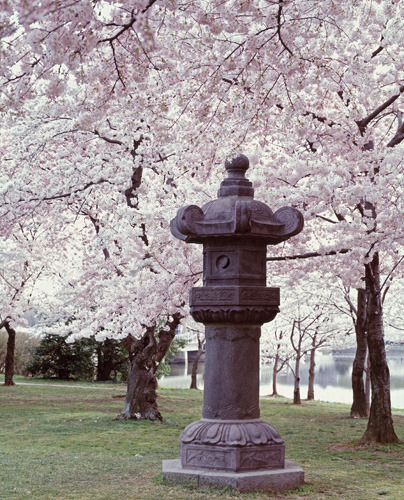
lantern at the Tidal Basin
The cherry blossoms will bloom in Washington this week. Congress remains in recess. The 2013 Sakura Matsuri will end the week on Saturday April 13th. HERE you can find the history of Japan's gift of the cherry trees to the city of Washington.

THE POLITICAL TURMOIL IN ITALY ON THE STABILITY OF EUROPE. 4/1, 10:00-11:30am. Sponsor: Peterson Institute for International Economics (PIIE). Speakers: PIIE fellows Dave Stockton, Jacob Kirkegaard and Barbara Kotschwar.

NEGOTIATING WITH IRAN: HOW BEST TO REACH SUCCESS. 4/1, 10:00-11:30am. Sponsor: Brookings. Speakers: Martin Indyk, vice president and director of foreign policy at Brookings; Javier Solana, former European Union high representative for common foreign and security policy, and distinguished fellow at Brookings; Gary Samore, former National Security Council coordinator for weapons of mass destruction, and executive director for research at the Belfer Center for Science and International Affairs.

THE FUTURE OF CHINA AND JAPAN-CHINA RELATIONS. 4/1, 1:30-3:00pm. Sponsor: Carnegie. Speakers: Akio Takahara, Professor of contemporary Chinese politics, Graduate School of Law and Politics, University of Tokyo; James L. Schoff, Senior Associate in the Carnegie Asia Program.

PREVENTING GENOCIDE AND PROTECTING HUMAN RIGHTS IN PLACES SUCH AS CONGO, SUDAN, SOUTH SUDAN AND SOMALIA. 4/1, 3:00-4:00pm, Washington, DC. Sponsor: School of International Service (SIS), American University. Speakers: SIS Dean James Goldgeier and John Prendergast, SIS/MA '90, co-founder of the Enough Project.

SUPER-LEGISLATURES: EVALUATING DODD-FRANK'S CFPB (CONSUMER FINANCIAL PROTECTION BUREAU) AND OLA (ORDERLY LIQUIDATION AUTHORITY) PROVISIONS AND OBAMACARE'S IPAB (INDEPENDENT PAYMENT ADVISORY BOARD). 4/1, 4:00-5:00pm. Sponsor: Cato. Speakers: former U.S. Ambassador to the United Nations and former White House Counsel C. Boyden Gray, founding partner at Boyden Gray & Associates LLP; Michael Cannon, director for health policy studies at Cato Institute; Louise Bennetts, associate director of financial regulation studies at the Cato Institute. 

THE POWER AND LIMITS OF LAW: TERRITORIAL AND MARITIME DISPUTES IN EAST ASIA. 4/1, 5:00-7:00pm, Washington, DC. Sponsor: SAIS, Johns Hopkins. Speaker: Professor Peter Dutton Director of the China Maritime Studies Institute, The U.S. Naval War College.

Thursday, March 28, 2013

America’s Commitment to Asia


On March 20th, Chairman of the House Foreign Affairs Committee Ed Royce (R-CA) gave an inspiring and important speech to an audience at the Heritage Foundation. The video is above and the text is HERE.

Notable was Chairman Royce's emphasis on strengthening America's economic relationships in the region. He made only passing reference to Japan and none of the US-Japan Alliance.

As Royce stated:
A fundamental restructuring of U.S. involvement in the Asia-Pacific region will resolve the endless standoff with North Korea once and for all.  India will no longer be artificially separated from the rest of Asia, and we will firmly anchor Taiwan into the global trading system.  The U.S. must take an in-depth look at its relationship with China and find a balanced approach that takes into account America’s interests while striving for a productive relationship.  Finally, we must once again make America the most attractive location to do business for the Asia-Pacific region.  Let’s get the conversation back on to economic prosperity and away from divisive nationalism.
And he ended his speech by pointing out today's political realities:
In my congressional district, for example, we have one of the highest concentrations of Asian Americans in country.  This includes Chinese Americans, Taiwanese Americans, Korean Americans, Filipino Americans – the list goes on.  In fact, there are 95 countries of origin represented within California’s 39th Congressional District.  I have long consulted with my constituents to better understand developments abroad.  Many of my constituents are active in trading and investing in Asia, which is a source of our national strength.