Wednesday, July 26, 2023

No surprise here - Chiune Sugihara is not what Conservative Japan wants him to be

Researchers say Japan has exaggerated the story of Chiune Sugihara, 

the ‘Japanese Schindler’

Jewish Telegraphic Agency, BY JORDYN HAIME JULY 19, 2023 

See original for pictures and links

YAOTSU, Japan (JTA) — Three years before the Olympics began in 2021, Tokyo was already developing the national image it would display as the world looked on.

The Tokyo Metropolitan Board of Education issued a handout to the city’s public schools in 2018 highlighting “the outstanding achievements of our predecessors” that were meant to “raise [students’] self-awareness and pride as Japanese.”

Occupying a majority of the four-page handout was the story of diplomat Chiune Sugihara, who wrote thousands of life-saving visas for Jews fleeing Europe in 1940. The pamphlet recreates a dramatized version of Sugihara’s life and actions, bolstered by quotes from nameless descendants of the Jewish refugees he saved.

“Sugihara should be remembered and honored as an amazing hero who sacrificed his profession and family to save strangers from a different ethnicity and culture,” one of the quotes reads.

Sugihara, a Japanese diplomat to Lithuania from 1939 to 1940, helped thousands of Jewish refugees flee wartime Europe by issuing transit visas that allowed them to travel across the Soviet Union to Japan. Today, his name and story can be found all over the country, from his supposed hometown in Yaotsu to a museum at the northern Tsuruga port where Jewish refugees landed.

His likeness is found in memorials in Tokyo and in manga series and films, in addition to nearly every modern history school textbook. In 2017, the Tokyo Weekender magazine dubbed Sugihara the “best Japanese person ever.” Some Catholics have even expressed hope that Sugihara will be officially canonized by the Catholic church as a Saint.

But over the past few years, a growing number of researchers — in addition to his own son — have publicly challenged Sugihara’s superhero status and many details of the version of his story pushed in Japan and around the world. Some researchers say that Japan has used him as a symbol of humanitarianism in the face of criticism of Japan’s World War II record.

And some note that Japan is taking the nationalist narrative one step further, by boosting another World War II-era figure whom they believe can achieve a similar level of national fame and hero status — whether or not his story is verifiable.

The Sugihara story

Issuing visas was not part of Sugihara’s job description. He was stationed in Kaunas, Lithuania, from 1939 to keep an eye on Soviet military activity in the region.

But when rumors spread of a Japanese diplomat issuing transit visas, Sugihara one day found a crowd of Jews lined up outside of his home hoping they would be lucky enough to get one. They were running from the Soviets; no one had yet predicted the havoc that would be unleashed on them by the Germans when they finally invaded one year later.

Sugihara issued some 2,140 transit visas, some used for entire households. But Meron Medzini, professor emeritus at the Hebrew University of Jerusalem’s Department of Asian Studies, wrote in his 2016 book “Under the Shadow of the Rising Sun: Japan and the Jews during the Holocaust Era” that “Not all of the visas were used, and this makes it difficult to substantiate the claim that Sugihara was instrumental in helping [the commonly accepted number of] between 6,000 and 7,000 Jews leave Lithuania.”

Sugihara’s act was also only one step in a series of events that led to the refugees’ escape. Tokyo required them to have a final destination permit as a condition of their transit through Japan, and those were provided by Jan Zwartendijk, a Dutch consul in Kaunas at the time who stamped thousands of Jewish passports to visa-free Dutch Curacao. Jewish organizations stepped in to pay for the refugees’ transit across the Soviet Union, which was miraculously granted by Soviet authorities.

Andrew Jocubowicz, whose parents escaped wartime Europe with the help of a Sugihara visa, emphasized the importance of Zwartendijk’s role in an interview. In recent years, the Dutch consulate has also attempted to boost the profile of their own Holocaust hero, who is often “hidden” in the shadow of Sugihara.

“The critical person in the whole game was really Zwartendijk,” said Jocubowicz, a professor of sociology at the University of Technology Sydney who has spent four decades researching the conditions of his family’s survival. “Without those visas, it would not have happened at all. There’s no way Sugihara could have cooked up something that didn’t have people moving on from Japan.”

After arriving in Japan, Jews left for Australia, Canada, the United States and other countries. Others were later deported to Japanese-controlled Shanghai, where authorities imprisoned them in a ghetto for the remainder of the war.

The hometown museum that isn’t

Claims that Sugihara helped several thousand Jews; that his requests for visas were rejected “three times” by his superiors; and that he was dismissed and punished for his actions are all important details that make Sugihara a hero. But they are also all claims that researchers have debunked.

Jocubowicz said his father barely met Sugihara, whose visa was just one chapter in a long journey to safety. The survival of this group of Jews was “almost pure luck at every point,” he said, especially their allowance by the Soviets to cross through Russia. After several months in Kobe, his family spent the remainder of the war in the Shanghai ghetto before boarding a ship to Australia, where Jocubowicz was raised.

“My feeling is that it was an extraordinary wormhole that opened up through these essentially conflicting empires, and as they crashed into each other, this little hole opened up and people were able to scurry into it,” he said.

Yaotsu’s claim as Sugihara’s birthplace is also disputed, said Nobuki Sugihara, the consul’s only surviving child. Nobuki said that according to family documents, his father was born in Mino, about 30 miles away from Yaotsu.

“It’s shocking. People come from around the world to visit Yaotsu [but] my father was not born there, he has never lived there,” Nobuki told the Jewish Telegraphic Agency. “They made a story that he was born in Yaotsu in order to get tourists because in that village there is nothing.”

The memorial and museum in Yaotsu, despite its distance from a major city, receives 20,000 tourists per year both foreign and domestic, according to Ito Yuko, who works in Yaotsu’s regional development and promotion division. She said the Sugihara family once lived in their small town, and elderly townspeople still remember them.

“For our museum, we are telling the truth that we know. Not exaggerated, not right or left, we just tell the story that we think is true,” she said.

Local tourism officials have also promoted a “Sugihara Remembrance Route,” part of a multimillion-dollar effort promoted widely in Israel that is described as “a nostalgic journey of discovery that will take you to places associated with the great man and areas where the Japan’s [sic] original landscape and traditional culture remain strong.” Although sometimes referred to as the “refugees remembrance route,” the route curiously excludes the city of Kobe, where Jewish refugees lived for months before leaving Japan for other destinations.

Sugihara had no connection to many of the areas on this route, Nobuki said. He explained that much of the common narrative about Sugihara comes from his mother Yukiko’s memoir, published in 1995.

“She didn’t know exactly what happened in Kaunas, in Europe. So she asked a ghostwriter. She wanted to make a novel, not a documentary. So she put here and there some fiction stories. And this became famous in Japan,” he said.

The rise to stardom

A decade or two ago, a much smaller portion of Japanese society knew the Sugihara story. Today, he is a household name.

In a recent article for the academic journal American Historical Review, University of Haifa professor and prominent Japan scholar Rotem Kowner examined how Sugihara became a “Holocaust paragon of virtue.” Sugihara, he wrote, “was not the only consul to issue visas to Jews during this period, and not every consul who issued visas turned into a hero.”

As Japan rebuilt and rebranded into a peace-loving nation after the war, said Chiharu Inaba, a professor who researches Jewish refugees in Japan, “The people didn’t know what a hero was anymore. They needed a new hero.”

The legacy of Japan’s wartime actions, including its military’s sexual “comfort women” system, continues to hinder its relations with China and South Korea.

The start of Sugihara’s rise to hero status can be traced back to his nomination as one of Yad Vashem’s Righteous Among the Nations in 1968. According to Kowner’s research, Sugihara did not earn the honor for 16 years after his initial nomination because of Yad Vashem’s initial doubts over whether he risked his life or professional position to help Jews — normally a requirement of Righteous Among the Nations status. Instead, Sugihara was at first given a certificate of recognition for his actions.

Eventually, though, when a panel was presented with new evidence and testimony from survivors, it determined that Sugihara had taken a career risk, and his Righteous status was granted in 1984. Authorities also saw it as an opportunity to improve Israel’s image in Japan, Kowner argues, as Japanese public opinion about Israel had sharply deteriorated amid the conflict with Lebanon at the time.

A former head of Yad Vashem’s Righteous Among the Nations department recently disputed the claim that political considerations were involved in Sugihara’s nomination.

Recognition of Sugihara remained scant within Japan until 2000, when the Japanese government for the first time officially recognized him at a centennial celebration of his birth. But Prime Minister Shinzo Abe — known throughout his 2012-2020 tenure for his conservative politics, revisionist views of Japan’s World War II activities and desire to ramp up Japan’s military — embraced Sugihara more than any other Japanese leader.

In Sugihara, Abe saw an opportunity to not only boost diplomatic relations with Israel and Lithuania, but to make Sugihara a positive representative of the Japanese people in its darkest historical period.

But the process had already started before Abe’s tenure. In the 2000s, revisionist writers began adding Sugihara’s name into texts that denied the Nanjing Massacre — a Japanese attack on the Chinese city in 1937 that resulted in an estimated 300,000 deaths — “to show that wartime Japan did not resemble Nazi Germany,” Kowner wrote.

Sugihara has been a key component of what some have called Asia’s “memory competition” to have documents and memorials receive recognition from UNESCO, the United Nations’ cultural heritage authority. In 2017, Japan nominated Chiune Sugihara Memorial Hall, the museum at Sugihara’s supposed hometown in Yaotsu, for UNESCO Memory of the World status; the bid failed.

“Sugihara posthumously allowed his country to shed a long-lasting self-justifying policy of victimization and, instead, rebrand itself as possessing proactive humanitarian values,” Kowner wrote. “Critically, Japan could cast itself in the role of a ‘good’ country that helped the Jews rather than that of an Axis villain.”

The next Sugihara

Sugihara’s vast fame has also paved the way for a new World War II-era Japanese hero to emerge: Kiichiro Higuchi.

Higuchi, a general, allegedly defied orders from his superiors to allow between 2,000 and 20,000 stranded Jewish refugees to cross the Russian border into Manchukuo, according to media reports and his supporters in Japan. This path to safety is now known as the “Higuchi route.”

Though far lesser known than Sugihara, efforts to attract attention to Higuchi have received mild success: through a manga series, media reports, and other commemoration efforts, such as a statue in his hometown of Awajishima. The Japanese embassy in Israel has reportedly been in discussions with Yad Vashem since 2005 about Higuchi’s Righteous Among the Nations status, but efforts have been unsuccessful.

When researchers began looking into the Higuchi story, it started to fall apart. Dylan Hallingstad O’Brien, a doctoral candidate at the University of California San Diego, has found that Higuchi likely facilitated the entrance of “at least 18 people” into Manchukuo. “There’s just no record” of more than that, O’Brien said.

“It just doesn’t add up that you have thousands and thousands of people flooding in and then there’s no record,” he said. “Especially when there are records of other Jewish refugee groups, [that have] receipts, letters, communications, and there’s just nothing for this group that supposedly went the ‘Higuchi route.’”

The website for the General Higuchi Association, an organization created to encourage the commemoration of Higuchi in Japan and pursue donations from abroad, is saturated with nationalism and false statements. Hideaki Kase — a right-wing politician who advised Shinzo Abe — chaired the association until his death last year.

“What would have happened if [Anne Frank’s] family knew of the ‘Higuchi Route’?” the website asks. “Perhaps the family would not have lived in the attic but instead would have sought passage for Manchuria, like so many other Jews did, and survived. At the time, neither the United States nor Britain accepted Jews; Japan was the only country in the world that opened its doors to Jews.”

The goal, O’Brien argued, is to promote the idea that Japan had a policy of racial harmony — in this case, of helping Jews during the war.

The consequences

Japan is far from the only country that has faced criticism for promoting Holocaust narratives for nationalist ends that historians disagree with. Poland has been widely derided for denying the part that many Polish citizens played in the killing of local Jews throughout the war. And in China, Shanghai’s history as a former home to thousands of Jewish refugees has been used as a diplomatic tool, at times to deflect from international accusations of genocide against Muslim Uighurs in Xinjiang.

Small inconsistent details or a selective use and omission of certain facts can be dangerous, Jocubowicz said. Holes in Holocaust stories give antisemites and Holocaust deniers ammunition for their arguments that Jews were not in danger, he argued.

“What happens if something is inaccurate and could be corrected is then the readers have no idea whether anything in the story is accurate,” Jocubowicz says. “So anything could be a fake. Maybe it’s all a fake, and maybe this is a signal that the whole Jewish story about the Holocaust is rubbish.”

Rabbi Mendy Sudakevich, a Chabad-Lubavitch movement emissary who has been living in Tokyo since the 1990s, sees the narrative differently. He thinks that the Sugihara story — whether it is 100% true or not — has a positive effect on people and endears them to Jews.

“Kids in Japan grew up not knowing what Japan did in the war. They don’t know the story. And Japan tried to build up a new story,” Sudakevich said. “I want the new generation of Japan to know that saving Jews is an important task. I want them to know that. And if that’s what they know about World War II, it is a good result for me.”

When Russia invaded Ukraine in 2022, many in Japan ventured out to Yaotsu, Kobe or Tsuruga to learn more about Sugihara. Invoking his memory, Inaba and his university students have organized a 5 million yen ($37,490) donation drive for Ukrainian refugees dubbed “donations for life.” The Visas for Life organization, founded by the Sugihara family in 2000, has raised 1.7 million yen ($12,746) for Ukrainian evacuees now living in Japan.

Madoka Sugihara, Chiune Sugihara’s granddaughter and soon-to-be-director of Sugihara Visas for Life, noted the dramatic change in the government’s reception of Sugihara in the past several years.

“The way the government changed their attitude is a very cynical thing,” but “it is a good thing that they regard Sugihara-san’s act very fairly. I’m convinced that it’s a good thing,” she said.

Tuesday, July 25, 2023

Jews and China

Jewish Conspiracy Theories Find an Audience in China

Anti-Jewish content and conspiracies take up significant real estate among the top results on Chinese media platforms including Douyin, WeChat and Bilibili. Though borrowed from the West, they have taken on a localized identity.

First published in the China Media Project, JUL 18, 2023 See original for graphics

Recent news of China’s renewed access to the Russian port of Vladivostok this May sparked celebration among some Chinese netizens. But among others, it was a painful reminder of its “century of humiliation,” beginning in the mid-nineteenth century. At the time, the Qing dynasty’s ruling Manchu royals had reluctantly handed over their homeland, which included the port, to their northern neighbors. More territory was ceded to the Japanese invaders in 1931, resulting in the creation of the puppet state of Manchukuo.

The Vladivostok decision sparked a debate in corners of Chinese social media about whether a debilitated and increasingly reliant Russia would be made to return the stolen land. Surprisingly, a third perpetrator has emerged alongside the Russian and Japanese empires: the Jews.

In the early 20th century, “before moving into Palestine, Jewish capital chose to settle in the Northeast [of China]”, explained a May 19 article by popular WeChat account “Blood Drink” (血饮). It added that the Jews “were even willing to make a Devil’s bargain with the Japanese fascists and give almost all of their money away for this purpose.”

Over one-hundred thousand people have now read the post, many of whom learned for the first time how “during the ensuing eight-year war, Japan’s military industry, which was financed by Jewish capital, massacred tens of millions of Chinese civilians.”

As with most conspiracies, the Jewish-Japanese blood libel contains a kernel of truth. It is based on a little-known episode in World War II known as the “the Fugu Plan” (河豚计划).

In 1939, Japanese “Jewish experts” had proposed to invite 50,000 German-Jewish refugees to Manchukuo with the hope that Jewish capital would help revitalize the territory. Drawing on their expertise of the fabricated antisemitic text The Protocols of the Elders of Zion, they hoped that a “deal” with the Jews would inspire them to help improve Japan’s position in the war due to their supposed power over the West. It was named after the “fugu,” the Japanese blowfish that — like the Jews — was a delicacy when handled correctly, but deadly if not. Although Jews indeed found refuge in Japanese-controlled areas during World War II, they were never seriously involved in the Fugu Plan, and the plan never came to fruition, writes Meron Medzini, a professor of modern Japanese history at the Hebrew University of Jerusalem.

The Fugu Plan, though, takes on a different meaning inside China: It demonstrates a foreign assault on the homeland, with “Jewish capitalists” portrayed as the puppeteers behind Western governments seeking to “contain” China’s rise.

At the time of writing, the Fugu Plan is featured in the top search result for the word “Jew” (犹太人) on Douyin, ByteDance’s Chinese equivalent of TikTok. The video is the first in a three-part series about the historical “mistakes” of the Jews.

In less than eight minutes, the video’s narrator blames the Holocaust on Jewish greed, accuses Jews of starting China’s “century of humiliation” by financing the Opium Wars, and describes their cunning Fugu Plan with the Japanese.

Other videos about the Fugu Plan have received as many as 200,000 likes and 30,000 shares. Millions of others have followed the story on social media, where it can also be found with a simple search on Bilibili, WeChat and Weibo, among other platforms.

The narrative has become so popular that an acclaimed Chinese author Yang Shu (杨树) received state funding to pen a spy novel based on the story, which has been short-listed for television or film adaptation by the state-led Chinese Writers Association.

The conspiratorial spin on the Fugu Plan only scratches the surface. A distinct brand of localized antisemitic conspiracies is thriving on Chinese media platforms. A quick search for “Jews” on WeChat, Douyin, BiliBili, Weibo, or Zhihu, reveals that negative, anti-Jewish content and conspiracies take up significant real estate among the top results.

The economics of antisemitism

Antisemitism is not just a social media phenomenon. Despite Beijing’s tight control of the information space, it can also be found among leading academics, party-state journalists, and military strategists. Whereas benign pro-LGBTQ posts and dissenting political voices are often censored, Jewish hatred is openly propagated.

The mirror image of this phenomenon is more well-known. Any Jew who travels through China and reveals their heritage will be met with an admiring torrent of ostensibly “philosemitic” remarks: Jews are inherently intelligent, clever, business savvy, and wealthy. Today, this attitude is widely understood by outsiders as a harmless admiration of stereotypical Jewish traits.

The issue with this “positive” spin is the very fine line that separates it from overt antisemitism. To those who admire Jews for being inherently intelligent and good with money, holding resentment for their supposed disproportionate power over American institutions like Wall Street, the Federal Reserve, and Hollywood is not a major leap.

None of this is to say that antisemitism is widespread in China, or to suggest the PRC is a uniquely and irrevocably racist country. However, it does beg the question of how a country with a negligible Jewish population and an even smaller indigenous Jewish community could form such strong opinions about people they had never met.

Chinese antisemitism should first be viewed as one manifestation of a broader problem of racist nationalism in Chinese discourse. Earlier this month, many observers were shocked and appalled to see how China’s top diplomat Wang Yi hinted at an East Asian race-based bonhomie against “sharp-nosed” and “yellow-haired” Europeans and Americans, advocating for an East Asian alliance that “can eliminate external interference and achieve sustainable development.”

To those who admire Jews for being inherently intelligent and good with money, holding resentment for their supposed disproportionate power over American institutions like Wall Street, the Federal Reserve, and Hollywood is not a major leap.

The irony is that despite exhibiting some of the most well-documented instances of systemic violence, dehumanization, and discrimination against ethnic minorities, China is rarely called out for racism.

In his seminal book on the subject, historian Frank Dikötter shows how racialized discourse has been a part-and-parcel of Chinese nationalism since its inception in the late nineteenth century. Sun Yat-sen, dubbed “the Father of the Nation,” shared many Chinese revolutionaries’ fear and hatred of the ruling Qing’s “Manchu race.” This led him to incorporate racist nationalism into the bedrock of his political thought. “Sun claimed that only nationalism could forestall racial destruction,” writes Dikötter. Conspiracy theories about the Manchus persist in China to this day.

Sun and his contemporaries among China’s intellectual elites have attempted to construct a sense of national identity by appropriating Western antisemitic representations of Jews. By defining the “Jewish race” as a homogeneous group, argues Zhou Xun (周逊) with the University of Essex, they hoped to create a similar sense of unity among the Han-Chinese race. This process of othering the Jews has allowed the Chinese to project their own anxieties and desires onto a group that is both foreign and familiar.

Chinese nationalism under Mao Zedong viewed racial issues through the prism of class struggle, though there were times when the differences were merely semantic. When socialist Israel aligned itself with the “capitalist” Western Bloc, China gravitated towards the anti-Zionist Muslim world, viewing the Jewish state as “the enemy.” With little to no personal contact with Jews, many Chinese scholars and statesmen came to rely on the deeply antisemitic Soviet and Pan-Arabist anti-Zionism that masqueraded as legitimate criticism of Israel.

The enduring legacy of ultra-leftist “enemy studies” abounds in the works of Beihang University military strategist Zhang Wenmu (张文木). In a series of articles for a peer-reviewed socialist journal under the Chinese Academy of Social Sciences (CASS), Zhang describes Covid-19 as a usurious American-Jewish bioweapon aimed at China and humanity as a whole. In keeping with the teachings of Mao and Karl Marx, Zhang says that “what Jews require most is an environment conducive to borrowing, which includes things like financial crises, pandemics, disasters, and, preferably, war.”

In the early 1990s, during the second coming of reform and opening, opportunistic writers and publishers flooded bookstores with “get-rich-quick” guides in an attempt to profit from the pervasive stereotype of the “Jewish Shylock.” An entire genre of books has emerged that portrays Jews as a wellspring of financial wisdom, a source from which the Chinese could learn valuable lessons.

One of those books is The Jewish Guide to Getting Rich, which includes a seemingly admiring line: “The money of the world is in the pockets of the Americans, but the money of the Americans is in the pockets of the Jews.”

Following this logic, nouveau riche families in Shenzhen can now enroll their kids in posh programs designed to help them “learn from the best” in management, finance, and parenting so that they, too, can carry on a Rothschild-like legacy.

However, these assertions become troubling when they contribute to the notion that Jews are influencing America’s trade war and efforts to contain China. Similar conclusions can be found in viral videos and posts discussing the alleged Jewish-Japanese Fugu Plan, in which “Jewish capital” supposedly supported Japan’s war against China.

Conspiracy theories thrive on ignorance and sensationalized content reaps lucrative clicks and revenues. However, spreading rumors online risks falling afoul of China’s dreaded Cyberspace Administration, inviting charges of “picking quarrels and making trouble” that could lead to imprisonment. Antisemitism avoids this fate, given that these narratives are seamlessly embedded within state-sanctioned nationalistic frameworks, warning against foreign encirclement and influence.

“The issue of Jewish conspiracies in our region is more pervasive and profound than we realize,” Simon K. Li told the JTA wire service last year. Li highlights that these conspiracies find greater expression on social media platforms like Douyin and Tencent QQ, where anonymity allows for open discussions, rather than in direct face-to-face interactions

A prime success story of this tactic is Currency Wars, a five-volume book series by Song Hongbing. Beginning in 2007, its publication represents a significant turning point in the integration of Jews as stakeholders in popular conspiracies.

The series claims to reveal the secrets of an international financial cabal dominated by a small group of wealthy Jewish elites, most notably the Rothschild family. According to the author, their intentional manipulation of the Federal Reserve results in major social, political, and military disasters.

Despite being panned in China and elsewhere for their broad generalizations, factual errors, and overt antisemitism, Song’s books were a commercial success, with over three million copies in circulation as of 2020. They even received endorsements from senior officials in Beijing, including former Chinese Vice President Wang Qishan (王岐山), who reportedly recommended the series to his staff.

Wuhan University professor Sunny Han Han argues that Currency Wars represents a broader trend of Chinese “pop-nationalism.” This phenomenon revolves around conspiracy theories targeting the “hypothetical West,” an abstract force believed to hinder China’s ascent.

It appeals to nativist anxieties over Western influence and globalization, which Han traces to the emergence of early Chinese nationalism in the late Qing. According to Han, such anachronisms perpetuate traditionalist groupthink. Even more concerning, they distort Chinese perceptions, ultimately perverting Beijing’s ability to communicate effectively with the world.

The ultimate Other

Conspiracy theories and racism are prevalent throughout the world, across all cultures and time periods. And yet, the setting in which they evolve is essential to understanding them.

From Sun Yat-sen to Wang Yi, racialized discourse has been an element of Chinese nationalism since the late Qing dynasty. By classifying Jews as innately external and homogeneous group, the PRC’s founding fathers were able to see a reflection of their nation’s own fate. Following decades of humiliation at the hands of foreign powers, it was natural to believe that if the Chinese could be as wealthy as the Jewish Shylock, China would be the most powerful country on the planet; or that in order to create the Chinese “New Man,” one must examine how to avoid being like the subservient weak Jew.

Historical trends also influence the geopolitical landscape. China established diplomatic relations with Israel in 1992, after the Cold War had ended and the Maoist class mentality had subsided. Consequently, antisemitic rhetoric wrapped in anti-imperialist and anti-Zionist language had to be discarded as well. Nevertheless, countless Chinese politicians and academics carry on the Soviet legacy and use the Jewish state as a battering ram against its American “big brother,” in what Glenn Timmermans of the University of Macau refers to as “antisemitism by proxy.”

In China, where there is a minuscule Jewish minority, conspiracy theories about the treatment of the country’s sizable Muslim, Christian, LGBTQ, or African communities face greater scrutiny. Antisemitism, however, is rarely discussed as it exists primarily in elite circles and online. Diplomats from China (and Israel) would even go so far as to claim that “antisemitism has never existed in China.”

The socioeconomics of the country’s rapid development may explain the niche market for books and programs based on the stereotypical Jewish financier. At the same time, the prevalence of antisemitism in the world’s second-largest economy is concerning. China accounts for one-fifth of the world’s internet users, with over a billion active users. As scholars Yang Tian and Fang Kecheng have found, the nationalist “influencers” who coordinate and share content on a daily basis comprise a large, toxic network.

Furthermore, despite their xenophobia, they share ideological ties with the far right in the West and Eastern Europe. According to Yang and Fang, the Chinese Han majority, which accounts for more than 90 percent of the population, claim that their own majority culture is in crisis due to minority groups such as Muslims, Blacks, or, in this case, Jews.

Due to their direct import from the West, many of the aforementioned Chinese conspiracies should be very familiar to Westerners. In his lectures, for example, Jin Canrong (金灿荣), dean of Renmin University’s School of International Studies, has promoted the Great Replacement theory. Popularized by French nationalist Renaud Camus, the theory holds that non-white immigrants are replacing white European societies with the help of Jews.

Nevertheless, when we examine these theories through a historical lens, we can observe their transformation and incorporation of Chinese metaphors and distinct cultural and historical notions. What is the Fugu Plan conspiracy but the Great Replacement with Chinese characteristics?

To rationalize Chinese antisemitism on ignorance is, at best, patronizing. Many of its proponents, including naturalized American citizen Song Hongbing, have resided or attended school in the West. Some have even written extensively about the perils of “Western” antisemitism.

Contemporary antisemitism — whether in the United States, Europe or China — is, in the end, a conspiracy that has proven remarkably useful around the world. As American writer and activist Elad Nehorai writes, antisemitism does not always appear to be Jew hatred: “Jew hatred is actually the end result of antisemitism.” Viewed from this perspective, perhaps no one should be surprised that kitschy admiration for Jews has turned sour; isn’t China just catching up to the rest of us?

Monday, July 24, 2023

Fukushima's Muddy Waters

Kishida Administration Provokes an International Dispute on Nuclear Contamination

By Takuya Nishimura, Editorial Writer, The Hokkaido Shimbun
The views expressed by the author are his own and are not associated with The Hokkaido Shimbun
July 17, 2023. Special to Asia Policy Point.

The International Atomic Energy Agency (IAEA) recently submitted to the government of Japan a report on the safety of discharging “treated water” from Fukushima Daiichi Nuclear Power Station (FDNPS). The FDNPS is still in the process of decommissioning after the severe accident caused by Great East Japan Earthquake 12 years ago. The IAEA determined that Japan’s discharge plan is relatively safe, saying “the discharge of the ALPS (Advanced Liquid Processing System) treated water -- will have a negligible radiological impact on people and the environment.”

 However, there is considerable skepticism about the report both inside and outside Japan. By inviting an international organization to weigh in on the dispute over the uncontrollable by-product of cooling down the broken reactors, the Japanese government seems to have made the issue an international problem.

 The IAEA’s review followed Prime Minister Yoshihide Suga’s announcement in 2021 that the diluted contaminated water from the FDNPS would be released into the sea.  The FDNPS storage tanks are reaching their capacity limits. At the Japanese government’s request, the IAEA established a task force of international experts. The task force analyzed data provided by Tokyo Electric Power Company (TEPCO), Nuclear Regulation Agency (NRA) of Japan and Ministry of Economy, Trade and Industry (METI). The report is not an assessment of political impact of discharging, but simply a scientific analysis of data provided by Japan.

 The report has concluded that the approach to the discharge of treated water processed by the system named Advanced Liquid Processing System, or ALPS, and the associated activities by TEPCO, NRA and the government of Japan are consistent with relevant international safety standards. Even so, IAEA notes that once discharges begin, many of the technical topics reviewed and assessed by the task force will need to be revised by the IAEA. In his July visit to Fukushima, the IAEA Secretary General, Rafael Grossi, assured residents “We’ll be here until the last drop is safely discharged.”

The main concern in Japan about the treated water focuses on a substance called tritium, a radioactive hydrogen isotope, that remains even after the ALPS has processed water from the FDNPS. The IAEA report estimates that the annual amount of tritium, limited to 22 TBq in Japan’s plan, to be as low as the pre-accident level and much lower than the annual production on the planet due to natural processes. According to the report, the biological half-time of tritium in humans is 10 and 40 days, while its physical half-time is 12.3 years. The report concludes that the discharged tritium has limited impacts on people and the environment.

 It is not strange for the IAEA to support Japan’s plan for the discharge of treated water because the organization was established by U.S. President Dwight Eisenhower to promote the use of atomic energy. When Japan was not able to find a way to dispose of contaminated water in 2015, the IAEA, under the leadership of the Japanese Secretary General, recommended that Japan discharge the water into the sea. Not surprisingly, then, the IAEA report is on the side of the Japanese government.

 With the IAEA report in hand, the Kishida administration believes that it has cleared the last hurdle and has decided that the discharge may begin. A few days after the report was published, the NRA issued an approval to the facilities for discharging on its safety. METI has already announced that the discharge will be started this summer.

 The IAEA’s endorsement of the discharge met with an immediate and unfavorable international response. Korean protesters chanted not to approve Japan’s discharge plan as Grossi entered and exited the building in Tokyo where he held a press conference early July. The parliamentary members of an opposition party in South Korea argued in a Tokyo press conference that releasing “contaminated water” (never calling it treated water) would violate international laws such as the United Nations Convention of the Law of the Sea and the London Convention and Protocol on prevention of marine pollution. The party members said that they would continue their protests until Japan stops discharging the water. Although the Yoon Suk-yeol administration has shown credibility in responding to Japan’s plan, the citizenry’s anxiety about contaminated water is causing a sharp political dispute in South Korea.

 China is firmly against the release of the water. Soon after the IAEA report was issued, the Chinese government announced that the review of IAEA “should not be the ‘shield’ or ‘green light’ for Japan’s discharge of nuclear-contaminated water into the ocean.” The government will consider more stringent inspection of imported seafood from Japan if Japan starts dumping the contaminated water into Pacific Ocean.

 When the buildings containing nuclear reactors exploded, TEPCO began to use water to cool down the reactors, instead of burying them. Ever since, the crippled plant has produced contaminated water. Although the FDNPS has taken various steps to reduce the risks, including the purifying process through ALPS system. Several measures, however, including blocking the water flow with underground frozen walls set around the site and lifting the water up before it reaches the site, the contaminated water, even though processed, is still increasing in the tanks built in FDNPS site. TEPCO and the government of Japan have yet to ensure that, in the words of former Prime Minister Shinzo Abe, the contaminated water in Fukushima is “under control.”

 TEPCO has said that the water must be discharged into the sea because the tanks are going to be filled soon. But the company has been building new tanks when they have become full. If there is no more space in the FDNPS tanks, TEPCO can build new ones anywhere on their own property. That is the point that the neighbor countries have been making. TEPCO’s justification sounds as if Japan is risking the environment of the planet to save money. Kishida has shown no sign of refuting these criticisms.

###


Kyodo News opinion poll & results from Tokyo Shimbun, July 17, 2023  Tokyo Shimbun , p. 21, Questions & answers (%), provisional translation for education use

Q8: The government plans to take the treated water from the TEPCO Fukushima Daiichi nuclear power plant, dilute it so that the concentrations of radioactive substances are below national standards, and release it into the ocean around this summer. Local fishermen as well as China and some of Japan’s other neighbors are opposed to this. Are you in favor of or opposed to releasing the treated water into the ocean?

In favor

31.3


Opposed

25.6


Unsure

43.1


D/K+N/A


Q9: The government says it will gain the understanding of the Japanese people and of the international community so that no economic damage arises through the spread of groundless rumors with the release of treated water from the Fukushima Daiichi nuclear power plant. Meanwhile, local fishermen and others are expressing concern. If the government releases the treated water into the ocean, do you think economic damage will arise through the spread of groundless rumors?

Major economic damage will arise through the spread of groundless rumors

15.8


Some economic damage will arise

71.6


Little economic damage will arise

9.1


Absolutely no economic damage will arise

0.8


D/K+N/A

2.7


Q10: Do you think the government has given an adequate explanation of the release of treated water from the Fukushima Daiichi plant?

Yes

16.1


No

80.3


D/K+N/A

3.6

Thursday, July 20, 2023

Japan's Ruling Coalition Cracks

Game of Chicken within Japan’s Ruling Coalition

By Takuya Nishimura, Editorial Writer, The Hokkaido Shimbun
The views expressed by the author are his own and are not associated with The Hokkaido Shimbun
July 7, 2023. Special to Asia Policy Point.
 
The Liberal Democratic Party (LDP) is suffering from unprecedented conflict with its long-time coalition partner, Komeito. Annoyed by LDP’s sober reaction over interparty cooperation for the next election of House of Representatives, Komeito announced that it would not support any LDP candidate in the Tokyo districts.  Without Komeito’s support, the LDP may suffer defeats in these districts.  While the struggle is not supposed to escalate to the point of dismantling the coalition, some LDP lawmakers have angrily criticized Komeito, urging them to leave. Whatever the outcome, it is clear that the LDP, led by Fumio Kishida, has not been taking good care of its ruling coalition partner.
 
The House of Representatives amended the Public Offices Election Act last November, increasing by ten the number of electoral districts in urban area and correspondingly decreases the number of electoral districts in rural regions. Realizing that these changes present a chance to raise as many candidates as possible, the LDP planned that to raise 11 candidates, including one in the Tokyo 29th district, in the next election. Meanwhile, the LDP, suffering from a decline in total votes in the current elections, planned to raises another candidate in Tokyo’s 28th district, one of the newly created districts.
 
Responding to complaints within the party, the LDP rejected Komeito’s idea. Traditional election cooperation between the LDP and Komeito mandated that LDP voters vote for Komeito candidates and vice versa. LDP lawmakers have now questioned why they have to support Komeito so much, since the LDP lost close to ten districts in the electoral reform. Komeito finally went without LDP support in the Tokyo 28th and decided that the party would not support LDP candidates in the Tokyo districts in next election. In an official agreement late last month, the LDP will recommend all the Komeito candidates in the Tokyo districts except for the Tokyo 29th. Komeito will recommend LDP candidates in the districts where the parties have reached a local deal except for the Tokyo districts.
 
In the 2021 election, Komeito only won nine districts in all of Japan. These districts included the Tokyo 12th, the only one that Komeito took in Tokyo. The winner, Mitsunari Okamoto, later decided to move to the Tokyo 29th in next election, a decision basically approved by the LDP. Komeito then tried to run a second candidate in the Tokyo 28th. The idea of two Komeito districts in Tokyo was too much for LDP to bear.
 
Comparing actual seats in the House of Representatives with the share of all the votes in 2021, the LDP’s advantage in the cooperation system is greater than Komeito’s. The LDP won 189 districts (65.4% of all 289), while Komeito won nine (3.1%). The LDP, however, earned only 34.6% of all the votes for proportional representation, while Komeito received 12.4%. It can be said that the LDP earned a great number of seats with relatively few votes, thanks to the inter party cooperation.
 
The decision not to support the LDP in Tokyo seems to have been led by a religious group, Soka Gakkai (SG), the political base of Komeito. Asahi Shimbun reported  that a vice president of SG has been involved aggressively in the negotiations with the LDP. Even after facing the reluctance of LDP local leaders to support Komeito candidates in the Aichi 16th and Saitama 14th districts, the vice president independently announced that he would raise candidates in both districts. If election strategy is actually controlled by SG board members, the leaders of Komeito are acting as puppets.
 
The current political surge of the Innovation Party, or Ishin-no-kai, is in the background of Komeito’s unusual anxiety. Ishin increased its seats in regional congresses in the local elections in April, when it won a historical victory over the LDP in a supplementary election of House of Representatives in Wakayama. Although it had been refraining from confrontation with Komeito in six districts in Osaka and Hyogo, Ishin announced that it would run its own candidates against Komeito’s incumbents in the next election.
 
Komeito’s irritation is caused not only by the uncooperative attitude of LDP. Kishida’s current support for military developments is at odds with Komeito’s traditional political principle as “party of peace.” Moreover, consecutive failures in the process of replacing health insurance cards with My Number Cards weakens the support of Soka Gakkai members, who are serious about welfare policies. Komeito can still not find a way to regain power.
 
Since joining the coalition with LDP (with the catalyst of the Liberal Party in 1999), Komeito has overcome many hardships of political differences with the conservative LDP. Maintenance of the leading coalition has actually worked for growth of the small party. The existence of Komeito has also helped soften the hawkish image of the LDP. Considering that Komeito possesses ten to twenty thousand votes in every district of the House of Representatives, there are a number of lawmakers who would not be reelected without Komeito’s support. Whether or not the next election in Tokyo is separated depends on which side will compromise. The 24-year-old coalition, however, looks exhausted with endless quibbles.

Sunday, July 9, 2023

Monday Asia Events July 10 2023


A CONVERSATION WITH SAN FRANCISCO FED PRESIDENT MARY DALY. 7/10,
10:30-11:30am (EDT), HYBRID. Sponsor: Brookings. Speaker: Mary C. Daly, President and Chief Executive Officer - Federal Reserve Bank of San Francisco. 

ASEAN: INEFFECTIVE OR INDISPENSABLE FOR SOUTHEAST ASIA? 7/10, 11:00am-Noon (EDT), IN PERSON ONLY. Sponsor: Asia Foundation. Speaker: Thomas Parks, Asia Foundation’s Country Representative in Thailand. 

BREAKING DOWN THE ADVANCED BATTLE MANAGEMENT SYSTEM. 7/10, 1:00-2:00pm (EDT), HYBRID. Sponsor: Air & Space Forces Association. Speaker: Brig. Gen. Luke C. G. Cropsey, the Department of the Air Force Integrating Program Executive Officer for Command, Control, Communications and Battle Management. 

HONEST PERSPECTIVES ON ESG AND LIBERTY. 7/10, 1:00-2:00pm (EDT), VIRTUAL. Sponsor: R Street. Speakers: Jennifer Schulp, Director of Financial Regulation Studies, Cato Institute; Nick Loris, Vice President of Public Policy, C3 Solutions; Devin Hartman, Director of Energy and Environmental Policy, R Street Institute. 

DEFENDING THE GLOBAL HUMAN RIGHTS SYSTEM FROM AUTHORITARIAN ASSAULT: HOW DEMOCRACIES CAN RETAKE THE INITIATIVE. 7/10, 10:30-11:30am (EDT), VIRTUAL. Sponsor: National Endowment for Democracy. Speakers: Dr. Rana Siu Inboden, Senior Fellow, Robert S. Strauss Center for International Security and Law, University of Texas at Austin; Dr. Sophie Richardson, China Director, Human Rights Watch; Christopher Walker, Vice President for Studies and Analysis, National Endowment for Democracy. 

Friday, June 30, 2023

My Number, Not

Japanese Skeptical about National ID Number


By Takuya Nishimura
, Editorial Writer, The Hokkaido Shimbun
The views expressed by the author are his own and are not associated with The Hokkaido Shimbun
June 25, 2023. Special to Asia Policy Point.

One of Prime Minister Fumio Kishida’s major domestic policy objectives has been the introduction and distribution of a national identification card called “My Number.” Although he seemed to have attained this objective when the Diet passed a bill to fold the national health insurance card into the My Number card, the rollout caused more problems than it solved.

The transition was inadequate and resulted in many errors. The public quickly began to distrust the program and blamed the government for incompetence. Kishida’s My Number campaign has the potential to be fatal to his administration.

My Number was originally introduced under the Shinzo Abe administration in 2013. It provided Japanese citizens with a 12-digit identification number to make administrative procedures such as taxation or social security efficient. Although the government distributed the number to every citizen, My Number card was not accepted as widely as the government expected.

The government hoped that My Number would be used for health insurance and drivers’ licenses. Instead, many felt these tie-ins would jeopardize their privacy. In 2020, Abe’s successor Yoshihide Suga, offered incentives to encourage acceptance. New card holders were offered 5,000 shopping points called “Maina Point” or the equivalent to ¥5,000.

Kishida began a second campaign of Maina Point last year, giving 5,000 points for obtaining the card, 7,500 points for integrating it with health insurance and 7,500 points for connection to a personal bank account. He also announced that the current health insurance card would be scrapped by the fall of 2024, integrating it with My Number card. Earlier this month, the Diet passed an amendment to the My Number Act, which expanded the utility of the card, confirmed the integration of the health insurance card with the My Number card, and established a new system to promote the linkage of the My Number with a holder’s personal bank account.

Although some operational flaws in My Number system had been reported before enactment of the amendment, several instances of the mishandling of personal data were reported after the the enactment. In the process of registering personal bank accounts in order to receive public benefits, there were many examples of incorrect linkages with family accounts. These mistakes occurred mainly when parents registered their accounts for their children, violating the rule of one account for one person. The rule makes no sense as long as young children, who are entitled to receive governmental benefits, cannot open their own bank accounts.

Despite the fact that the My Number system is a national policy, implementation was left to local governments. In some cases, personal data was registered to wrong person. Such data included medical history, the history of pension payment, and benefits for raising children or handicapped persons. As result of mishandling MyNumber accounts, some hospital patients were charged 100% for their medical bills even though such charges must normally be 30% or less by using health insurance. Unlike the ID systems in other countries, including social security numbers in the United States, according to the report of Mainichi Shimbun, Japan’s My Number system is not controlled in a unified manner. Since many ministries hope to utilize My Number in their programs, they dividedly hold the citizens’ personal data for protecting privacy.

The political impact of the system errors of My Number is not small. The Digital Minister, Taro Kono, apologized for the consecutive failures in My Number registration. Kishida established a special inspection team in an effort to cool down the public opposition. Nevertheless, the Kishida government fully intends to scrap the current health insurance card and integrate it into the My Number card in the fall of 2024. Polls conducted on June 17th and 18th showed a steep decline in support for Kishida. In the Kyodo poll, support dropped by 6.2 points to 40.8%. The Asahi poll that approval had dropped by 4 percentage points to 42%. Mainichi’s poll showed a drop of 12 points to 33%. Most people, as well as most newspapers’ editorials, are demanding the cancellation or postponement of the integration plan of the health insurance card with the My Number card.

Kishida promised that he would not scrap the current health insurance card until popular anxiety about integration has eased. However, an integrated personal identification number has been a long-cherished wish of the central government. When the government considered introduction of an integrated ID number in 1970s, it faced firm opposition from the public worried about growing governmental control and the loss of the security of confidential personal information. The Democratic Party of Japan renewed discussion of the common ID number in the integrated reform of taxation and social security in early 2010’s.

My Number originated as an attempt to protect low-income families from the negative impact of consumption tax hikes under the DPJ administration. One possible solution at that time was a “tax credit with benefits,” which would have been accompanied by a common ID number. My Number has also been discussed as a method for delivering government benefits. But the unchanged hidden intention appears to be stronger and easier governmental control over the people. The government’s haste in implementing My Number has resulted in confusion and error capped by weak, gimmicky incentives. As a result, Kishida’s government looks weak with no easy way for the Prime Minister to regain public credibility for the My Number system.

Sunday, June 25, 2023

Monday Asia Events June 26, 2023

REFLECTIONS ON U.S.-ROK ALLIANCE IN THE HUMANITIES. 6/26
, 8:30am-5:30pm (EDT), IN PERSON ONLY. Sponsor: Korean Library Association (KLA); Library of Congress. Speakers: Dr. Stella Xu, John Turbyfill Endowed Chair of History, Roanoke College; Owen Rogers, Liaison Specialist, Veterans History Project Megan Harris, Senior Reference Specialist, Veterans History Project; Dr. Jaechan Jeong, Professor of Korean Language Education, Hanyang University; Joseph Juhn, documentary filmmaker. 

MEKONG WATER DATA HOUR: DAM DEVELOPMENT & FISH BIODIVERSITY LOSS. 6/26, 9:00-10:00am (EDT), VIRTUAL ONLY. Sponsor: Stimson Center. Speakers: Dr. Ratha Sor, Director of Graduate School, National University of Cheasim Kamchaymear; Sarah Null, Associate Professor, Watershed Sciences Department at Utah State University. 

RIPPLE EFFECT: EXPLORING THE INTERSECTION OF WATER INSECURITY AND DISPLACEMENT IN THE MIDDLE EAST. 6/26, 9:30-10:30am (EDT), VIRTUAL. Sponsor: CSIS Middle East Program. Speakers: Natasha Hall, Senior Fellow, Middle East Program; Giorgi Gigauri, Chief of Mission, The International Organization for Migration in Iraq; Michael Talhami, Senior Program Manager, The International Committee of the Red Cross; Niku Jafarnia, Yemen and Bahrain Researcher, Human Rights Watch. 

MEI CLIMATE WEEK 2023: WATER MANAGEMENT & ENVIRONMENTAL SUSTAINABILITY. 6/26, 10:00am-Noon (EDT), VIRTUAL. Sponsor: Middle East Institute (MEI). Speaker: Diana Francis, Assistant Professor & Head of ENGEOS Lab, Khalifa University. 

A CONVERSATION WITH DR. KURT CAMPBELL AND ADMIRAL MICHAEL GILDAY ON THE STRATEGIC AND MILITARY IMPLICATIONS OF AUKUS. 6/26, 2:00-3:00pm (EDT), VIRTUAL. Sponsor: CSIS Australia Chair. Speakers: Kurt Campbell, Deputy Assistant to the President and Coordinator for the Indo-Pacific, The White House; Charles Edel, Senior Adviser and Australia Chair; Michael Gilday, Admiral Michael Gilday, Chief of Naval Operations, U.S. Navy. 

TRANSFORMING EUROPEAN DEFENSE REPORT LAUNCH. 6/26, 2:00-3:00pm (EDT), VIRTUAL. Sponsor: CSIS Europe, Russia, and Eurasia Program. Speakers: Max Bergmann, Director of the Stuart Center and the Europe, Russia, and Eurasia Program at CSIS; Marie Jourdain, visiting fellow at the Atlantic Council’s Europe Center; Sean Monaghan, visiting fellow in the Europe, Russia, and Eurasia Program at CSIS, where he focuses on NATO, European security, and defense. 

(CIVIL) WAR AND (NOW) PEACE? THE WAGNER GROUP REBELLION AND RUSSIA'S FUTURE. 6/26, 3:00pm (EDT), VIRTUAL. Sponsor: Jewish Institute for National Security of America. Speakers: Gen Philip M. Breedlove, USAF (ret.), Former Supreme Allied Commander of NATO; Amb. Stephen Sestanovich, George F. Kennan Senior Fellow for Russian and Eurasian Studies; The Honorable Stephen Rademaker, Former Assistant Secretary of State for International Security and Nonproliferation, Member, JINSA's Iran Policy Project; Senior Advisor, JINSA Gemunder Center. 

BUILDING U.S. SPACE FORCE COUNTERSPACE CAPABILITIES: AN IMPERATIVE FOR AMERICA’S DEFENSE. 6/26, 3:00pm (EDT), VIRTUAL. Sponsor: Mitchell Institute for Aerospace Studies. Speakers: Maj Gen David N. Miller Jr., Director of Operations, U.S. Space Force; Robert Atkin, Vice President, Special Space Systems, General Atomics. 

REVITALIZING NATIONAL SECURITY AMIDST SUPPLY CHAIN DISRUPTIONS. 6/26, 5:00-6:00pm (EDT), VIRTUAL. Sponsor: Institute of World Politics. Speaker: Chris Garcia, former national deputy director of the U.S. Department of Commerce and acting national director of the Minority Business Development Agency. 

Wednesday, June 21, 2023

Kishida's population strategy

Introduced Without A Firm Basis

By Takuya Nishimura
, Editorial Writer, The Hokkaido Shimbun
The views expressed by the author are his own and are not associated with The Hokkaido Shimbun
June 19, 2023. Special to Asia Policy Point.

Prime Minister Fumio Kishida announced his plan, the Children’s Future Strategy Policy, for dealing with Japan’s declining population on June 13. Recognizing the urgency of turning the current trend around, Kishida offered an “acceleration plan” to fix the problem of a declining birthrate by 2028. His policy package, which includes subsidies for families with children, met immediate skepticism as it did not include credible budgetary resources. Experts on Japan’s demography believe that policy is misguided, arguing that the measures wrongly focused on the existing children instead of encouraging childbirth.

Financial benefits for children currently are available only to those families beneath an income cap. The acceleration plan removes that cap. Benefits will also be expanded to include families with a high school student in addition to those with a middle-school student or younger. Every child between the ages of 0 and 2 will receive ¥15,000 monthly, and she or he between 3 and 18 will receive ¥10,000. The amount will be raised to ¥30,000 monthly for the third child or more. For the families with a student in higher education, the plan streamlines the application process for student loans and scholarships. The system of nursery schools will also be improved for the workers with small children.

Recommending that all fathers take time off from work to help raise new-born babies, the plan aims for a society in which male workers’ recess for a new baby is nothing strange. The policy sets a target of 85% of all male workers taking the new-baby leave by 2030 and offers public financial support to guarantee nearly 100% of the family’s income. Mid- or small businesses that provide their own additional measures for the new-baby leave will receive subsidies from the government.

Those policies require certain amounts of budgetary resources to be viable. One thing clear is that the plan requires ¥3.5 trillion annually for the concentration period between FY2024-26. While the plan assumes ¥1.5-1.6 trillion for financial supports for children, ¥700-800 billion for improving nursery services, ¥700-800 billion for the families with double income and ¥500 billion for poverty or abuse on child, there is no explanation of how the government will fund the budget. First, Kishida rejected any tax increase, including a consumption tax, and stressed the necessity of reforming the whole structure of current expenditures. One option on the table is the creation of a new budget for child support, supported by cuts in the social security budget or reforms to the social insurance system. Because the social insurance system supported by payments from both employers and employees, increasing those payments may contradict the current governmental policy of raising worker salaries. Although the plan mandates that the government find stable financial resources by the end of FY 2028 and offers a bridge bond until then, the anxiety about possible additional tax burdens on old agers cannot be removed.

Kishida’s seriousness about the decline of interest in parenthood, which the policy describes as “the biggest crisis we are facing,” is not baseless. The Ministry of Health, Labor and Welfare released the annual population trend statistics of 2022, which indicate that Japan’s total birth rate – the average number of children a woman will bear in her lifetime – hit a record-tying low of 1.26. While a nation needs 2.07% to maintain its population, the statistics shows consecutive drops for in the past seven years. The number of new-born babies in 2022 was 770,747, falling below 800,000 for the first time.

One of the biggest questions on Kishida’s demographic policy is whether the measures for existing children are effective enough to change the negative trend on childbearing. According to the study by Kenji Kamata, Assistant Professor at Meiji University, non-marriages or late marriages account for 90% of the downward trend and the remaining 10% is the decline in the number of children each married couple has. A policy to support child-raising accordingly will not improve the birth rate. Rather, closing the gap between the regular and non-regular employment and remedying the disparity between male and female workers are more to change the course of demographic downturn.

Sunday, June 18, 2023

Monday Asia Events June 19, 2023

BOOK TALK: COOPERATING FOR THE CLIMATE: LEARNING FROM INTERNATIONAL PARTNERSHIPS IN CHINA'S CLEAN ENERGY SECTOR. 6/20, 9:30-11:00am (EDT), HYBRID. Sponsor: Wilson Center. Speakers: Joanna Lewis, Provost Distinguished Associate Professor and Director, Science, Technology and International Affairs (STIA), Director, STIA Program, Georgetown University; Erica Thomas, Director of Policy, Environment, Sustainability, and Regulatory, Information Technology Industry Council; Shuang Liu, China Finance Director, World Resources Institute. PURCHASE BOOK


THE SEMICONDUCTOR SUPPLY CHAIN. 6/19
, 5:30-7:00pm (GMT +10), HYBRID. Sponsors: Australian Institute of International Affairs; Taipei Economic and Cultural Office in Australia. Speaker: Terry Tsao, Global Chief Marketing Officer, SEMI.


REFORMING AMERICA'S AILING MONEY REGIME. 6/19, 3:00-4:00pm (EDT), VIRTUAL. Sponsor: Hudson. Speakers: Brendan Brown, Senior Fellow; Alex J. Pollock, Senior Fellow, Mises Institute; Harold Furchtgott-Roth, Senior Fellow and Director, Center for the Economics of the Internet. 

Saturday, June 17, 2023

LGBTQ Rights in Japan Falter

Slow Progress in Japan’s LGBTQ Legislation


By Takuya Nishimura
, Editorial Writer, The Hokkaido Shimbun
The views expressed by the author are his own and are not associated with The Hokkaido Shimbun
June 5, 2023. Special to Asia Policy Point.
 
For Japan’s ruling LDP and its government, G7 membership is considered precious for it gives Japan an advantage relative to other Asian nations. However, Japan is the only G7 member without any legislation prohibiting discrimination based on sexual orientation or self-recognition of gender identity, an embarrassment since Japan is the chair of the G7 this year. Although the LDP submitted a new non-discrimination bill to the Diet just before the opening of the G7 Hiroshima Summit, it remains unclear whether it will pass before the end of the current session on June 21. The rightwing powers in the Diet continue their efforts to derail the bill, regardless Japan’s status among developed countries.
 
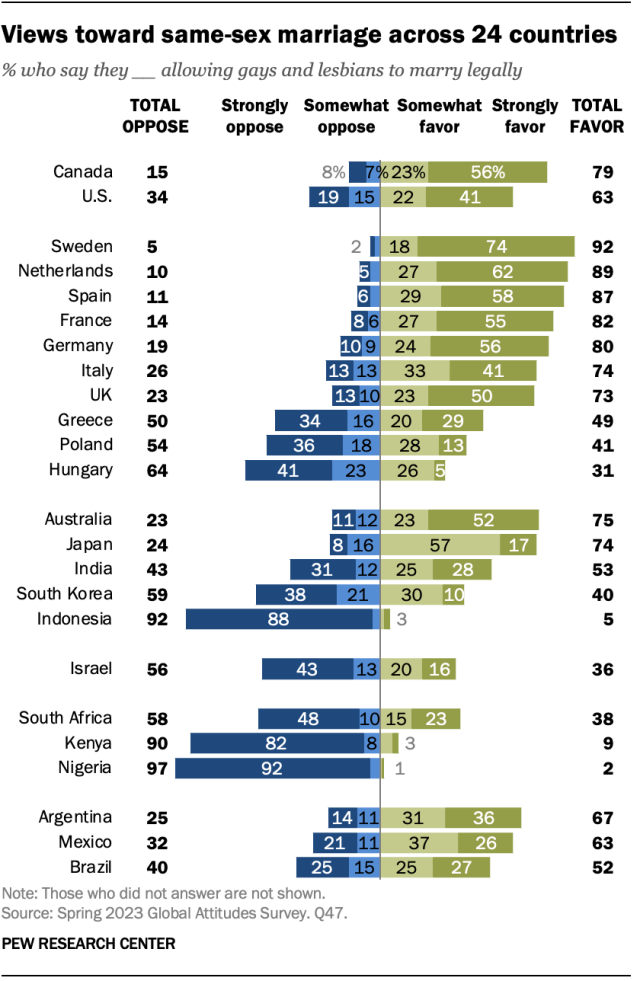
The discussion over legislation for sexual minorities has been led mainly by Japan’s opposition parties. They submitted a bill to eliminate discrimination based on sexual orientation or self-recognition of gender identity to the Diet in 2016. The movement eventually included some of the LDP lawmakers. Lawmakers on both sides of the aisle reached an agreement on a multi-partisan draft of the new bill in 2021, but it was blocked by the conservative members of the LDP. Earlier this year, after a careless speech by Kishida that same sex marriage would entirely change Japanese society and much-criticized remarks by a staff member in the prime minister’s office on the legitimacy of discrimination against the LGBTQ community, the administration was pressured to do something to protect gender orientation and identification. Kishida further demanded that the LDP pass an LGBTQ law before the G7 summit.
 
Conservative lawmakers who had been blocking LGBTQ legislature have been annoyed by this pressure. In LDP internal meetings on the issue of sexual minorities, they worked hard to dilute expressions that promote understanding of sexual minorities in the multi-partisan agreement under consideration. The most controversial change was the mainline LDP’s willingness to replace the phrase “discrimination on the basis of sexual orientation or self-recognition of gender identity shall not be tolerated” with the more ambiguous “no unfair discrimination on the basis of sexual orientation is allowed.” The opposition parties objected strongly, saying the insertion of “unfair” is needless to say, because there is no such thing as fair discrimination.
 
Other parts of the legislation were watered down as well. All the phrases of “self-recognition of gender identity” in the multi-partisan draft were replaced with “gender identity” on the theory that self-recognition might be interpreted as self-profession. The LDP conservatives’ apparent concern was that someone might be sneaking into the wrong side of public restrooms or baths. The LDP also dropped the words “effort of school administrators [gakkou setchisha]" in education. The argument in the LDP was that teachers were too immature and unskilled in sex education to lecture about LGBTQ.  
 
The LDP submitted a revised version of the bill to the Diet a few days before the Hiroshima Summit, receiving approval from its junior partner of the leading coalition, Komeito. Encouraged by the domestic legislative progress over gender recognition, Kishida, as the chairman of the G7 Summit, succeeded in organizing the leaders’ communiqué, including the section supporting a society where “all people can enjoy vibrant lives free from violence and discrimination independent of gender identity or expression or sexual orientation.”
 
After the summit, work on LGBTQ legislation bills became further complicated by the submission of several related bills. The Constitutional Democratic Party and the Japan Communist Party had already submitted a bill much the same as the multi-partisan draft, and the two parties did so on the same day that LDP submitted its own. The Japan Innovation Party (Ishin-no Kai) and the Democratic Party for the People submitted a third bill, which replaced the words of “gender identity” with “jendaa-aidentiti,” after the summit.

Not all the bills submitted to the Diet were discussed in either the Plenary or committees meetings. The Committee of Rules and Administration is chaired by an LDP lawmaker who selects the bills to be considered. Thus, a number of bills, mainly submitted by the opposition, are rejected even without discussion in every session. With the current Diet session ending June 21, time is running out to select and debate any bill selected.

While the political parties continue to struggle with LGBTQ legislation, the judicial branch is considering lawsuits brought in five Japanese cities by same-sex couples against the state. So far, three out of four courts have said that not allowing same-sex marriage is constitutionally problematic. At the end of May, the Nagoya Regional Court decided that provisions of Japan’s Civil Code or Family Register Act, which did not recognize same-sex marriage, were unconstitutional. The defect in the laws was that, the court said, “the same-sex couple of plaintiffs is excluded from the important personal benefit that is attached to a legal marriage.”

The court recognized the unconstitutionality of laws that do not recognize same-sex marriage, relying on Paragraph 2 of Article 24 of the constitution, which requires that all the laws be based on respect of individuals and the essential equality of both sexes in the choice of spouse. This is the first time for a court in Japan to recognize the unconstitutionality based on that clause. Although the Court did not comment on legislation under consideration in the Diet, the decision should be regarded as an expression of frustration with the slow progress in the legislative branch. This week, a court in Kyushu will issue a ruling on the fifth lawsuit.

UPDATE (6/16/23): After two years of discussion, the Diet passed a bill to promote understanding of sexual minorities. In the House of Councillors, the LDP, Komeito, Innovation Party, and the National Democratic Party (NDP) supported the bill. It was an amended version, actually a mixture of two bills, one submitted by the LDP and Komeito, and another by the Innovation and NDP. These four parties agreed on an amendment before the bill passed the House of Representatives on 13th. After an argument over the interpretation of “gender identity” in the Japanese language, the expression which would confusingly be recognized as allowing a man to enter a woman’s public bath, the four parties agreed on using the term of “jendaa aidentiti.” It also requires educational institutes to make efforts to achieve cooperation of families and local community before approving LGBTQ organizations. It is obvious that the law will be working as an obstruction to promote understanding of sexual minorities.

Fukuoka Regional Court ruled on June 8th that current laws related to marriage were in a “state of unconstitutionality,” because the plaintiffs, requiring the right for same-sex marriage, were suffering from the disadvantage of not being able to take advantage of the institution of marriage. Four out of five regional courts, including Fukuoka, Nagoya, Tokyo and Sapporo, decided that the laws were unconstitutional or in the state of unconstitutional on the lawsuits demanding recognition of the unconstitutionality of existing laws on same-sex marriage, urging the legislative branch to take further action. It is doubtful that the passed bill fulfills that requirement of the judicial branch.


Saturday, June 3, 2023

What did the G7 achieve?

 A World Still with Nuclear Weapons


By Takuya Nishimura, Editorial Writer, The Hokkaido Shimbun
The views expressed by the author are his own and are not associated with The Hokkaido Shimbun
May 22, 2023
 
As the chair of the Group of Seven (G7) Hiroshima Summit, Japanese Prime Minister Fumio Kishida stated that he would use the summit to pave the way to “a world without nuclear weapons.” Although the Leaders’ Communiqué did include those specific words, the G7 leaders did not provide a way to implement of this goal. This leaves one wondering what Kishida did achieve with this high-profile international engagement.
 
The document for nuclear disarmament, called the Hiroshima Vision on Nuclear Disarmament, was issued a day before the Communiqué. It unequivocally declared the indispensability of nuclear weapons in the context of nuclear deterrence. The G7 thus continue to contemplate a world where nuclear weapons still exist. Those who suffered the nuclear bombs, or the Hibakusha, in Hiroshima and Nagasaki were deeply disappointed by how ineffective Kishida had been.
 
While underscoring the importance of the 77-year record of non-use of nuclear weapons, the Hiroshima Vision firmly accuses Russia of its “irresponsible nuclear rhetoric, undermining of arms control regimes, and stated intent to deploy nuclear weapons in Belarus.” With these and other strong words denouncing Russia’s rhetoric, the Vision statement follows: “Our security policies are based on the understanding that nuclear weapons, for as long as they exist, should serve defensive purposes, deter aggression and prevent wars and coercion.”
 
This document, made under the leadership of Kishida, conditionally recognized the role of nuclear weapons without showing any clear roadmap to the world without nuclear weapons. The G7 fundamentally reject the work of Hibakushas. Coming through hardships of losing loved ones, being threatened by the fear of cancer, or discrimination from the fellow citizens, Hibakushas define nuclear weapons as “absolute evil” that kill too many people immediately. Their use can never be justified.
 
The Hiroshima Vision ironically justifies nuclear weapons as a countermeasure to Russian aggression in Ukraine and nuclear saber-rattling. Thus, to 91-year-old atomic bomb survivor, Setsuko Thurlow, the G7 Summit was a “huge failure,” as stated in her press conference on Sunday, May 21. The International Campaign to Abolish NuclearWeapons (ICAN), the 2017 Nobel Peace Prize winner, stated that the G7 fell “far short of providing any meaningful outcomes for nuclear disarmament.”

Mostly ignoring the backlash from the Hibakushas, Kishida said at his post-summit press conference that he was satisfied with the outcome of the G7 Hiroshima Summit. “We shared an ideal for the future of the world without a nuclear weapon.” Recognizing appeals from nuclear-suffered cities, Kishida considers Hiroshima Vision the basis for future actions to attain a world without nuclear weapons. Kishida viewed the visit of Ukrainian President Volodymyr Zelenskyy to Hiroshima as a chance to deliver further a message against threats to use nuclear weapons.
 
Although the G7 Summit was a stage to show that the G7 leaders stand together with Zelenskyy and to condemn Russia for its aggression against international law and order, inviting the Ukrainian president at war nevertheless was questionable. Hiroshima’s significance is as a place once devastated by a nuclear weapon and of the Hiroshima people’s hope for unconditional peace, not war at any cost.
 
After laying flowers at the cenotaph to A-bomb victims, Zelenskyy reflected that “Photographs of ruins of Hiroshima absolutely remind me of Bakhmut and other similar settlements.” For the people in Hiroshima who believe in the principle of “war is not the answer,” the sympathetic comment of Zelenskyy might have brought a sense of discomfort to them.
 
Obviously, Zelenskyy’s purpose in visiting Hiroshima was to continue and win the war with as much support as possible from the G7. U.S. President Joe Biden told Zelenskyy that the US would start training Ukrainian pilots to fly F-16 fighter jets. In a bilateral meeting with Zelenskyy, Indian Prime Minister, Narendra Modi, who is regarded as a key for anti-Russia groups to reach the countries called “global south,” conveyed his clear support for dialogue and diplomacy to find a way forward. Hiroshima had become the place where world leaders were seen deeply engaged in Ukraine’s war strategy.
 
For Kishida who has been promoting his positive pro-active security policies, the appearance of the Ukrainian president must have been a good opportunity to trumpet the “success” of policies to domestic audiences. In the meeting with Zelenskyy, Kishida pledged Japanese assistance by sending trucks and provisions and accepting injured Ukrainian military personnel in the Self-Defense Forces Central Hospital in Tokyo. The Kishida administration is likely to insist that current budget request for security measures or positive involvement in maintaining world order has been necessary.
 
In terms of dealing with China’s advances in Asia-Pacific region, the G7 summit produced some positive outcomes. Zelenskyy’s attendance reinforced the ties of democratic nations. In the outreach meeting attended by the G7 leaders, eight guests and Zelenskyy, Kishida stressed that coercive and unilateral change of status quo would not be tolerated anywhere in the world. It is necessary, he said, to protect free and open world order based on the rule of law.
 
The G7 Leaders’ Communiqué, in contrast to its message to Russia, was toward China, calling on engagement with G7 and recommending “de-risking” for economic resilience instead of decoupling from China. Yet, the leaders of four major powers in the Asia-Pacific region, Japan, United States, India, and Australia (meeting as the quadrilateral security dialog or QUAD), also issued a statement that opposed “destabilizing or unilateral actions that seek to change the status quo by force or coercion,” a suggestion that a Chinese invasion of Taiwan would be unacceptable.
 
Inevitably, Japan will have to deal with further pressure from China. Kishida’s inability to make progress on nuclear disarmament among his peers at the G7 Summit does not engender much confidence on how well he can pursue this. To date, Kishida has yet to offer a concrete vision for a meaningful dialogue with China. By following along with the G7's support of Ukraine and deterrence, Kishida set aside Japan's priority to stabilize the situation in Northeast Asia. China reacted against the G7 Communique with "strong dissatisfaction." It is possible that Kishida has raised the tension in Northeast Asia by introducing the structure of hostility in the Eastern Europe.