Saturday, November 7, 2015

Monday in Washington, November 9, 2015

PRESIDENT OBAMA AT G20, APEC AND ASEAN SUMMITS. 11/9, 8:30-9:30am. Sponsor: CSIS. Speakers: Heather Conley, Senior Vice President for Europe, Eurasia and the Arctic, CSIS; Michael Green, Senior Vice President for Asia, CSIS; Matthew Goodman, Senior Adviser for Asian Economics, CSIS; Ernest Bower, Senior Adviser for Southeast Asia Studies, CSIS.

IMF AFRICA REGIONAL ECONOMIC OUTLOOK. 11/9, 8:45am-12:30pm. Sponsor: Institute for International Economic Policy (IIEP), GWU. Speakers: Stephen C. Smith, IIEP Director; Celine Allard, IMF Lead Author; Amb. Reuben Brigety, Dean, Elliott School, GWU; Bhaswar Mukhopadhyay, IMF; Fariha Kamal, U.S. Census Bureau; Danny Leipzeiger, GWU; Dalia Hakura, IMF; James Foster, GWU.

TELECONFERENCE: THE CHINA-TAIWAN SUMMIT: HAS ANYTHING REALLY CHANGED? 11/9, 9:30-10:30am. Sponsor: Wilson Center. Speakers: Yeh-Chung Lu, Associate Professor of Diplomacy, National Cheng-chi University; Amb. J. Stapleton Roy, Distinguished Scholar, Wilson Center; Ming Wan, Professor of Policy, George Mason University.

WHAT IS THE BEST WAY TO HELP THE WORLD’S POOREST AND MOST VULNERABLE? 11/9, 10:00-11:30am. Sponsor: Center for Global Development (CGD). Speakers: Owen Barder, Director of CGD Europe and Senior Fellow, CGD; Jodi Nelson, Senior Vice President, Policy and Practice, International Rescue Committee; Sarah Bailey, Research Associate, Overseas Development Institute; Satwik Seshasai, Vice President of Engineering, Segovia; Moderator: Rajesh Mirchandani, Senior Director for Communications and Policy Outreach, CGD.

U.S. FED INTEREST RATE NORMALIZATION: THE IMPACT ON KOREA, THE U.S., AND THE GLOBAL ECONOMY. 11/9, Noon-1:30pm, Lunch. Sponsor: Korea Economic Institue (KEIA). Speakers: Thomas Byrne, President, Korea Society; Ayhan Kose, Director, Development Prospects Group, World Bank Group; Alex Pollack, Resident Fellow, AEI. Moderator: Donald Manzullo, President, CEO, KEI of America, Former member, House Subcommittee on Capital Markets and Government Sponsored Enterprises.

SECURITY CHALLENGES IN EAST ASIA. 11/9, 2:30-4:00pm. Sponsor: Wilson Center. Speakers: J. Stapleton Roy, Distinguished Scholar, Kissinger Institute, Wilson Center; Gerald Curtis, Burgess Professor of Political Science, Columbia University; Evans Revere, Nonresident Senior Fellow, Center for East Asia Policy Studies, Brookings; Rear Admiral Michael McDevitt, Senior Fellow, Center for Naval Analyses; Moderator: Donald Zagoria, Senior Vice President, National Committee on American Foreign Policy.

AFGHANISTAN IN 2015: RIPENING INVESTMENT OR REGRESSIVE TURNS? 11/9, 3:30-5:00pm. Sponsor: Carnegie. Speaker: Mohammad Umer Daudzai, Former Minister for Interior Affairs, Afghanistan, Former Chief of Staff to President of Afghanistan; Moderator: Ashley J. Tellis, Senior Associate, Carnegie.

THE STRATEGIC LESSONS OF THE CAMPAIGNS IN AFGHANISTAN AND IRAQ. 11/9, 4:30pm. Sponsor: Institute of World Politics. Speaker: Joseph J. Collins, Director, Center for Complex Operations, National Defense University, Author of Lessons Encountered: Learning from the Long War.

BEHIND THE SWOOSH: SWEATSHOPS JUSTICE. 11/9, 7:00pm-8:30pm. Sponsor: Georgetown University. Speaker: Jim Keady, Director of Educating for Justice Inc.

Wednesday, November 4, 2015

Prime Minister of Japan’s Schedule May 4-10, 2015

Monday, May 4, 2015

AM
12:00 At holiday home (no visitors)
07:08 Depart from holiday home in Narusawa Village, Yamanashi Prefecture
07:12 Arrive at golf course Fujizakura Country Club in Fujikawaguchiko Town, Yamanashi Prefecture. Golf with relatives, friends, and secretary

PM
03:26 Depart from golf course
03:29 Arrive at holiday home
05:30 Barbecue with wife Akie, mother Kishi Yoko, Cabinet Advisor Honda Etsuro, and secretaries


Tuesday, May 5, 2015

AM
12:00 At holiday home (no visitors)
07:50 Depart from holiday home in Narusawa Village, Yamanashi Prefecture
07:55 Arrive at Narusawa Golf Club in Narusawa Village. Golf with wife Akie, President of Rickie Business Solution Shibuya Koichi, and secretaries

PM
04:07 Depart from Narusawa Golf Club
04:13 Arrive at holiday home
06:20 Depart from holiday home
06:30 Arrive at yakiniku restaurant Tetsuan in Fujikawaguchiko Town, Yamanashi Prefecture. Dinner with wife Akie and relatives
08:20 Depart from restaurant
08:28 Arrive at holiday home

Wednesday, May 6, 2015

AM
12:00 At holiday home (no visitors)
07:24 Depart from holiday home in Narusawa Village, Yamanashi Prefecture
07:47 Arrive at Fuji Golf Course in Yamanakako Village, Yamanashi Prefecture. Golf with Honorary Chairman of Federation of Economic Organizations (Keidanren) Mitarai Fujio, Chairman of Keidanren Sakakibara Sadayuki, and Honorary Executive Consultant of JX Holdings Watari Fumiaki

PM
02:41 Depart from golf course
04:12 Arrive at private residence in Tomigaya, Tokyo

Thursday, May 7, 2015

AM
12:00 At private residence (no visitors)
08:00 At private residence in Tomigaya, Tokyo (no morning visitors)
09:30 Depart from private residence
09:45 Arrive at Imperial Palace. Register return to Japan
09:54 Depart from Imperial Palace
10:04 Arrive at office
10:23 Speak with Ministry of Defense (MOD)’s Director-General of Bureau of Operational Policy Miyama Nobuaki, Chief of Staff for Joint Staff Council Kawano Katsutoshi, and Commander of Escort Flotilla 4, Japan Maritime Self-Defense Force (JMSDF) Ito Hiroshi
10:37 Finish speaking with Mr. Miyama, Mr. Kawano, and Commander Ito
10:43 Meet with Minister of State for Science and Technology Policy Yamaguchi Shunichi and President of Science Council of Japan Onishi Takashi
11:02 End meeting with Mr. Yamaguchi and Mr. Onishi
11:03 Speak with Chairman of INPEX Corporation Kuroda Naoki
11:11 Finish speaking with Mr. Kuroda
11:21 Speak with Commissioner General of the National Police Agency Kanetaka Masahito
11:31 Finish speaking with Mr. Kanetaka
11:33 Speak with Director of Cabinet Intelligence Kitamura Shigeru
11:46 Finish speaking with Mr. Kitamura

PM
12:02 Meet with LDP Secretary-General Tanigaki Sadakazu
12:46 End meeting with Mr. Tanigaki
01:45 Meet with LDP Upper House member Moriya Hiroshi and others
02:02 End meeting with Mr. Moriya and others
02:03 Meet with Director of NSC Yachi Shotaro and MOD’s Director-General of Bureau of Defense Policy Kuroe Tetsuro
02:52 End meeting with Mr. Yachi and Mr. Kuroe
02:53 Meet with Vice-Minister for Foreign Affairs Saiki Akitaka
03:31 End meeting with Mr. Saiki
03:32 Meet with Minister for Reconstruction Takeshita Wataru and Reconstruction Agency’s Director-General for Reconstruction Policy Okamoto Masakatsu
03:53 End meeting with Mr. Takeshita and Mr. Okamoto
04:03 Receive a courtesy call from former Prime Minister of Papua New Guinea Michael Somare and his wife. Wife Akie also attends
04:34 Coutesy call ends
04:46 Meet with new Justice of the Supreme Court of Japan Koike Hiroshi and former Justice of the Supreme Court of Japan Kanetsuki Seishi
05:05 End meeting with Mr. Koike and Mr. Kanetsuki
05:08 Meet with Mr. Kitamura
05:32 End meeting with Mr. Kitamura
05:37 Meet with Minister of Internal Affairs and Communications Takaichi Sanae
06:00 End meeting with Ms. Takaichi
06:01 Meet with Minister for Foreign Affairs Kishida Fumio and MOFA’s Director-General of Latin American and Caribbean Affairs Bureau Takase Yasushi
06:49 Depart from office
06:50 Arrive at official residence

Friday, May 8, 2015

AM
12:00 At official residence (no visitors)
08:00 At official residence (no morning visitors)
08:06 Depart from official residence
08:07 Arrive at office
08:11 Headquarters for Promotion of Privatization of Postal Services meeting
08:17 Meeting ends
08:23 Cabinet Meeting begins
08:34 Cabinet Meeting ends
08:41 Meet with Deputy Prime Minister and Minister of Finance Aso Taro
09:06 End meeting with Mr. Aso
09:07 Meet with Secretary-General of Japan-Korea Parliamentarians’ Union Kawamura Takeo
09:33 End meeting with Mr. Kawamura
09:35 Speak with Special Advisor to the Prime Minister Kimura Taro
09:42 Finish speaking with Mr. Kimura
10:02 Depart from office
10:11 Arrive at Imperial Palace
10:30 Spring Presentation of Grand Cordon Ceremony
10:52 Depart from Imperial Palace
11:02 Arrive at office
11:21 Meet with Minister in charge of Abduction Issue Yamatani Eriko
11:47 End meeting with Ms. Yamatani

PM
01:11 Depart from office
01:18 Arrive at Imperial Palace. Spring Conferring of Order Ranks Ceremony
01:53 Depart from Imperial Palace
02:04 Arrive at office
03:15 Speak with President of Hisamitsu Pharmaceutical Company Nakatomi Hirotaka
03:25 Finish speaking with Mr. Nakatomi
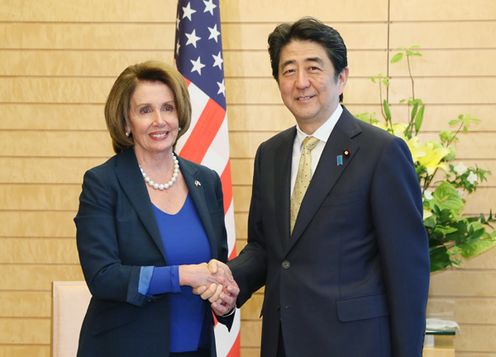
03:31 Receive a courtesy call from Democratic Leader of the United States House of Representatives Nancy Pelosi (D – CA)
04:19 Courtesy call ends
06:21 Depart from office
06:38 Arrive at private residence in Tomigaya, Tokyo

Saturday, May 9, 2015

AM
12:00 At private residence (no visitors)
08:00 At private residence in Tomigaya, Tokyo (no morning visitors)
Stay at private residence throughout morning

PM
12:17 Depart from private residence
12:36 Arrive at Palace Hotel Tokyo in Marunouchi, Tokyo. Attend Pacific Vision 21 Tokyo Meeting at French restaurant Crown within hotel, deliver address
01:51 Depart from hotel
02:03 Arrive at hotel Grand Hyatt Tokyo in Roppongi, Tokyo. Exercise at NAGOMI Spa and Fitness within hotel
03:44 Depart from hotel
04:07 Arrive at private residence

Sunday, May 10, 2015

AM
12:00 At private residence (no visitors)
10:00 At private residence in Tomigaya, Tokyo (no morning visitors)
Stay at private residence throughout morning

PM
Stay at private residence throughout afternoon and evening

Provisional Translation by: Erin M. Jones and Lu Pengqiao

Will Africa feed China? - no


Professor Deborah Bräutigam, a leading expert on China in Africa, is the MacMillan Center's Coca-Cola World Fund at Yale Lecturer. She disputes the common beliefs that China is acquiring large swaths of land, exporting food from Africa, and exploiting communities.

She is the Bernard L. Schwartz Professor of International Political Economy at Johns Hopkins University, and her teaching and research focus on international development strategies, governance, and foreign aid. She regularly advises international agencies and governments on China-Africa economic engagement. Professor Bräutigam is the author of The Dragon’s Gift: The Real Story of China in Africa and Chinese Aid and African Development: Exporting Green Revolution. We talk with her about her new book, Will Africa Feed China? It focuses on the question of “land grabs,” food security, and Chinese agribusiness investment in Africa.

Tuesday, November 3, 2015

Prime Minister of Japan’s Schedule April 27-May 3, 2015

Monday, April 27, 2015
AM
(Local time in Boston, U.S.)
Visit the site of the Boston Marathon bombing incident, lay a wreath
Visit Harvard Kennedy School. Deliver address, question and answer session with students
Visit Massachusetts Institute of Technology (MIT)

PM
designed so he does not bow
(Local time in Washington DC, U.S.)
Arrive by personal government aircraft at Andrews Air Force Base on outskirts of Washington, DC
Visit and walk around Lincoln Memorial guided by President of U.S. Barack Obama 
Visit Arlington National Cemetery, lay a wreath
Visit Holocaust Memorial Museum

Tuesday, April 28, 2015
AM
(Local time in Washington DC, U.S.)
Welcome ceremony at White House, summit meeting with President of U.S. Barack Obama

PM
(Local time in Washington DC, U.S.)
Joint Press Conference
Attend a luncheon hosted by Vice-President of U.S. Joe Biden and U.S. Secretary of State John Kerry at U.S. Department of State
Attend a state dinner at White House

Wednesday, April 29, 2015
again careful not to bow or lean forward
AM
(Local time in Washington DC, U.S.)
Visit National World War II Memorial
Deliver an address to a joint meeting of the U.S. Congress

PM
(Local time in Washington DC, U.S.)
Interview with Nippon TV in Blair House
Attend a reception hosed by the Speaker of the U.S. House of Representatives, meet with members of the U.S. Senate 
Participate in a symposium organized by Sasakawa Peace Foundation USA
Meet with members of the U.S. Chamber of Commerce
Attend a dinner reception for contributors to U.S.-Japan relations in Freer Gallery of Art.

Thursday, April 30, 2015
AM
(Local time in Washington DC, U.S.)
Attend a breakfast meeting with members of the U.S. science and technology community
Depart on personal government aircraft from Andrews Air Force Base on outskirts of Washington, DC

PM
Arrive at San Francisco International Airport by personal government aircraft
Exchange opinions with members of the U.S. business community, technology industry, and venture capital industry
Attend the Silicon Valley Japan Innovation Program and other events at Stanford University
Visit the headquarters of Tesla Motors and the headquarters of Facebook, and hold talks with Tesla Motors CEO Elon Musk and Facebook CEO Mark Elliot Zuckerberg
Visit the Gladstone Institutes, which are affiliated with the University of California, San Francisco Hold talks with Gladstone Institutes Senior Investigator and Director of Kyoto University’s Center for iPS Cell Research and Application Shinya Yamanaka and other members of the Institutes
Receive a courtesy call from Governor of the State of California Edmund G. Brown Jr., attend a cocktail reception and banquet held for contributors to Japan-U.S. exchange

Friday, May 1, 2015
AM
(Local time in California, U.S.)
Attend a breakfast meeting with Japanese entrepreneurs in Silicon Valley
Depart from San Francisco International Airport by personal government aircraft
Arrive at Los Angeles International Airport

here Abe bows
PM
(Local time in California, U.S.)
Attend a luncheon with contributors to Japan-U.S. exchange
Attend the Japan-U.S. Economic Forum
Hold talks with accompanying press group
Hold talks with Japanese nationals living in the United States and Japanese-Americans
Visit the Go For Broke Monument for Japanese American World War II veterans, lay a wreath
Visit the Japanese American National Museum, attend a reception hosted by the Museum

Saturday, May 2, 2015
AM
(Local time in California, US)
Hold talks with members of the KAKEHASHI Project
Visit University of Southern California

PM
(Local time in California, US)
Depart from Los Angeles International Airport on personal government aircraft

Sunday, May 3, 2015
AM
(In transit)

PM
(Japan time)
03:03 Finish visit to U.S., arrive at Haneda Airport on personal government aircraft with wife Akie
03:20 Depart from airport
03:44 Arrive at private residence in Tomigaya, Tokyo
05:33 Depart from private residence
06:54 Arrive at Chinese restaurant Ren in Fujiyoshida city, Yamanashi Prefecture. Dinner with mother Kishi Yoko, friends, and secretary
08:51 Depart from restaurant
09:01 Arrive at holiday home in Narusawa Village, Yamanashi Prefecture

Provisional Translation by: Erin M. Jones and Lu Pengqiao 

Sunday, November 1, 2015

Monday in Washington, November 2, 2015

BLOOD, OIL, AND CASH: CONFRONTING TERROR FINANCE IN TODAY’S MIDDLE EAST. 11/2, 10:00-11:30am. Sponsor: Center for American Progress (CAP). Speakers: Vikram Singh, Vice President for National Security and International Policy, Center for American Progress; Juan Zarate, former Deputy National Security Adviser for Combating Terrorism; first Assistant Secretary of the Treasury for Terrorist Financing and Financial Crimes; William F. Wechsler, Senior Fellow, Center for American Progress; former Deputy Assistant Secretary of Defense for Special Operations and Combating Terrorism; Hardin Lang, Senior Location: CAP, 1333 H St. NW, 10th Floor.

THE LAST CELESTIAL EMPIRE: MAO ZEDONG, KIM IL-SUNG AND SINO-NORTH KOREAN RELATIONS. 11/2, 10:00am-Noon. Speakers: Zhihua Shen, director of the Center for Cold War International History Studies at East China Normal University in Shanghai, China. Robert Daly, Director, Kissinger Institute on China and the United States, Woodrow Wilson International Center for Scholars; James Person, Coordinator, Hyundai Motor–Korea Foundation Center for Korean History and Public Policy; Deputy Director, History and Public Policy Program, Woodrow Wilson International Center for Scholars; Jonathan Pollack, Senior Fellow in the John L. Thornton China Center and the Center for East Asia Policy Studies at the Brookings Institution; Moderated by: Christian F. Ostermann, Director, History and Public Policy Program, Woodrow Wilson International Center for Scholars.

REPORT LAUNCH: TO WALK THE EARTH IN SAFETY. 11/2, 10:30-11:30am, Washington, DC. Sponsor: Stimson Center. Speakers: Rose Gottemoeller, Under Secretary of State for Arms Control and International Security, U.S. Department of State; Lincoln P. Bloomfield, Jr., Chairman, Stimson Center Board of Directors; Stanley Brown, Director of the Office of Weapons Removal and Abatement, Bureau of Political-Military Affairs, U.S. Department of State; Antoine Chedid, Lebanese Ambassador to the United States of America; Jamie Franklin, Executive Director, Mines Advisory Group; Moderator: Rachel Stohl, Senior Associate, Stimson Center.

NUCLEAR POLICY TALK: ARGONNE NATIONAL LAB AND NATIONAL & GLOBAL SECURITY. 11/2, 12:30-2:00pm. Sponsor: Elliott School, GWU. Speaker: Keith S. Bradley, Director of National & Global Security Programs, Argonne National Laboratory (ANL).

DIALOGUE ON TRADE POLICY 2015. 11/2, 1:00-2:30pm. Sponsor: Association of Government Relations Professionals (AGRA). Speaker: Angela Ellard, Ways & Means Committee Chief Trade Counsel and Trade Subcommittee Staff Director; Jason Kearns, Chief International Trade Counsel, House Ways and Means Committee; Jayme White, Chief Adviser for International Competitiveness and Innovation, Senate Finance Committee; Everett Eissenstat, Chief International Trade Counsel, Senate Finance Committee.

THE NEW GLOBAL TRADE AGENDA. 11/2, 3:00-4:30pm. Sponsor: Peterson Institute for International Economics (PIIE). Speakers: Pascal Lamy, Former Director-General, World Trade Organization; Robert B. Zoellick, Chairman, Goldman Sachs International Advisors; Anabel González, Senior Director, World Bank Group Global Practice Trade and Competitiveness.

SYMPOSIUM ON IMPROVING WOMEN AND MEN'S WORK ENVIRONMENT IN JAPANESE SOCIETY. 11/2, 5:30pm. In Japanese. Sponsors: Japan-America Society of Washington DC (JASW); Japan Information and Culture Center (JICC). Speakers: Abigail Friedman, CEO, Founder, The Wisteria Group, Senior Advisor, Asia Foundation; Author, The Haiku Apprentice, Memoirs of Writing Poetry in Japan, I Wait for the Moon: 100 Haiku of Momoko Kuroda; Ken Kuribayashi, Vice President & General Manager, Washington Office, Sojitz Corporation of America; Kataoka Ai, Scientist, Grocery Manufacturers Association; Ayako Smethurst, Co-Founder, Board Member, President, Kizuna Across Cultures; Moderator: Shigeko Bork, Founder, President, The Shigeko Bork Mu Project.

NCIS: CURRENT AND FUTURE OPERATIONS IN INVESTIGATING AND DEFEATING TERRORISTS, FOREIGN INTELLIGENCE, ADN CRIMINAL THREATS. 11/2, 5:30-6:30pm. Sponsor:  The Institute of World Politics. Speaker: Andrew L. Traver, Director, Naval Criminal Investigative Service (NCIS).

Thursday, October 29, 2015

Historical revisionism undermines Abe’s apology

the books being distributed by Dietmembers
By Professor Tessa Morris-Suzuki, ARC Laureate Fellow based at the School of Culture, History and Language, at the College of Asia and the Pacific at The Australian National University and APP member

First published in the East Asia Forum, 26 October 2015

On 14 August, the day before the 70th anniversary of the end of the Pacific War, Japanese Prime Minister Shinzo Abe issued a long-awaited statement on Japanese memory of the war and his vision for the future. In it, he emphasised that the apologies given by previous Japanese cabinets ‘will remain unshakable into the future’. Abe’s statement received mixed responses from around the world. While some expressed concern at its account of 20th century history, the United States welcomed Abe’s ‘expression of deep remorse for the suffering caused by Japan during the World War II era, as well as his commitment to uphold past Japanese government statements on history’.

But recent events raise serious questions about the commitment of the Abe government to upholding past apologies.

For the past several weeks, prominent members of the Liberal Democratic Party (LDP) have sent unsolicited gifts of two books to academics, journalists and politicians in the English-speaking world (mostly in the United States). The books are accompanied by letters that draw attention to Abe’s 70th anniversary statement. They claim that history is being distorted by certain unnamed individuals and urge the recipients to read the books as a corrective.

The first book is Getting Over It! Why Korea Needs to Stop Bashing Japan, by Oh Sonfa, a naturalised Japanese citizen of Korean origin who is best known in Japan for publications disparaging her former homeland. Oh’s book urges Japan to turn its back on China and particularly on South Korea, which, she argues, suffers from incurable ‘narrow egotism and prejudice’ reflecting the nation’s ‘history and its racial characteristics’.

Echoing Japanese wartime propaganda, Oh paints Japanese colonial expansion, in opposition to Western colonialism, as essentially good. While she describes Western imperial powers as brutal and exploitative, she claims Japanese colonial control of the Korean peninsula ‘implemented no policies aimed at exploiting Korea’, ‘did not use armed suppression to govern’ and even ‘abolished restrictions on freedom of speech’. All of this will come as news to most historians of Asia.

The second book, History Wars, Japan — False Indictment of the Century, is written [by Sankei Washington reporter at large Yoshihisa Komori] and published by the right-wing Sankei newspaper. It pours vitriolic scorn on the historic 1993 Kono Statement, which apologised to former ‘comfort women’, who were sexually exploited in Japanese military brothels during the war. The Kono Statement, along with the Murayama Statement, is the most crucial of the Japanese government official statement on wartime history that Abe declared Japan’s ‘commitment to uphold’ in his statement.

History Wars claims that there is no evidence to support Japan’s 1993 admission that some ‘comfort women’ had been recruited against their own will, at times with the direct involvement of Japanese military or officials. A number of the book’s arguments echo those presented in June 2014 by a team created by the Abe government to investigate the processes that led to the Kono Statement, though the Sankei book expresses these arguments in more extreme terms.

History Wars depicts the surviving Korean ‘comfort women’ as confused old women tempted into giving false evidence by promises of money. And it claims that the Japanese government made the apology knowing it to be factually baseless, simply out of an ardent desire to appease South Korea. These bizarre claims are based on a selective misreading of the available historical evidence and have been strongly denied by former Chief Cabinet Secretary Yohei Kono, who issued the 1993 apology.

return address on package
National Press Club DC
If these books had been distributed by a fringe right-wing organisation, they might have caused minor embarrassment. But they are being distributed by leading politicians from the ruling LDP, including a key member of the party’s International Information Investigation Committee (LDP/IIIC). One of the politicians actively distributing the books in the United States has since been appointed the special advisor to the prime minister on cultural diplomacy. [Another, Lower House member, Katsuyuki KAWAI, was recently appointed special advise to the prime minister. Dr. Inoguchi has a PhD from Yale University and is on Japan's National Commission for UNESCO.]

On 19 June 2015, the LDP/IIIC presented Prime Minister Abe with an interim report on proposed measures to counter the ‘anti-Japanese propaganda of China and South Korea etc’. Abe’s reported response was to exhort the committee to ‘further strengthen its efforts’. On 19 September, the Committee passed a resolution that blamed the distortion of ‘international society’s perception of our country’s history’ on ‘lies’ disseminated by the liberal Asahi newspaper. It went on to call for a national information policy that would ‘change from the merely “neutral” or “defensive” stance to a more positive dissemination of information’. The dissemination of History Wars and Getting Over It appears to be a step in this ‘positive dissemination’ campaign.

This is deeply concerning as it suggests that the campaign has been endorsed by Abe and is being carried out by key figures in the ruling LDP party. These actions are inconsistent with Abe’s promise to the global community in his statement on 14 August. Historical revisionism that denounces the Kono Statement and whitewashes the record of Japanese colonialism is incompatible with Abe’s expressions of ‘deep remorse’ and promises to ‘engrave in our hearts the past’.

There is no evidence to suggest that the extremist views expressed in these two books are shared by most ordinary Japanese people. The actions by members of the LDP are undermining decades of hard work by many Japanese civil society groups to heal the wounds of past violence. Such factually inaccurate accounts of Japan’s war history can only damage the standing of Japan in the international community. The time has come for a more reasoned approach from all participants in these tragic and destructive ‘history wars’.

Wednesday, October 28, 2015

Russia announces plans to build military base on disputed Kurile Islands


Seventy Years After the End of WWII, the Kuriles Still Roil Russian-Japanese Relations

By: Dr. John C. K. Daly, Jamestown Foundation


On October 22, Russian Defense Minister Sergei Shoigu announced that Russia plans to build a military base in the Kurile Islands, annexed by the Soviet Union from Japan at the end of World War II (Zerkalo Nedeli, October 22). Shoigu did not specify what the facility would be. Following Shoigu’s remarks Japan’s Chief Cabinet Secretary Yoshihide Suga said that the government was studying the Russian defense minister’s statements, telling a press conference in Tokyo, “We do not have accurate data, [due to] the form in which the declaration was made, so there will be no further response until after a full examination of this information is made. Our position remains unchanged” (Vzgliad, October 23). Tokyo’s position, since 1945, has been that Russia must return the four southernmost Kurile Islands, a demand that Russia has consistently refused.

The Kurile archipelago straddles the western Pacific Ocean from the northernmost Japanese island of Hokkaido to the southern tip of Russia’s Kamchatka Peninsula. The four southernmost of the chain’s 18 islands—Kunashir, Iturup, Shikotan and the Habomai islets—are called the Southern Kuriles by Russia and the Northern Territories by Japan. The dispute involves the four islands seized by Soviet forces after the Union of Soviet Socialist Republics (USSR) declared war on Japan, on August 8, 1945.

The declaration came three months to the day after the end of the war in Europe, as Joseph Stalin had promised his Western allies at both the Yalta and subsequent Potsdam conferences that the USSR would enter the Pacific theater against Japan after European military operations ended. The declaration nullified the Soviet-Japanese Neutrality Pact of April 13, 1941, which was to run for five years. By September 1, the Soviet seizure of the Kuriles was complete. Since 1956, Japan has persistently demanded the return of the “Northern Territories,” but both the USSR and, since 1991, the Russian Federation, have refuted Japanese claims.

During the Cold War, the Kuriles assumed increasing strategic importance for the USSR because they block the entrance to the Sea of Okhotsk. Beginning in the late 1960s, the Soviet navy introduced the Yankee-class submarine, armed with 16 SS-N-6 submarine-launched ballistic missiles (SLBM). At that time, many Western analysts predicted that the USSR would assume a “bastion defense” concept for this and successive ballistic missile submarines. The “bastion defense” concept involves removing ballistic missile submarines from enemy coastlines into Soviet maritime “bastions”—one of which being the Sea of Okhotsk—making it both difficult for enemy maritime forces to penetrate and easier for the Soviet military to defend (Richard L. Haver, “Soviet Navy Perspectives,” United States Naval Institute Proceedings, May 1988, p. 236).

Yet, Russia’s interest in retaining the Kuriles is not solely nationalistic and military. On Iturup, near the Kudriavyi volcano, is the world’s richest known deposit of rhenium, a rare earth element used in alloys to create components for missile and supersonic aircraft technology (Interfax, August 10). Moreover, nickel-based rhenium super-alloys are used in combustion chambers, turbine blades and jet engine exhaust nozzles. The Iturup rhenium deposit’s discovery was announced in 1994 (Nature 369, May 5, 1994, pp. 51–52).

Because of this element’s low availability relative to demand, rhenium is among the most expensive of metals; in March in the wake of earthquakes in top producer Chile, prices of refined rhenium pellets, used in heat-resistant alloys by the aircraft industry, were quoted at $4,000–$5,200 per kilogram, up from around $3,600–$5,000 per kg the previous week (Reuters, March 31). In August 2015, Interfax reported that Kurile Island production of rhenium could reach up to 40 tons by the year 2025 (Interfax, August 10).

Other mineralogical deposits in the Kuriles include thousands of tons of titanium and iron ore, along with 1,867 tons of recoverable gold and 9,284 tons of silver. The islands are also surrounded by rich fishing grounds (Pravda, January 26, 2012).

Three months before Shoigu made his announcement of new Kurile Island military facilities, Russian Prime Minister Dmitriy Medvedev told reporters that the island chain would be included as a territory of priority development (TOR) for Russia, along with two areas in Khabarovsk krai and one in Primorye. Medvedev added that the total funding of the Kurile program was set at $1.1 billion over the next decade, further noting that he planned to visit the Kurile Islands in the future (Vzgliad, July 23). More recently, on October 15, emphasizing Russia’s military interests in the contested archipelago, Russian Eastern Military District spokesman Aleksandr Gordeev announced that advanced Russian Su-35 fighter jets carried out military exercises near the Kurile Islands (TASS, October 15).

The Kurile dispute remains unresolved since World War II and has kept Russia and Japan from signing a formal peace treaty (see EDM, July 31, October 9). Farther afield, Russia’s expansion of its military bases in both the Arctic and Kurile Islands, combined with its intervention in Syria, is causing concern in the West. An official of the North Atlantic Treaty Organization (NATO), speaking on condition of anonymity, recently told Voice of America, “Russia is increasingly assertive and unpredictable” (Voice of America, October 23). 

Unlike Japan’s diplomatic dispute with South Korea over the Liancourt Rocks or the Japanese-administered Senkaku Islands, also claimed by China and Taiwan, the Kurile issue is the result of military action, not contested sovereignty claims based on historical maps and documents. As Vladimir Putin’s administration has been increasingly flexing Russia’s military prowess against opponents ranging from NATO to the Islamic State, it would seem that diplomacy remains Japan’s best option, despite a lack of success over seven decades.

Sunday, October 25, 2015

Monday in Washington, October 26, 2015

OVERCOMING THE LIMITS TO GROWTH: SUSTAINABILITY LESSONS FROM JAPAN. 10/26, 10:00-11:15am. Sponsor: CNEAPS, Brookings. Speakers: Mireya Solís, Senior Fellow, Philip Knight Chair in Japan Studies, Brookings; Hiroshi Komiyama, Chairman, Mitsubishi Research Institute, Founder, Advisory Board, U.S.-Japan Research Institute, President Emeritus, University of Tokyo.

click to order
PUTIN’S CRIMEAN GAMBLE: RUSSIA, UKRAINE, AND THE NEW COLD WAR. 10/26, 10:30am-Noon. Sponsor: Brookings. Speaker: author Marvin Kalb, Nonresident Senior Fellow, Foreign Policy; Moderator: Martin S. Indyk, Executive Vice President, Brookings.

THE RISE OF THE WORLD'S POOREST COUNTRIES. 10/26, Noon-2:00pm, Lunch. Sponsor: National Endowment for Democracy (NED). Speakers: Steven Radelet, Donald F. McHenry Chair in Global Human Development, Edmund A. Walsh School of Foreign Service, Georgetown University; Richard Messick, Senior Contributor, Global Anticorruption Blog; Moderator: Marc F. Plattner, Vice President, Research and Studies, NED.

click to order
DEVOTION: A TALE OF COURAGE FROM THE "FORGOTTEN WAR". 10/26, 2:00-3:30pm. Sponsor: Korea Economic Institute of America (KEI). Speakers: Adam Makos, Author, Devotion: An Epic Story of Heroism, Friendship, and Sacrifice; Lt. Gen. Wallace "Chip" Gregson (USMC, Ret.), Senior Advisor at Avascent International, Former Assistant Secretary of Defense for Asian and Pacific Security Affairs; James Person, Ph.D, Deputy Director, History & Public Policy Program, Coordinator, Center for Korean History & Public Policy, Wilson Center.

EMPOWERING THE NEXT GENERATION: A CONVERSATION WITH PAKISTAN'S CIVIL SOCIETY LEADERS. 10/26, 4:00-5:15pm, Reception. Sponsor: Atlantic Council. Speaker: The 2015 Emerging Leaders of Pakistan, including Ali Haider, Anam Bhatti, Danish Ali Bhutto, Fakiha Ali, Fatima Rizwan, Hussain Haider, Khalid Khawaja Mushtaq, Rafia Farooqui, Rizwan Shoukat, Saima Feroz, Sawai Mal, Syed Azhar Shah, Usman Khan, Zahra Ali, and Zulqarnain Jameel; Moderator: Nazia Khan, Assistant Director, South Asia Center, Atlantic Council.

Prime Minister of Japan’s Schedule April 20-26, 2015

Monday, April 20, 2015

AM
12:00 At private residence (no visitors)
08:00 At private residence in Tomigaya, Tokyo (no morning visitors)
08:53 Depart from private residence
09:06 Arrive at office
09:07 Meet with Minister in charge of Abduction Issue Yamatani Eriko
09:40 End meeting with Ms. Yamatani
09:41 Meet with Ministry of Foreign Affairs (MOFA)’s Director-General of Foreign Policy Bureau Hiramatsu Kenji
10:02 End meeting with Mr. Hiramatsu
10:34 Meet with Deputy Chief Cabinet Secretary Kato Katsunobu; Administrative Vice-Minister for Foreign Affairs Sugiyama Shinsuke; Vice-Minister of Finance for International Affairs Yamasaki Tatsuo; Administrative Vice-Minster of Agriculture, Forestry and Fisheries Harihara Hisao; Administrative Vice-Minister of Economy, Trade and Industry Ishiguro Norihiko; Administrative Vice-Minister of Land, Infrastructure, Transport and Tourism Muto Hiroshi; and MOFA’s Director-General of Middle Eastern and African Affairs Bureau Uemura Tsukasa
11:21 End meeting with Mr. Kato, Mr. Sugiyama, Mr. Yamasaki, Mr. Harihara Hisao, Mr. Ishiguro, Mr. Muto, and Mr. Uemura

PM
12:41 Meet with Vice-Minister for Foreign Affairs Saiki Akitaka
01:01 End meeting with Mr. Saiki
01:15 Speak with Governor of Mie Prefecture Suzuki Eikei
01:26 Finish speaking with Mr. Suzuki
01:27 Speak with Special Advisor to the Prime Minister Kimura Taro and LDP Upper House member Iwaki Mitsuhide
01:41 Finish speaking with Mr. Kimura and Mr. Iwaki
01:42 Meet with Director of National Security Council (NSC) Yachi Shitaro, and MOFA’s Mr. Saiki and Director-General of Asian and Oceanian Affairs Bureau Ihara Junichi
02:04 End meeting with Mr. Yachi, Mr. Saiki, and Mr. Ihara
02:36 Interview with American newspaper Wall Street Journal
03:33 Interview ends
03:50 Receive a courtesy call from Speaker of Milli Mejlis (Parliament) of the Republic of Azerbaijan Ogtay Asadov
meeting with Heike Associaiton
04:01 Courtesy call ends
04:15 Speak with Chairman of National Heike (Taira Clan) Association Nozaki Hiroshi and colleagues
04:23 Finish speaking with Mr. Nozaki and colleagues
04:24 Meet with Mr. Yachi, MOFA’s Mr. Saiki, Mr. Sugiyama, and Director-General of North American Affairs Bureau Tomita Koji
04:57 End meeting with Mr. Yachi, Mr. Saiki, Mr. Sugiyama, and Mr. Tomita
04:58 Depart from office
05:00 Arrive at Diet
05:01 Enter LDP President’s Office
05:02 Speak with Mayor of Shizuoka City (Shizuoka Prefecture) Tanabe Nobuhiro
05:03 Finish speaking with Mr. Tanabe
05:04 LDP Officers Meeting
05:15 Meeting ends
05:23 Leave LDP President’s Office
05:24 Depart from Diet
05:26 Arrive at office
05:43 Ministerial Council on Monthly Economic Report and Other Relative Issues meeting
05:56 Council meeting ends
06:10 Speak with Mr. Yachi and Assistant Chief Cabinet Secretary Kanehara Nobukatsu
06:19 Finish speaking with Mr. Yachi and Mr. Kanehara
06:20 Meet with LDP Lower House member Kawai Katsuyuki
06:38 End meeting with Mr. Kawai
07:28 Depart from office
07:41 Arrive at Fuji TV in Daiba, Tokyo
08:00 Appear on news program
08:49 Finish appearance
09:09 Depart from Fuji TV
09:31 Arrive at private residence

Tuesday, April 21, 2015
AM
12:00 At private residence (no visitors)
07:41 Depart from private residence in Tomigaya, Tokyo
07:54 Arrive at office
07:58 Meet with Deputy Prime Minister and Minister of Finance Aso Taro, Minister for Foreign Affairs Kishida Fumio, Ministry of Finance (MOF)’s Director-General of Budget Bureau Kagawa Shunsuke, Vice-Minister of Finance for International Affairs Yamasaki Tatsuo, and Director-General of International Bureau Asakawa Masatsugu
08:25 End meeting with Mr. Aso, Mr. Kishida, Mr. Kagawa, Mr. Yamasaki, Mr. Asakawa
08:29 Cabinet Meeting begins
08:38 Cabinet Meeting ends
08:40 Meet with Mr. Aso, MOF’s Mr. Kagawa, Director-General of Tax Bureau Sato Shinichi, and Mr. Asakawa
09:22 End meeting with Mr. Aso, Mr. Kagawa, Mr. Sato, and Mr. Asakawa
09:35 Meet with Minister in charge of TPP Amari Akira, Chief Domestic Coordinator of Governmental Headquarters for TPP Sasaki Toyonari and Deputy Chief Negotiator Oe Hiroshi
09:50 End meeting with Mr. Amari, Mr. Sasaki, and Mr. Oe
09:51 Meet with Director of Cabinet Intelligence Kitamura Shigeru
10:25 End meeting with Mr. Kitamura
10:28 Meet with resident US Ambassador to Japan Caroline Kennedy
11:00 End meeting with Ms. Kennedy
11:04 Receive a courtesy call from the winners of the 2015 (31st) Japan Prize
11:19 Courtesy call ends
11:20 Speak with the governor of Fukui Prefecture Nishikawa Issei
11:26 Finish speaking with Mr. Nishikawa
11:27 Depart from office
11:30 Arrive at ANA InterContinental Hotel Tokyo in Akasaka, Tokyo. Lunch meeting with former mayor of Yuya-cho, Yamaguchi Prefecture Fujita Yoshihisha and others at Chinese restaurant Karin within hotel
11:48 Depart from hotel
11:55 Arrive at Diet
11:57 Enter Lower House Chamber
11:58 Speak with LDP Lower House member Kishi Nobuo

PM
12:00 Finish speaking with Mr. Kishi
12:02 Lower House Plenary Session opens
12:04 Speak with LDP Executive Acting Secretary-General Hosoda Hiroyuki
12:09 Finish speaking with Mr. Hosoda
12:49 Lower House Plenary Session adjourns
12:50 Leave Lower House Chamber
12:51 Enter Lower House Speaker’s Office. Greet Lower House Speaker Oshima Tadamori
12:53 Leave Lower House Speaker’s Office
12:54 Depart from Diet
12:56 Arrive at office
12:58 Meet with Chairman of LDP Election Strategy Committee Motegi Toshimitsu
01:24 End meeting with Mr. Motegi
01:31 Depart from office
01:40 Arrive at Akasaka Imperial Gardens in Moto-Akasaka, Tokyo. Attend Spring Garden Party with wife Akie
03:18 Depart from Akasaka Imperial Gardens
03:25 Arrive at office
04:32 Interview open to all media: when asked “the possibility of holding a Japan-China Summit meeting during the Asian-African Conference,” Mr. Abe answers, “if there is a chance to hold a summit meeting in a natural way, I am ready. I hope to Japan and China can return to the origin of mutually beneficial relationship based on common strategic interests and further improve our relations.”
04:35 Interview ends
04:36 Depart from office
04:55 Arrive at Haneda Airport
05:21 Depart from airport on personal government aircraft bound for Indonesia in order to attend 60th Anniversary of Asian African Conference Commemoration Summit
(Local time in Jakarta City, Indonesia)
Arrive at Halim Perdanakusuma International Airport in Jakarta City, Indonesia
Arrive at Hotel Mulia Senayan in Jakarta City
Stay night at hotel

Wednesday, April 22, 2015
AM
(Local time in Jakarta City, Indonesia)
Attend 60th Anniversary of Asian African Conference (Bandung Conference)
Commemoration Summit at Jakarta Convention Center. Commemorative photo session. Opening Ceremony
Offer flowers at Kalibata Heroes’ Cemetery in Jakarta City. [military casualties and veterans from Indonesia's War of Independence as well as many Japanese veterans of the Imperial Japanese Army who assisted]
Conference with Prime Minister of the Arab Republic of Egypt Ibrahim Mahlab within convention center
Give speech at the conference

PM
(Local time in Jakarta City, Indonesia)
Working lunch with King of Jordan Abdullah II bin Al Hussein at Hotel Mulia Senayan
Conference with President of Indonesia Joko Widodo within convention center. Conference with Prime Minister of Bangladesh Sheikh Hasina
Conference with President of China Xi Jinping. Interview open to all media. Conference with President of Iran Hassan Rouhani
Stand and speak with Foreign Minister of Republic of Tunisia Baccouche Taieb.
Dinner meeting at Merdeka Palace
Stay night at hotel

Thursday, April 23, 2015
AM
(Local time in Jakarta City, Indonesia)
Depart from Halim Perdanakusuma International Airport in Jakarta City on personal government aircraft

PM
05:38 Finish attendance of 60th Anniversary of Asian African Conference Commemoration Summit, arrive at Haneda Airport on personal government aircraft
05:55 Depart from airport
06:15 Arrive at Imperial Palace. Register return to Japan
06:22 Depart from Imperial Palace
06:39 Arrive at private residence in Tomigaya, Tokyo

Friday, April 24, 2015
AM
12:00 At private residence (no visitors)
07:32 Depart from private residence in Tomigaya, Tokyo
07:44 Arrive at office
08:04 Cabinet Meeting begins
08:17 Cabinet Meeting ends
08:20 Meet with Minister for Foreign Affairs Kishida Fumio; Minister of Economy, Trade and Industry Miyazawa Yoichi; Minister of the Environment Mochizuki Yoshio; and Commissioner of Agency for Natural Resources and Energy Ueda Takayuki
08:46 End meeting with Mr. Kishida, Mt. Miyazawa, Mr. Mochizuki, and Mr. Ueda
08:47 Meet with Minister of Land, Infrastructure, Transport and Tourism Ohta Akihiro
09:09 End meeting with Mr. Ohta
09:23 Meet with Special Advisor to President of LDP Hagiuda Koichi
09:40 End meeting with Mr. Hagiuda
10:14 Meet with MOFA’s Vice-Minister Saiki Akitaka and Director-General of North American Affairs Bureau Tomita Koji
11:01 End meeting with Mr. Saiki and Mr. Tomita
11:41 Meet with Chairman of Japan-US Business Council Ishihara Kunio
11:56 End meeting with Mr. Ishihara
11:59 Meet with LDP Secretary-General Tanigaki Sadakazu

PM
12:39 End meeting with Mr. Tanigaki
01:19 Meet with Minister in charge of TPP Amari Akira and Chief Domestic Coordinator of Governmental Headquarters for TPP Sasaki Toyonari
02:02 End meeting with Mr. Amari and Mr. Sasaki
02:08 Meet with Minister for Foreign Affairs Kishida Fumio, MOFA’s Administrative Vice-Minster for Foreign Affairs Sugiyama Shinsuke, Director-General of North American Affairs Bureau Tomita Koji and MOF’s Vice-Minister of Finance for International Affairs Yamasaki Tatsuo and Director-General of International Bureau Asakawa Masatsugu
02:45 End meeting with Mr. Kishida, Mr. Sugiyama, Mr. Tomita, Mr. Yamasaki, and Mr. Asakawa
02:46 Speak with Governor of Fukuoka Prefecture Ogawa Hiroshi
02:49 Finish speaking with Mr. Ogawa
02:51 Meet with Mr. Kishida; Administrative Vice-Minister of Internal Affairs and Communications Sakamoto Yasuo; Mr. Sugiyama; Administrative Vice-Minister of Agriculture, Forestry and Fisheries Harihara Hisao; Administrative Vice-Minister of Economy, Trade and Industry Ishiguro Norihiko; Administrative Vice-Minister of Land, Infrastructure, Transport and Tourism Muto Hiroshi; and Administrative Vice-Minister of Defense Tokuchi Hideshi
03:57 End meeting with Mr. Kishida, Mr. Sakamoto, Mr. Sugiyama, Mr. Harihara, Mr. Ishiguro, Mr. Muto, and Mr. Tokuchi
04:20 Speak with Cabinet Advisor Hamada Koichi
04:33 Finish speaking with Mr. Hamada
04:34 Meet with Director-General of North American Affairs Bureau Tomita Koji and MOD’s Director-General of Bureau of Defense Policy Kuroe Tetsuro
05:01 End meeting with Mr. Tomita and Mr. Kuroe
05:24 Interview with Yukan Fuji
05:57 Interview ends
05:58 Speak with Special Advisor to the Prime Minister Kimura Taro
06:01 Finish speaking with Mr. Kimura
06:03 NSC meeting
06:24 Meeting ends
06:25 Meet with LDP Lower House member Nukaga Fukushiro
06:43 End meeting with Mr. Nukaga
06:59 Depart from office
07:00 Arrive at official residence


Friday, October 23, 2015

Japan’s public diplomacy of churlish cluelessness

From the Yushukan
BY JEFF KINGSTON director of Asian Studies, Temple University Japan and APP Member

First published in The Japan Times October 17, 2015

Enough is enough. How dare UNESCO inscribe primary sources and a wartime video about the Nanking mayhem into global memory? I fully support the Japanese government’s threats to withdraw funding from UNESCO to protest its recent decision to include a dossier submitted by China, “Documents of Nanjing Massacre,” in the Memory of the World Register. Nothing could better highlight Japan’s bumbling public diplomacy, or pettifogging about its shared history with Asia.

Perhaps the money saved could be used to establish a “Forgetting of the World Registry,” an institution that would surely do a brisk business as so many nations would love to cleanse their reputations and bury their darkest moments in such a repository. The Yushukan Museum adjacent to Yasukuni Shrine could serve as a model for such an initiative as the displays regarding Japan’s era of imperialism are meticulously scrubbed of any atrocities, while the wartime leaders who led the rampage through Asia between 1931 and 1945 — liberating tens of millions of oppressed Asians from the miseries of life, while enslaving countless others — are presented as martyrs who sacrificed their lives for a noble mission.

I think the Cabinet of Prime Minister Shinzo Abe should make a publicized visit with a phalanx of LDP lawmakers to the museum, perhaps inviting UNESCO representatives, so everyone can see that there was no Nanking Massacre, no mistreated prisoners of war, no Unit 731 vivisection experiments on those POWs, no “comfort women” and indeed no Asian victims whatsoever of Japanese colonialism or aggression. Now that is airbrushing with verve!

At a news conference following the UNESCO decision, Chief Cabinet Secretary Yoshihide Suga complained about the lack of transparency in the process of evaluating the documents. But truth be told, the Japanese government has a rather mixed record on this issue. Nonetheless, Suga confirmed the government’s official position that Japanese soldiers killed many noncombatants and engaged in the plundering of China’s wartime capital. So what it boils down to is Japan quibbling over the precise scale of the atrocity that it owns up to committing, caviling about exactly how many died and were raped in the Rape of Nanking.

Sure there are some reactionary Japanese who deny that a massacre ever took place, but Abe has denied denying this. Alas at the time nobody had an abacus handy to record every single Chinese soldier, hands tied behind their back, mowed down on the banks of the river by machine-gun fire, nor was anyone meticulously keeping track of the rapes and slaughter of noncombatants, but a Japanese Army Veterans Association survey of members who were actually there, which was published in the group’s magazine in 1985, confirms that atrocities were widespread. Conservative historian Ikuhiko Hata actually revised his casualty estimates significantly upward after the publication of the diary of John Rabe, a German employee of Siemens and member of the Nazi party who witnessed the outrages and tried desperately to protect as many Chinese as he could from marauding Japanese soldiers.

In terms of public diplomacy, the Abe government’s fulminating damages Japan’s reputation because it sends a message that the government is seeking to downplay or deny the atrocities committed by the Imperial armed forces in the war of aggression Tokyo instigated against China. Its denunciation of UNESCO makes Japan appear churlish and clueless while handing China a rare diplomatic victory.

Moreover, there is very little glory in hypocrisy. UNESCO also accepted two sets of archives compiled by Japan, including a submission about the mistreatment of Japanese detainees by the Soviet Union. Furthermore, UNESCO did not accept China’s dossier on the comfort women, a decision that further undermines Japan’s intemperate attack on UNESCO’s alleged bias. No complaints about lack of transparency there. And, to put it delicately, accusations that Beijing is politicizing UNESCO seem inconsistent. Is Japan alone allowed to position itself as a victim of World War II while nations victimized by Japanese imperialism are castigated for drawing attention to Japan’s misdeeds? Tokyo’s finger-pointing is just as petulant and diplomatically deplorable as Washington’s legendary UNESCO-bashing.

The Abe government has issued guidelines that require Japanese textbook publishers to present history that conforms to the government’s views, and compelled deletion of passages that don’t, but seems to have gotten carried away with its revisionist hubris in ways that tarnish Japan’s global image.

In July, the government also made a hash of the UNESCO designation of 23 Meiji Era (1868-1912) industrial sites after some very public wrangling with South Korea. Seoul had opposed the listing of seven sites honoring Japan’s modernization because they involved over 50,000 Korean forced laborers, but finally acquiesced to Japan’s proposal. This is because Japan agreed to establish an information center that would acknowledge the miserable conditions experienced by Koreans and because Kuni Sato, Japan’s ambassador to UNESCO, stipulated, “Japan is prepared to take measures that allow an understanding that there were a large number of Koreans and others who were brought against their will and forced to work under harsh conditions in the 1940s at some of the sites.”

This meeting of minds was short lived as Foreign Minister Fumio Kishida soon thereafter asserted — quite wrongly — that “forced to work” does not mean “forced labor.” His remarks were probably aimed at smoothing the ruffled feathers of benighted LDP constituencies, but that does not make them any less fatuous and unbecoming of Japan’s top diplomat.

Earlier this year it was announced that Japan would treble its budget for public diplomacy to $500 million, apparently a response to perceptions that the governments of China and South Korea are embracing a more assertive diplomacy aimed at tarnishing Japan’s reputation. There is a worry that Japan’s diplomats have been ciphers on the world stage, adopting a reactive and ineffective approach to countering misinformation and misinterpretation of government policies and initiatives. Now they can’t complain about a lack of firepower in what is often likened to a public relations war. But based on Japan’s recent miscues, taxpayers have every right to complain that this gold-plated, brasher diplomacy is undermining Japan’s stature.

Actually, Japan’s reticent diplomacy over the years has paid dividends as polls show that Americans rate Japan more highly on history issues than Germany, a nation usually held up as the model penitent. It takes a quiet confidence for a government to acknowledge and atone for a shameful past, build a track record of peace and believe that, warts and all, global support will follow. Polls show that Japan’s self-effacing style over the years has won widespread admiration for Brand Japan, but this is now at risk from the Abe government’s swaggering public diplomacy, a shift in tone that reflects a fundamentally feeble self-esteem.

Prime Minister of Japan’s Schedule April 13-19, 2015

Monday, April 13, 2015
AM
12:00 At private residence (no visitors)
08:00 At private residence in Tomigaya, Tokyo (no morning visitors)
09:12 Depart from private residence
09:26 Arrive at office
09:55 Meet with Vice-Minister for Foreign Affairs Saiki Akitaka
10:27 End meeting with Mr. Saiki
10:35 Meet with Director of National Security Council (NSC) Yachi Shotaro, Director General of Secretariat of Cabinet Office’s International Peace Cooperation Headquarters
Yamamoto Jota, Ministry of Foreign Affairs (MOFA)’s Director-General of Foreign Policy Bureau Hiramatsu Kenji and Director-General of North American Affairs Bureau Tomita Koji, and Ministry of Defense (MOD)’s Director-General of Bureau of Defense Policy Kuroe Tetsuro
11:20 End meeting with Mr. Yachi, Mr. Yamamoto, Mr. Hiramatsu, Mr. Tomita, and Mr. Kuroe
11:22 Depart from office
11:31 Arrive at Iwatani Hydrogen Fuelling Station in Shiba Park, Tokyo. Attend opening ceremony, deliver address
11:46 Depart from Iwatani Hydrogen Fuelling Station
11:55 Arrive at office

PM
12:04 Ruling Party Liaison Conference
12:27 Conference ends
12:29 Film video message for the Annual Meeting of the Japanese Society for Spine Surgery and Related Research
12:36 Finish filming
01:35 Speak with Okazaki Akiko, wife of former resident Ambassador to Thailand the late Okazaki Hisahiko
01:40 Finish speaking with Ms. Okazaki
02:34 Receive a courtesy call from Vice President of the Plurinational State of Bolivia Alvaro Marcelo Garcia Linera
02:49 Courtesy call ends
02:51 Meet with Chairman of Science and Technology in Society (STS) Forum and former Minister of State for Science and Technology Policy Omi Koji and LDP Lower House member Omi Asako
03:26 End meeting with Mr. Omi and Ms. Omi
04:57 Depart from office
04:59 Arrive at Diet
05:00 Enter LDP President’s Office
05:01 LDP Officers Meeting
05:25 Meeting ends
05:26 Meet with LDP Vice-President Komura Masahiko, LDP Secretary-General Tanigaki Sadakazu, Chairman of LDP General Council Nikai Toshihiro, and colleagues
05:41 End meeting with Mr. Komura, Mr. Tanigaki, Mr. Nikai, and colleagues
05:42 Leave LDP President’s Office
05:43 Depart from Diet
05:45 Arrive at office
05:56 Meet with Minister in charge of Economic Revitalization Amari Akira. Ministry of Economy, Trade and Industry (METI)’s Director-General of Economic and Industrial Policy Bureau Sugawara Ikuro also attends
06:13 End meeting with Mr. Amari
06:18 Depart from office
06:31 Arrive at Chinese restaurant Turandot in Akasaka, Tokyo. Dinner meeting with Vice-Chairman of Sumitomo Mitsui Banking Corporation (SMBC), President of Marubeni Kokubu Fumiya, Executive Vice-President of Nippon Steel & Sumitomo Metal Corporation Ota Katsuhiko, and others
07:08 Depart from restaurant
07:19 Arrive at Izumi Garden Tower in Roppongi, Tokyo. Dinner meeting with Governor of Kyoto Prefecture Yamada Keiji, President of Keio University Seike Atsushi, Chairman of Obayashi Corporation Obayashi Takeo, President of Nippon Life Insurance Company Tsutsui Yoshinobu, and colleagues at Sumitomo Hall within building
09:11 Depart from Izumi Garden Tower
09:28 Arrive at private residence

Tuesday, April 14, 2015

AM
12:00 At private residence (no visitors)
08:00 At private residence in Tomigaya, Tokyo (no morning visitors)
08:06 Depart from private residence
08:20 Arrive at office
08:27 Cabinet Meeting begins
08:37 Cabinet Meeting ends
08:40 Intellectual Property Strategy Headquarters meeting
09:00 Meeting ends
09:27 Meet with Chairman of Interchange Association, Japan (the representative office of Japan in Taiwan) Ohashi Mitsuo
10:04 End meeting with Mr. Ohashi
10:05 Speak with MOD’s Director-General of Bureau of Personnel and Education Manabe Ro and Vice-Chief of Joint Staff Council Iwata Kiyofumi
10:15 Finish speaking with Mr. Manabe and Mr. Iwata
10:31 Depart from office
10:34 Arrive at LDP Party Headquarters
10:35 Enter President’s Reception Room
10:37 Meet with Yokoda Sakie and Yokoda Shigeru, the parents of Yokoda Megumi who is a Japanese citizen abducted by North Korean government
10:54 End meeting with Mr. and Mrs. Yokoda
10:55 Leave room
10:56 Depart from LDP Party Headquarters
10:59 Arrive at office
11:20 Meet with Vice-Minister for Foreign Affairs Saiki Akitaka
11:45 End meeting with Mr. Saiki

PM
01:13 Meet with Secretary-General of Headquarters for Abduction Issue Ishikawa Shoichiro
01:33 End meeting with Mr. Ishikawa
02:26 Receive a courtesy call from Minister for President’s Office of the Republic of the Union of Myanmar Aung Min
02:36 Courtesy call ends
03:01 Receive a courtesy call from Khaldoon Al Mubarak, Chairman of Executive Affairs Authority of the Government of Abu Dhabi
03:37 Courtesy call ends
03:44 Director of NSC Yachi Shotaro, Director of Cabinet Intelligence Kitamura Shigeru, National Policy Agency (NPA)’s Director of Security Bureau Takahashi Kiyotaka, and Deputy Director-General of Public Security Intelligence Agency (PSIA) Sugiyama Haruki enter
03:57 Mr. Yachi, Mr. Takahashi, and Mr. Sugiyama leave
04:14 Mr. Kitamura leaves
04:15 Meet with Vice-Minister for Foreign Affairs Saiki Akitaka and Director-General of Intelligence and Analysis Service Oka Hiroshi
04:54 End meeting with Mr. Saiki and Mr. Oka
05:04 Receive a courtesy call from the Japan Cherry Blossom Queen and Miss Japan Goddess of Greenery on the occasion of the Green Feather Campaign
05:10 Courtesy call ends
05:23 Speak with Governor of Kanagawa Prefecture Kuroiwa Yuji
05:24 Finish speaking with Mr. Kuroiwa
05:38 Depart from office
05:44 Arrive at Imperial Hotel in Uchisaiwai-cho, Tokyo. Attend the Presidents’ Conference of the Association of Japan Local Banks in banquet hall Mainoma within hotel
06:02 Depart from hotel
06:08 Arrive at office
06:09 Council on Overcoming Population Decline and Vitalizing Local Economy in Japan meeting
06:18 Council meeting ends
06:48 Depart from office
06:56 Arrive at Japanese restaurant Asada in Akasaka, Tokyo. Dinner meeting with Chairman of the board of Mitsubishi Corporation Yorihiko Kojima and President of Fujifilm Holdings Komori Shigetaka
08:44 Depart from restaurant
09:01 Arrive at private residence

Wednesday, April 15, 2015

AM
12:00 At private residence (no visitors)
08:00 At private residence in Tomigaya, Tokyo (no morning visitors)
08:59 Depart from private residence
09:17 Arrive at office
09:40 Meet with Sankei Shimbun’s former Director of Seoul Branch Office Kato Tatsuya
10:00 End meeting with Mr. Kato
11:30 Meet with Director-General of International Atomic Energy Agency (IAEA) Amano Yukiya. MOFA’s Director-General of Disarmament, Non-Proliferation and Science Department Hikihara Takeshi also attends
11:50 End meeting with Mr. Amano

PM
12:05 Meet with Chief Representative of Komeito Yamaguchi Natsuo
01:02 End meeting with Mr. Yamaguchi
01:26 Meet with Minister of State for Economic and Fiscal Policy Amari Akira, Vice-Minister for Cabinet Office Matsuyama Kenji, and Cabinet Office Director-Generals for Policies on Cohesive Society Maekawa Mamoru, Habuka Shigeki, and Tawa Hiroshi
01:50 End meeting with Mr. Amari, Mr. Matsuyama, Mr. Maekawa, Mr. Habuka, and Mr. Tawa
01:51 Meet with Minister in charge of TPP Amari Akira
02:16 End meeting with Mr. Amari
02:58 Meet with Minister of Health, Labour and Welfare Shiozaki Yasuhisa. Director-General of Mnistry of Health Labour and Welfare (MHLW)’s Pension Bureau Katori Teruyuki also attends
03:36 End meeting with Mr. Shiozaki
04:31 Meet with Director of NSC Yachi Shotaro, Director of Cabinet Intelligence Kitamura Shigeru, MOFA’s Director-General of Foreign Policy Bureau Hiramatsu Kenji, MOD’s Director-General of Bureau of Defense Policy Kuroe Tetsuro and Chief of Staff for Joint Staff Council Kawano Katsutoshi
05:03 End meeting with Mr. Yachi, Mr. Kitamura, Mr. Hiramatsu, Mr. Kuroe, and Mr. Kawano
05:04 Speak with Deputy Prime Minister and Minister of Finance Aso Taro
05:17 Finish speaking with Mr. Aso
05:18 The fifth Thematic Meeting of the Industrial Competitiveness Council
05:32 Council meeting ends
06:09 Receive a courtesy call from Secretary-General of Organization for Economic Co-operation and Development (OECD) Angel Gurría
06:27 Courtesy call ends
06:41 Depart from office
06:43 Arrive at official residence

Thursday, April 16, 2015

AM
12:00 At official residence (no visitors)
08:00 At official residence (no morning visitors)
08:56 Depart from official residence
08:57 Arrive at office
09:05 Meet with Deputy Chief Cabinet Secretary Kato Katsunobu
09:40 End meeting with Mr. Kato

PM
12:54 Depart from office
12:55 Arrive at Diet
12:56 Enter Lower House Speaker’s Drawing Room
01:00 Leave room, enter Lower House Chamber
01:02 Lower House Plenary Session opens
02:58 Lower House Plenary Session adjourns
02:59 Leave Lower House Chamber
03:00 Depart from Diet
03:02 Arrive at Lower House 1st Diet Members’ Meeting Hall. Dental appointment at dentist’s office
03:42 Depart from Lower House 1st Diet Members’ Meeting Hall
03:44 Arrive at office
03:50 Speak with Cabinet Advisor Iijima Isao
03:59 Finish speaking with Mr. Iijima
04:00 Meet with MOFA’s Director-General of North American Affairs Bureau Tomita Koji and Director-General of Economic Affairs Bureau Saiki Naoko
04:28 End meeting with Mr. Tomita and Ms. Saiki
04:48 Speak with London School of Hygiene & Tropical Medicine professor Peter Piot. MOFA’s Director-General of African Affairs Department Maruyama Norio also attends
04:58 End meeting with Mr. Piot
05:07 Council on Economic and Fiscal Policy meeting
05:48 Council meeting ends
05:49 Meet with Special Advisor to the Prime Minister Isozaki Yosuke
06:07 End meeting with Mr. Isozaki
06:10 Depart from office
06:33 Arrive at private residence in Tomigaya, Tokyo